
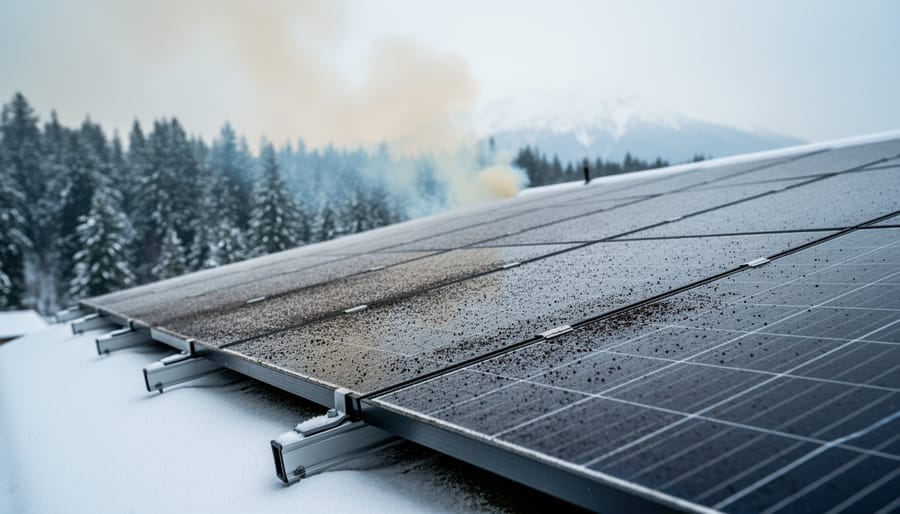
Wildfires burning invisibly beneath snow and ice throughout BC’s winter months are creating a new threat to solar energy production that few homeowners see coming. These “zombie fires”—holdover blazes that smolder underground during cold months and resurface in spring—are fundamentally changing how we predict wildfire smoke patterns and their impact on solar panel performance.
Traditional wildfire models assumed fires ended with autumn rains and snowfall. The zombie fire phenomenon reveals a different reality: peat-rich soils and dense organic matter can sustain combustion for months beneath the surface, releasing smoke into the atmosphere long before spring’s official fire season begins. For BC solar owners, this means extended periods of reduced energy production from smoke haze that arrives earlier and lingers longer than conventional forecasts predicted.
Recent zombie fire activity in northern BC demonstrates the scale of this challenge. In 2023, holdover fires contributed to prolonged smoke events that reduced solar panel efficiency by 15-30% across affected regions—losses that existing solar production models hadn’t accounted for. This gap between expected and actual performance creates financial uncertainty for solar investments and complicates energy planning for businesses relying on predictable renewable output.
Understanding zombie fire behavior joins other environmental obstacles that BC solar owners must navigate. The question isn’t whether these fires will impact your solar system, but how to prepare for and mitigate their effects on your energy independence and financial returns.
What Are Zombie Fires and Why Should BC Solar Owners Care?
You’ve likely heard about wildfires during summer, but have you encountered the term “zombie fires”? These peculiar phenomena are becoming increasingly relevant for BC solar owners, and understanding them is essential for protecting your energy investment.
Zombie fires, also called holdover or overwintering fires, are wildfires that refuse to die. Instead of being completely extinguished, these fires burrow into carbon-rich organic materials like peat, tree roots, and thick forest floor layers. There, they smolder quietly beneath the snow throughout BC’s winter months, surviving on minimal oxygen while generating almost no visible smoke or flames. When spring arrives and conditions dry out, these underground embers reignite, sparking new wildfires weeks or even months before the traditional fire season begins.
British Columbia’s climate conditions create ideal circumstances for zombie fires. Our province’s extensive peatlands and thick organic soil layers in boreal and sub-boreal regions provide perfect fuel for underground smoldering. The 2023 fire season demonstrated this reality when several major fires in northern BC were traced back to holdover fires from the previous year, catching communities off guard in early spring.
For solar owners, zombie fires represent a significant shift in how we think about wildfire smoke impacts. Traditional fire season planning assumed clear skies from October through May. However, zombie fires extend smoke conditions into months when your solar panels should be capturing precious spring sunlight. This means prolonged periods of reduced solar production, potentially affecting your energy independence and return on investment during critical high-production months.
The zombie fire model helps predict these extended smoke events, allowing solar owners to better understand and prepare for year-round air quality challenges that affect photovoltaic performance.
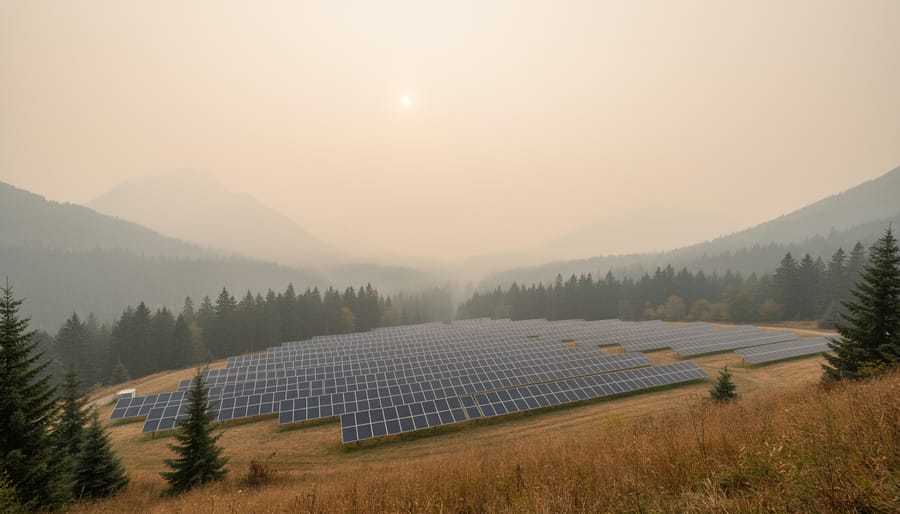
The Zombie Fire Model: Predicting Smoke Before It Appears
How the Model Works in Plain English
Think of zombie fires as embers hiding beneath the forest floor, quietly smoldering through winter before reigniting in spring. The model works by tracking three key indicators that scientists can monitor from satellites and ground sensors.
First, soil moisture levels tell us where conditions are dry enough for underground burning. When organic material in the soil—peat, roots, and decomposed plants—becomes extremely dry, it can sustain slow combustion even under snow.
Second, temperature patterns reveal hot spots beneath the surface. While a typical forest floor stays cool, zombie fire zones show unusual warmth signatures that persist through cold months, sometimes just a few degrees warmer but enough to indicate ongoing combustion.
Third, the model tracks smoke and carbon emissions during unexpected times. When sensors detect wildfire smoke in early spring before traditional fire season, or during winter when new fires shouldn’t start, it signals that last season’s fires never truly died.
For BC solar owners, understanding these patterns helps predict when smoke events might occur outside typical wildfire season, affecting your system’s energy production during months you’d normally expect clear skies.
BC’s Unique Zombie Fire Risk Zones
British Columbia’s northern interior and central regions face the highest zombie fire risk, with particular concern for communities in the Peace River region, Prince George area, and the Cariboo-Chilcotin. These zones experience deep organic soils and peat layers that can smolder underground throughout winter, reigniting when temperatures rise. The 2023 wildfire season demonstrated this clearly when several early-season fires in the Fort Nelson and Vanderhoof areas were confirmed as holdovers from the previous summer.
For solar energy systems, the Okanagan Valley represents a unique challenge. While this region enjoys BC’s highest solar potential, its proximity to Interior fire zones means smoke from zombie fires can drift southward, affecting air quality and solar production during critical spring months when systems typically begin ramping up energy generation. Communities like Kamloops, Vernon, and Kelowna should monitor early-season smoke forecasts.
Coastal regions generally face lower zombie fire risk, but prevailing winds can carry smoke from Interior fires westward. Understanding your local risk zone helps solar owners anticipate potential production impacts and plan accordingly for seasonal variations in energy generation.
How Wildfire Smoke Actually Reduces Your Solar Energy Production
The Invisible Filter: Smoke Particles and Solar Radiation
Think of smoke as an uninvited guest at a solar party. When wildfire smoke blankets the sky, it acts like a translucent curtain between the sun and your solar panels, scattering and absorbing sunlight before it reaches your system. Unlike temporary shading and obstruction from clouds or trees, smoke particles create a persistent haze that reduces the intensity and quality of solar radiation.
Here’s what happens: microscopic particles in smoke—some as small as 2.5 micrometers—intercept photons traveling from the sun. Imagine trying to read through a dirty window; the text is still there, but much harder to see. Similarly, your panels receive less direct sunlight, forcing them to work with diminished energy input. During BC’s 2021 wildfire season, some communities experienced sky conditions so smoky that midday resembled dusk. For solar systems, this invisible filter can reduce energy production by 20-50 percent, depending on smoke density and duration, affecting both your environmental impact and energy savings.
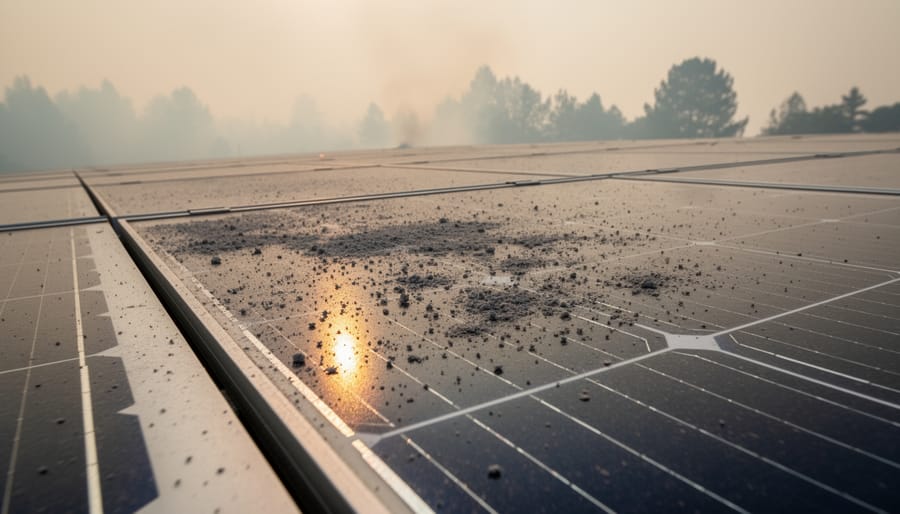
Real Numbers: What BC Solar Owners Lost During Recent Fire Seasons
Recent wildfire seasons have shown measurable impacts on solar production across BC. During the 2023 fire season, when smoke blanketed much of the province for several weeks in July and August, solar installations experienced production drops of 15-30% compared to typical summer output.
Take the Kamloops region, where homeowner Sarah Chen tracked her system’s performance. Her 8 kW residential array typically generates 1,200 kWh monthly during peak summer. During the heaviest smoke periods, production fell to just 850 kWh—a loss of nearly 30%. With prolonged smoke events becoming more common, that translated to approximately $120 in lost energy value for just one month.
Commercial installations faced similar challenges. A Vernon-based warehouse with a 50 kW system documented a three-week period where daily production averaged only 70% of expected output due to persistent smoke cover. These aren’t catastrophic losses, but they represent a new reality for BC solar owners.
The emergence of zombie fires means these smoky conditions may begin earlier in spring and extend later into fall, potentially affecting shoulder seasons when BC systems traditionally perform well. Understanding these patterns helps current and prospective solar owners plan more accurately for long-term energy independence.
Using Zombie Fire Predictions to Protect Your Solar Investment
Adjusting Your Energy Expectations and Storage Plans
Understanding zombie fire forecasts empowers you to make smarter energy decisions during challenging periods. When predictions indicate elevated smoke risks in the coming weeks, consider adjusting your battery storage strategy to maximize self-sufficiency.
If you have a battery system, charge it fully during clear days before predicted smoke events. This stored energy becomes especially valuable when solar production drops by 20-50% during smoky periods. Program your system to prioritize solar charging during morning hours when air quality is typically better, as smoke often intensifies throughout the day.
For those without storage, zombie fire forecasts offer a planning window to shift energy-intensive activities. Run dishwashers, washing machines, and other major appliances during smoke-free periods when your panels operate at peak efficiency. One Kelowna family reduced their grid reliance by 35% simply by timing their EV charging around wildfire smoke forecasts.
Businesses can use these predictions to schedule high-energy operations strategically. A Vernon warehouse adjusted their refrigeration cycles based on weekly smoke forecasts, maintaining efficiency while reducing costs during impacted periods.
Check local air quality forecasts alongside zombie fire predictions to create a comprehensive energy management plan. This proactive approach helps BC solar users maintain energy independence even as our climate evolves, turning scientific predictions into practical household benefits.
Maintenance Tips for Smoke-Affected Solar Systems
After a smoke event, inspect your solar panels within 24-48 hours once air quality improves and it’s safe to do so. Light ash deposits often wash away with rain, but heavier residue requires attention. Look for gray or brown film coating your panels—this reduces light absorption and decreases energy production by 15-30%.
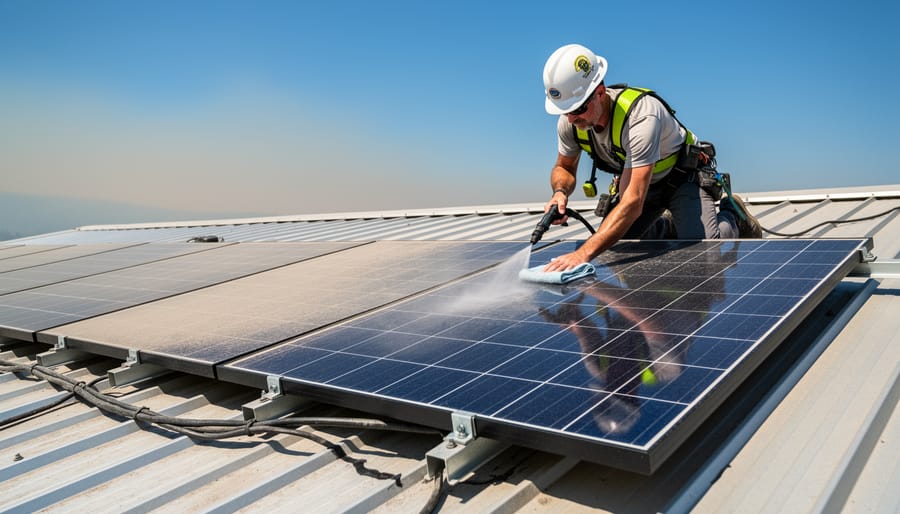
For accessible ground-mounted systems, gently rinse panels with a garden hose in early morning or evening to avoid thermal shock. Never use abrasive materials or high-pressure washers, which can damage protective coatings. If residue persists after rinsing, contact a certified solar technician who has proper equipment and safety training for rooftop access.
BC solar owners should integrate smoke-related cleaning into their seasonal maintenance routine, particularly during wildfire season from July through September. Monitor your system’s production data through your inverter app—a sudden drop of 20% or more after smoke events signals cleaning is needed.
Professional cleaning becomes essential when dealing with oily residue from intense fires, hard-to-reach roof installations, or if you notice hot spots or discoloration on panels. Most BC installers offer post-wildfire inspection services, and catching issues early prevents long-term efficiency loss. Document cleaning dates and production recovery for warranty purposes.
What This Means for Solar Planning in British Columbia
The good news for British Columbians considering solar energy is that zombie fires should not deter your investment decision. While these overwintering fires contribute to seasonal smoke events, they represent just one piece of the larger wildfire picture. The research shows smoke impacts are real but manageable, typically reducing annual solar production by 2-5% in affected areas during severe fire seasons.
When calculating your solar return on investment, it’s wise to build in a smoke buffer. Instead of using the absolute best-case scenario for production estimates, consider reducing projected annual output by 3-4% to account for occasional smoke events. This conservative approach ensures your financial projections remain realistic even during challenging fire years. Most solar assessment tools already include weather variability, but specifically asking your installer about smoke impacts demonstrates informed planning.
The reality is that zombie fires and related climate challenges affect all energy systems. Transmission lines face fire risks, hydroelectric facilities contend with drought, and traditional power sources contribute to the climate conditions intensifying these patterns. Solar installations, even with occasional smoke reduction, still provide decades of clean energy generation and meaningful cost savings.
For current solar owners, the zombie fire research validates what many have observed during recent summers. Your system isn’t underperforming due to equipment issues but responding to atmospheric conditions. The key takeaway is patience during smoky periods and confidence in long-term performance.
British Columbia’s solar potential remains strong. While acknowledging smoke as a seasonal reality, the fundamental economics and environmental benefits of solar energy hold firm. Smart planning means factoring in all variables, but zombie fires are simply another consideration, not a dealbreaker for going solar.
Zombie fires represent a real and evolving challenge for solar energy systems in British Columbia, but understanding this phenomenon actually strengthens the case for well-designed solar installations rather than undermining it. By recognizing how these smoldering wildfires can contribute to prolonged smoke events, we can make informed decisions that enhance system resilience and performance over the long term.
The key takeaway is simple: knowledge equals preparedness. When you work with installers who understand BC’s unique climate challenges—including the increasing prevalence of zombie fires and their smoke impacts—you’re investing in a system designed to perform reliably even during difficult conditions. Modern monitoring technology allows you to track performance in real time, while proper maintenance ensures your panels continue generating clean energy efficiently.
Solar energy remains one of the most practical and impactful steps British Columbians can take toward energy independence and environmental stewardship. The occasional reduction in output during smoke events doesn’t diminish the decades of reliable, emissions-free power your system will provide. In fact, by acknowledging these challenges upfront and planning accordingly, you’re making a more informed investment.
Ready to explore solar for your home or business? Connect with certified BC installers who understand local conditions and can design a system tailored to our region’s specific needs. They’ll help you navigate considerations like smoke impacts, optimal panel placement, and system sizing to ensure your solar investment delivers maximum value for years to come.