
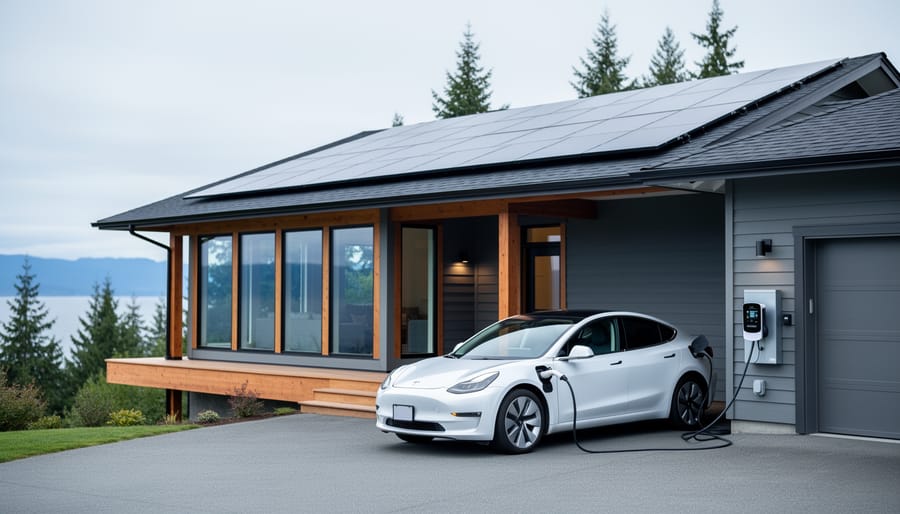
Install a Level 2 smart charger with built-in load management capabilities to automatically balance your EV charging with your home’s existing electrical capacity, eliminating the need for costly panel upgrades that can run $3,000-$8,000 in BC. These systems monitor your household’s real-time power consumption and adjust charging rates dynamically, ensuring you never exceed your service capacity while still waking up to a fully charged vehicle.
Pair your smart charger with solar panels to capture BC Hydro’s net metering benefits, where your EV charges primarily from excess solar production during daylight hours rather than drawing from the grid during expensive evening peak periods. This integration can reduce your transportation costs by up to 80% compared to gasoline vehicles while maximizing your solar investment’s return.
Configure your load management system to prioritize charging during off-peak hours (typically 11 PM to 7 AM when BC Hydro rates are lowest) and set charging limits that prevent simultaneous high-draw appliances from overloading your electrical service. Most modern systems offer smartphone apps that let you adjust these parameters remotely and track your energy savings in real-time.
Verify your chosen system supports Vehicle-to-Grid (V2G) or Vehicle-to-Home (V2H) capabilities if you’re planning future energy resilience, allowing your EV’s battery to power your home during outages or sell stored energy back to the grid during peak demand periods. While V2G infrastructure is still developing in BC, selecting compatible equipment now prepares you for emerging opportunities in energy arbitrage and grid services compensation.
What Is an EV Automatic Load Management System?

How It Works in Your Home
An EV automatic load management system works quietly in the background, ensuring your home’s electrical system never gets overloaded while charging your vehicle. Here’s how it operates day-to-day in a typical BC home.
The system starts with a monitoring device installed at your electrical panel. This device continuously tracks your home’s total electricity consumption, measuring how much power your appliances, heating, cooling, and other devices are using at any given moment. Think of it as a smart traffic controller for your home’s energy.
When you plug in your EV, the system immediately calculates available capacity. It compares your home’s maximum electrical capacity (typically 100 to 200 amps for BC residences) against current usage. If your dryer, oven, and water heater are all running, the system detects this increased demand.
Based on this real-time information, the system automatically adjusts your EV charging rate. During peak household usage, it may reduce charging to 16 amps. When everyone’s asleep and appliances are off, it ramps up to maximum speed. This dynamic adjustment happens continuously throughout the charging session.
The beauty of this technology is its hands-off nature. You simply plug in your vehicle and forget about it. The system ensures your EV charges fully overnight without tripping breakers or requiring expensive electrical panel upgrades. For BC homeowners with solar panels, many systems prioritize charging during peak solar production hours, maximizing your clean energy usage and minimizing grid dependence.
The Connection Between Solar and Smart Charging
When you pair solar panels with an EV automatic load management system, you create a powerful partnership that maximizes your clean energy investment. These intelligent systems are designed to prioritize solar-generated electricity for your EV charging needs, ensuring your vehicle runs on sunshine rather than grid power whenever possible.
Here’s how it works: the load management system monitors your solar production in real-time and automatically directs that energy to your EV charger first. On sunny days, your car charges primarily from your rooftop panels, dramatically reducing grid dependency. When solar production dips in the evening or on cloudy days, the system seamlessly switches to grid power while still managing your total electrical load to prevent overages.
This smart coordination increases your solar self-consumption rates, typically from around 30-40 percent without load management to 60-70 percent with it. For BC homeowners paying time-of-use rates, this means significant savings. The system can also integrate with storing excess solar energy through battery systems, creating an even more resilient, sustainable home energy ecosystem that keeps your EV charged with clean power year-round.
Why BC Homeowners Need This Technology
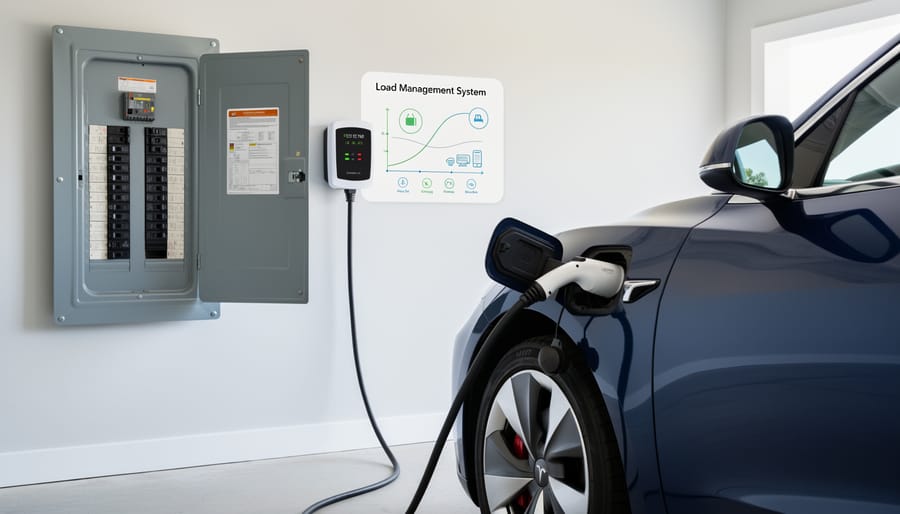
Avoiding Costly Panel Upgrades
For many BC homeowners, installing an EV charger comes with an unwelcome surprise: your electrician recommends a panel upgrade costing between $3,000 and $8,000. This happens because traditional EV chargers draw significant power, and older electrical panels simply weren’t designed to handle the combined load of household appliances, heating systems, and a Level 2 charger simultaneously.
An EV automatic load management system offers a practical alternative. Instead of upgrading your entire electrical panel, the system monitors your home’s real-time energy consumption and intelligently adjusts your EV charging speed to stay within your existing capacity. When your dryer is running or your heat pump kicks in, the system temporarily reduces charging power. Once those appliances cycle off, it ramps charging back up.
The savings are substantial. A Surrey family recently shared how their load management system eliminated a quoted $5,200 panel upgrade while still providing a full overnight charge for their electric vehicle. For households with solar panels, these systems become even more valuable, prioritizing solar energy for charging during peak production hours and automatically adjusting as clouds pass or household consumption changes.
This approach makes EV ownership accessible to more British Columbians without the barrier of expensive electrical infrastructure modifications.
Making the Most of BC Hydro’s Time-of-Use Rates
BC Hydro’s residential time-of-use rates create a significant opportunity for EV owners to reduce their electricity costs. During off-peak hours, typically between 11 PM and 7 AM, electricity rates can be substantially lower than peak daytime rates. Smart automatic load management systems take full advantage of this pricing structure by automatically scheduling your EV charging for these cheaper periods.
Here’s how it works in practice: Instead of plugging in your EV when you arrive home at 6 PM during expensive peak hours, your smart charging system waits until rates drop at 11 PM to begin charging. For a typical EV requiring 40 kWh to fully charge, this simple shift can save BC residents approximately $15-20 per charge during winter months when rate differences are most pronounced.
These systems are particularly valuable for households with solar panels. Your load management system can prioritize charging with excess solar energy during the day, then automatically switch to grid power during off-peak hours if additional charging is needed. One Vancouver family reported saving over $600 annually by combining solar charging during sunny days with automated off-peak charging on cloudy days or during winter months. The system handles everything automatically, ensuring your vehicle is fully charged each morning while minimizing costs.
Vehicle-to-Grid (V2G): Your EV as a Home Battery

How V2G Works With Your Solar System
Vehicle-to-Grid (V2G) technology transforms your EV into a mobile battery, creating a powerful partnership with your solar panels. During sunny BC days, your solar system generates electricity that charges your EV while you’re at work or running errands. Instead of sending excess power back to the grid at low rates, you’re storing that clean energy right in your vehicle’s battery.
When evening arrives and your solar panels stop producing, V2G allows that stored energy to flow back into your home. This bidirectional electricity flow means you can power your lights, appliances, and heating systems using the solar energy you captured earlier, rather than drawing from the grid during expensive peak hours.
Think of your EV as one of several energy storage solutions available to BC homeowners. While thermal storage tanks store heat energy, your EV stores electrical energy that can be deployed whenever needed.
A Kelowna family recently demonstrated this concept beautifully. Their system charges their EV between 10 AM and 3 PM when solar production peaks, then uses that stored power from 6 PM to 9 PM when BC Hydro rates climb and their household energy use increases. They’ve reduced their grid dependence by 40% while ensuring their EV is fully charged for their morning commute. This smart integration maximizes both investments while supporting BC’s clean energy goals.
Current V2G Availability in BC
As of 2024, V2G technology in BC remains limited but is expanding. Currently, only a handful of EV models support bidirectional charging, including the Nissan Leaf (2013 and newer models), Ford F-150 Lightning, and select Mitsubishi Outlander PHEV vehicles. The Hyundai Ioniq 5 and Kia EV6 also have V2G capability, though activation requires specific equipment.
Compatible bidirectional chargers available in the BC market include the Fermata Energy FE-15 and Wallbox Quasar 2, though availability can be inconsistent. Installation costs typically range from $3,000 to $8,000, depending on existing electrical infrastructure and panel capacity.
The good news? The landscape is shifting rapidly. Major automakers including GM, Volkswagen, and Tesla have announced V2G-capable models arriving between 2024 and 2026. Meanwhile, BC Hydro is piloting V2G programs in select communities, testing how bidirectional charging can support grid stability during peak demand periods.
For BC residents considering V2G today, the practical approach is pairing current V2G-capable vehicles with smart load management systems that can easily upgrade to full bidirectional capability when broader adoption makes the technology more accessible and affordable.
Real-World Benefits for BC Homes and Businesses
A Vancouver Island Success Story
When the Thompson family in Nanaimo installed a 10 kW rooftop solar array in 2022, they quickly realized their existing electrical panel couldn’t handle adding a Level 2 EV charger for their new Chevrolet Bolt without a costly upgrade. The quoted $8,000 panel replacement seemed like a dealbreaker until their installer suggested an automatic load management system.
“We went with a smart charging solution that communicates with our main panel and solar inverter,” explains Sarah Thompson, a local teacher. “It automatically adjusts our car’s charging speed based on what our solar panels are producing and what else is running in the house.”
The system cost $1,200 installed, saving them $6,800 compared to the panel upgrade. During summer months, their EV charges almost exclusively on solar power between 10 AM and 4 PM. The family tracks their energy use through a smartphone app, which shows they’ve reduced their grid electricity consumption by 65 percent since adding the load management system.
“We’re essentially driving on sunshine,” Sarah notes. “The system even works with energy storage technologies we’re considering for the future.”
Their biggest lesson? Start with load management from day one. “Don’t wait until you hit capacity issues like we did,” Sarah advises. “Building it into your initial solar or EV installation saves time and stress.”
Environmental Impact: Beyond Just Driving Electric
Switching to electric driving is a great first step, but combining your EV with smart charging technology and solar panels creates something far more powerful. A BC family using solar panels with an automatic load management system can reduce their carbon footprint by approximately 4-6 tonnes annually—equivalent to planting 200 trees every year.
Here’s how the complete system amplifies your environmental impact. Solar panels generate clean electricity during the day, which your load management system directs to your EV when grid demand is lowest. During peak evening hours when BC’s grid relies more heavily on natural gas plants, your system can draw power from your EV’s battery through vehicle-to-grid technology, reducing regional emissions.
A Vancouver Island business recently reported that their integrated system offset 85% of their transportation emissions while simultaneously reducing building energy costs by 40%. When you factor in BC’s increasingly clean grid, smart charging during off-peak hours means you’re accessing power when renewable hydro makes up the largest percentage of the energy mix.
The calculation is straightforward: more solar plus intelligent charging equals dramatically reduced lifetime emissions compared to conventional EVs charged randomly from the grid. Your investment creates ripple effects throughout BC’s energy system, supporting grid stability while maximizing clean energy use.
Choosing the Right System for Your Situation
Key Features to Look For
When choosing an EV automatic load management system for your BC home or business, prioritize features that align with your energy goals and existing setup.
Essential features include real-time load monitoring, which prevents circuit overloads by automatically adjusting charging power based on your household’s current electricity use. Look for systems compatible with your electrical panel capacity—most BC homes have 100-200 amp service, and quality load management can help you avoid costly panel upgrades that typically run $3,000-$8,000.
Solar integration capability is particularly valuable for BC’s growing solar community. Your system should communicate with your solar inverter to prioritize charging when panels are producing excess energy, maximizing your self-consumption and reducing grid reliance. This feature becomes even more important as BC Hydro’s net metering policies evolve.
Multiple vehicle support matters if you have more than one EV or anticipate adding another. The system should intelligently distribute available power between vehicles based on your preferences.
Smartphone control and scheduling allow you to take advantage of BC Hydro’s time-of-use rates where applicable, charging during off-peak hours or when solar production peaks. Remote monitoring provides peace of mind and usage insights.
For businesses and preparedness-minded homeowners, vehicle-to-grid or vehicle-to-home capability offers backup power during outages—increasingly relevant given BC’s winter storm patterns.
Finally, choose systems with open communication protocols rather than proprietary technology, ensuring compatibility with future upgrades and preventing vendor lock-in. BC residents should verify compatibility with local utility requirements and available provincial incentive programs before purchasing.
Installation Considerations in BC
Installing an EV automatic load management system in BC typically takes four to eight hours, depending on your electrical panel’s configuration and the complexity of your setup. Before installation begins, you’ll need to secure an electrical permit from your municipality. Most BC cities, including Vancouver, Victoria, and Surrey, require permits for EV charger installations that modify your electrical system. Your installer will typically handle this paperwork as part of their service.
Working with certified installers is essential for both safety and warranty protection. Look for electricians certified by the Electrical Safety Authority and experienced with smart charging systems. Many BC installers now specialize in integrated solar and EV solutions, understanding how to optimize load management with your existing renewable energy setup.
During your initial consultation, expect a thorough assessment of your electrical panel capacity, existing solar system, and household energy patterns. The installer will determine whether your panel requires upgrades or if load management alone can accommodate your EV charging needs. In many cases, particularly homes with solar already installed, load management eliminates costly panel upgrades that could otherwise run $3,000 to $8,000.
Request quotes from at least three certified installers and ask specifically about their experience with load management systems integrated with solar installations.
Costs, Incentives, and Return on Investment
Available BC Rebates and Incentives
British Columbia residents and businesses installing EV automatic load management systems can access several financial incentives that significantly reduce upfront costs. The provincial CleanBC Go Electric program offers rebates up to $350 for home EV chargers with smart capabilities, while businesses can receive up to $5,000 per charging port through the Go Electric Commercial Vehicle Charging program.
At the federal level, the Zero-Emission Vehicles Infrastructure Program provides funding for public and on-street charging infrastructure, particularly benefiting multi-unit residential buildings and workplaces. When combining load management with solar installations, homeowners may also qualify for the Canada Greener Homes Grant, which provides up to $5,000 for energy-efficient home retrofits including electrical panel upgrades necessary for advanced charging systems.
Local utilities like BC Hydro occasionally offer time-of-use incentives that reward smart charging during off-peak hours, maximizing savings when paired with load management technology. The CleanBC Better Homes program also provides low-interest financing options for energy upgrades.
To apply, visit the CleanBC website or contact a qualified installer who can guide you through available programs. Many BC solar and EV charging companies offer rebate navigation services, ensuring you capture every available dollar while building your integrated energy system.
Automatic load management systems are removing the final barriers that make EV ownership feel complicated for BC homeowners. By intelligently coordinating your electric vehicle charging with your home’s electrical capacity and solar production, these systems eliminate the need for expensive panel upgrades that can cost $3,000-$5,000 or more. You’re not just adding an EV charger—you’re creating a smarter, more efficient home energy ecosystem that maximizes every kilowatt-hour your solar panels produce.
The families and businesses across British Columbia who’ve embraced this technology are already experiencing the benefits: lower electricity bills, optimized solar self-consumption, and the peace of mind that comes from future-ready infrastructure. As our province moves toward cleaner transportation and time-of-use electricity rates become more common, having intelligent charging capabilities positions you ahead of the curve rather than scrambling to catch up.
Whether you’re driving an EV today or planning to make the switch in the coming years, automatic load management transforms your solar investment from a simple electricity offset into a comprehensive energy solution. Your solar panels charge your vehicle, your system prevents overloads, and you’re contributing to BC’s clean energy future while keeping more money in your pocket.
Ready to explore how automatic load management can work for your home? Connect with Solar BC’s network of certified installers who understand the unique requirements of BC homeowners. Use our interactive savings calculator to see exactly how much you could save by combining smart EV charging with your solar system. The energy future isn’t coming—it’s already here, and it’s more accessible than you think.