
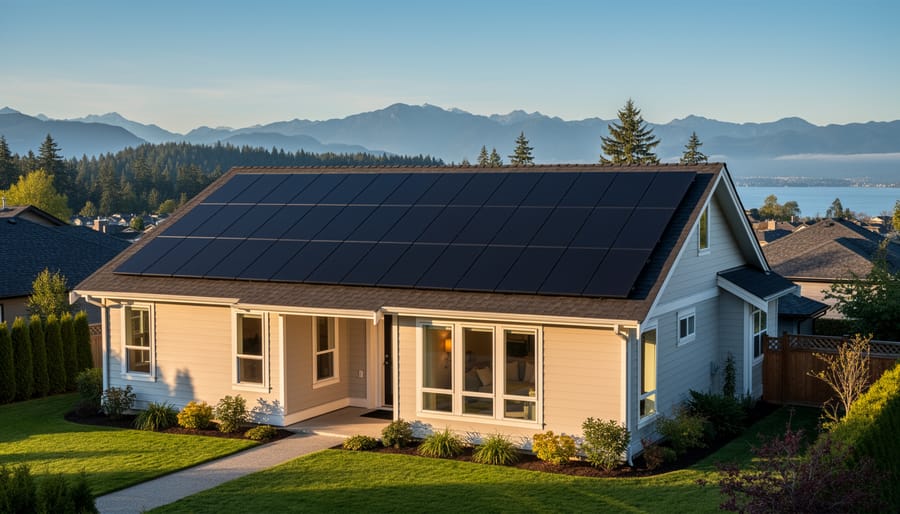
Solar Power Purchase Agreements (PPAs) let you access clean energy without the $15,000-$30,000 upfront cost typical of BC solar installations. Under a PPA, a third-party company installs and maintains solar panels on your property at no cost to you, then sells you the electricity generated at a fixed rate—usually lower than what you currently pay BC Hydro.
Here’s how PPAs work in practice: A solar provider owns the equipment, handles all maintenance and monitoring, and assumes performance risk. You simply agree to purchase the solar electricity produced for 15-25 years at a predetermined price per kilowatt-hour. If the panels underperform, that’s the provider’s problem, not yours. When the contract ends, you typically have options to renew, purchase the system at fair market value, or have it removed.
The catch for British Columbians? Our exceptionally low hydro rates—among the cheapest in North America at roughly 12 cents per kWh—make the economics challenging compared to California or Ontario, where PPAs thrive. Most BC solar PPAs target commercial properties with higher daytime electricity consumption or rural properties without grid access, rather than typical residential customers already enjoying affordable hydroelectric power.
This doesn’t mean PPAs are wrong for BC homeowners—just that you need realistic expectations. Understanding the true costs, comparing them against BC’s electricity rates, and evaluating whether solar ownership or a PPA better matches your financial situation and environmental goals requires looking beyond the appealing “zero down” promise.
What Is a Solar PPA Program?
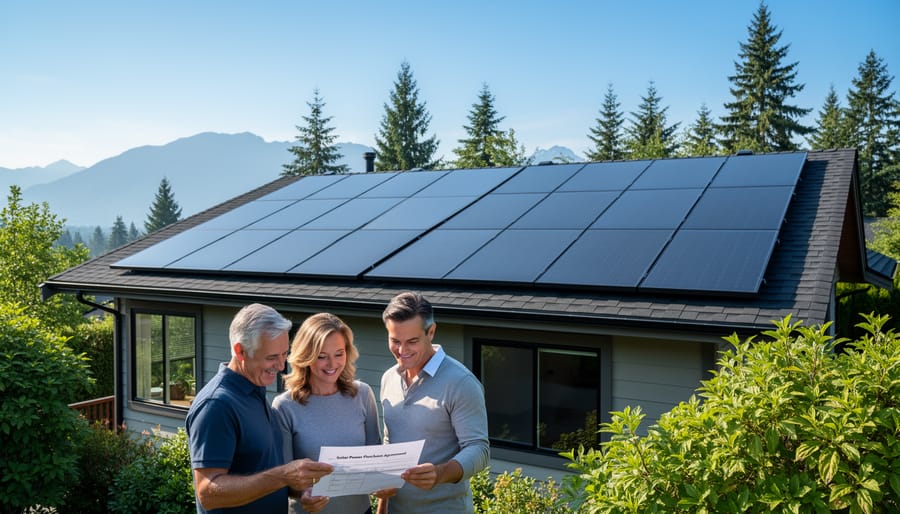
The Simple Mechanics: How PPAs Work in Practice
Let’s walk through how a solar PPA works using the example of the Chen family in Kelowna, who wanted to reduce their environmental impact without depleting their savings.
First, a solar company assesses your property to determine if it’s suitable for solar panels. They evaluate your roof condition, sun exposure, and typical energy usage. For the Chens, the assessment showed their south-facing roof could accommodate a 6kW system.
Once approved, the solar company handles everything: they secure permits, purchase equipment, and complete the installation at no cost to you. The Chens didn’t pay a single dollar upfront. The solar company owns the system and maintains responsibility for repairs and monitoring.
After installation, the system begins generating electricity immediately. Here’s where the billing gets straightforward: you simply pay the solar company a fixed rate per kilowatt-hour for the solar power you use. The Chens pay 12 cents per kWh for their solar electricity, compared to BC Hydro’s current residential rate.
Each month, you receive two bills: one from the solar company for the power their panels generated, and one from BC Hydro for any additional electricity you needed. The Chen family typically uses about 80 percent solar power, with BC Hydro covering the remainder during cloudy periods or high-usage times.
The PPA agreement typically lasts 20-25 years, with the solar company maintaining the equipment throughout. At the contract’s end, you often have options to purchase the system, renew the agreement, or have it removed.
PPAs vs. Solar Leases: What’s the Difference?
When exploring financing options for going solar without upfront costs, you’ll likely encounter both Power Purchase Agreements (PPAs) and solar leases. While they share similarities, understanding their differences helps you choose what works best for your situation.
The key distinction lies in how you pay. With a PPA, you pay only for the electricity the panels actually generate, typically at a per-kilowatt-hour (kWh) rate that’s locked in or increases at a predetermined rate over 20-25 years. If your system produces 500 kWh in a sunny month, you pay for 500 kWh. In cloudier months with lower production, your bill decreases accordingly.
Solar leases work differently. You pay a fixed monthly amount regardless of how much electricity the panels produce. Think of it like renting the solar system—your payment stays consistent whether it’s sunny July or rainy November.
For BC residents, PPAs often make more sense because they align payments with actual production. Given our seasonal weather variations, this flexibility means you’re not locked into high payments during winter months when solar generation naturally drops.
Solar leases can be advantageous if you value predictable budgeting and want to know exactly what you’ll pay each month. They’re simpler to understand and may offer slightly lower rates if the system consistently performs well.
Both options typically include maintenance and monitoring, so you won’t face unexpected repair costs. The provider owns the system and handles upkeep, making either choice relatively hands-off.
Consider your priorities: Do you want payment flexibility tied to production (PPA) or budget predictability (lease)? Your energy usage patterns and financial planning style should guide this decision.
The Real Costs: What You’ll Actually Pay
Breaking Down Your PPA Rate
Your PPA rate is the price you pay per kilowatt-hour (kWh) of solar electricity your system produces. Think of it like your regular electricity bill, but with predictable, locked-in pricing. In British Columbia, typical PPA rates range from $0.10 to $0.14 per kWh, depending on several factors.
What influences your rate? System size plays a key role—larger installations often secure lower per-kWh rates due to economies of scale. Your roof’s characteristics matter too: optimal south-facing orientation and minimal shading can reduce costs. The PPA provider’s financing costs, installation expenses, and projected maintenance over the contract term all factor into pricing. Geographic location within BC also affects rates, as installation costs vary between urban and rural areas.
For a typical BC home using 10,000 kWh annually, a solar system producing 75 percent of that electricity at $0.12 per kWh would cost roughly $75 monthly. Compare this to BC Hydro’s current residential rate of approximately $0.12 per kWh, and you’ll notice the initial savings may be modest. However, remember that your PPA rate typically includes a modest annual escalator (usually 1-2 percent), while BC Hydro rates have historically increased faster.
The real value emerges when comparing PPAs to purchasing systems outright. While green housing loans and direct purchases offer long-term savings potential, PPAs eliminate upfront costs entirely—making solar accessible to households without $15,000-$30,000 in available capital.
The Benefits of Going Solar Without Buying
Solar Power Purchase Agreements offer BC residents and businesses a compelling pathway to clean energy without the financial barriers that typically come with solar adoption. Instead of paying tens of thousands of dollars upfront for a solar system, you simply agree to purchase the electricity it generates at a predetermined rate, usually lower than what you currently pay your utility company.
The most attractive benefit is zero upfront investment. A solar provider installs, owns, and maintains the entire system on your property at no cost to you. This means you can start saving on electricity from day one without touching your savings, taking out loans, or navigating complex financing arrangements. For businesses managing tight cash flows or homeowners prioritizing other expenses, this removes the biggest obstacle to going solar.
Maintenance becomes someone else’s responsibility entirely. When you sign a PPA, the solar provider handles all system upkeep, monitoring, repairs, and performance guarantees. If a panel needs replacing or an inverter malfunctions, you make one phone call and the issue gets resolved without any cost to you. This peace of mind is particularly valuable for busy business owners or homeowners who lack technical expertise.
Immediate energy savings start as soon as your system goes live. While BC’s hydroelectric rates are among Canada’s lowest, commercial and industrial users often face higher tier pricing where PPAs can deliver meaningful reductions. Residential customers may see more modest savings, but every dollar counts, especially with BC Hydro rates rising over time.
Predictable electricity costs represent another major advantage. Your PPA locks in a rate for 20 to 25 years, protecting you from future utility rate increases. This long-term price certainty helps both homeowners budget confidently and businesses forecast operating expenses more accurately. When BC Hydro rates inevitably climb, your contracted PPA rate stays the same, increasing your savings year after year.
For environmentally-conscious British Columbians who want to reduce their carbon footprint without financial risk, PPAs provide the perfect solution. You contribute to clean energy generation, support BC’s climate goals, and enjoy lower electricity costs simultaneously.
The Trade-Offs You Should Know About
While solar PPAs offer an accessible entry point to solar energy, it’s important to understand what you’re trading for that convenience.
The most significant consideration is that you won’t own the solar system on your roof. The third-party company retains ownership throughout the contract period, typically 20-25 years. This means you’ll miss out on federal tax incentives and rebates that system owners can claim. In BC, where provincial and federal programs occasionally offer solar incentives, this could represent thousands of dollars in missed savings over the system’s lifetime.
Long-term contracts are another factor to weigh carefully. While locked-in rates protect you from electricity price increases, breaking a PPA agreement early can be complicated and costly. If you decide to sell your home, the new buyer must agree to assume the remaining contract. Some buyers appreciate the lower energy costs, but others may find it a deterrent, potentially affecting your home’s marketability.
Your electricity savings may also be more modest than with owned systems. In BC, our hydroelectric rates are among the lowest in North America. A PPA might save you 10-15% on your solar-generated electricity, but the overall impact on your total energy bill could be less dramatic compared to regions with higher utility rates. Running the numbers specific to your situation is essential before committing.
There’s also less flexibility with system upgrades or modifications. Since you don’t own the equipment, you can’t make changes without the provider’s approval, and you’re dependent on their maintenance schedule and response times.
That said, these trade-offs don’t automatically make PPAs a poor choice. For homeowners who value simplicity, have limited capital, or prefer predictable monthly expenses, a PPA might still be the right fit. Consider exploring alternative financing methods as well, such as solar loans or leases, which may offer different advantages that better align with your financial goals and homeownership plans.

PPAs in the BC Context: What Makes Our Province Different
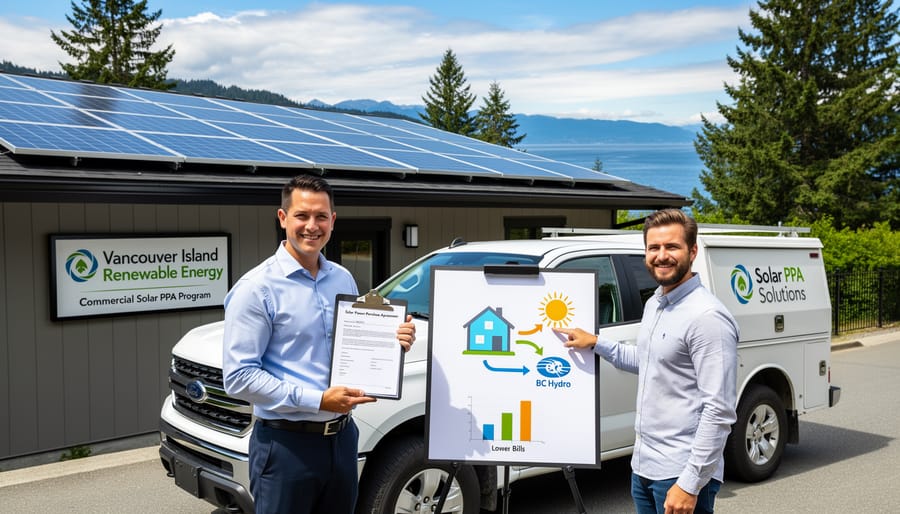
Success Story: A Vancouver Island Business Goes Solar with a PPA
When Sooke Harbour Marina considered going solar in 2022, the $85,000 upfront cost seemed prohibitive. Instead, they partnered with a Vancouver-based solar provider through a 20-year PPA that required zero initial investment.
The marina’s 50kW rooftop system now generates approximately 55,000 kWh annually. Under their PPA agreement, they pay 10.5 cents per kWh for solar electricity—slightly below their BC Hydro commercial rate of 11.2 cents at the time of signing. While the savings appear modest compared to other provinces, the marina’s general manager, Patricia Chen, emphasizes the broader benefits.
“Our customers care deeply about environmental responsibility,” Chen explains. “The solar panels have become a talking point and align perfectly with our commitment to protecting the harbour ecosystem.”
The financial picture improved after two years when BC Hydro rates increased to 12.8 cents per kWh, while the PPA rate remained locked at 10.5 cents. The marina now saves approximately $1,265 annually, with savings expected to grow as electricity rates continue rising.
Key lessons learned include thoroughly reviewing the contract’s maintenance responsibilities and understanding how the PPA would transfer if the property were sold. Chen also recommends using multiple years of electricity bills to accurately size the system, ensuring you generate what you actually need.
The marina’s experience demonstrates that PPAs can work in BC’s lower-rate environment when viewed as a long-term sustainability investment rather than purely a cost-cutting measure.
Is a PPA Right for Your Situation?
Before signing a solar PPA, take time to evaluate whether this arrangement aligns with your specific situation. Here’s a practical framework to guide your decision.
Start with your home ownership timeline. PPAs typically run 20-25 years, so they work best if you plan to stay in your home long-term or are confident that a solar system will add value when selling. If you’re planning to move within five years, transferring the PPA to new homeowners adds complexity you’ll want to consider carefully.
Next, assess your roof condition and suitability. Is your roof in good shape with at least 15-20 years of life remaining? Does it receive adequate sunlight without significant shading from trees or neighboring buildings? A south or southwest-facing roof performs best in BC. If your roof needs replacement soon, handle that before installing solar panels to avoid costly removal and reinstallation fees.
Examine your electricity usage patterns. PPAs deliver the most value for households with consistent, moderate to high electricity consumption. Review your BC Hydro bills from the past year. If you’re using 8,000-12,000 kWh annually or more, you’re more likely to see meaningful savings.
Consider your financial goals and available solar financing options. While PPAs require no upfront investment, purchasing a system outright or through a loan typically yields greater long-term savings. However, if preserving capital for other priorities matters more, a PPA’s predictable monthly payments might suit you better.
Finally, evaluate your comfort level with BC Hydro’s tiered electricity rates. As usage increases, rates climb, making solar more attractive for higher-consuming households. Understanding where you fall on this spectrum helps clarify potential savings.
Your Next Steps: Moving Forward with a Solar PPA in BC
Ready to explore whether a solar PPA is right for your BC home or business? Here’s how to move forward with confidence.
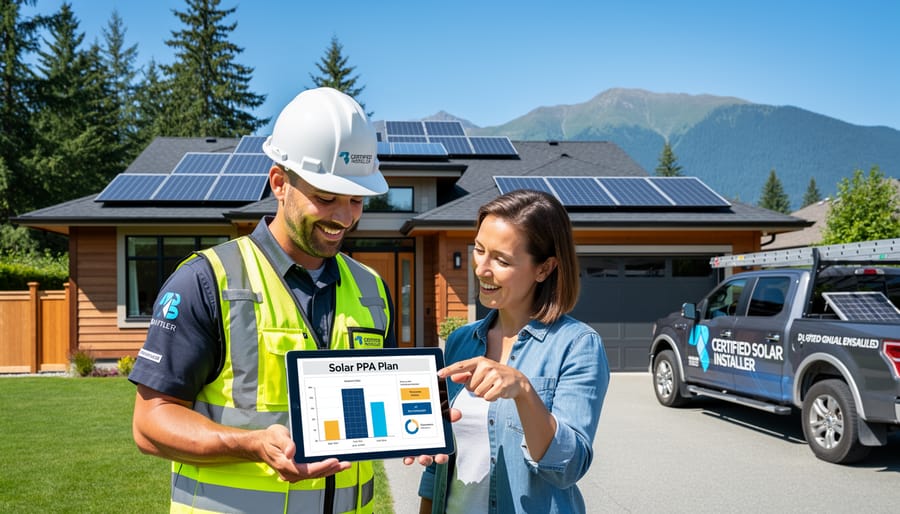
Start by connecting with certified solar installers who understand BC’s unique energy landscape. Solar BC’s online platform makes this easy—simply complete a quick assessment of your property, and we’ll connect you with up to three pre-screened installers in your area. These professionals can evaluate your roof’s solar potential and discuss whether a PPA, purchase, or other affordable solar solutions best fit your situation.
When evaluating PPA proposals, request detailed information beyond the basic rate. Ask providers to show you the complete payment schedule over the contract term, explain how rate escalators work, and clarify what happens if you sell your home. Compare the PPA rate against your current BC Hydro tier-two rates—if you’re consistently in the higher usage bracket, a PPA might deliver more value.
Review contract terms carefully, paying attention to maintenance responsibilities, system performance guarantees, buyout options, and early termination conditions. Don’t hesitate to ask questions: How is system performance monitored? What happens if production falls below projections? Are there penalties for early contract termination? How does the transfer process work if you sell your property?
Consider having a lawyer review the agreement before signing, especially for commercial PPAs with longer terms or larger systems.
Talk to existing PPA customers in BC if possible. Their real-world experiences can provide valuable insights that go beyond marketing materials.
Remember, going solar is a long-term commitment, whether through a PPA or ownership. Take time to explore all options, understand the numbers specific to your situation, and choose the path that aligns with your financial goals and sustainability values. Solar BC is here to support you every step of the way with unbiased information and connections to trusted local professionals.
Solar power purchase agreements offer a genuine solution to the most common obstacle preventing BC residents and businesses from going solar: the upfront investment. By eliminating this barrier, PPAs make clean energy accessible to those who want to reduce their carbon footprint without depleting their savings or taking on debt. However, they’re not the right fit for everyone. If you own your property long-term, have access to capital, and want maximum savings, purchasing your system outright might serve you better.
The key is understanding your unique situation. What are your energy goals? How long do you plan to stay in your current location? What’s your available capital for green investments? These questions will guide your decision.
Ready to explore whether a PPA makes sense for you? Use our interactive solar savings calculator to see personalized estimates based on your location, energy consumption, and roof characteristics. You’ll get a clear comparison of PPA versus purchase options, helping you take the next confident step toward sustainable energy. BC’s solar future is bright—and it’s more accessible than you might think.