
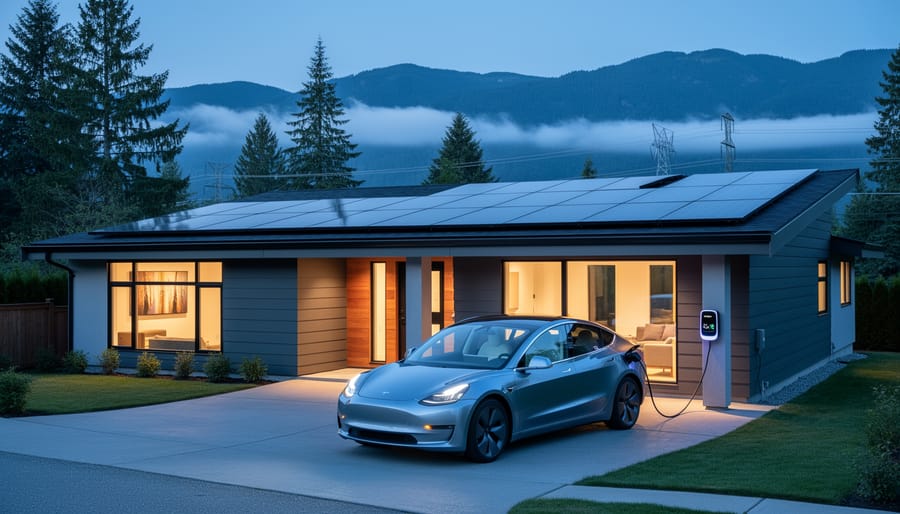
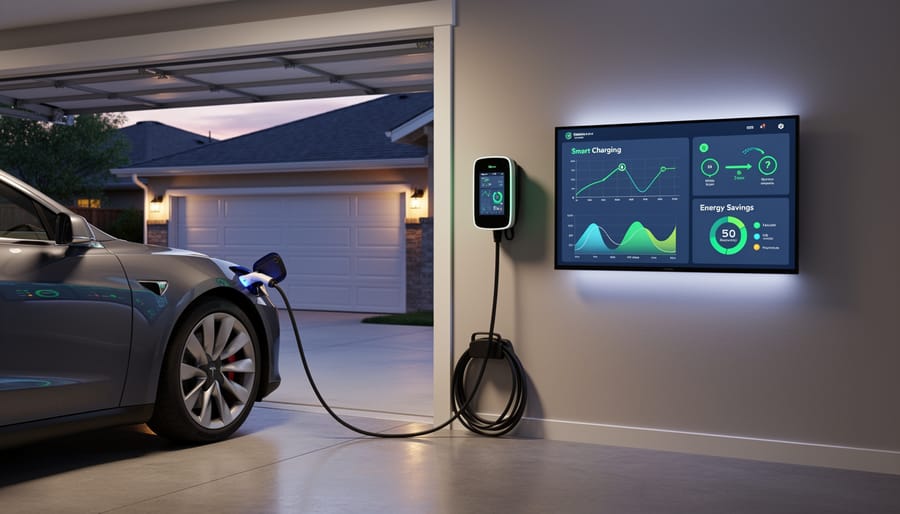
Smart charging transforms your electric vehicle from a simple consumer of electricity into an intelligent energy asset that saves you money and supports BC’s clean energy grid. Instead of plugging in whenever you arrive home, smart charging systems automatically schedule your EV to charge during off-peak hours when electricity rates are lowest—typically overnight when demand drops. This timing optimization can reduce your charging costs by 30-50% compared to standard charging, while also reducing strain on the provincial grid during peak afternoon and evening hours.
The technology works through connected charging stations that communicate with your utility provider, adjusting charging speed and timing based on real-time electricity prices and grid conditions. BC Hydro and FortisBC both offer time-of-use rates that reward smart charging behavior, with some programs providing additional incentives for EV owners who participate in demand response initiatives.
Beyond cost savings, smart charging enables vehicle-to-grid (V2G) capabilities, where your EV’s battery can supply power back to your home during peak rate periods or outages. When paired with rooftop solar panels, this creates a comprehensive home energy system that maximizes self-consumption of clean energy you generate while minimizing reliance on grid electricity during expensive peak times.
For British Columbians committed to sustainability, smart charging represents the practical intersection of transportation electrification and intelligent energy management—delivering immediate financial benefits while contributing to the province’s clean energy future.
What Smart EV Charging Actually Means for BC Drivers
The Solar Connection: Charging When the Sun Shines
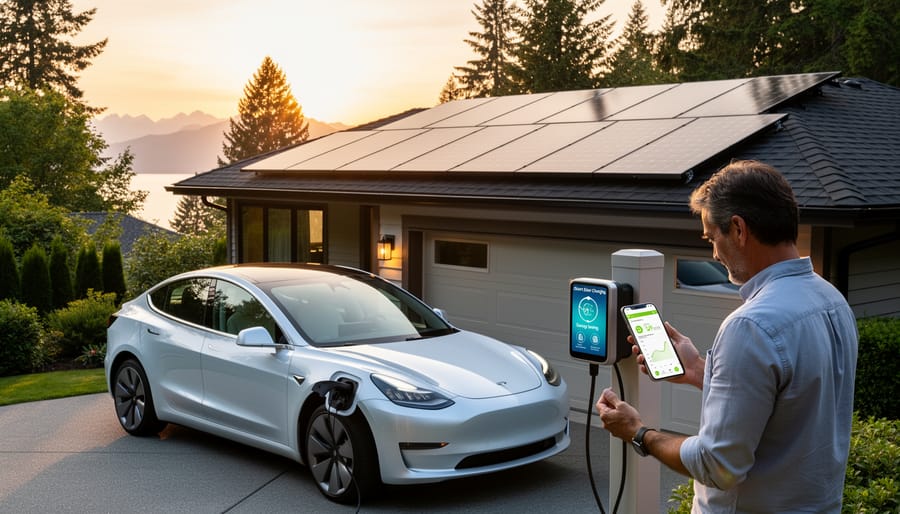
If you’ve invested in rooftop solar panels, smart charging transforms your EV into a perfect partner for your renewable energy system. In British Columbia, where sunny summer days can generate substantial solar power, timing your vehicle charging to coincide with peak production hours means using clean energy you’ve already paid for instead of drawing from the grid.
Smart chargers can be programmed to automatically begin charging when your solar panels are producing excess electricity—typically between 10 a.m. and 3 p.m. on clear days. This approach, combined with smart load management, ensures your home’s essential needs are met first while directing surplus solar generation to your vehicle. For many BC homeowners, this means charging their EV almost entirely from sunlight during summer months.
Consider a Vancouver Island family who installed both solar panels and a smart charger last year. By adjusting their charging schedule to match solar production, they reduced their grid electricity consumption for EV charging by 75 percent during peak solar months. Even on cloudy days, they capture whatever solar energy is available.
The environmental benefits extend beyond your household. When thousands of EV owners charge during solar peak hours, we collectively reduce demand on BC’s electrical grid during evening hours, supporting our province’s clean energy goals while maximizing the return on your solar investment.
Real Savings: What BC Homeowners Are Seeing
BC homeowners are already experiencing significant savings by switching to smart charging strategies. Let’s look at what this means in real dollars using current BC Hydro rates.
Take the Morrison family from Victoria, who drive a Chevy Bolt with a 65 kWh battery. Before smart charging, they typically plugged in around 6 PM when rates are highest. By shifting their charging to overnight hours using BC Hydro’s time-of-use pricing, they reduced their electricity costs from approximately 16 cents per kWh during peak times to just 9 cents per kWh. For their typical 250 km of weekly driving, this translates to monthly savings of about $35, or $420 annually.
A Vancouver couple with a Tesla Model 3 took it further by installing a smart charging system that automatically schedules charging during the lowest-rate periods. They’re saving roughly $45 per month compared to random charging times. Over a year, that’s $540 back in their pocket while reducing strain on the local grid.
Commercial fleet operators see even more dramatic results. A Surrey-based delivery company with five electric vans reports saving over $2,400 annually through coordinated smart charging that avoids demand charges and capitalizes on off-peak rates.
These aren’t theoretical numbers. They reflect actual BC Hydro billing statements and demonstrate how smart charging pays for itself quickly. Most smart charging equipment costs between $500 and $1,500, meaning many homeowners recover their investment within two to three years while supporting BC’s clean energy goals.
Vehicle-to-Grid (V2G): Your EV as a Mobile Power Bank
How V2G Works With Your Solar System
When you combine Vehicle-to-Grid technology with your home solar system, you create a complete energy ecosystem that maximizes both your clean energy production and cost savings. This integration transforms your EV from a simple vehicle into an active participant in your home’s energy management.
Here’s how the system works together: During sunny daylight hours, your solar panels generate electricity that can simultaneously power your home, charge your EV, and send excess energy to the grid. On cloudy days or after sunset, your V2G-enabled vehicle becomes a mobile battery, supplying stored power back to your home when electricity rates peak or solar production drops.
The real magic happens when these systems communicate with each other. Smart energy management systems monitor your solar production, household consumption, electricity rates, and your vehicle’s charging needs. They automatically optimize when to charge your EV, when to draw power from it, and when to interact with the grid—all working to minimize your costs and carbon footprint.
A Kelowna family recently shared their experience combining rooftop solar with their V2G-capable vehicle. They noticed their energy independence jumped from 60 percent with solar alone to nearly 85 percent after adding V2G capability. During BC’s winter months when solar production naturally decreases, their vehicle’s battery provides crucial backup power during evening peak hours.
For homes with existing battery storage or thermal storage solutions, adding V2G creates even more flexibility. You can strategically use each storage method for different purposes—your home battery for daily cycling, thermal storage for heating needs, and your EV for both transportation and energy arbitrage during peak demand periods.
BC Pilot Programs and Incentives
British Columbia is emerging as a leader in smart charging and vehicle-to-grid innovation, with several exciting opportunities for EV owners to participate in programs that benefit both their wallets and the environment.
BC Hydro has been exploring V2G technology through research partnerships with universities and technology companies, though a full-scale residential V2G program isn’t yet available province-wide. However, EV owners can currently access time-of-use rates in some regions, allowing them to charge during off-peak hours when electricity is cheaper and cleaner. The utility is also studying bidirectional charging pilots that could launch in the coming years, so staying connected with BC Hydro’s updates is worthwhile.
Several BC municipalities have launched their own initiatives. The City of Vancouver has partnered with local businesses to test smart charging infrastructure in commercial fleets, demonstrating how V2G can reduce peak demand while lowering operating costs. These pilot projects provide valuable data that will shape future residential programs.
For BC residents eager to prepare for V2G technology, the provincial CleanBC Go Electric program offers rebates up to $3,000 for new EVs and point-of-sale rebates for used electric vehicles. While these incentives don’t specifically cover V2G equipment yet, they make EV ownership more accessible, positioning you to take advantage of smart charging opportunities as they expand.
Consider joining early adopter programs through your local utility or municipality. Many communities are seeking participants for pilot projects, offering equipment subsidies or preferential rates in exchange for testing new technologies. By participating, you’ll contribute to building a cleaner, more resilient energy grid across British Columbia.
Load Management: Balancing Your Home Energy Use
Avoiding Peak Demand Charges
BC Hydro’s residential electricity rates increase during peak demand periods, typically between 4 PM and 9 PM on weekdays. Smart charging technology helps you automatically avoid these expensive hours while ensuring your EV is ready when needed.
The most effective strategy is scheduling your EV to charge overnight when rates are lowest and grid demand drops. Most EVs and smart chargers let you set departure times, so your vehicle charges during off-peak hours and finishes just before you leave. For example, if you arrive home at 6 PM with a depleted battery, your smart charger will wait until after 9 PM to begin charging, completing by 7 AM the next morning.
BC residents using time-of-use rates can save 30-40% on charging costs through strategic scheduling. A typical commuter driving 50 kilometers daily might spend $35 monthly charging during peak hours versus $22 charging overnight, saving over $150 annually.
Smart load management systems take this further by integrating solar production and home energy use. When you balance your EV charging with your solar panels, you can prioritize charging during sunny midday hours when your panels generate excess power, then supplement with overnight grid charging only as needed.
Real-world example: Vancouver resident Michelle Chen programmed her smart charger to prioritize solar charging between 10 AM and 2 PM on weekends when her car is home, then scheduled weeknight charging from midnight to 6 AM. This combination reduced her monthly EV charging costs by 45% while maximizing her solar investment.
Setting Up Smart Charging in Your BC Home
Compatible Equipment and Installation
Choosing the right smart charger for your BC home starts with understanding compatibility with our provincial electrical standards. Smart EV chargers in British Columbia must comply with Canadian Electrical Code requirements and operate on standard 240-volt circuits, the same voltage used for electric dryers and stoves. Most modern smart chargers work seamlessly with BC Hydro’s infrastructure and are compatible with all major EV brands, from Tesla to Chevrolet Bolt to Nissan Leaf.
Professional installation is essential for both safety and optimal performance. A certified electrician will assess your home’s electrical panel to determine if upgrades are needed. Many BC homes built before 2010 may require a panel upgrade to accommodate a Level 2 charger, which typically draws 30 to 50 amps. This upgrade often costs between $1,500 and $3,000, but it’s a one-time investment that supports your home’s overall electrical capacity for years to come.
Solar BC’s network of certified installers brings valuable expertise to the process. These professionals understand BC’s unique climate considerations, from coastal humidity in Vancouver to interior temperature extremes in Kelowna. They’ll help you position your charger optimally, whether in a garage, carport, or outdoor location, ensuring weather-resistant installation.
Installation typically takes four to eight hours, and your installer will configure smart features like scheduled charging during off-peak hours and integration with your home energy system. Many installers also assist with accessing available rebates and incentives, making the entire process straightforward. By working with experienced local professionals, you’ll ensure your smart charging system operates safely and efficiently from day one.
Apps and Controls: Taking Command of Your Charging
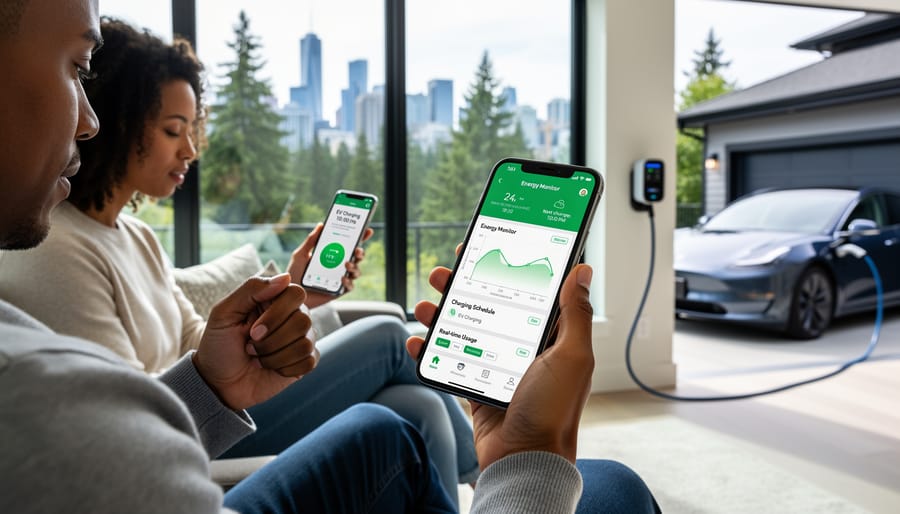
Managing your EV’s smart charging is simpler than you might think. Most modern electric vehicles and home charging stations come with intuitive smartphone apps that put you in complete control of when and how your vehicle charges.
These apps let you set charging schedules to take advantage of BC Hydro’s time-of-use rates, automatically starting your charge during off-peak hours when electricity costs less. You can monitor exactly how much energy you’re using, track your charging costs, and adjust settings from anywhere. For example, a Vancouver Island family reduced their charging costs by 40% simply by scheduling their EV to charge overnight when rates are lowest.
If you have solar panels, many smart charging systems integrate seamlessly with your home energy setup. The app can prioritize charging your vehicle with solar power during sunny days, storing that clean energy in your battery for later use. You’ll see real-time data showing how much solar energy is powering your vehicle versus grid electricity.
Most apps also send helpful notifications when charging is complete or if any issues arise. The learning curve is minimal—if you can use a smartphone, you can optimize your EV charging. Within days, these settings become automatic, running quietly in the background while you save money and reduce your environmental footprint.
Environmental Impact: Beyond Personal Savings
When you charge your EV smartly, you’re doing more than reducing your personal electricity bill—you’re contributing to British Columbia’s clean energy future. Smart charging and V2G technology help our province move away from fossil fuel dependence while maximizing the value of our renewable energy resources.
BC Hydro generates over 95% of its electricity from clean hydroelectric power, but managing demand peaks remains challenging. During high-usage periods, utilities sometimes rely on fossil fuel sources or import electricity from jurisdictions with higher emissions. Smart charging shifts EV power demand to off-peak hours when clean hydro is abundant, ensuring your vehicle runs on the cleanest possible energy while reducing strain on the grid.
The collective impact multiplies quickly. If just 10,000 BC EV owners adopted smart charging, it could shift approximately 40 megawatt-hours of demand daily—equivalent to powering 4,000 homes. This grid optimization supports the province’s CleanBC climate targets, which aim to reduce emissions by 40% by 2030.
V2G technology takes environmental benefits further by enabling EVs to function as mobile energy storage systems. When paired with residential solar panels, your EV can store excess renewable energy generated during sunny afternoons and feed it back during evening peaks. This community-level energy sharing reduces the need for new infrastructure and accelerates renewable integration across BC’s grid.
Consider a Vancouver neighborhood where 50 homes with EVs participate in smart charging programs. Together, they create a virtual power plant that stabilizes local grid demand, reduces transmission losses, and demonstrates how individual actions create measurable environmental change. Your charging choices today help build the resilient, sustainable energy system BC needs for tomorrow.
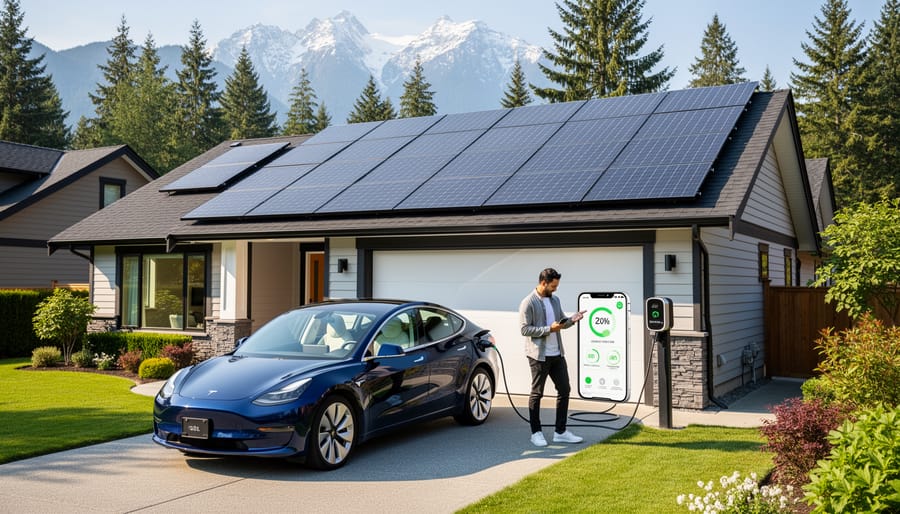
Smart charging technology offers BC residents a powerful opportunity to transform their electric vehicles into assets that both save money and support our province’s clean energy goals. By shifting your charging to off-peak hours, you can reduce your electricity costs by 30-50% annually while helping balance the grid during times of high demand. When combined with home solar systems, these savings grow even larger as you power your vehicle directly from the sun.
The environmental benefits extend beyond your personal carbon footprint. Every EV charged intelligently contributes to a more resilient electrical grid, reducing the need for fossil fuel backup generation during peak periods. This collective impact strengthens BC’s position as a leader in sustainable transportation and renewable energy.
Ready to discover your potential savings? Use Solar BC’s interactive calculator to see exactly how smart charging and solar integration could reduce your energy costs. Our network of certified installers throughout the province can assess your home’s specific needs and design a solution that maximizes both your financial returns and environmental contribution. Take the first step today by exploring your options and connecting with local experts who understand BC’s unique energy landscape. Your transition to smarter, cleaner vehicle charging starts with a simple calculation and a conversation with professionals who are committed to helping our communities thrive sustainably.