

British Columbia’s solar landscape shifted dramatically in November 2023 when BC Hydro introduced Net Metering 3.0, slashing compensation rates for excess solar energy from retail value to approximately 9.99 cents per kilowatt-hour. If you’re considering solar panels or already have a system, this policy change directly impacts your return on investment and requires a fresh approach to system design and energy usage.
The financial equation has fundamentally changed. Under the previous Net Metering 2.0 program, homeowners received full retail credit for every kilowatt-hour exported to the grid, typically around 12-14 cents depending on your tier. Now, that same exported energy earns roughly 30% less, meaning maximizing self-consumption rather than grid export has become the primary strategy for achieving solar savings.
This shift doesn’t eliminate the solar value proposition in BC, but it does demand smarter planning. Successful solar investment under Net Metering 3.0 means right-sizing your system to match actual daytime consumption, shifting energy-intensive activities to sunny hours, and potentially incorporating battery storage to capture excess generation for evening use. Properties with consistent daytime electricity demand, such as home-based businesses or households with electric vehicle charging needs, now see stronger financial returns than those exporting most of their generation.
Understanding these changes helps you make informed decisions about moving forward with solar. The key is optimizing system design and usage patterns to align with the new compensation structure while still reducing your carbon footprint and electricity costs.
What’s Actually Changing with Net Metering 3.0 in BC
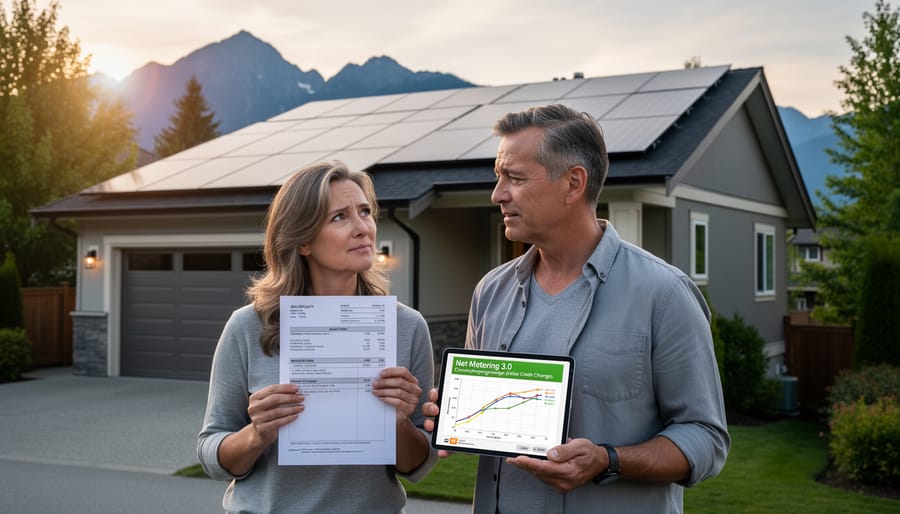
The Old System: How Net Metering 2.0 Worked
Under Net Metering 2.0, BC solar owners enjoyed a straightforward arrangement that made the economics of solar power particularly attractive. When your solar panels generated more electricity than your home or business needed, that excess power flowed back into the grid. In return, you received credits at the full retail electricity rate—the same price you paid when drawing power from the grid.
This one-to-one credit system meant every kilowatt-hour of solar energy you exported was valued identically to the electricity you consumed. If you paid 12 cents per kWh for grid power, your excess solar generation earned you credits worth 12 cents per kWh. For many BC homeowners, this arrangement allowed their systems to offset most or even all of their annual electricity costs.
Consider the Thompson family in Victoria, who installed a 6 kW system in 2021. During sunny summer months, their panels often produced twice their household needs. Those excess kilowatt-hours built up valuable credits that covered their electricity usage during darker winter months, resulting in minimal annual utility bills. This predictable, generous credit structure made calculating solar savings simple and encouraged thousands of British Columbians to invest in renewable energy with confidence.
The New Reality: Export Compensation Under NEM 3.0
Under NEM 3.0, the way you’re compensated for excess solar energy has fundamentally changed. Instead of receiving retail rates for the electricity you send back to the grid, you’ll now receive wholesale rates that vary by time of day.
The new compensation structure operates on a time-of-use basis. During peak demand hours, typically late afternoon and early evening when people return home, your export credits hold higher value. Conversely, mid-day solar production when the grid already has abundant renewable energy receives lower compensation rates. This shift reflects the actual grid value of electricity at different times.
Here’s a practical example from a Vancouver homeowner: Previously, excess energy exported during sunny afternoons earned credits at approximately 12 cents per kilowatt-hour. Under NEM 3.0, that same mid-day export might earn only 3-5 cents per kilowatt-hour, while evening exports from battery storage could earn 8-10 cents.
Credits are calculated monthly based on your net consumption versus production across different time periods. You’ll see separate line items on your utility bill showing production and consumption by time slot, making it easier to understand when you’re generating value and when you’re consuming from the grid.
The good news? This time-based approach creates opportunities for strategic energy management. By understanding these compensation patterns, you can maximize your solar investment through smart consumption habits and battery storage solutions that shift your solar production to higher-value time periods.
How This Affects Your Solar Investment
Impact on Residential Solar Owners
For BC homeowners, Net Metering 3.0 brings notable changes to the solar investment equation. Under the previous system, a typical residential 5kW solar array in Metro Vancouver could expect payback periods of 12-15 years. With the new rate adjustments, similar systems now see payback periods extending to 15-18 years, depending on your utility provider and household energy consumption patterns.
The monthly savings picture has shifted as well. Previously, homeowners banking excess summer solar credits could offset winter electricity costs almost dollar-for-dollar. Now, with modified credit valuations, that same household might see their monthly winter savings reduce by 20-30%. For example, a family in Kelowna previously saving $80 monthly during peak production months might now see closer to $55-65 in credits.
However, these changes don’t eliminate solar’s value proposition. Strategic system design and pairing your panels with storage technology can significantly improve your returns. Battery systems allow you to store excess daytime production for evening use rather than exporting it at reduced credit rates, maximizing self-consumption.
The Sharma family in Surrey adjusted their approach by installing a modest battery system alongside their solar panels. By storing 60% of their excess generation, they maintained payback timelines comparable to pre-3.0 rates while gaining backup power security.
Ready to see how these changes affect your specific situation? Use our solar savings calculator to input your household’s energy profile and get personalized projections under the current framework.
What Business and Commercial Users Should Expect
For commercial and industrial solar users, Net Metering 3.0 brings distinct considerations compared to residential installations. Businesses typically have larger solar arrays and different energy consumption patterns, often using more electricity during daytime business hours when solar production peaks.
This timing alignment can actually work in your favour under the new framework. Since your business likely consumes significant power during the day, you’ll export less to the grid and rely more on direct solar consumption, which always provides the best return. However, businesses with weekend closures or seasonal operations may see reduced benefits from exported credits.
The 10-year rate guarantee provides valuable long-term budget certainty for business planning. For example, a Vancouver-based manufacturing facility recently found that despite lower export rates, their daylight-heavy operations meant 75% of their solar generation was consumed immediately, maintaining strong overall savings.
Commercial users should carefully analyze their consumption profiles across different times and seasons. Consider battery storage to capture excess daytime production for use during evening cleaning shifts or early morning prep work. Run the numbers using actual utility bills from the past year to understand your specific export versus consumption ratio before proceeding with installation decisions.
Real Numbers: A Kelowna Family’s Story
The Thompson family in Kelowna installed a 7.2 kW solar system in 2022, and the policy shift has noticeably affected their returns. Under the previous Net Metering 2.0 system, their annual electricity bill savings averaged $1,240, with excess summer generation credited at full retail rates of approximately 14 cents per kWh. Their system was projected to pay for itself in 11 years.
Under Net Metering 3.0, their annual savings have dropped to around $890. The reduced export credit rate means their surplus power now earns roughly 40% less value. While still beneficial for the environment, their payback period has extended to approximately 15 years. The Thompsons have responded by adding a battery storage system to capture more of their solar production for evening use, improving their self-consumption rate from 35% to 68% and recovering some of the lost financial benefits.
Making Solar Work Under the New Rules
Optimize Your Energy Usage Timing
Under net metering 3.0, timing becomes your secret weapon for maximizing solar savings. Since you’ll receive significantly less for energy exported to the grid than what you pay for imports, the goal is simple: use your solar power when you’re producing it.
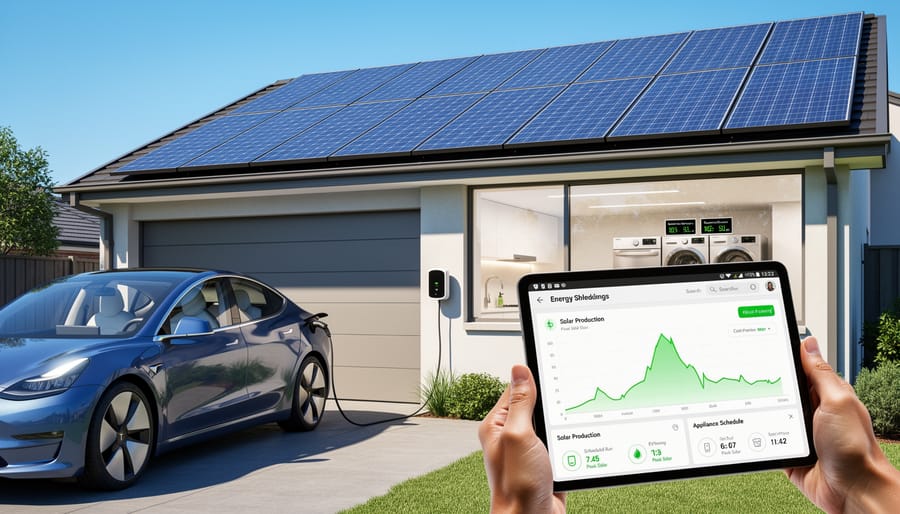
Start with your major appliances. Run your dishwasher, washing machine, and dryer between 10 a.m. and 3 p.m. when your panels are generating peak power. If you work from home, charge your laptop and devices during these sunny hours. Consider setting timers on your hot water heater to operate during midday rather than early morning.
A family in Kelowna saved an extra $400 annually by simply adjusting their pool pump schedule to run during solar production hours instead of overnight. Small changes like these add up quickly.
For businesses, the opportunity is even greater. Shift energy-intensive operations like HVAC systems, commercial cooking equipment, or manufacturing processes to daylight hours wherever possible. Many BC companies report reducing their grid dependency by 60-70% through strategic timing alone.
Smart home technology can automate these shifts, making optimization effortless. Even without fancy gadgets, a bit of habit adjustment transforms your solar investment from good to great.
Battery Storage: Now More Important Than Ever
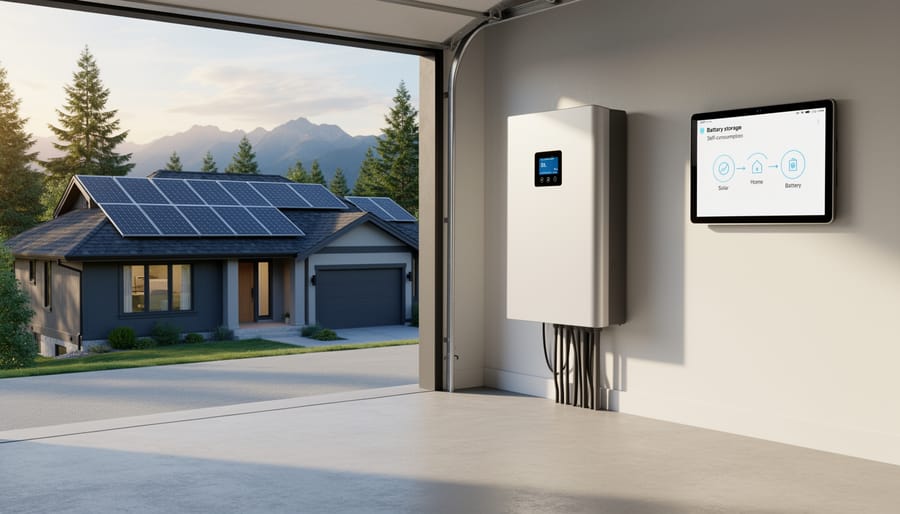
With reduced export rates under Net Metering 3.0, BC solar owners now have a stronger financial incentive to use their solar energy themselves rather than sending it to the grid. This is where battery storage options become game-changers.
Energy storage systems allow you to store excess solar power generated during sunny days and use it during evening hours when your household demand peaks. Instead of exporting power at the reduced rate and buying it back at the full retail rate later, you’re keeping that value for yourself.
Here’s a practical example: A typical Vancouver household might generate 15 kWh of excess solar power on a summer afternoon. Under the old net metering, that energy credited at full retail value meant about $1.80 in savings. With Net Metering 3.0’s reduced export rate, you might only receive $0.90. However, storing that power and using it during evening hours when you’d otherwise buy from the grid saves you the full $1.80, effectively doubling your return.
The upfront cost of battery storage has decreased significantly in recent years. Many BC homeowners are finding that systems pay for themselves within 7-10 years through these improved savings, while also providing backup power during outages. For those installing new solar systems, adding storage from the start maximizes your energy independence and financial returns under the new policy framework.
Right-Sizing Your System for Maximum Return
Under Net Metering 3.0, the strategy has shifted from installing the largest possible system to designing one that closely matches your actual energy consumption. Since excess generation now receives lower compensation, you’ll maximize your return by focusing on offsetting your own usage rather than producing surplus power.
Start by reviewing your electricity bills from the past year to identify your average monthly consumption. A well-sized system should generate approximately 90-100% of your annual needs, minimizing both the energy you purchase and the excess you export. This approach ensures most of your solar production is consumed on-site at the full retail rate rather than exported at reduced credit values.
Consider your household’s energy patterns too. If you use more electricity during evenings when solar production drops, a smaller system paired with energy-efficient practices or battery storage might deliver better financial results than a larger array that generates unused midday power.
For example, a Kelowna family reduced their system size by 20% after analyzing their consumption patterns, investing the savings into a small battery and smart home devices. They now use 95% of their solar generation directly, achieving payback two years faster than their original oversized plan would have delivered.
Should You Still Go Solar in BC?
When Solar Still Makes Perfect Sense
Despite reduced export rates, solar remains an excellent investment for many BC residents and businesses. High electricity consumers who use most of their solar production during daylight hours see the strongest returns, as self-consumed electricity still offsets retail rates. Homes with electric vehicle charging needs, heat pumps, or daytime business operations particularly benefit from this alignment.
Properties with southern exposure and minimal shading maximize production efficiency, making the economics work even with lower export values. Adding home battery solutions helps capture excess generation for evening use, dramatically improving self-consumption rates.
Consider the Robinsons in Kelowna, who installed solar with battery storage in 2024. Their daylight EV charging and battery-shifted evening consumption means 85% self-consumption, achieving payback in under 10 years despite NEM 3.0 rates.
Solar also makes sense for those prioritizing energy independence and environmental impact over maximum financial returns. With BC’s clean energy goals and rising electricity demand, investing in solar today positions you favourably for future rate structures while reducing your carbon footprint immediately.
Beyond the Numbers: Energy Independence and Climate Impact
While financial returns matter, solar energy under Net Metering 3.0 delivers benefits that extend far beyond your electricity bill. By generating clean power at your home or business, you’re actively reducing BC’s reliance on imported energy during peak demand periods, strengthening our provincial grid resilience.
Every kilowatt-hour your solar system produces displaces electricity that would otherwise come from the grid, reducing greenhouse gas emissions and contributing to BC’s climate action goals. A typical residential solar array in Vancouver prevents approximately 1.5 tonnes of CO2 emissions annually—equivalent to planting 70 trees each year.
Solar also provides valuable protection against future rate increases. BC Hydro rates have risen steadily over the past decade, and this trend is expected to continue. Once your system is installed, you’re generating a portion of your electricity at a fixed cost, insulating your household or business from these increases. Consider the Johnson family in Kelowna, who installed solar in 2019: while their neighbours have seen 15% rate increases, the Johnsons produce 60% of their power at yesterday’s prices.
Additionally, solar installations increase property values and demonstrate environmental leadership in your community, inspiring neighbours and local businesses to consider their own sustainable energy solutions.
Your Action Plan: What to Do Next
If You Already Have Solar
If you’re already generating solar power, you’re grandfathered under your existing net metering agreement, so your rates won’t change. However, it’s worth reviewing your system’s performance to maximize savings. Check your energy production data to ensure panels are operating efficiently—cleaning panels and trimming nearby trees can boost output by 10-15%. Consider adding battery storage to use more of your solar energy directly rather than exporting it to the grid, which becomes increasingly valuable as export rates decline for new installations. Many BC homeowners who’ve added batteries report reducing their grid dependence by 60-70%. Connect with your solar installer for a system health check and discuss whether expansion or optimization makes sense for your household’s changing energy needs.
If You’re Planning to Install Soon
If you’re moving forward with a solar installation in the coming months, maximize your system’s value under current regulations. Work with your installer to ensure your system size aligns with your actual energy consumption rather than oversizing, as excess generation provides minimal return under NM 3.0. Consider adding battery storage to capture more of your solar production for nighttime use when grid electricity costs more. Complete your utility interconnection application promptly to lock in today’s rates. Many BC homeowners who installed in early 2024 report strong satisfaction by pairing appropriately-sized systems with strategic energy management practices that shift usage to peak production hours.
Getting Expert Help That Understands BC’s New Rules
Navigating NEM 3.0 is easier with the right expert on your side. Look for certified solar installers who understand BC’s updated net metering framework and can design systems that maximize your savings under the new rules. These professionals will help you determine optimal system sizing, incorporate battery storage if beneficial, and ensure your installation meets all technical requirements.
Solar BC maintains a network of qualified installers across the province who stay current with policy changes and local utility requirements. When choosing an installer, ask about their experience with NEM 3.0 projects and request examples of how they’ve optimized recent installations. A knowledgeable installer will provide detailed financial projections showing your expected returns, help you navigate utility interconnection processes, and design a system tailored to your consumption patterns rather than simply maximizing production.
While net metering 3.0 has certainly changed the financial landscape for solar in BC, the fundamentals remain strong. With thoughtful system sizing, strategic energy use, and battery storage where appropriate, solar continues to offer a reliable path to reducing both your electricity bills and environmental footprint. The key difference today is precision planning. Rather than viewing these policy changes as roadblocks, consider them an invitation to optimize your approach based on your household’s specific energy patterns and goals. The environmental benefits remain unchanged, and with BC’s rising electricity rates, locking in solar production still makes economic sense for many homeowners and businesses. Ready to see how net metering 3.0 affects your situation? Use updated calculators that factor in the latest compensation rates to get an accurate picture of your potential savings and payback period under current rules.