
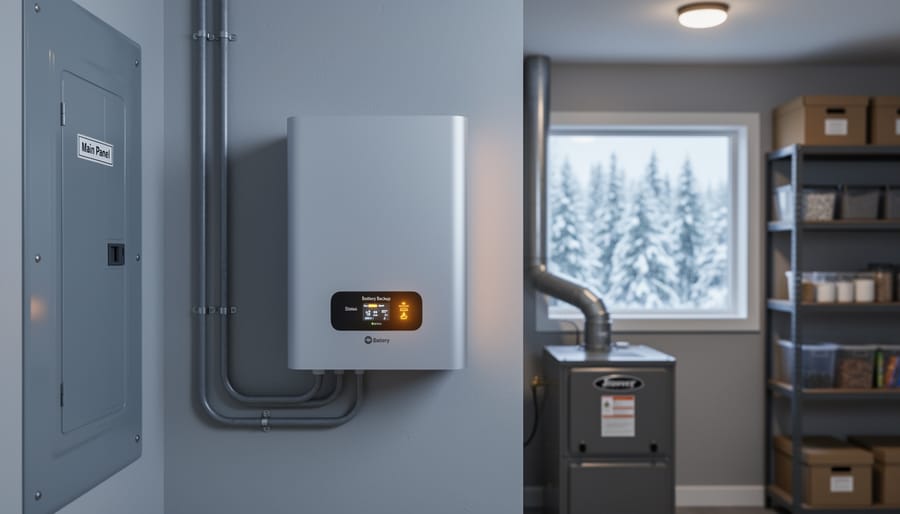
Assess your home’s essential power needs by listing critical appliances you’d run during an outage: a typical 5kWh system powers your refrigerator for 20 hours, keeps lights running for days, and maintains your home’s heating system through most BC winter storms. Calculate your actual backup requirements by adding up the wattage of must-have devices—most BC households find 5kWh covers essentials like refrigeration, heating controls, internet connectivity, and several lights for 8-12 hours, making it ideal for the province’s typical 4-6 hour grid interruptions.
Understand what 5kWh means in practical terms: it’s enough stored energy to run a 500-watt load for 10 hours straight, or more realistically, to cycle between your fridge (150 watts), furnace fan (600 watts), and basic lighting through a standard outage. For BC homeowners experiencing increasingly frequent weather-related power disruptions, battery backup solutions in this capacity range typically cost between $8,000-$12,000 installed, with prices varying based on brand, installation complexity, and whether you’re pairing it with solar panels.
Determine if 5kWh fits your situation by tracking your power usage during the evening hours when solar isn’t generating—if you typically use 15-25kWh daily, a 5kWh battery covers roughly one-third of your needs, perfect for peak shaving or essential backup, but insufficient for full off-grid living. BC residents should factor in our moderate climate advantage: unlike extreme cold regions, heating demands here make 5kWh systems more viable for meaningful backup protection without requiring massive, expensive battery banks.
What Exactly Is a 5kWh Battery Backup?
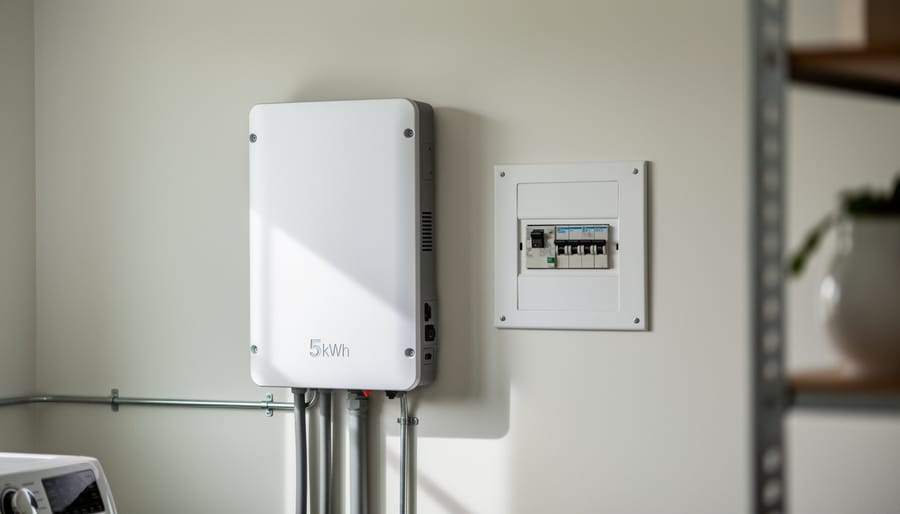
How Long Will 5kWh Actually Power Your Home?
Understanding what 5kWh actually means in your daily life makes all the difference when deciding if this battery size fits your needs. Let’s break down some real-world scenarios for typical BC homes.
A 5kWh battery can keep your essential systems running during short outages. For example, a modern Energy Star refrigerator uses about 150 watts, meaning you could run it for roughly 33 hours on a full charge alone. Your LED lighting throughout the home typically draws 60-100 watts total, adding another full day of illumination to that same battery.
Here’s a practical winter scenario many BC homeowners face: During a 12-hour overnight outage, you could simultaneously power your fridge (150W), essential lights (75W), your internet router and phone chargers (50W combined), and still have capacity left over. That’s about 275 watts total, giving you approximately 18 hours of runtime.
For heating considerations, electric baseboard heaters are power-hungry at 1,000-1,500 watts each. A 5kWh battery might run one heater for 3-5 hours, which is why many BC families pair their battery backup with alternative heating sources like wood stoves or gas fireplaces during extended outages.
One Kelowna family shared their experience: their 5kWh system kept their home office running for two full workdays during last winter’s ice storm, powering a laptop, monitor, router, and desk lamp without issue.
The key takeaway? A 5kWh battery excels at maintaining your essential functions rather than running your entire home indefinitely.
The Perfect Match: Pairing Your 5kWh Battery with Solar Panels
Making It Work During BC’s Grey Winter Months
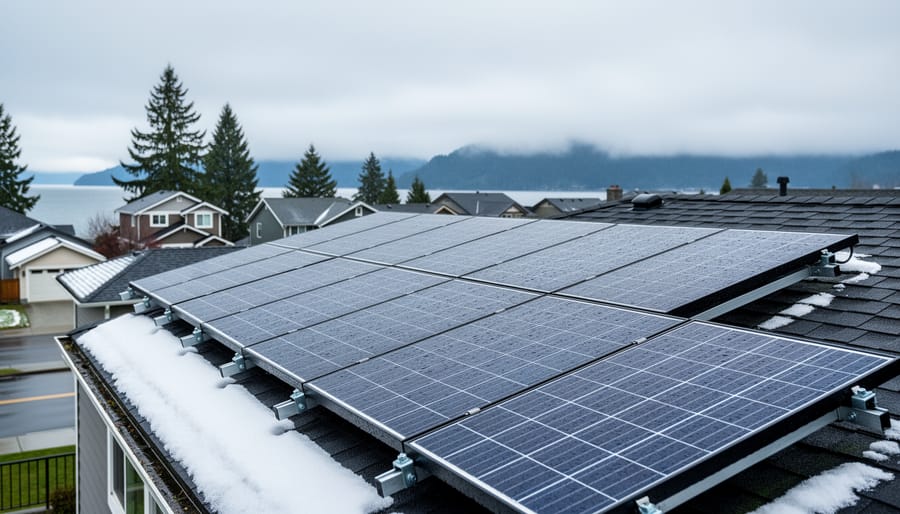
Let’s be honest: BC’s winter skies aren’t exactly solar-friendly. From November through February, shorter days and persistent cloud cover mean your solar panels won’t produce nearly as much energy as they do in summer. But that doesn’t make your 5kWh battery useless during these grey months.
The reality is that solar energy storage systems can still charge from reduced sunlight, just more slowly. On overcast days, you might only partially charge your battery, but every kilowatt-hour counts toward reducing grid dependence. Many BC homeowners use a hybrid approach during winter: their batteries charge from whatever solar energy is available, then top up from the grid during off-peak hours when electricity rates are lower.
Grid charging is actually a smart winter strategy. You can program most battery systems to charge overnight when BC Hydro rates are typically at their lowest, then use that stored power during peak evening hours. This time-shifting still saves money and reduces strain on the grid, even without solar input.
Some homeowners find their batteries most valuable in winter not for daily savings, but for backup power during storm-related outages, which are more common in BC’s wet season. Your 5kWh battery keeps essential circuits running when winter weather knocks out power.
The key is adjusting your expectations seasonally while maintaining year-round functionality through flexible charging options.

Real BC Homes Running on 5kWh Battery Backup
Meeting real people who’ve already made the switch to battery backup helps you understand what a 5kWh system can actually do. Here are three BC homes and businesses that took the leap, and what they’ve learned along the way.
The Nanaimo Family: Peace of Mind During Storm Season
Sarah and Tom Chen installed a 5kWh battery backup system in their Nanaimo home in early 2023, motivated by increasingly frequent winter power outages that left their family of four in the dark for hours at a time.
“We weren’t looking to go off-grid,” Sarah explains. “We just wanted to keep our fridge running, have lights, and charge our phones when the power went out during windstorms.”
Their total installation cost came to $7,800, including a basic battery unit and installation by a local electrician. During a six-hour outage last November, their system powered essential circuits including their refrigerator, several LED lights, their internet router, and phone chargers. The battery still had 20% capacity remaining when power returned.
“It’s not about running everything in the house,” Tom adds. “It’s about staying comfortable and connected until BC Hydro gets things back online. That peace of mind is worth every penny.”
Penticton Café: Keeping Business Open
Mountain View Café owner Jennifer Park invested $8,500 in a 5kWh system after losing thousands in spoiled inventory and lost business during summer outages.
“In tourist season, every hour we’re closed costs us money,” Jennifer says. Her system powers the point-of-sale system, wifi, lighting, and one commercial fridge for up to four hours. She’s used it three times in eighteen months, estimating she’s saved roughly $3,000 in lost revenue and spoiled goods.
Victoria Townhome: Complementing Solar
David Rodriguez combined his 5kWh battery with existing solar panels in his Victoria townhome, creating a system that stores excess solar energy for evening use and provides backup during outages.
His installation cost was $6,900, and he’s seen his evening grid consumption drop by 40%. During a three-hour afternoon outage, his battery seamlessly took over, and his family didn’t notice the transition until neighbors mentioned the blackout.
What You’ll Actually Pay (And Save) in British Columbia
Current Rebates and Incentives Available to BC Residents
BC homeowners investing in a 5kWh battery backup system can access several financial incentives to reduce upfront costs. The Canada Greener Homes Grant provides up to $5,000 for eligible home energy improvements, including battery storage systems when paired with renewable energy sources. Additionally, the CleanBC Home Retrofit Rebate offers rebates for energy efficiency upgrades that complement battery installations.
BC Hydro customers may benefit from time-of-use rates in the future, making battery storage increasingly valuable for cost savings. The federal government’s Interest-Free Home Energy Loan program allows qualified homeowners to finance up to $40,000 in eligible improvements with zero interest for ten years, making battery backup more accessible.
Many BC municipalities also offer property tax exemptions for renewable energy systems, including battery storage. For example, Victoria homeowners have saved thousands through local green building incentives. Contact your municipal office to learn about region-specific programs.
When exploring financing options, consider working with Clean Energy BC certified installers who understand current rebate programs and can help maximize your savings. These professionals can guide you through application processes and ensure your 5kWh system qualifies for available incentives, potentially reducing your investment by 20-30 percent.
Is 5kWh Enough for Your Home?
Understanding whether 5kWh meets your needs starts with knowing how much energy your household typically uses during a power outage. A 5kWh battery can power essential loads for several hours, but the exact duration depends on what you’re running.
Start by identifying your critical appliances. A typical BC home’s essentials might include a refrigerator (150 watts), LED lighting (50 watts), internet router (10 watts), and a laptop (50 watts). Running these simultaneously draws about 260 watts, meaning a 5kWh battery could sustain them for roughly 19 hours. Add a space heater (1,500 watts) during winter, and that drops to about 3 hours of total runtime.
To calculate your own requirements, list the appliances you can’t live without and note their wattage (found on labels or in manuals). Multiply wattage by estimated hours of daily use, then divide 5,000 by this total to see how long your battery would last.
For most BC households, 5kWh works well as backup for essentials during brief outages or overnight power storage from solar panels. It’s ideal if you’re primarily concerned about keeping food fresh and staying connected rather than running your entire home normally.
However, homes with electric heating, well pumps, or medical equipment may need 10kWh or more. Conversely, urban condos with gas appliances might find even 3kWh sufficient. Consider starting with 5kWh with the option to expand later, as many battery systems are modular and designed to grow with your needs.
Choosing the Right Battery System for BC’s Climate
BC’s climate presents unique considerations when selecting a 5kWh battery system, particularly our cold, wet winters and varied regional temperatures. The good news is that modern lithium-ion batteries perform well in our conditions when properly installed.
Popular options in BC include the Tesla Powerwall (though at 13.5kWh, it exceeds 5kWh), Enphase IQ Battery 5P, and LG Chem RESU series. The Enphase IQ Battery 5P is particularly well-suited for BC homes, offering exactly 5kWh of usable capacity and excellent cold-weather performance down to -15°C. Generac’s PWRcell can be configured to 4.5kWh increments, providing flexibility for smaller installations.
Cold weather performance matters here. Quality batteries maintain 80-90% efficiency in temperatures down to -10°C, typical for coastal regions. Interior BC homeowners should prioritize systems rated for -20°C operation and consider garage installations with insulation rather than outdoor mounting.
Installation varies by home type. Heritage homes may need electrical panel upgrades to accommodate battery systems, adding $1,500-3,000 to costs. Newer builds typically have the necessary infrastructure. Apartment dwellers face more challenges, though some strata councils now permit individual battery installations with proper approvals.
Selecting a certified installer is critical. Look for professionals with Clean Energy BC membership and CSA certification. Ask for BC-specific references and verify they understand CleanBC rebate requirements. The Maple Ridge-based installer GreenPower Energy recently completed 47 residential battery installations, pairing them with the latest solar technology to maximize savings.
Request quotes from three installers, comparing warranty coverage, monitoring capabilities, and emergency response times. The right system should include remote monitoring through smartphone apps, allowing you to track performance during our unpredictable weather patterns.
Your Next Steps Toward Energy Independence
Ready to take the next step toward energy independence with a 5kWh battery backup? Here’s your practical roadmap to get started.
Begin with a home energy assessment to understand your actual power consumption patterns. Many BC utility companies offer free or subsidized energy audits that identify which appliances use the most electricity and when. This baseline information helps you determine if 5kWh matches your needs or if a different capacity makes more sense.
Use Solar BC’s online calculator tool to estimate your potential savings and system requirements. This interactive resource accounts for BC’s specific electricity rates, available rebates, and regional sunshine hours. You’ll get personalized projections based on your location and energy usage.
Connect with certified installers who understand BC’s regulations and climate conditions. Look for professionals with Clean Energy BC membership and solid local references. A Surrey family we featured recently saved time and money by choosing an installer familiar with municipal permitting in their area.
During consultations, ask these essential questions: What warranty coverage comes with the battery? How does the system perform during BC’s winter months? What happens during extended power outages? Can the system expand if my energy needs grow? What rebates and financing options are currently available?
Request detailed quotes from at least three installers, comparing not just price but equipment quality, installation timelines, and ongoing support. Most importantly, ensure they explain everything in plain language so you feel confident about your investment in energy independence.
A 5kWh battery backup offers BC residents a practical stepping stone toward greater energy independence while supporting our province’s environmental goals. While it won’t power your entire home indefinitely, it delivers meaningful protection during outages and helps you maximize clean energy use. For those with solar panels, it means storing sunshine for evening use. For others, it provides peace of mind knowing essential appliances stay running when the grid goes down.
This solution isn’t right for everyone. Households with high energy demands or frequent extended outages may need larger systems, while those in urban areas with reliable power might find it unnecessary. However, for many British Columbians seeking a balance between cost, capability, and environmental responsibility, a 5kWh system hits the sweet spot.
Ready to take the next step? Start by tracking your essential power needs during a typical evening, then connect with local installers who understand BC’s unique climate and energy landscape. Your journey toward energy resilience begins with one informed decision.