
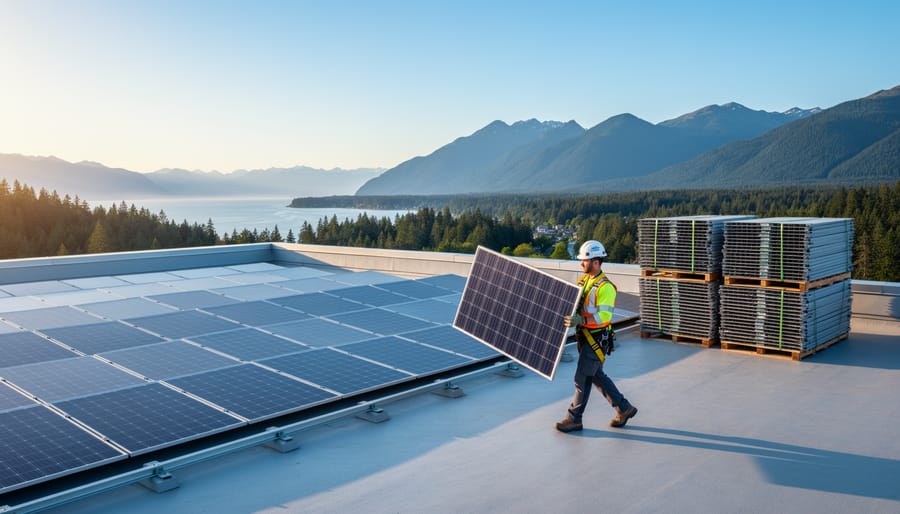
Solar panels generate clean energy for decades, but their environmental story begins long before installation and continues well after they stop producing power. Understanding the complete lifecycle—from raw material extraction through manufacturing, 25-30 years of operation, and eventual recycling or disposal—reveals the true carbon footprint of your solar investment.
The numbers tell a compelling story: while manufacturing a solar panel does require significant energy and produces approximately 50 grams of CO2 per kilowatt-hour when spread across its lifetime, this carbon debt gets repaid remarkably fast. In British Columbia’s climate, most solar installations offset their manufacturing emissions within 1-2 years of operation, then continue producing clean energy for two more decades.
Manufacturing happens primarily in facilities that increasingly use renewable energy themselves, reducing the initial carbon burden. Raw materials like silicon, aluminum, and glass require energy-intensive processing, yet innovations in production methods have cut manufacturing emissions by 30% over the past decade. During the operational phase, panels generate electricity with zero direct emissions while requiring minimal maintenance—just occasional cleaning and monitoring.
The end-of-life phase matters too. When you’re wondering what happens after 25 years, the answer increasingly involves recycling programs that recover up to 95% of panel materials, including valuable silicon and metals. British Columbia is developing local recycling infrastructure to handle the growing number of panels reaching retirement.
This lifecycle perspective demonstrates that solar panels deliver net positive environmental benefits despite their manufacturing impact. The carbon payback period represents just a tiny fraction of their productive lifetime, making them one of the most effective tools for reducing long-term emissions.
Manufacturing and Transportation: Where Your Solar Panel’s Carbon Story Begins
From Silicon to Solar Cell: The Manufacturing Process
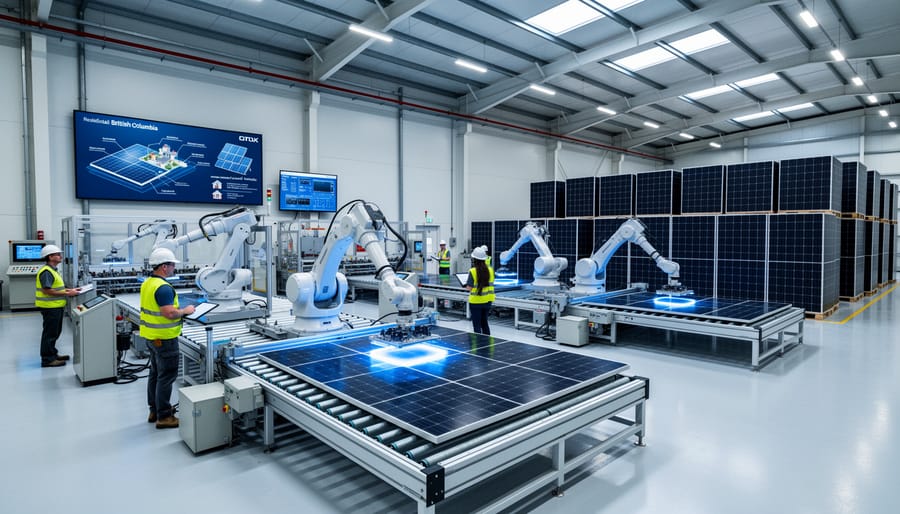
Creating solar panels requires significant energy upfront, but understanding this process helps put their environmental benefits in perspective. The journey from raw silicon to finished panel involves several energy-intensive steps, yet modern manufacturing has made remarkable strides in reducing this carbon footprint.
The process begins with refining quartz into metallurgical-grade silicon, then further purifying it to solar-grade quality through high-temperature reactions. This silicon is formed into ingots, sliced into thin wafers, treated with chemicals to create the photovoltaic effect, and assembled into panels with protective glass and aluminum frames. Each step requires substantial electricity, often from varied energy sources depending on where manufacturing occurs.
A typical residential solar panel generates approximately 50-75 kg of carbon dioxide equivalent during manufacturing. This might sound concerning, but here’s the encouraging part: a panel operating in BC’s sunny Interior or coastal regions pays back this carbon debt within 1-3 years of operation, then continues producing clean energy for 25-30 years or more.
Manufacturing efficiency has improved dramatically over the past decade. Today’s panels require 40% less energy to produce than those made in 2010, thanks to streamlined processes, thinner wafers, and manufacturers increasingly powering their facilities with renewable energy. Some leading manufacturers have achieved carbon-neutral production facilities.
When you choose solar panels from companies committed to clean manufacturing practices, you’re supporting an industry actively working to minimize its environmental footprint while delivering decades of emission-free electricity to BC communities.
Getting to BC: Transportation Emissions in Context
Once solar panels are manufactured, they need to travel to BC—and yes, this journey adds to their carbon footprint. Most panels produced in China travel approximately 10,000 kilometers by container ship to Vancouver, generating roughly 50-75 kg of CO2 per panel. Panels manufactured in North America have a smaller transportation footprint, typically around 10-20 kg CO2 per panel depending on the facility location.
Here’s the encouraging reality: transportation emissions account for only 5-10% of a solar panel’s total lifecycle carbon footprint. To put this in perspective, a typical residential panel offsets its shipping emissions within the first 3-6 months of operation in BC’s climate. Over a 25-year lifespan, the clean energy generated is roughly 40-60 times greater than the carbon cost of getting the panel here.
A Vancouver homeowner who installed panels in 2023 shared that understanding these numbers helped solidify their decision. While they initially worried about overseas shipping, they realized that six months of clean energy production more than compensated for the one-time transportation impact—making solar a clear environmental win for BC families.
The 25-Year Payback: When Your Panels Become Carbon Heroes
BC’s Solar Advantage: Sun Hours and Grid Carbon Intensity
British Columbia’s unique energy landscape presents an interesting case for solar panel carbon payback calculations. While our province receives excellent sun exposure—averaging 1,800 to 2,000 hours of sunshine annually in southern regions—we also benefit from one of the cleanest electricity grids in North America, powered primarily by hydroelectricity.
This clean grid creates a nuanced situation for carbon accounting. In regions dependent on coal or natural gas, solar panels offset approximately 0.5 to 1 tonne of CO2 per year. In BC, however, the carbon offset is smaller, typically around 0.1 to 0.3 tonnes annually, since we’re already replacing relatively clean energy. Despite this difference, solar panels in BC still achieve carbon payback within 2 to 4 years—competitive with other regions when considering our manufacturing improvements and strong solar resource.
The real advantage for BC residents lies in three areas. First, you’re contributing to grid resilience during peak demand periods when BC Hydro occasionally imports power from carbon-intensive sources. Second, you’re future-proofing against potential grid changes as our population grows. Third, solar adoption here demonstrates renewable technology leadership to other jurisdictions.
Consider the Okanagan’s Community Solar Garden project, which achieved carbon neutrality within three years while creating local green jobs. Your investment in solar panels contributes to this provincial momentum toward even cleaner energy, proving that environmental impact extends beyond simple carbon math to include community benefits and technological advancement.
Real Numbers from a Kelowna Installation
When the Chen family installed a 6.5 kW solar array on their Kelowna home in 2019, they weren’t just thinking about electricity bills. They wanted to understand their real environmental impact. Five years later, the numbers tell a compelling story.
Their system has generated approximately 32,500 kWh of clean electricity, offsetting roughly 13 tonnes of carbon dioxide that would have been emitted by BC’s grid. To put that in perspective, that’s equivalent to taking two cars off the road for an entire year or planting about 215 trees.
What makes this case particularly interesting is that BC already has one of the cleanest electrical grids in North America, powered largely by hydroelectricity. In provinces with coal or natural gas generation, the same system would offset significantly more carbon. Yet even here in BC, the environmental benefit is substantial and measurable.
The Chen family’s installation required about 2.5 tonnes of carbon to manufacture and install, meaning their system paid back its carbon debt within the first 18 months of operation. With an expected lifespan of 25 to 30 years, they’re looking at a net carbon offset of approximately 60 tonnes over the system’s lifetime.
Beyond carbon, their panels have reduced local air pollutants and decreased demand on the grid during peak summer hours when Kelowna’s air conditioning needs are highest. The family tracks their production through a monitoring app, watching real-time proof that their investment generates both financial returns and environmental benefits.
Their experience demonstrates that solar works in the Okanagan climate, delivering consistent results year after year while contributing to BC’s clean energy future.
Operating Years: Minimal Impact, Maximum Generation
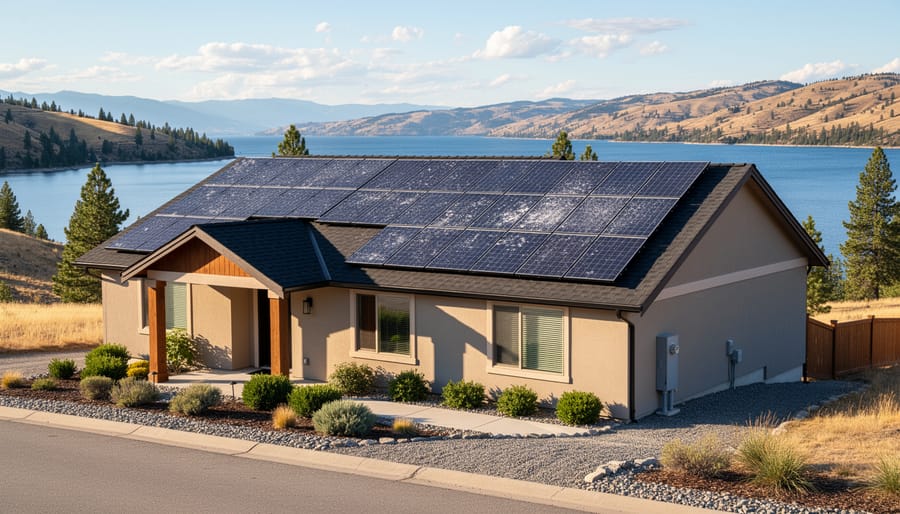
Once your solar panels are installed, they enter their longest and most productive phase—typically 25 to 30 years of reliable, clean energy generation. This operational period represents the heart of solar’s environmental benefit, as panels produce electricity with virtually zero emissions and minimal maintenance requirements.
British Columbia homeowners consistently report how effortlessly their systems perform. Unlike traditional energy sources, solar panels have no moving parts, require no fuel, and operate silently day after day. Most systems need only occasional cleaning to remove dust, pollen, or debris—usually handled by BC’s regular rainfall. In drier regions or areas with heavy bird activity, a simple rinse once or twice yearly keeps panels operating at peak efficiency.
Performance degradation is minimal and predictable. Quality panels typically lose only 0.5% to 0.8% of their efficiency annually, meaning after 25 years, your system will still generate approximately 80-85% of its original output. This gradual decline is factored into financial projections and doesn’t significantly impact your energy savings or environmental benefits.
The Johnsons in Kelowna provide a perfect example. After 15 years, their system still offsets 95% of their household electricity, requiring nothing more than an annual visual inspection and the occasional garden hose rinse. Their monitoring system alerts them to any performance issues, though they’ve experienced none.
Maintenance costs remain remarkably low—most BC homeowners spend less than $200 over a decade. This makes panel performance and longevity exceptionally predictable for both financial planning and carbon accounting. During these decades, your panels continuously prevent greenhouse gas emissions equivalent to planting hundreds of trees annually, all while requiring minimal intervention or resources.
End of Life: The Recycling Revolution Happening Now
What’s Inside Your Panel That Can Be Recycled?
Modern solar panels are remarkably recyclable, which is great news for anyone concerned about end-of-life environmental impacts. Understanding what’s inside your panel helps illustrate why solar truly is a sustainable choice.
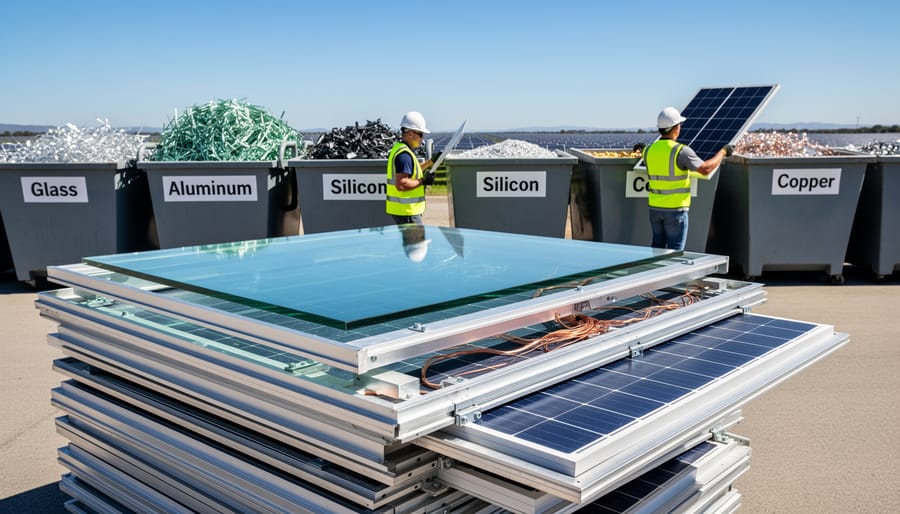
Glass makes up about 75% of a typical solar panel’s weight and can be recycled at rates up to 95%. This high-quality glass gets sorted, crushed, and remelted for use in new panels or other glass products. The aluminum frame, representing roughly 10% of the panel’s weight, boasts recovery rates of 85-90% and is one of the most valuable recyclable components.
Silicon cells, the heart of your panel’s energy production, account for about 3-5% of total weight. Current technologies recover approximately 85% of silicon wafers, which can be refined and reused in new panels. The silver, copper, and other precious metals within the cells are also highly recoverable at 80-95%, making them economically worthwhile to extract.
The remaining materials include the plastic backsheet, junction box, and encapsulant materials. While these present more recycling challenges, newer processing methods are improving recovery rates beyond the current 50-60% range.
Here in BC, these recovery rates matter because they mean the solar panels you install today won’t become tomorrow’s waste problem. When panels reach their 25-30 year lifespan, the majority of materials return to the manufacturing cycle, dramatically reducing the overall environmental footprint. This closed-loop approach reinforces solar energy’s position as a genuinely sustainable solution for BC households and businesses committed to long-term environmental stewardship.
Recycling Options for BC Solar Owners
British Columbia is leading Canada in solar panel recycling infrastructure, making it easier than ever for solar owners to responsibly manage their systems when the time comes. Understanding your recycling options is an important part of the end-of-life considerations for your solar investment.
Currently, BC operates under the Electronics Stewardship Program managed by Recycle BC and the Canadian Electrical Stewardship Association. Many solar panels qualify as electronic waste and can be dropped off at designated collection sites across the province. Check with your local recycling depot or contact the Electronic Products Recycling Association for locations near you.
Exciting changes are coming. BC is developing an Extended Producer Responsibility program specifically for solar panels, expected to roll out by 2025. This means manufacturers and importers will be responsible for the collection and recycling of panels at no cost to owners. This follows successful EPR models already in place for other electronics and appliances.
In the meantime, several private recycling companies in BC specialize in solar panel recovery, extracting up to 95 percent of materials including silicon, glass, and aluminum. Companies like Cascades Recovery and Quantum Lifecycle Partners offer commercial pickup services for larger installations.
What you can do now:
Keep documentation of your solar panel make and model for future recycling requirements.
Contact your installer to ask about their take-back programs when replacement time comes.
Join community solar advocacy groups to stay informed about policy developments.
Register with your regional district’s hazardous waste program for proper disposal notifications.
Planning ahead ensures your solar panels complete their lifecycle as sustainably as they operated throughout their productive years.
The Complete Carbon Picture: How BC Solar Stacks Up
When you consider the complete lifecycle carbon picture, solar panels in BC emerge as clear environmental champions. Let’s put all the pieces together to see the full story.
From manufacturing through installation, operation, and eventual recycling, a typical residential solar system in BC generates between 30-50 grams of CO2 equivalent per kilowatt-hour over its lifetime. Compare this to BC’s electricity grid, which produces about 12-15 grams per kWh thanks to our hydroelectric resources. At first glance, solar might seem less green than our already-clean grid. However, when solar panels offset natural gas heating or reduce peak-time electricity demand that requires fossil fuel backup, the carbon savings multiply significantly.
The real comparison becomes striking when we look at fossil fuels: natural gas generates approximately 450 grams of CO2 per kWh, while coal produces over 900 grams. Solar panels pay back their manufacturing carbon footprint in 1-3 years under BC’s moderate sunlight conditions, then provide 22-27 years of virtually emissions-free energy. Over a 25-year lifespan, one residential solar system prevents roughly 100-150 tonnes of CO2 emissions when displacing fossil fuel use.
Against other renewables, solar holds its own remarkably well. Wind power produces similar lifecycle emissions at 11-40 grams per kWh, while hydroelectric ranges from 4-20 grams. The beauty of solar in BC is its decentralized nature, reducing the broader environmental impact on ecosystems that large-scale hydro projects sometimes create.
Consider the Nelson family in Victoria, whose 6-kilowatt system offsets both grid electricity and propane heating. Over 25 years, they’ll prevent approximately 125 tonnes of carbon emissions while demonstrating how BC households can amplify climate action.
The carbon reduction potential across BC is substantial. If just 20 percent of suitable residential rooftops installed solar panels, we’d offset over 2 million tonnes of CO2 annually, equivalent to removing 430,000 cars from our roads.
The bottom line? While solar panels do carry an initial carbon cost, their long-term environmental return on investment makes them a powerful tool for BC residents committed to meaningful climate action. Every panel installed contributes to a cleaner, more resilient energy future for our province.
Making Your BC Solar Installation Even Greener
Making informed choices before and after your solar installation can significantly reduce your panels’ environmental footprint. Here’s how BC residents can maximize the green benefits of their solar investment.
Start by selecting panels with strong environmental credentials. Look for manufacturers who publish Environmental Product Declarations and use recycled materials in their frames and packaging. Companies committed to carbon-neutral manufacturing facilities make a measurable difference. Ask your installer about panel certifications and the company’s take-back programs for end-of-life recycling.
Plan for the future from day one. When signing your installation contract, discuss end-of-life options with your provider. Many BC solar companies now offer recycling services or partnerships with provincial programs. Document your panel specifications and keep warranties accessible—this information becomes crucial for proper recycling decades later.
Maximize energy production through strategic placement and regular maintenance. In BC’s climate, panels facing south with a tilt between 30-40 degrees typically perform best. Keep panels clean, especially after our rainy seasons when debris accumulates. A well-maintained system produces more clean energy over its lifetime, improving its carbon payback ratio. Simple quarterly inspections can identify shading issues from growing trees or performance drops indicating needed repairs.
Combine solar with other efficiency measures to multiply your environmental impact. Upgrading insulation, switching to LED lighting, and installing a heat pump alongside solar panels reduces your overall energy needs. This means your solar system offsets a larger percentage of your consumption, and you might need fewer panels to achieve energy independence. The combined effect creates greater carbon savings than solar alone.
Connect with local solar communities to learn from experienced users. BC has numerous online forums and community groups where residents share maintenance tips, installer recommendations, and insights about sustainable solar practices. These networks often organize bulk purchasing programs and share updates about provincial recycling initiatives, helping everyone make greener choices together.
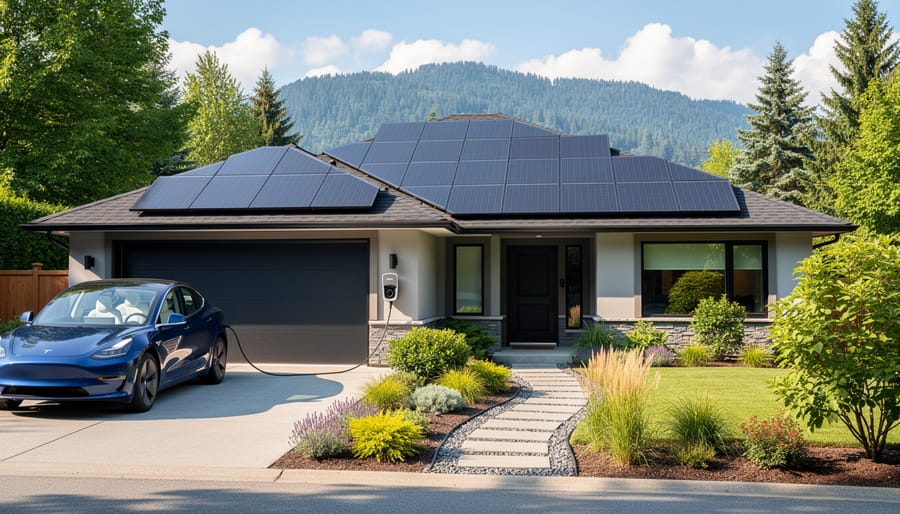
When you consider the complete picture—from silicon extraction through decades of clean energy production to responsible recycling—solar panels in British Columbia deliver remarkable environmental value. Yes, manufacturing requires energy and resources, and end-of-life management demands thoughtful planning. But the evidence is clear: over their 25 to 30-year lifespan, solar panels typically offset their manufacturing carbon footprint within 1 to 4 years, depending on your location and system specifics. In BC, with our abundant sunlight and relatively clean grid, the carbon payback can be even faster.
That means your solar installation could provide two to three decades of genuinely clean energy, preventing tons of carbon emissions while generating electricity for your home or business. Real BC households are already experiencing this benefit, reducing their carbon footprint while enjoying energy independence and lower utility bills.
The solar industry continues advancing too. Manufacturers are improving efficiency, reducing material waste, and developing better recycling technologies. By choosing solar today, you’re supporting an industry that’s becoming cleaner with every innovation.
Ready to discover your own solar potential? Understanding the lifecycle is just the first step. Now it’s time to calculate your specific savings and environmental impact. Connect with certified solar installers in your area who can assess your property, explain available incentives, and design a system tailored to your needs. Your investment in solar today means decades of clean energy tomorrow—for your household and for British Columbia’s sustainable future.