
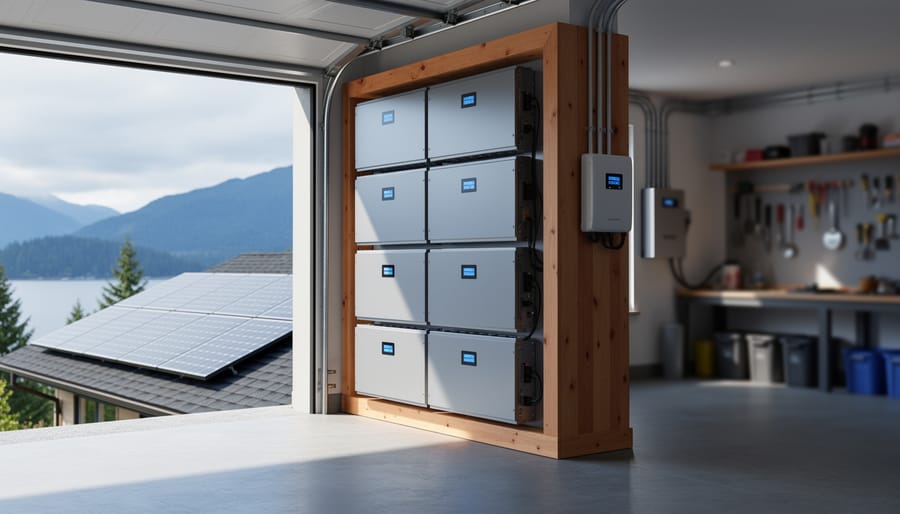
Electric vehicle batteries don’t die when they leave the road—they begin a second career storing renewable energy. As EV adoption in BC accelerates, thousands of batteries will soon reach the point where they retain 70-80% capacity, no longer optimal for vehicles but perfectly suited for stationary energy storage. These second-life batteries offer BC residents and businesses an affordable pathway to pair solar systems with storage, reducing both costs and environmental impact.
The concept is straightforward: retired EV batteries get tested, reconditioned, and repurposed into energy storage units for homes, businesses, and community solar projects. A battery pack that once powered a Nissan Leaf can now store solar energy generated during the day for use during evening peak hours, cutting grid dependence and electricity costs. In BC’s context, where hydroelectric power already provides a clean baseline, second-life batteries maximize the value of rooftop solar installations by addressing the intermittency challenge.
This circular approach extends battery lifespan by 10-15 years before recycling becomes necessary, dramatically improving the environmental return on the energy and materials invested in manufacturing. For BC’s cleantech sector, second-life batteries represent both an economic opportunity and a practical solution to making renewable energy storage accessible to more households and small businesses. The technology isn’t experimental—it’s happening now, with local projects demonstrating real-world viability across the province.
What Exactly Is a Second-Life Battery?
The Journey From Road to Storage
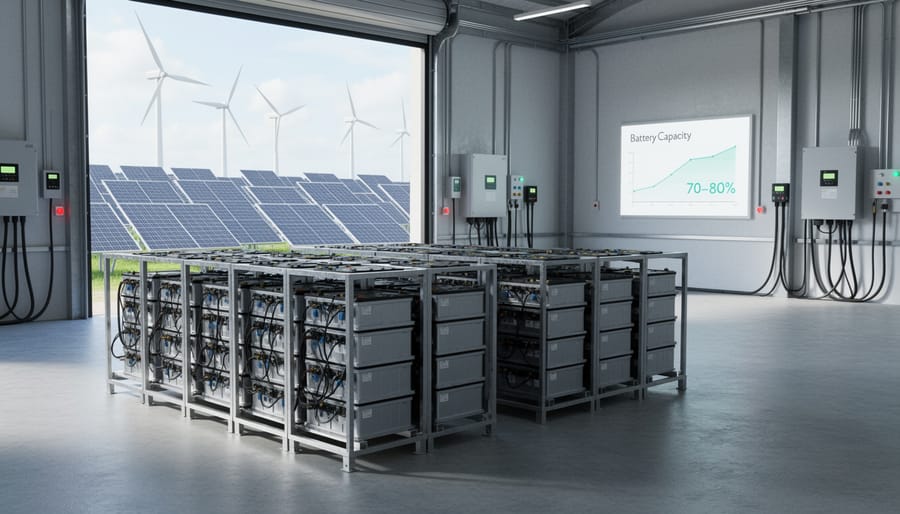
When an electric vehicle battery drops below 70-80% of its original capacity, it’s typically retired from automotive use. However, this doesn’t mean the battery is useless. In fact, most of these batteries retain enough capacity to serve effectively in less demanding applications for many more years.
The transition begins with careful evaluation. Once removed from the vehicle, each battery undergoes comprehensive testing to assess its remaining capacity, charge-discharge performance, and overall health. Technicians examine individual cell modules to identify any damaged components and determine if the battery pack is suitable for second-life use.
During the refurbishment phase, damaged or degraded cells are replaced or repaired. The battery management system may be updated or reconfigured for its new application. This process ensures the battery meets safety standards and performance requirements for stationary energy storage.
The repurposing step involves adapting the battery for its new role. Unlike the high-power demands of accelerating a vehicle, second-life applications like home energy storage or backup power systems require steady, consistent energy delivery. This makes retired EV batteries ideal candidates for storing solar energy, providing emergency power during outages, or helping businesses manage peak electricity demand.
In British Columbia, several facilities now specialize in this transformation process. The Moment Energy facility in Coquitlam, for example, has successfully repurposed hundreds of EV batteries into energy storage systems for local businesses and institutions. These refurbished batteries typically cost 30-50% less than new storage systems while delivering reliable performance for another decade or more, making sustainable energy storage more accessible to BC communities.
Why BC Is Perfect for Second-Life Battery Projects
Local Success Story: Second-Life Batteries in Action
Right here in British Columbia, second-life batteries are already proving their worth beyond the test lab. At the Revelstoke Community Energy Corporation, retired Nissan LEAF batteries now store solar energy for a local housing complex, providing backup power during outages and reducing strain on the grid during peak demand hours.
The project, launched in partnership with BC Hydro and local installers, took 24 EV batteries that still retained 70-80% of their original capacity and combined them into a 500-kilowatt-hour storage system. For residents, the impact has been tangible: lower electricity bills during peak rate periods and uninterrupted power during the winter storms that occasionally affect the Columbia Valley region.
“We were skeptical at first,” admits housing cooperative member James Chen. “But these batteries have been running smoothly for two years now, and we’ve cut our energy costs by 23%. It’s reassuring to know we’re using resources that would otherwise sit in a warehouse or worse.”
The project demonstrates what’s possible when communities embrace circular economy principles. The installation cost roughly 40% less than purchasing new battery storage systems, making renewable energy storage accessible to a mid-sized housing cooperative that couldn’t have afforded premium options.
Similar initiatives are emerging across BC. The District of Squamish recently completed a feasibility study for using second-life batteries at their municipal facilities, while several Vancouver Island farms are piloting systems that pair solar panels with repurposed EV batteries to power irrigation equipment and reduce diesel generator dependence.
These success stories share common threads: committed community partners, technical support from experienced installers, and recognition that sustainability doesn’t always require brand-new solutions. They’re proving that second-life batteries aren’t just theoretical concepts but practical tools for BC communities ready to take control of their energy future.
How Second-Life Batteries Work With Solar Energy
Cost Savings Compared to New Battery Systems
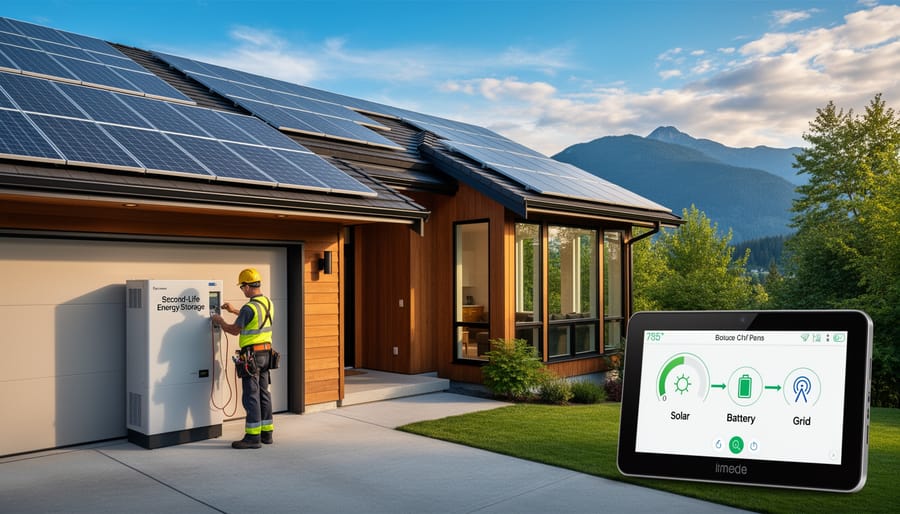
Choosing second-life batteries for energy storage delivers substantial financial advantages compared to purchasing new battery systems. In British Columbia, residential second-life battery installations typically cost 30-50% less than equivalent new systems, with average savings ranging from $3,000 to $8,000 depending on capacity and configuration.
For a typical BC home pairing solar panels with battery storage, the purchase price difference means a second-life system might cost $7,000 compared to $12,000 for a new equivalent. This lower upfront investment significantly improves return on investment timelines. While new battery systems in BC generally achieve payback in 8-12 years through energy savings and reduced grid dependence, second-life batteries can reach payback in 5-8 years.
Total cost of ownership calculations reveal additional benefits. Although second-life batteries may have slightly shorter warranties (typically 5-8 years versus 10 years for new systems), their lower initial cost often results in better overall value. A Vancouver Island community centre recently shared that their second-life battery installation saved them $5,500 upfront while meeting all their backup power requirements during outages.
For businesses, the economics become even more compelling at scale. A Kelowna warehouse using second-life batteries for demand charge management reported 40% lower capital costs compared to new systems, with full cost recovery projected within six years through peak shaving savings. These real-world examples demonstrate how second-life batteries make sustainable energy solutions financially accessible to more BC residents and organizations.
The Environmental Impact That Actually Matters
When you choose second-life batteries, you’re making a decision that ripples through our entire environmental system in BC and beyond. The numbers tell a powerful story about resource conservation and climate action.
Consider this: manufacturing a new lithium-ion battery requires extracting approximately 250 tons of raw materials, including lithium, cobalt, and nickel. By giving EV batteries a second career in energy storage, we dramatically reduce the demand for new mining operations. This matters particularly in BC, where we’re already seeing the environmental pressures of resource extraction in our own backyard.
The carbon footprint difference is equally impressive. Producing a new battery pack generates roughly 75 kilograms of CO2 per kilowatt-hour of capacity. Second-life batteries, having already absorbed this initial carbon cost during their first use, enter their second application with a fraction of the environmental burden. When BC businesses like those in Vancouver and Victoria integrate these batteries into their solar storage systems, they’re building on an existing investment rather than creating new environmental debt.
Think of it like this: if a typical EV battery serves 8-10 years on the road and then another 10-15 years in stationary storage, we’re extending the useful life of those carefully extracted materials by up to 250%. That’s similar to buying a durable raincoat that lasts 25 years instead of replacing a cheaper one every few years—except the environmental stakes are much higher.
For BC specifically, this aligns perfectly with our CleanBC goals and our province’s commitment to a circular economy. Every second-life battery installed in a home or business represents approximately 2-3 tons of mining waste avoided and keeps valuable materials in productive use rather than heading to landfills prematurely.
The waste reduction angle is straightforward: batteries that would otherwise require expensive recycling processes or specialized disposal continue serving a useful purpose, delaying or even eliminating the need for energy-intensive breakdown and reprocessing.
What Happens After the Second Life Ends?
Even after serving a valuable second life in energy storage applications, these batteries don’t end up in landfills. British Columbia has established robust systems to ensure responsible end-of-life management, making second-life battery use even more sustainable.
When a battery can no longer hold sufficient charge for energy storage, it enters the recycling phase. BC’s Extended Producer Responsibility (EPR) program requires battery manufacturers and importers to manage their products through end-of-life, funding collection and recycling infrastructure across the province. This means residents and businesses have access to free battery recycling at designated depots throughout BC.
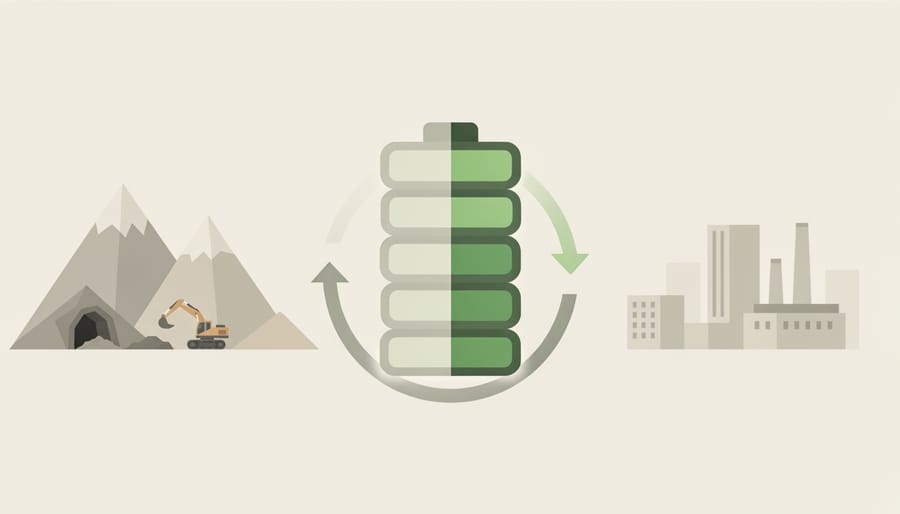
The recycling process recovers valuable materials including lithium, cobalt, nickel, and manganese. These recovered materials can be used to manufacture new batteries, reducing the need for mining virgin resources. Advanced recycling facilities can now recover up to 95% of battery materials, creating a circular economy that minimizes environmental impact.
Here’s where second-life use creates an important advantage: batteries that serve 10-15 additional years in stationary storage delay the energy-intensive recycling process while providing continued value. This extended lifespan improves the overall environmental footprint and makes the economics of recycling more favorable. By the time these batteries reach recycling facilities, improved technologies and larger recycling volumes often make material recovery more efficient and cost-effective.
BC is home to several recycling initiatives, including partnerships with companies like Li-Cycle, which operates North America’s largest lithium-ion battery recycling facility. Local programs like Call2Recycle maintain collection sites across the province, making responsible disposal convenient for everyone.
By choosing second-life batteries, you’re participating in a complete sustainability cycle, ensuring these valuable resources continue contributing to BC’s clean energy future from first use through final recycling.
Is a Second-Life Battery Right for Your Home or Business?
Questions to Ask Before You Buy
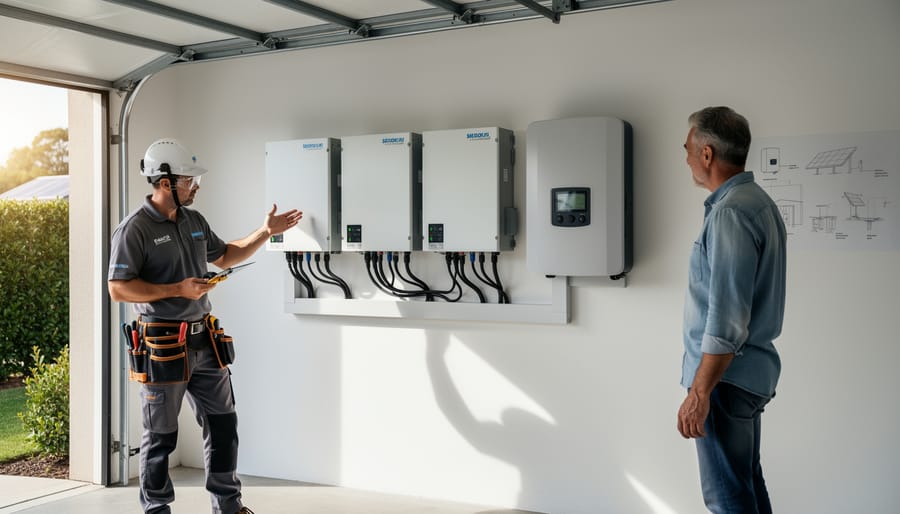
Before investing in a second-life battery system, arm yourself with the right questions to ensure you’re making a smart, safe choice. Start by asking about warranty coverage: What’s included, and for how long? Reputable suppliers should offer clear warranties that cover both performance and safety.
Inquire about capacity guarantees. Second-life batteries typically retain 70-80% of their original capacity, but get specific numbers for your unit. Ask how this translates to real-world performance for your intended application, whether that’s solar energy storage or backup power.
Safety certifications are non-negotiable. Request documentation showing the battery has been properly tested and certified for its second-life use. In BC’s climate, ask specifically about performance in varying temperatures and moisture conditions.
Compatibility matters significantly. Will the battery integrate smoothly with your existing solar system or electrical setup? Request a technical assessment before purchasing, and confirm that local installers are familiar with the specific battery model.
Finally, ask about end-of-life disposal. A truly sustainable solution includes responsible recycling options when the battery reaches its final stage. Understanding the complete lifecycle helps you make an environmentally sound decision that aligns with BC’s sustainability values while protecting your investment.
Second-life batteries represent more than just a smart recycling solution—they’re a practical bridge connecting British Columbia’s electric vehicle revolution with our growing renewable energy needs. As our province continues leading Canada in EV adoption, we have a unique opportunity to transform retired vehicle batteries into valuable energy storage assets that support solar installations, stabilize the grid, and reduce environmental impact.
Every BC resident and business can participate in this circular economy. Whether you’re considering solar panels for your home, managing a commercial property, or simply making informed choices about battery disposal, your decisions contribute to a more sustainable energy future. The infrastructure is developing rapidly across the province, with local programs and companies already implementing second-life battery solutions.
Ready to explore how second-life batteries could work for your renewable energy project? Start by contacting local solar installers who offer battery storage consultations, research BC Hydro’s energy storage programs, or connect with provincial recycling initiatives to learn about proper battery disposal. The transition to circular energy systems begins with informed community members taking that first step. Together, we’re not just powering homes—we’re building a resilient, sustainable energy ecosystem for generations to come.