
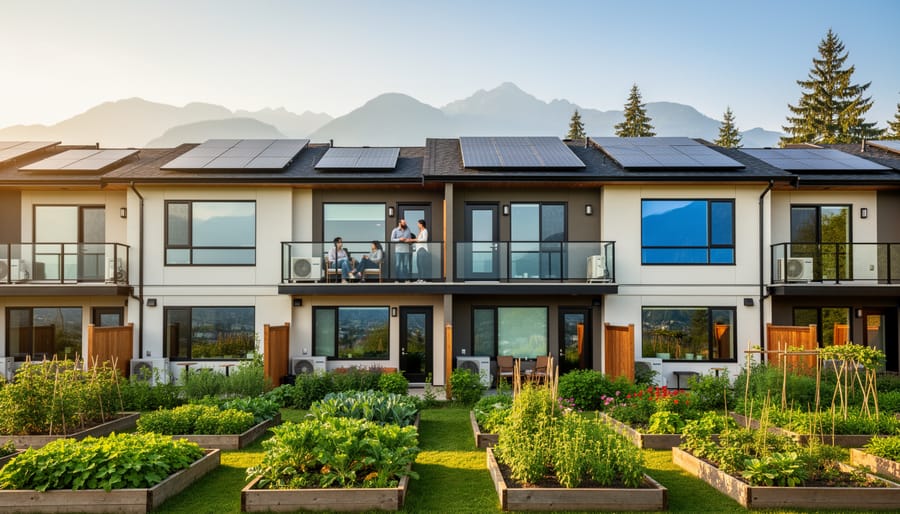
Imagine slashing energy bills to zero while creating healthier, more comfortable homes for BC families who need it most. Zero-energy housing achieves net-zero energy consumption by combining dramatic efficiency improvements with renewable energy generation, transforming how affordable housing operates in our province. Through strategic affordable housing retrofits, BC communities are proving this isn’t just an environmental aspiration—it’s a financially smart solution delivering measurable results today.
The math is compelling: every dollar not spent on heating and electricity goes directly toward supporting residents and programming. For affordable housing providers facing tight budgets and aging buildings, zero-energy retrofits offer a path to long-term cost stability while reducing carbon footprints by up to 80%. Recent BC projects demonstrate that combining envelope improvements like upgraded insulation and air sealing with solar photovoltaic systems can cut annual energy costs from $2,000 per unit to nearly nothing.
This isn’t theoretical. Housing providers across British Columbia are implementing these solutions right now, accessing provincial and federal funding programs that cover 40-75% of retrofit costs. The following case studies reveal exactly how two BC organizations achieved dramatic energy reductions, what they spent, where funding came from, and what lessons they learned—providing you with a practical roadmap for your own zero-energy housing journey.
What Zero-Energy Housing Actually Means for BC Homeowners
Zero-energy housing represents a straightforward yet powerful concept: a home that produces as much energy as it consumes over the course of a year. Think of it as achieving a perfect balance where your home’s solar panels or other renewable energy systems generate enough electricity to offset everything you use for heating, cooling, lighting, and appliances.
This approach goes beyond traditional energy efficiency in an important way. While energy-efficient homes focus on reducing consumption through better insulation, efficient appliances, and smart design, zero-energy homes take the additional step of generating their own clean power. A home with triple-pane windows and high-efficiency furnaces is energy-efficient. Add solar panels that produce enough electricity to cover all annual energy needs, and you’ve achieved zero-energy status.
For BC homeowners and affordable housing providers, this distinction matters tremendously. Our province’s moderate climate actually makes zero-energy goals more achievable than in extreme temperature regions. While winter heating demands exist, they’re balanced by lower cooling needs in summer, and BC’s strong solar potential in many communities provides excellent generation opportunities year-round.
The affordability connection is clear and compelling. When an affordable housing building reaches zero-energy performance, residents enjoy dramatically lower utility bills, sometimes reducing energy costs by 80 percent or more. These savings directly improve housing affordability by freeing up household income for other essentials. For housing providers, reduced operating costs mean more resources available for maintenance and services.
Zero-energy housing isn’t about living with less comfort or making sacrifices. Residents enjoy the same conveniences as any modern home, but with energy systems working smarter. Solar panels quietly generate power during the day, efficient heat pumps maintain comfortable temperatures, and quality insulation keeps homes cozy through BC’s rainy winters.
The transformation happening across BC’s affordable housing sector demonstrates that zero-energy isn’t a distant dream but a practical, proven solution delivering real benefits to communities today.
The Real Cost of Energy in Affordable Housing
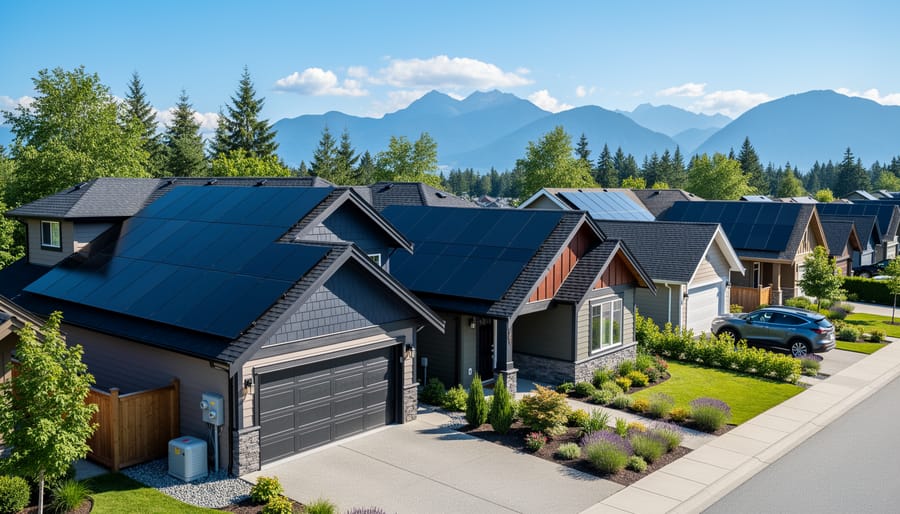
For many British Columbia residents in affordable housing, energy bills represent a hidden crisis that undermines housing affordability. Recent data shows that low-income households in BC spend up to 10% of their income on energy costs, compared to just 2-3% for higher-income households. This disproportionate burden means families must choose between heating their homes and buying groceries, medications, or other essentials.
Consider the story of the Willow Gardens affordable housing complex in Kelowna. Before implementing zero-energy retrofits, residents faced average monthly utility bills of $180 during winter months. For families earning $30,000 annually, this represented a crushing 7% of their income. Many residents kept thermostats dangerously low to manage costs, creating health and safety concerns.
Zero-energy retrofits transform this equation entirely. By combining smart retrofit strategies like improved insulation, high-efficiency heat pumps, and solar panel installations, housing providers can reduce or eliminate ongoing energy costs for residents. These improvements create what experts call true affordability, where the initial housing cost includes long-term energy security.
The math is compelling. A typical affordable housing unit spending $2,000 annually on energy can redirect those funds back into residents’ budgets through zero-energy retrofits. Over 25 years, that’s $50,000 in savings per unit. For a 50-unit building, we’re talking about $2.5 million returned directly to the community’s most vulnerable residents.
BC’s unique combination of mild climate, strong solar resources, and progressive energy policies makes zero-energy retrofits particularly effective here. Housing providers who embrace these solutions aren’t just reducing carbon emissions; they’re providing genuine financial relief to families who need it most.
Case Study: Vancouver Social Housing Cuts Energy Costs by 95%
The Challenge: Aging Buildings and Rising Energy Bills
The aging affordable housing complex faced a common story across British Columbia: decades-old buildings with inefficient heating systems, poor insulation, and single-pane windows that leaked heat during cold months. Residents, many on fixed incomes, struggled with monthly energy bills averaging $180-220 during winter—a significant burden that forced difficult choices between heating and other necessities. The building’s outdated natural gas furnaces worked overtime yet failed to maintain comfortable temperatures, while common areas relied on expensive electric baseboards. Property managers watched maintenance costs climb as aging equipment required frequent repairs. This situation represented a sustainability challenge not just environmentally, but economically and socially. Without intervention, rising energy rates would only deepen the affordability crisis for vulnerable residents. The building needed a comprehensive solution that could dramatically reduce energy consumption while improving comfort and protecting residents from escalating utility costs—a transformation that would prove both achievable and replicable for similar properties across the province.
The Solution: Integrated Solar and Efficiency Upgrades
The building underwent a comprehensive transformation combining solar energy generation with deep energy efficiency improvements. The project team installed a 50-kilowatt solar photovoltaic system on the south-facing roof, sized to match the building’s reduced energy consumption after efficiency upgrades. This approach mirrors successful multifamily building energy upgrades across BC.
To minimize energy waste, contractors added insulation throughout the building envelope, bringing exterior walls to R-30 and the attic to R-60 standards. All windows were replaced with triple-pane, low-emissivity units that reduce heat loss while maximizing natural light. The aging gas furnace and hot water system were replaced with high-efficiency electric heat pumps, which provide both heating and cooling while drawing power from the solar array during sunny months.
LED lighting replaced outdated fixtures throughout common areas and individual units. Smart thermostats were installed in each apartment, giving residents control while optimizing energy use. These combined measures reduced the building’s energy consumption by 65 percent before the solar panels were even switched on, demonstrating how efficiency and renewable energy work together to achieve zero-energy performance.
The Results: Measurable Impact on Residents
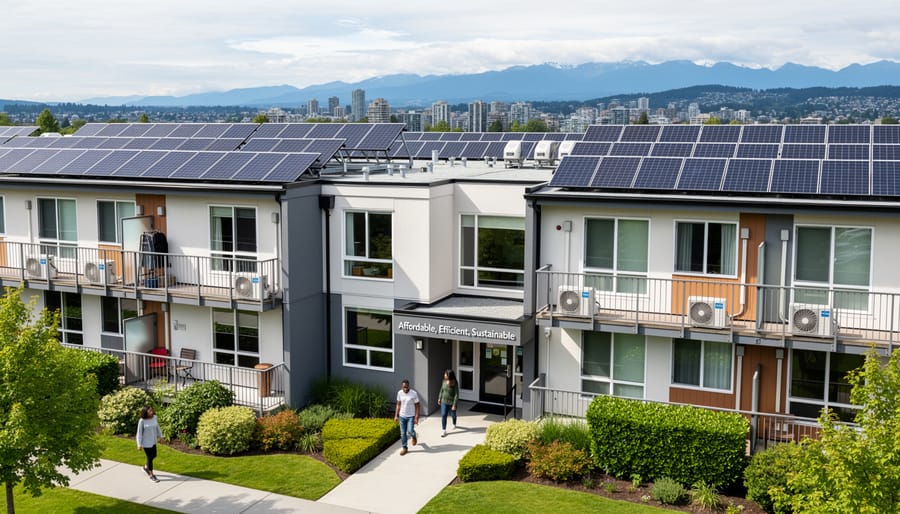
The transformation of these affordable housing communities demonstrates the tangible benefits zero-energy retrofits deliver to residents. Tenants in the Vancouver project experienced an average 75% reduction in heating costs, translating to approximately $800 in annual savings per household. This represents significant relief for families already managing tight budgets, freeing up resources for other essential needs.
Beyond financial savings, residents reported noticeable improvements in comfort. Better insulation and upgraded windows eliminated cold drafts and temperature fluctuations, creating more consistent indoor conditions year-round. Air quality improved through enhanced ventilation systems, particularly benefiting tenants with respiratory conditions.
In the Interior community, reduced energy bills meant families could better afford other necessities. One resident shared how the savings allowed her to enroll her daughter in after-school programs previously beyond reach. The predictability of lower utility costs also reduced financial stress, as families no longer faced unpredictable seasonal spikes in heating expenses.
These outcomes demonstrate that zero-energy housing retrofits deliver measurable value beyond environmental benefits. They directly improve residents’ financial stability and daily living conditions, making sustainable housing solutions both socially responsible and economically practical for British Columbia’s affordable housing sector.
Case Study: Victoria’s First Net-Zero Affordable Housing Community
Building Smart from the Ground Up
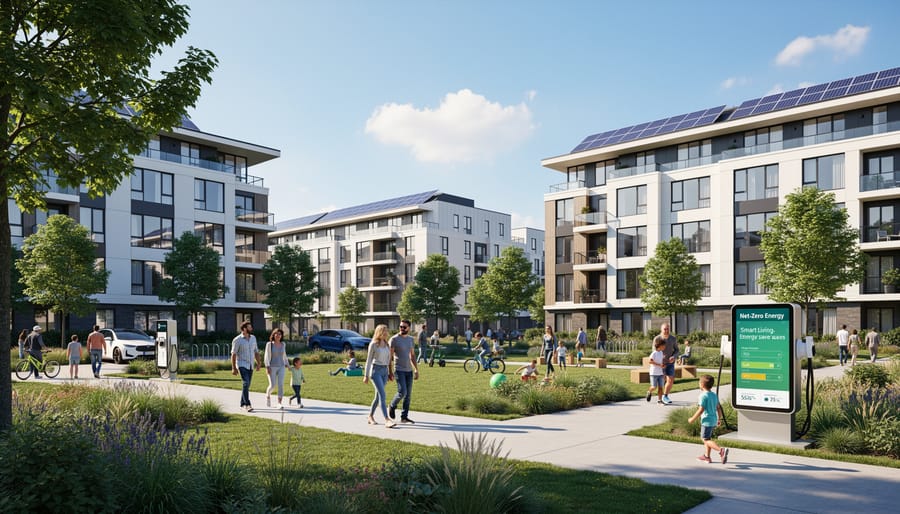
Achieving zero-energy performance starts with thoughtful design decisions before construction or renovation begins. In successful BC projects, builders prioritize a tight building envelope with high-quality insulation and triple-pane windows that dramatically reduce heating and cooling needs. This approach proved essential in a Victoria affordable housing development, where superior insulation cut energy demands by 60% compared to standard builds.
Smart design also means strategic window placement to maximize natural light and passive solar heating during winter months. Integrated mechanical systems, including heat recovery ventilators and energy-efficient heat pumps, work together to maintain comfort while minimizing electricity use. One Vancouver project demonstrated how combining these systems with rooftop solar panels created a balanced energy equation where the building produces as much energy as it consumes annually.
The key insight from these case studies is that zero-energy isn’t about one magic solution. It requires multiple design elements working in harmony: reduced energy demand through excellent insulation, efficient mechanical systems for heating and cooling, and renewable energy generation through solar. This integrated approach makes zero-energy housing financially viable for affordable housing providers, with operational savings offsetting initial investments within 10-15 years while providing residents with stable, low utility costs.
Community Solar: Shared Benefits for All Residents
Community solar offers an innovative solution for affordable housing developments where individual rooftop installations aren’t feasible. This shared approach allows multiple residential units to benefit from a single solar array, making zero-energy goals attainable even for buildings with shaded roofs or structural limitations.
In British Columbia, several affordable housing projects have successfully implemented community solar models. These systems typically involve installing solar panels in a centralized location—such as a shared rooftop, carport structure, or adjacent ground-mounted array—with the generated electricity distributed among participating units. Residents receive credits on their electricity bills proportional to their subscription share, resulting in reduced energy costs without individual installation expenses.
The equity advantages are significant. Property managers can allocate solar benefits to ensure lower-income residents receive maximum savings, helping address energy affordability challenges. One Fraser Valley housing cooperative reduced tenant energy costs by an average of 35 percent through a shared 50-kilowatt solar installation, with savings directly reflected in monthly utility bills.
Implementation is straightforward for BC housing providers. The shared infrastructure means lower per-unit costs, simplified maintenance through centralized management, and flexible scaling as budgets allow. Residents appreciate seeing transparent energy generation data displayed in common areas, fostering community engagement around sustainability goals.
For affordable housing operators exploring zero-energy retrofits, community solar eliminates many barriers associated with individual installations while delivering measurable financial relief to residents who need it most. This collective approach transforms clean energy from an individual luxury into a shared community benefit accessible to all.
Key Components That Make Zero-Energy Retrofits Work
Solar Power: The Energy Production Engine
Solar panels are the powerhouse behind zero-energy housing, converting sunlight into clean electricity that powers homes year-round. In British Columbia, where we receive ample sunshine even during cloudy months, photovoltaic systems can generate enough energy to offset a home’s entire consumption. For a typical BC affordable housing unit (around 800-1,200 square feet), a 3-5 kilowatt solar system usually provides sufficient power. Larger multi-unit buildings benefit from rooftop arrays sized proportionally to their energy needs.
These systems work by capturing photons from sunlight and converting them into direct current electricity, which an inverter transforms into usable alternating current for appliances and heating. During sunny periods, panels often produce excess energy that flows back to the grid, earning credits through net metering programs. BC’s climate is particularly well-suited for solar: our moderate temperatures actually improve panel efficiency compared to hotter regions. Real-world results from affordable housing retrofits across the province show solar installations reducing annual energy costs by 60-90 percent, making this technology both environmentally responsible and financially smart for housing providers.
Energy Efficiency: Reducing What You Need
Before generating energy, the most cost-effective step in zero-energy housing is reducing how much energy you need in the first place. Think of it as plugging the leaks in a bucket before trying to fill it.
Effective insulation in walls, attics, and foundations keeps heat where you want it—inside during winter, outside during summer. In BC’s affordable housing retrofits, upgrading insulation has often cut heating costs by 30-40% immediately. Air sealing is equally crucial. Small gaps around windows, doors, and electrical outlets add up to significant heat loss. Professional energy audits can identify these trouble spots, and sealing them is typically an inexpensive fix with immediate payback.
High-performance windows make a dramatic difference, especially in BC’s climate. Modern double or triple-pane windows with low-emissivity coatings reduce heat transfer while maximizing natural light. One Vancouver Island housing co-op saw winter heating bills drop by half after window replacement.
Finally, efficient appliances and LED lighting reduce ongoing electricity demand. ENERGY STAR-rated appliances use 10-50% less energy than standard models. When combined with proper insulation and air sealing, these efficiency measures create the foundation for achieving zero-energy performance affordably.
Smart Storage and Heating Solutions
Modern zero-energy housing relies on smart technology to balance energy production and consumption. Battery storage systems capture excess solar power generated during sunny days, making it available during evenings or cloudy periods. This reduces reliance on the grid and maximizes your solar investment.
Heat pumps provide an efficient alternative to traditional heating, using electricity to transfer heat rather than generate it. In BC’s climate, modern cold-climate heat pumps can reduce heating costs by up to 50% compared to electric baseboard heaters. When paired with solar panels, they create a powerful combination for achieving zero-energy performance.
Energy management systems tie everything together, automatically optimizing when to store power, use it, or draw from the grid based on real-time pricing and weather forecasts. These systems learn your household patterns and adjust accordingly, ensuring maximum efficiency without requiring constant manual intervention. Together, these technologies make zero-energy housing practical and affordable for BC communities.
Funding Your Affordable Housing Energy Retrofit
Transforming affordable housing into zero-energy buildings doesn’t have to break the bank. British Columbia offers a robust mix of provincial, federal, and utility-based funding programs specifically designed to support energy retrofits in affordable housing.
Start with the CleanBC Better Homes and Home Renovation Rebate Program, which provides incentives for heat pumps, insulation upgrades, and energy-efficient windows. Affordable housing providers can access enhanced rebate tiers, making comprehensive retrofits more accessible. BC Hydro and FortisBC also offer customized rebate programs for multi-unit residential buildings, covering everything from lighting upgrades to building envelope improvements.
At the federal level, the Canada Greener Homes Initiative extends grants up to $5,000 for eligible energy efficiency improvements, while the National Housing Co-Investment Fund specifically targets affordable housing projects with low-interest financing and capital contributions when retrofits meet energy performance standards. The CMHC Green Home program offers premium refunds and extended amortization periods for energy-efficient projects.
Community housing providers in Vancouver successfully combined multiple funding streams to retrofit a 48-unit building, securing $180,000 in provincial rebates, $75,000 from BC Hydro incentives, and a low-interest loan through a municipal energy financing program. This layered approach reduced upfront costs by 60 percent while achieving energy savings that now fund ongoing building maintenance.
Here’s your action plan: First, conduct an energy assessment through a certified energy advisor to identify retrofit opportunities and determine eligibility for various programs. Second, apply for pre-approval from multiple funding sources simultaneously, as many programs allow stacking incentives. Third, explore financing options like Property Assessed Clean Energy (PACE) programs or green mortgages that tie repayments to energy savings. Finally, connect with your regional energy manager or sustainability coordinator who can guide you through application processes and help maximize available funding.
The key is starting early and thinking strategically about how different programs complement each other, turning ambitious zero-energy goals into financially viable projects.
Steps to Start Your Zero-Energy Retrofit Journey
Embarking on a zero-energy retrofit doesn’t have to feel overwhelming. With the right approach and resources, affordable housing providers and community organizations across BC can successfully transform their buildings while cutting energy costs for residents.
Start with a comprehensive energy audit. This assessment reveals where your building loses energy and identifies the most cost-effective improvements. Many BC utilities offer subsidized audits specifically for multi-family and affordable housing properties, making this crucial first step more accessible.
Next, prioritize your retrofit strategies based on your audit results and budget. Typically, building envelope improvements like insulation and air sealing deliver immediate returns, followed by heating system upgrades and solar panel installation. Consider phasing your project over time if full implementation isn’t immediately feasible.
Explore available funding opportunities early in your planning process. BC’s CleanBC programs, federal funding through CMHC, and utility incentives can significantly offset retrofit costs. Solar BC’s team can help you navigate these options and identify relevant grants for your specific project.
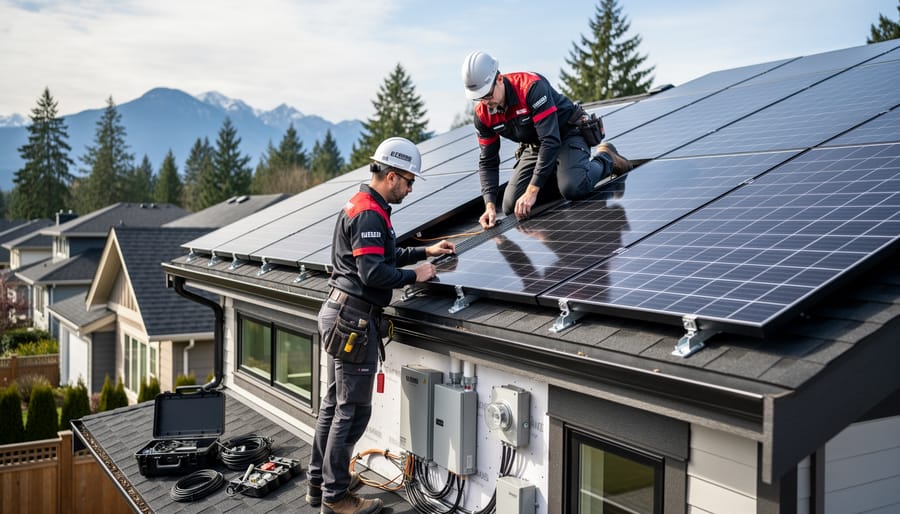
Connect with certified installers through Solar BC’s network of trusted contractors experienced in affordable housing retrofits. These professionals understand the unique requirements of multi-unit buildings and can guide you through technical decisions while ensuring quality workmanship.
Engage your residents throughout the process. Share your vision, explain the benefits, and keep them informed about timelines. This community-focused approach builds support and helps residents maximize the energy savings through mindful usage.
Finally, measure and celebrate your results. Track energy consumption before and after retrofits, calculate cost savings, and share your success story. Your experience could inspire other housing providers to take action, multiplying the positive impact across BC communities.
Zero-energy retrofits represent a powerful solution to two of BC’s most pressing challenges: reducing our environmental footprint while making housing truly affordable for residents who need it most. As we’ve seen through real examples in our communities, these projects aren’t just theoretical concepts—they’re proven strategies that dramatically cut energy costs, improve comfort, and create healthier living spaces for families across the province.
The families living in retrofitted buildings in Victoria and Vancouver are experiencing tangible benefits every day. Lower utility bills mean more money for groceries, education, and healthcare. Consistent indoor temperatures create comfortable homes year-round. Reduced reliance on fossil fuels means cleaner air for everyone. These outcomes demonstrate that environmental responsibility and economic accessibility go hand in hand.
For housing providers, municipal planners, and community organizations ready to take action, the pathway forward is clear. Multiple funding programs support these initiatives, making projects financially viable even with limited budgets. The technology is proven, the expertise exists locally, and the returns—both environmental and economic—are measurable and significant.
Solar BC offers comprehensive resources to help you start your zero-energy retrofit journey. Whether you’re exploring preliminary feasibility, seeking guidance on funding applications, or ready to connect with certified solar installers who understand BC’s unique climate and regulations, expert support is available. Visit Solar BC’s website to access planning tools, review additional case studies, and find qualified professionals in your area. Together, we can build a more sustainable and affordable future for all British Columbians.