
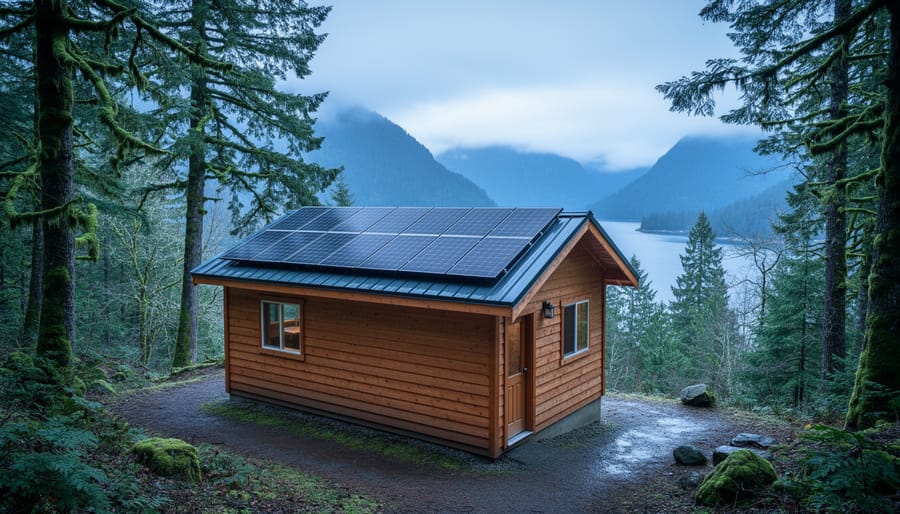
Evaluate your property’s solar potential by calculating your daily electricity consumption in kilowatt-hours, then multiply by 1.5 to account for British Columbia’s winter months when solar production drops by up to 60%. This baseline determines your minimum battery storage needs and panel array size.
Examine successful BC installations matching your location’s climate zone. A Sunshine Coast cabin running entirely off-grid uses a 5kW system with 20kWh battery storage, costing $28,000 installed, while a similar Gulf Islands setup required 30% more capacity due to increased winter cloud cover. These real-world examples reveal how microclimates dramatically affect system specifications and budgets.
Calculate total costs beyond equipment: expect $15,000-$45,000 for complete residential systems in BC, including panels, inverters, batteries, installation, and permits. Battery banks represent 40-50% of this investment but determine whether you’ll have power during week-long winter storms. Factor in replacement costs every 10-15 years for batteries versus 25-30 years for panels.
Assess your energy independence goals honestly. Off-grid solar eliminates monthly utility bills but requires lifestyle adjustments like running high-draw appliances during peak sun hours and maintaining backup generators for extended cloudy periods. BC’s certified solar installers provide site assessments showing whether your location receives sufficient annual sunlight, typically 1,200-1,800 hours depending on regional weather patterns.
Connect with local off-grid communities through BC Sustainable Energy Association meetings where homeowners share operational costs, maintenance schedules, and seasonal performance data specific to your region’s conditions.
What Off-Grid Solar Actually Means in BC
The Real Difference Between Off-Grid and Grid-Tied
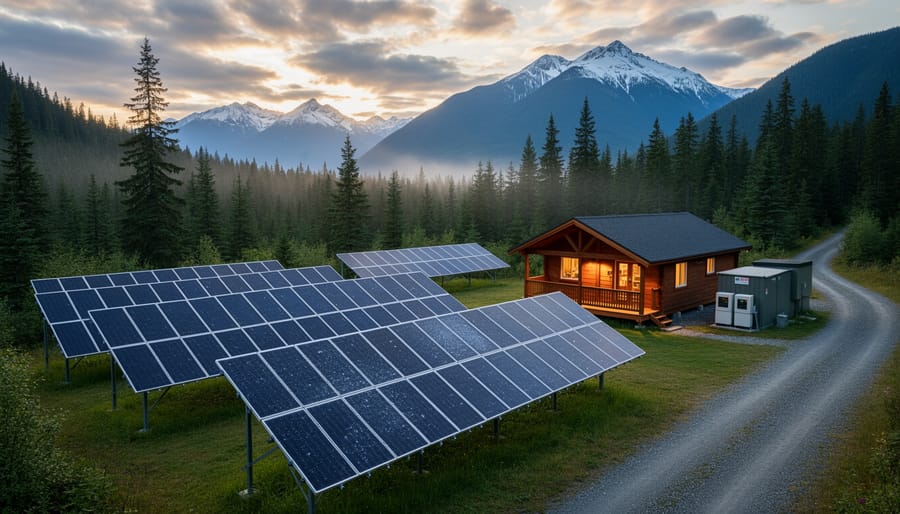
The key difference comes down to connection and commitment. Grid-tied systems remain connected to BC Hydro’s electrical grid, allowing you to draw power when your panels aren’t producing enough and send excess energy back to the grid through net metering programs. Think of it as having a safety net—you generate clean energy but still have reliable backup.
Off-grid systems operate completely independently from the utility grid. You’re responsible for generating and storing all the electricity you need, typically using battery banks. This means carefully managing your energy consumption, especially during BC’s darker winter months when solar production drops significantly.
The Johnsons, a family near Sechelt, went fully off-grid after realizing their remote property would cost $45,000 just to connect to the grid. While they love their energy independence, they’ve learned to be mindful about running high-power appliances simultaneously and have a backup generator for extended cloudy periods.
Grid-tied systems offer easier installation, lower upfront costs, and fewer maintenance demands. Off-grid living requires greater commitment, larger battery investments, and active energy management. For most BC residents with grid access, staying connected while maximizing solar production provides the best balance of sustainability and reliability.
Why BC’s Climate Works Better Than You Think
Yes, it rains in BC—but that doesn’t mean solar won’t work for you. While BC’s rainy climate often raises doubts, the province actually receives more annual sunshine than many assume, especially during peak summer months when days are long and solar production is highest.
Modern off-grid systems are specifically designed to handle seasonal variations. During sunny months, your panels generate surplus energy that gets stored in battery banks, compensating for cloudier periods. Even on overcast days, solar panels still produce energy—just at reduced capacity. Many BC homeowners are surprised to learn their systems perform well year-round with proper sizing and battery storage.
The key is matching your system to local conditions. A qualified installer will account for BC’s seasonal patterns, ensuring your battery capacity can bridge those grey winter weeks. Real-world data from existing off-grid homes across the province consistently shows that well-designed systems meet energy needs throughout the year, rain or shine.
The Four Essential Components of Your Off-Grid System
Solar Panels: Sizing for BC’s Reality
Determining your solar panel needs in BC requires honest assessment of your location and energy patterns. Coastal regions like Vancouver Island face different challenges than interior areas such as the Okanagan. Coastal systems need approximately 30-40% more panel capacity to compensate for cloudier winters, while interior locations benefit from clearer skies but colder temperatures.
Start by calculating your daily energy consumption in kilowatt-hours. A typical BC household uses 20-30 kWh daily, but off-grid living often reduces this to 10-15 kWh through efficiency improvements. Next, consider seasonal variations. December through February produces only 15-20% of summer solar output in most BC locations, meaning you’ll need five to six times more panels than summer-only calculations suggest.
Thanks to modern solar technology, panels perform better in low-light conditions than ever before. For a 15 kWh daily need, expect to install 4-6 kW of panels coastally or 3-5 kW in the interior. Factor in a 25% buffer for inefficiencies and cloudy stretches.
Real-world example: A Gabriola Island family installed 5.5 kW of panels for their 12 kWh daily usage, successfully maintaining year-round power with proper battery storage.
Battery Storage: Your Power Bank
Your battery bank determines how long your home stays powered when the sun isn’t shining—crucial during BC’s darker winter months. Think of it as your energy reservoir, storing excess solar production for nighttime use and cloudy periods.
Modern battery storage systems offer two main options. Lithium batteries cost more upfront but last 10-15 years, require no maintenance, and provide deeper discharge capacity. Traditional lead-acid batteries are budget-friendly initially but need replacement every 3-5 years and regular maintenance.
To calculate your capacity needs, multiply your daily energy consumption by your desired days of autonomy. Most BC off-grid systems aim for 3-5 days of backup power to handle winter weather patterns. A typical cabin using 10 kWh daily would need 30-50 kWh of battery capacity for three days of autonomy.
Consider the Sunshine Coast family who sized their system for four days of winter autonomy. Their 40 kWh lithium setup handles November’s grey stretches comfortably, proving that proper planning makes year-round off-grid living practical in BC’s variable climate.
Inverters and Controllers: The Brain of Your System
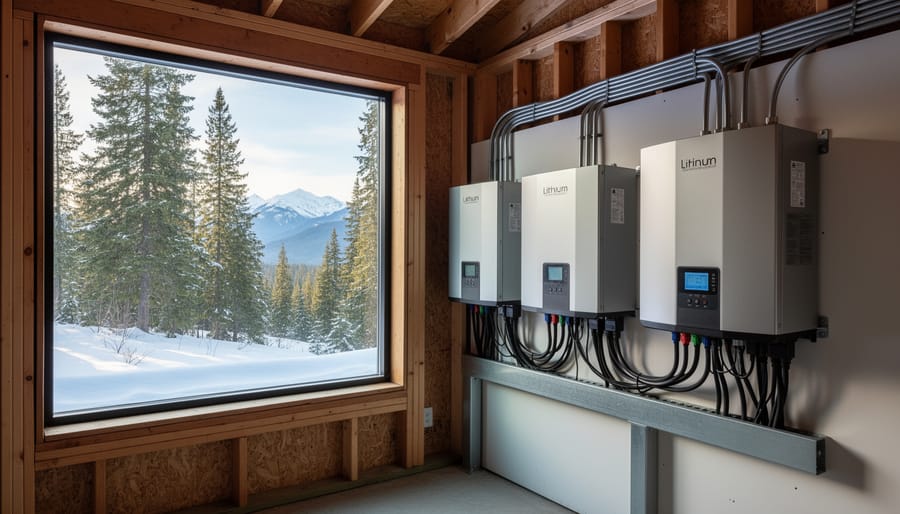
Think of inverters and controllers as your system’s command center. The charge controller manages power flowing from your solar panels to your batteries, preventing overcharging during sunny summer days and optimizing charging during BC’s cloudier winter months. It’s like a traffic cop directing energy where it needs to go. The inverter then converts stored DC power from your batteries into AC power that runs your everyday appliances—from your coffee maker to your well pump. Together, they ensure your system operates efficiently and safely. Modern units include monitoring features that let you track your energy production and usage through simple apps, helping you understand your consumption patterns. For example, a homeowner in the Kootenays uses their controller’s data to time high-energy tasks like laundry for peak sun hours, maximizing their solar investment and extending battery life throughout BC’s varying seasons.
Backup Generators: Your Insurance Policy
BC’s winter months can challenge even well-designed solar systems with shorter days and prolonged cloud cover. That’s why most successful off-grid installations include a backup generator as part of their backup power solutions.
Think of your generator as an insurance policy rather than a primary power source. Most off-grid homes in BC run their generators only 50-100 hours annually, typically during December and January or extended cloudy periods. A properly sized generator should produce 25-40% of your total energy needs while charging batteries efficiently.
For a typical BC cabin using 10 kWh daily, a 5-7 kW generator usually suffices. Propane models work well in cold climates and store indefinitely, while diesel offers better fuel efficiency for larger systems.
Right-sizing matters. An oversized generator wastes fuel running inefficiently, while an undersized unit struggles to charge batteries quickly. Your solar installer can calculate the optimal size based on your battery bank capacity and typical usage patterns, ensuring your backup runs only when truly needed.
Real BC Homes Running on Off-Grid Solar
The Gulf Island Weekend Cabin
Sarah and Tom installed a modest 1.2 kW solar system at their Gulf Islands weekend cabin for approximately $8,500, including four solar panels, a 200Ah lithium battery bank, and a basic inverter. Their system powers LED lighting, a small refrigerator, phone charging, and a laptop during their frequent weekend visits from April through October.
During BC’s sunnier months, their system performs beautifully, often providing more power than needed. However, they learned important lessons about winter limitations. November through February visits require significantly reducing electricity use, and they now rely on propane for cooking and heating during darker months.
The couple recommends starting smaller than you think necessary. “We initially wanted to power everything year-round, but our solar installer suggested a practical seasonal approach that saved us $4,000 upfront,” Tom explains. They also invested in energy-efficient appliances from the start, which proved essential for maximizing their limited power supply.
Their biggest surprise? How quickly they adapted to monitoring their battery levels and adjusting usage accordingly. “It’s become second nature, and we actually enjoy the mindfulness it brings to our cabin experience,” Sarah notes.
Year-Round Living in the Kootenays
The Thompson family lives year-round in their off-grid home near Nelson, proving that full-time off-grid living works even through harsh Kootenay winters. With two adults and three children, they’ve learned to balance comfort with energy awareness.
Their winter strategy centers on smart appliance choices and seasonal adjustments. They use a propane fridge during December through February when solar production drops, switching back to their electric fridge in sunnier months. All lighting runs on LED bulbs, using 75% less energy than traditional options. Their washer operates on sunny afternoons when solar production peaks, and they line-dry clothes indoors during winter.
The family’s 8kW solar array with 48kWh battery storage handles daily needs, but they’ve made practical compromises. A wood stove provides primary heating, dramatically reducing electrical demands. Entertainment choices matter too—the family limits screen time naturally, finding that two hours of evening television fits comfortably within their energy budget.
What surprised them most? How quickly energy-conscious habits became second nature. The children now instinctively turn off lights and check the battery monitor before asking to watch shows. Their monthly propane costs run approximately $150 in winter, while their solar system eliminates electricity bills completely. This real-world balance makes off-grid family life not just possible, but genuinely sustainable.
Remote Northern BC Property
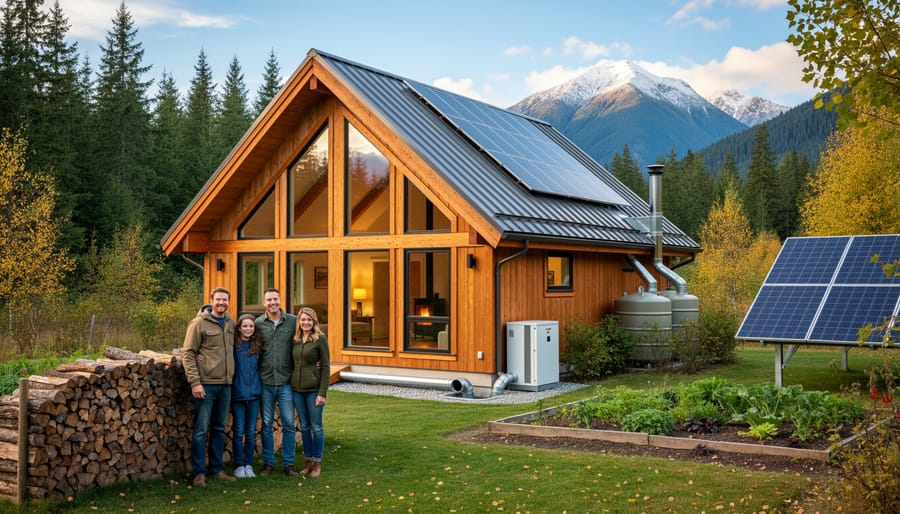
A family living near Fort Nelson faced BC’s most challenging solar conditions: winter days with barely six hours of sunlight and temperatures dropping to -40°C. Their solution required a robust 15kW solar array paired with 48kWh of lithium battery storage and a propane backup generator for the darkest months.
The system cost approximately $85,000 but eliminated monthly power bills that would have exceeded $400. They installed ground-mounted panels at a 60-degree angle to maximize winter sun capture and allow snow to slide off naturally. The family runs their home, a small workshop, and essential farm equipment year-round.
Their biggest lesson? Seasonal energy discipline matters. During November through January, they rely more heavily on their backup generator, using about 100 litres of propane monthly. Come spring and summer, their oversized array produces surplus power, which they use for energy-intensive tasks like running power tools and charging electric vehicles.
This case demonstrates that off-grid living works even in extreme northern conditions when systems are properly sized and expectations align with seasonal realities. Strategic energy use and backup planning make the difference between frustration and energy independence.
What It Actually Costs to Go Off-Grid in BC
Initial Investment: The Real Numbers
Understanding the upfront investment helps you plan realistically for your off-grid journey. Here’s what BC residents can expect to invest based on system size.
Small systems, suitable for a cabin or tiny home using 5-10 kWh daily, typically range from $15,000 to $25,000. This includes basic solar panels, a battery bank for 2-3 days of backup power, charge controller, inverter, and installation. These systems work well for weekend retreats or modest energy needs.
Medium-sized systems designed for year-round family homes consuming 15-25 kWh daily fall between $35,000 and $55,000. You’ll get a more robust solar array to handle BC’s winter conditions, larger battery storage for 3-4 days of autonomy, monitoring equipment, and professional installation with permits. Many BC homeowners choose this range for reliable off-grid living.
Large systems for energy-intensive properties or small farms requiring 30+ kWh daily start at $60,000 and can exceed $100,000. These comprehensive setups include expansive panel arrays, commercial-grade batteries, backup generators, and sophisticated energy management systems.
The good news? Financial support exists to ease your investment. The Canada Greener Homes Grant offers up to $5,000 for eligible renewable energy upgrades. BC Hydro occasionally runs programs for remote properties, and some regional districts provide additional rebates. The federal government’s interest-free loan program can cover up to $40,000 for energy retrofits.
Consider these investments with BC’s perspective in mind: no monthly power bills, increased property value, and energy independence that protects you from grid outages and rising electricity costs.
When Off-Grid Makes Financial Sense
Off-grid solar becomes financially attractive when grid connection costs exceed $15,000 to $30,000—a common scenario for remote BC properties. If you’re building more than half a kilometer from existing power lines, the utility connection fee alone often makes solar the economical winner.
Consider the Sunshine Coast example: a family comparing a $40,000 grid extension versus a $35,000 off-grid solar system. Beyond the upfront savings, they eliminate monthly electricity bills averaging $150, creating additional long-term value. The break-even point typically arrives within 7-10 years for remote properties.
Seasonal properties offer another strong case. If you use a cabin only part of the year, paying grid connection fees and minimum monthly charges makes little sense. A properly sized off-grid system serves your needs without ongoing utility costs.
Calculate your specific situation by adding grid connection fees, monthly service charges, and projected usage costs over 10 years. Compare this total against a complete solar installation with battery storage. For properties beyond urban centers, off-grid frequently emerges as the clear winner—both financially and practically. Local solar installers can provide detailed assessments tailored to your property’s location and energy needs.
Making Your Off-Grid System Work Year-Round
Winter Survival Strategies
British Columbia’s winter months bring shorter days and cloudier skies, but smart planning keeps off-grid systems running smoothly. The key is understanding that winter energy management differs from summer abundance.
Start by prioritizing essential loads. A family in Squamish reduced their winter electricity needs by 40% simply by identifying which appliances were truly necessary during darker months. Heat pumps and refrigerators stay on, while energy-intensive tasks like laundry get scheduled for sunny days when batteries are charged.
Battery storage becomes your best friend in winter. Most successful BC off-grid homes maintain 3-5 days of backup power, allowing them to coast through prolonged cloudy periods. Consider sizing your battery bank for winter conditions rather than summer peaks, ensuring you have reserves when solar production drops to 20-30% of summer levels.
A backup generator provides peace of mind during extended storms. Vancouver Island residents typically run their generators 10-15 hours monthly in winter, mainly for battery charging during particularly dark weeks. Modern propane or diesel generators integrate seamlessly with solar systems, automatically starting when batteries reach preset levels.
Track your energy patterns throughout the first winter to refine your strategy. Many homeowners discover surprising energy drains and adjust accordingly, building resilience for future seasons.
Appliances and Energy Efficiency
Choosing the right appliances dramatically impacts your off-grid system’s success in BC’s varied climate. Energy Star-rated appliances are essential, but some devices work better than others without grid connection.
LED lighting is your best friend, using 75% less energy than incandescent bulbs. Modern DC refrigerators designed for off-grid use consume only 0.5-1 kWh daily, compared to 3-4 kWh for standard models. Induction cooktops outperform electric coil stoves, heating faster while using less power. Heat pump water heaters recover 2-3 times more energy than conventional electric models, making them worthwhile investments despite higher upfront costs.
Avoid electric space heaters, which drain batteries quickly. Instead, consider wood stoves or propane backup for BC’s winter months. Traditional well pumps and older deep freezers also consume excessive power. Replace them with variable-speed pumps and chest freezers, which maintain temperature more efficiently.
A Sunshine Coast family reduced their energy needs by 60% simply by upgrading to efficient appliances before installing their solar array. This approach saved them thousands in panel and battery costs. Start by conducting a home energy audit to identify your biggest power consumers. Small changes like unplugging phantom loads and using power strips create meaningful savings, allowing smaller, more affordable solar systems to meet your needs effectively.
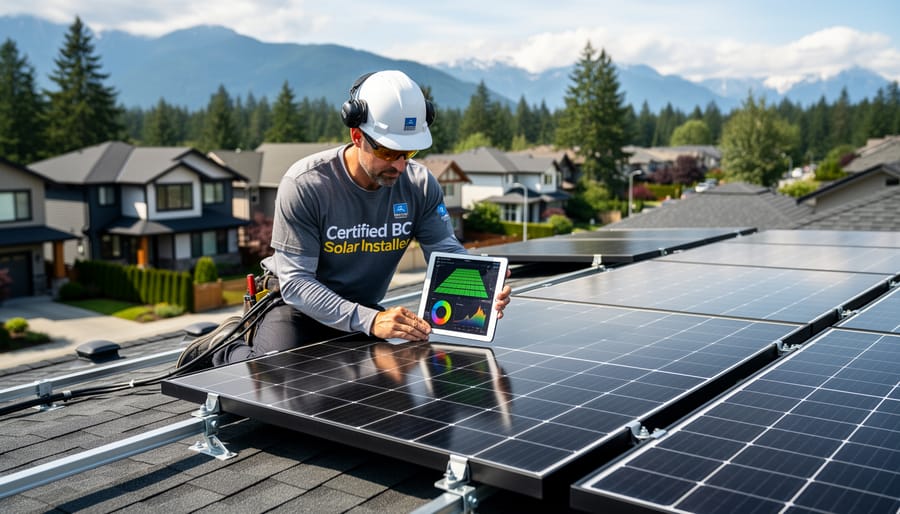
Finding the Right Off-Grid Installer in BC
Choosing the right installer can make the difference between a system that performs reliably for decades and one that creates ongoing headaches. In BC’s diverse terrain and climate zones, you need an installer who understands local conditions, from coastal fog patterns to interior winter extremes.
Start by verifying credentials. Look for installers with Clean Energy BC membership and CSA F387 certification, which demonstrates expertise in photovoltaic system design and installation. Ask about their experience specifically with off-grid systems, as these require different skills than grid-tied installations. Request references from customers in similar geographic areas and climate zones to yours.
During consultations, pay attention to how thoroughly installers assess your property. Quality professionals will conduct detailed site evaluations, discuss your actual energy needs rather than pushing maximum capacity systems, and explain how solar panel warranties and equipment guarantees work in your specific situation.
Red flags include pressure tactics, promises that sound too good to be true, reluctance to provide written quotes, or inability to explain system sizing calculations. Be wary of installers who don’t ask detailed questions about your energy usage patterns or who dismiss concerns about winter performance.
Ask these essential questions: How many off-grid systems have you installed in BC? What battery technology do you recommend for my climate zone and why? What ongoing maintenance will my system require? Can you provide monitoring solutions so I can track performance?
Solar BC maintains a network of vetted, qualified installers throughout the province. Our platform helps match you with professionals who have proven track records in your region, ensuring you benefit from local expertise and accountability. We make it simple to compare quotes, verify credentials, and move forward with confidence.
Energy independence through off-grid solar is not only achievable in British Columbia—it’s happening right now in communities across the province. From the Gulf Islands to the Kootenays, BC residents are successfully powering their homes and businesses with customized solar systems designed for our unique climate conditions.
Your path to off-grid living starts with understanding your specific energy needs, seasonal sunlight patterns in your region, and realistic budget expectations. The key decision points include system sizing, battery capacity for winter months, and whether a hybrid approach with backup generators makes sense for your situation.
Ready to take the next step? Start by using Solar BC’s calculator tools to estimate your energy consumption and potential system size. These interactive resources provide personalized insights based on your location and usage patterns. Next, connect with certified local installers who understand BC’s building codes, climate challenges, and available incentives. Request multiple quotes to compare system designs and pricing.
Remember, every successful off-grid installation begins with careful planning and expert guidance. Your local installer can assess your property’s solar potential, recommend appropriate equipment, and create a customized solution that delivers reliable, clean energy year-round. The transition to energy independence is within reach—take that first step today.