

Understand how BC’s net metering reform affects your solar investment by checking your utility’s current net surplus compensation rate—the amount credited for excess electricity your solar panels send back to the grid. BC Hydro now compensates surplus generation at wholesale rates (approximately 9.99 cents per kWh) rather than the previous retail rate (around 12-14 cents per kWh), reducing annual returns by 20-30% for typical residential systems.
Calculate your new payback period using this rate change before committing to solar installation. A standard 5kW system in Vancouver that previously achieved payback in 12-15 years may now require 15-18 years, though government incentives and rising electricity costs can offset these impacts.
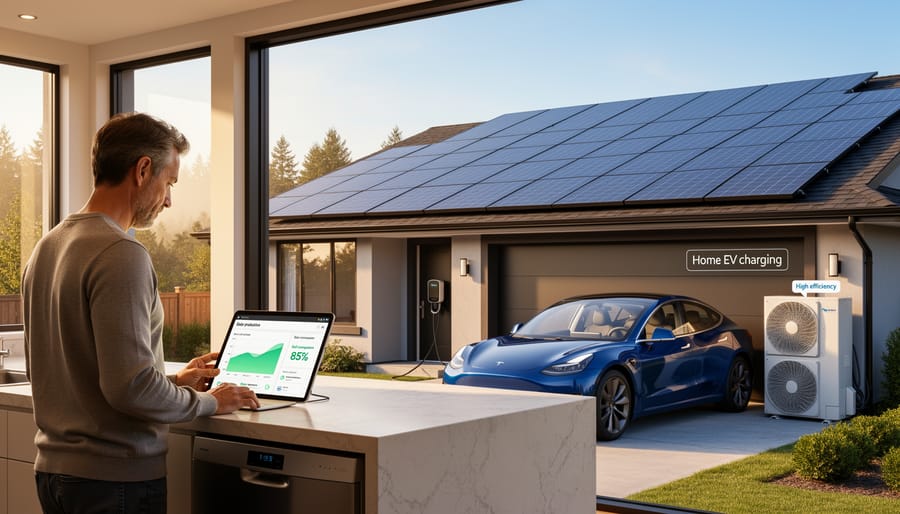
Maximize self-consumption to minimize surplus generation sent to the grid. Install battery storage systems to capture excess daytime production for evening use, or schedule high-energy activities like EV charging and water heating during peak solar hours. Local homeowners in Victoria report reducing grid exports by 40% through strategic load shifting alone.
Right-size your system based on actual consumption patterns rather than maximum roof capacity. Installing a 4kW system that matches your usage delivers better returns than an oversized 7kW system generating surplus power at reduced rates. This practical approach maintains financial viability while supporting BC’s clean energy transition.
What Is the Net Surplus Compensation Rate?
When you generate more solar power than your home uses, that excess electricity flows back to BC Hydro’s grid. Understanding how you’re compensated for this contribution is essential for calculating your solar investment returns.
BC Hydro’s Net Surplus Compensation program differs significantly from traditional net metering. With net metering, you receive retail-rate credits for excess power, which you can use to offset future electricity consumption. However, under the current compensation structure, BC Hydro pays a predetermined rate for surplus electricity that exceeds your annual consumption.
Here’s how it works in practice: Throughout the year, your solar system generates electricity. When production exceeds your immediate needs, that surplus first offsets your own consumption, reducing your electricity bill at the full retail rate. Any remaining surplus beyond your annual usage receives compensation at BC Hydro’s Net Surplus Compensation rate, which is typically lower than retail rates.
Think of the Thompsons in Kelowna, who installed a 6kW solar system. During summer months, their panels generate significantly more power than they use. This excess first zeros out their monthly bill, then any additional surplus accumulates as credit. At year-end, BC Hydro compensates them for surplus credits exceeding their total annual consumption.
The key distinction: electricity you generate and use yourself saves you money at retail rates (currently around 12-14 cents per kWh depending on your tier). Surplus electricity exported beyond your annual needs receives compensation at a lower rate set by BC Hydro.
This structure encourages strategic system sizing. Rather than maximizing panel capacity, successful solar customers in BC focus on matching their system size closely to annual consumption patterns, ensuring maximum savings through self-consumption while minimizing lower-value surplus exports.

The BC Net Metering Reform: What Changed and When
From Annual Credits to Monthly Compensation
Understanding BC Hydro’s shift from annual credits to monthly compensation helps solar customers plan their energy investments more effectively. Under the previous system, solar owners accumulated credits throughout the year when their panels generated excess electricity. These credits rolled over month to month, allowing you to offset higher winter consumption with summer surplus production. At the end of your annual true-up period, any remaining credits were settled, typically at a lower rate than retail.
The new monthly settlement structure changes this timeline significantly. Instead of banking credits for up to twelve months, BC Hydro now calculates your net surplus on a monthly basis. Each month, if you generate more electricity than you consume, you receive compensation for that excess at the established rate. This means surplus production in July won’t carry forward to offset December’s usage.
For solar customers, this shift emphasizes the importance of sizing your system to match your actual consumption patterns rather than oversizing for maximum production. The Robinsons in Kelowna discovered this firsthand when they adjusted their energy usage habits to maximize self-consumption during peak solar hours, reducing their reliance on banked credits and improving their overall return on investment.
Understanding the New Compensation Rate
Under BC Hydro’s new compensation structure, solar owners receive different rates depending on how their excess energy is used. When your solar system generates more electricity than you consume, that surplus flows back to the grid.
Previously, BC solar owners received the full retail rate for excess generation, typically around 12-14 cents per kilowatt-hour (kWh). Now, surplus compensation follows a wholesale rate structure, currently sitting at approximately 3-5 cents per kWh, depending on your location and BC Hydro rate class.
Here’s what this means in practical terms: A typical residential system in Vancouver producing 1,000 kWh of surplus annually would earn around $40-50 under the wholesale rate, compared to $120-140 under the previous retail rate structure. The gap is significant, but the good news is that you still receive full retail credit for any solar energy you use directly in your home.
This change emphasizes the importance of maximizing self-consumption rather than exporting excess power. The financial case for solar remains strong when systems are properly sized to match household consumption patterns throughout the day.
How This Impacts Your Solar Investment
Real Numbers: Before and After the Reform
Let’s look at how the compensation change affects a typical BC household with solar panels. Under the old system, any surplus electricity you sent back to the grid was credited at the full retail rate of approximately 12.4 cents per kilowatt-hour (kWh). This made the economics particularly attractive for solar adopters.
Meet the Johnsons from Victoria, who installed a 6-kilowatt solar system in 2022. During summer months, their system generates about 800 kWh monthly, while they only consume 600 kWh. Under the previous rules, those 200 extra kWh earned them credits worth $24.80 per month at the retail rate, which they could apply toward winter bills when their solar production drops.
Under the current Net Surplus Compensation system implemented in 2024, that same 200 kWh surplus now receives approximately 9.99 cents per kWh, the wholesale generation rate. The Johnsons now earn $19.98 monthly for their surplus energy, a reduction of about $4.82 per month, or roughly $58 annually.
While this represents a decrease in compensation, the Johnsons still benefit significantly from offsetting their own consumption first. The 600 kWh they use directly from their panels saves them $74.40 monthly at the retail rate. Their overall annual savings remain substantial at approximately $835, demonstrating that solar investments continue delivering strong returns despite the policy adjustment. The key is maximizing self-consumption rather than relying heavily on surplus compensation.
Who Benefits and Who Loses
The changes to BC Hydro’s net surplus compensation rate create winners and losers among solar customers based on their consumption patterns and system sizing.
Households with well-matched solar systems benefit most. If your solar array closely aligns with your annual electricity consumption, you’ll use most of your generated power directly, earning the full retail rate through net metering. These customers experience minimal impact from the lower surplus compensation rate because they rarely export excess electricity.
Oversized system owners face the biggest financial hit. Customers who installed larger arrays expecting to profit from excess generation now receive significantly less compensation for their surplus power. Properties with low daytime electricity use, like vacation homes or workplaces that are empty on weekends, fall into this category.
New solar adopters actually gain an advantage with clearer expectations. Unlike early adopters who invested under previous assumptions, today’s customers can right-size their systems from the start, avoiding unnecessary capacity that won’t deliver proportional returns.
Businesses with daytime operations remain strong beneficiaries. Commercial properties that consume electricity during peak solar production hours maximize self-consumption, making their installations financially resilient despite policy changes. Manufacturing facilities and retail shops exemplify this winning category.
Maximizing Your Solar Returns Under the New Rules
Self-Consumption Is Now King
With reduced compensation for surplus energy sent back to the grid, the financial advantage now lies in using your solar power as it’s generated. Think of it like growing vegetables in your garden—you get the most value when you consume them fresh rather than trying to sell the extras.
Start by identifying your highest energy-use periods and see if you can align them with peak solar production hours, typically between 10 AM and 3 PM. Run your dishwasher, washing machine, and dryer during sunny afternoon hours instead of evenings. If you work from home, schedule energy-intensive tasks like vacuuming or charging devices for midday.
A family in Kelowna reduced their grid dependence by 40% simply by adjusting when they ran major appliances. They programmed their hot water heater to operate primarily during solar production hours, maximizing the value of every kilowatt-hour their panels produced.
Consider adding a battery storage system to capture excess daytime production for evening use. While this requires upfront investment, it dramatically increases your self-consumption rate and provides backup power during outages. Even small habit changes—like pre-cooling your home on hot afternoons while the sun shines—can significantly improve your solar investment returns under the current compensation structure.

Battery Storage: The Game-Changer
With lower compensation rates for surplus energy sent back to the grid, maximizing your self-consumption becomes crucial. This is where battery storage options truly shine. Instead of exporting excess solar power during the day for minimal credit, you can store it for use during evening hours when your panels aren’t producing.
Energy storage systems allow you to shift your consumption patterns strategically. For example, a Kelowna family installed a battery alongside their existing solar array and increased their self-consumption from 40% to 85%. This means they’re buying less power from the grid and exporting less surplus, making every kilowatt-hour their panels produce work harder for them.
The financial benefit is clear: power you store and use yourself saves you the full retail rate, while exported surplus earns only a fraction of that value. As battery technology improves and prices continue declining, storage is becoming an essential component of smart solar investments in BC, helping you maintain strong returns despite changing compensation rates.
Right-Sizing Your Solar System
Under the updated compensation structure, sizing your solar system strategically becomes more important than ever. The goal is to match your system’s production as closely as possible to your actual energy consumption throughout the year, minimizing surplus energy sent back to the grid.
Start by reviewing 12 months of your electricity bills to understand your consumption patterns. A system that covers 90-100% of your annual usage typically provides the best financial return, rather than oversizing to generate excess power. Consider seasonal variations—BC homes often use more electricity in winter for heating and lighting.
For most households, a 5-7 kW system strikes the right balance. The Johnson family in Victoria found that their 6 kW installation offset 95% of their annual consumption without generating significant surplus. They used BC Hydro’s online account tools to track their production versus usage monthly, making small adjustments to their energy habits to optimize savings.
Working with a qualified solar installer who understands the current compensation rates will help you model different system sizes against your specific usage profile. Many local installers now offer free assessments that factor in BC’s compensation structure, ensuring you invest in a system sized for maximum value rather than maximum production.
Local Success Story: How One Vancouver Island Family Adapted
When the net surplus compensation rate changed in 2022, the Morrison family from Courtenay faced a decision that many Vancouver Island homeowners are now confronting. Their 8.5 kW solar array had been performing well, but they wanted to ensure they were getting maximum value under the new rate structure.
“We realized we needed to shift our thinking from selling power back to the grid to using every bit of it ourselves,” explains Jennifer Morrison, who worked with a local solar consultant to reassess their system.
The family started by examining their consumption patterns. They discovered that their panels produced peak power between 10 a.m. and 3 p.m., but their highest electricity use occurred in early morning and evening. This mismatch meant they were exporting power at the lower net surplus rate and buying it back at retail prices during peak household hours.
Their solution involved three practical changes. First, they installed a 10 kWh battery storage system, allowing them to store midday solar production for evening use. Second, they programmed their heat pump water heater and dishwasher to run during solar production hours. Third, they added a timer to their electric vehicle charger to prioritize daytime charging when possible.
The results were impressive. Within six months, the Morrisons reduced their grid exports by 65 percent and increased their self-consumption rate from 42 percent to 78 percent. While their payback period extended slightly compared to pre-reform projections, they’re now saving approximately 920 dollars annually on electricity costs.
“The rate change actually made us smarter energy users,” Jennifer notes. “We’re not just generating clean power—we’re using it more efficiently than ever before.”
Should You Still Go Solar in BC?
Despite the reduced net surplus compensation rate, going solar in BC remains a sound investment for most homeowners and businesses. Here’s why the numbers still add up.
The key to understanding solar value in BC is recognizing that self-consumption provides the real savings. When you use solar power directly in your home, you avoid paying BC Hydro’s retail rate of approximately 14 cents per kWh. The export rate only affects surplus electricity you don’t use, typically 10-30% of total production for well-sized systems.
Take the example of the Richardson family in Victoria. Even with the current compensation structure, their 6 kW system saves them about $900 annually through reduced electricity bills. Combined with federal and provincial incentives, they’re on track for a 12-year payback period with 25+ years of system life remaining.
The environmental benefits also carry significant weight. A typical residential solar installation in BC offsets approximately 2 tonnes of CO2 annually, equivalent to planting 50 trees each year. For environmentally-conscious households, this impact matters alongside financial returns.
Economic factors further strengthen the case. BC Hydro rates historically increase 2-3% annually, while your solar investment locks in predictable energy costs. Battery storage technology is becoming more affordable too, letting you store surplus power for evening use rather than exporting it at lower rates.
The bottom line? Solar still makes financial and environmental sense in BC, especially when you optimize your system for maximum self-consumption and take advantage of available incentives.
Despite the changes to BC Hydro’s net surplus compensation rate, solar energy remains a smart, viable investment for British Columbians when approached strategically. The key is understanding how the new compensation structure works and optimizing your system accordingly. By sizing your solar installation to match your actual consumption patterns rather than oversizing for excess generation, you can maximize the value of every kilowatt-hour your panels produce.
The transition to the reduced net surplus rate shouldn’t discourage you from pursuing solar. Many BC homeowners and businesses are still seeing excellent returns by focusing on self-consumption, pairing systems with battery storage, and working with knowledgeable installers who understand the current landscape.
Ready to explore whether solar makes sense for your situation? Start by using Solar BC’s online calculator tool to estimate your potential savings under the current compensation structure. This interactive resource factors in the new rates and helps you understand realistic payback periods based on your specific energy usage.
Next, connect with certified solar installers who have experience navigating the post-reform environment. They can design a system optimized for your consumption patterns and explain financing options that work within your budget. Solar energy continues to support BC’s clean energy goals while offering meaningful long-term savings for those who plan thoughtfully.