
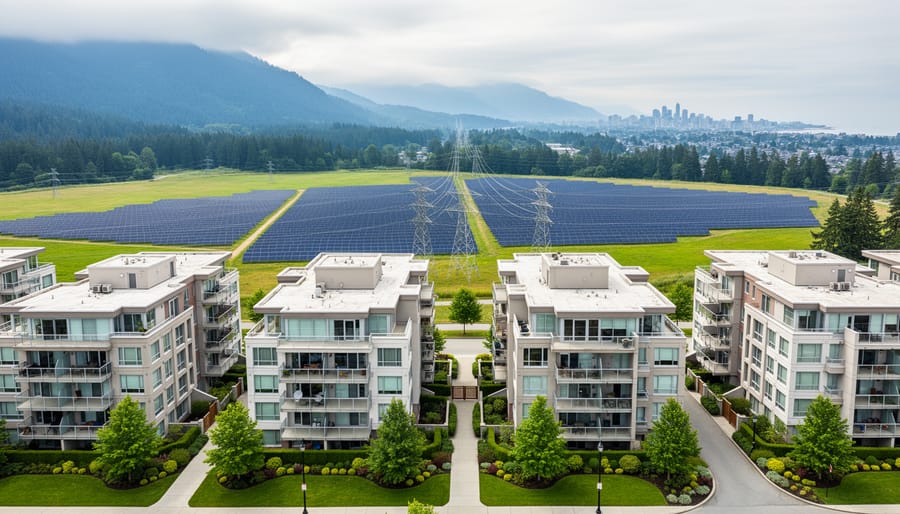
Virtual net metering transforms how BC residents access solar energy by removing the biggest barrier: your roof doesn’t need to be suitable for solar panels. Instead of installing panels on your property, you purchase a share of a community solar project located elsewhere in your utility’s service area. The solar energy your share produces gets credited directly to your BC Hydro bill at the retail rate you normally pay, reducing your monthly costs without any installation, maintenance, or upfront equipment expenses on your part.
This arrangement proves especially valuable if you’re a renter, live in a condo or apartment building, have a shaded or unsuitable roof, or simply want to support renewable energy without the complexity of ownership. The financial mechanism works straightforwardly: when your allocated portion of the community solar array generates 100 kilowatt-hours in a month, you receive a $15-20 credit on your electricity bill, depending on your rate tier.
For BC residents facing Vancouver’s high housing density, Victoria’s heritage building restrictions, or Northern BC’s challenging installation conditions, virtual net metering opens solar participation to households previously excluded from renewable energy savings. The model eliminates concerns about roof maintenance, system repairs, or what happens when you move, since you can typically transfer or cancel your subscription.
Understanding whether community solar through virtual net metering makes financial sense for your specific situation requires examining your current electricity consumption, available community solar projects in your area, and comparing subscription costs against your projected bill credits.
What Is Virtual Net Metering?
Virtual net metering is a billing arrangement that lets you receive credits on your electricity bill for solar energy generated at a shared, off-site solar installation. Think of it like a community garden: instead of growing vegetables in your own backyard, you join a shared garden plot and receive a portion of the harvest based on your membership. With virtual net metering, you subscribe to a portion of a larger solar array located elsewhere in your community, and you get credits for the clean energy your share produces.
Unlike traditional net metering, where solar panels sit on your own roof and directly offset your home’s energy use, virtual net metering connects you to a solar farm that could be kilometers away. The word “virtual” refers to this disconnect between where the solar energy is produced and where you live. You’re not physically receiving electrons from the solar panels into your home. Instead, the electricity flows into the broader grid, and you receive financial credits on your BC Hydro bill proportional to your share of the energy generated.
Here’s how it works in practice: A community solar project gets built in a sunny location, perhaps on unused land or a large commercial rooftop. You purchase or lease a portion of that installation. Each month, the solar array generates electricity and feeds it into the provincial grid. Your share of that production translates into credits that reduce your electricity bill, just as if those panels were on your own property.
This approach opens solar energy access to renters, condo dwellers, and homeowners with shaded roofs or older buildings unsuitable for panel installation. It’s particularly valuable in British Columbia’s diverse housing landscape, where many residents lack the option for traditional rooftop solar but still want to support renewable energy and reduce their utility costs. You get the financial and environmental benefits of solar power without the need for property ownership, roof work, or system maintenance.

How Community Solar Subscriptions Work in BC
The Subscription Process
Signing up for virtual net metering through a community solar program is straightforward and typically takes just a few simple steps. First, you’ll need to verify your eligibility by confirming you’re a BC Hydro customer within the service area of your chosen community solar project. Most programs require basic information including your BC Hydro account number, recent electricity bills to assess your average usage, and contact details.
Once you’ve selected a subscription size that matches your energy needs, you’ll review the agreement outlining community solar subscription costs, credit rates, and contract terms. Many BC programs offer flexible subscription levels, allowing you to purchase a portion of a solar array that aligns with your household or business consumption.
After submitting your application and completing any required payments or financing arrangements, the approval process usually takes two to four weeks. Credits begin appearing on your BC Hydro bill in the following billing cycle once your subscription is activated. Some programs provide online portals where you can track your solar generation and credits in real-time, helping you see the environmental impact of your participation from day one.
Understanding Your Bill Credits
Your electricity bill with virtual net metering is simpler to understand than you might expect. Each month, you’ll see a line item showing credits generated by your share of the community solar project. These credits directly offset your electricity consumption, reducing what you owe BC Hydro. Think of it like a discount applied automatically to your bill based on the solar energy your subscription produces.
When your allocated solar panels generate more electricity than you use in a given month, those excess credits typically roll over to future billing periods. This rollover system works particularly well in BC’s climate. During sunny summer months, your subscription might produce surplus credits that accumulate and help offset higher electricity usage during darker winter months when solar production naturally decreases.
For example, a Vancouver family participating in a community solar project might generate 150 kilowatt-hours of credits in July but only use 100 kWh. Those extra 50 kWh credits carry forward to November when their usage increases to 180 kWh but their solar share only produces 80 kWh. The stored summer credits bridge the gap, maximizing their annual savings.
This seasonal balancing is why virtual net metering makes financial sense in BC. You’re essentially banking sunshine during peak production periods. Most programs maintain credit balances for 12 months, ensuring you capture the full value of your investment throughout the year. Review your bill monthly to track your credit accumulation and understand your energy patterns, helping you make informed decisions about your household electricity use.
Who Benefits Most from Virtual Net Metering?
Virtual net metering opens doors for BC residents who’ve been locked out of traditional solar options. If you’ve felt frustrated watching neighbors install rooftop panels while your situation makes it impossible, community solar through virtual net metering might be your answer.
Renters gain the most obvious advantage. Take Sarah, who’s been renting a Vancouver apartment for five years. She’s environmentally conscious but has no control over her building’s roof. By subscribing to a community solar project, she receives monthly credits on her BC Hydro bill without needing landlord approval or making permanent installations. When she moves, her subscription can move with her.
Condo owners face similar barriers. Even if you own your unit, strata councils must approve rooftop installations, and shared roof space complicates individual systems. Virtual net metering sidesteps these governance challenges entirely, allowing you to support solar energy without navigating strata politics.
Property limitations affect countless homeowners. Perhaps mature trees shade your roof, making solar panels inefficient. Maybe your home has a heritage designation that restricts exterior modifications, or your roof needs replacement within five years, making a 25-year solar investment impractical. Jim, a Victoria homeowner with a beautiful century-old Tudor-style home, couldn’t modify his protected roof but now receives solar credits from a nearby community project.
Seniors on fixed incomes also benefit significantly. Installing rooftop solar requires substantial upfront investment, even with financing. Community solar subscriptions typically require minimal entry costs and provide immediate savings, making clean energy accessible regardless of available capital.
If any of these situations resonate with you, virtual net metering transforms solar energy from an impossible dream into an achievable reality, delivering environmental impact and financial savings without the traditional barriers.
Real Savings: What BC Subscribers Actually Pay and Save
Let’s break down the numbers to see what community solar subscribers in BC typically experience with their electricity bills.
Understanding the basic economics helps clarify the value proposition. BC Hydro’s residential rate sits around $0.1223 per kWh for the first 1,350 kWh used in a two-month billing period. Community solar subscriptions generally cost between $0.08 and $0.11 per kWh, creating immediate savings for most households.
Here’s a realistic example: A typical BC household using 10,000 kWh annually might subscribe to a community solar project generating 3,000 kWh of their consumption. With a subscription rate of $0.10 per kWh versus BC Hydro’s retail rate, this household saves approximately $67 per year on that portion of their electricity. While this might seem modest, remember you’re avoiding rooftop installation costs of $15,000 to $25,000 while still supporting renewable energy.
The savings calculation considers several factors beyond simple rate comparison. When you subscribe, you receive bill credits for the solar energy generated by your share of the community project. These credits offset your regular BC Hydro charges. The difference between what you pay for your subscription and what you would have paid BC Hydro represents your net savings.
For businesses with higher consumption, the numbers scale significantly. A small retail shop using 30,000 kWh annually could see savings of $200 to $400 per year, depending on their subscription size and rate structure.
The actual subscription costs versus savings vary based on your electricity usage, the specific community solar program, and seasonal generation patterns. That’s where personalized calculation becomes valuable.
The Solar BC savings calculator provides customized estimates based on your actual consumption patterns and local solar resources. Simply input your recent BC Hydro bills to see how community solar subscriptions might impact your specific situation, helping you make an informed decision about whether virtual net metering aligns with your financial and environmental goals.
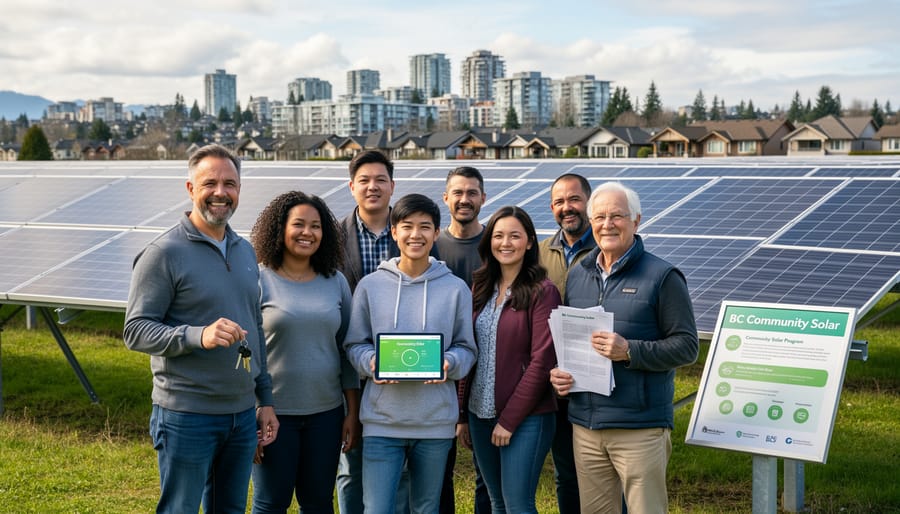
A BC Community Solar Success Story
Meet Sarah Chen, a Vancouver condo owner who wanted to support renewable energy but couldn’t install solar panels on her building. Like many BC residents, she felt stuck between her environmental values and practical limitations.
Sarah’s situation changed when she discovered a community solar project in the Fraser Valley offering virtual net metering. “I was skeptical at first,” she admits. “How could I get solar credits from panels I don’t own?” After attending an information session, she learned that subscribers receive credits on their BC Hydro bill proportional to their share of the array’s production.
The decision process took Sarah about two months. She compared the subscription cost of $45 monthly against her average electricity bill of $80. The project manager showed her how she’d receive approximately $35 in credits each month based on her subscribed capacity, plus the satisfaction of supporting clean energy. With no upfront costs and the flexibility to cancel with 30 days’ notice, the risk felt manageable.
Eighteen months later, Sarah reports consistent results. Her net electricity costs have dropped by roughly 40 percent, and she’s avoided about 1.2 tonnes of carbon emissions. “What surprised me most was the community aspect,” she shares. “I get quarterly updates about our array’s performance and meet other subscribers at annual events. It feels good knowing I’m part of BC’s clean energy future without needing a single-family home.”
What to Look for When Choosing a Community Solar Program
Choosing the right community solar program requires careful evaluation to ensure you maximize both savings and environmental impact. Here’s what to examine before signing up:
Start by reviewing contract terms carefully. Most BC programs offer one to five-year agreements. Look for flexibility—programs with shorter initial commitments or reasonable cancellation policies give you peace of mind if your circumstances change. Ask specifically about cancellation fees and notice requirements.
Understanding what you’re paying for is essential. Compare the monthly fees versus savings by requesting a clear breakdown showing your subscription cost against projected BC Hydro credit amounts. Reputable programs should guarantee at least 10-15% savings on your energy costs. Request sample bills to see exactly how credits appear.
Distance matters in community solar. BC regulations typically require subscribers to be within the same utility service area as the solar farm. Closer proximity often means better alignment with local grid conditions and community benefits.
Investigate program reputation thoroughly. Check online reviews, ask for references from current subscribers, and verify the developer’s track record. The Pemberton Valley Solar Garden, for example, has built strong credibility through transparent communication and consistent performance since launching.
Look for environmental certifications that validate genuine sustainability commitments. Programs certified by organizations like Bullfrog Power or those following EcoLogo standards demonstrate verified environmental benefits beyond basic solar generation.
Finally, request detailed performance reports. Quality programs provide regular updates showing actual energy production, your proportional share, and resulting credits. This transparency ensures accountability and helps you track your environmental contribution over time.
Taking Your Next Step Toward Community Solar
Ready to join BC’s community solar movement? Your first step is checking your eligibility. Contact your local utility provider to confirm they offer virtual net metering programs in your area. BC Hydro and FortisBC both support community solar initiatives, though specific programs vary by region.
Next, explore Solar BC’s online directory to find certified community solar projects near you. Their interactive calculator helps estimate your potential savings based on your current energy consumption. Most subscribers see their first credits within 30 to 60 days of enrollment, with ongoing monthly savings appearing on subsequent bills.
Before committing, review the subscription agreement carefully. Understand the payment structure, contract length, and cancellation terms. Many projects offer flexible options, from month-to-month commitments to longer-term subscriptions with greater savings.
Remember, choosing community solar extends beyond personal savings. Each subscription supports BC’s transition to clean energy, reducing provincial carbon emissions while strengthening local energy independence. You’re not just lowering your electricity costs; you’re investing in a sustainable future for your community. Whether you’re a renter in Vancouver or a small business owner in Kelowna, community solar through virtual net metering makes renewable energy accessible to everyone.