
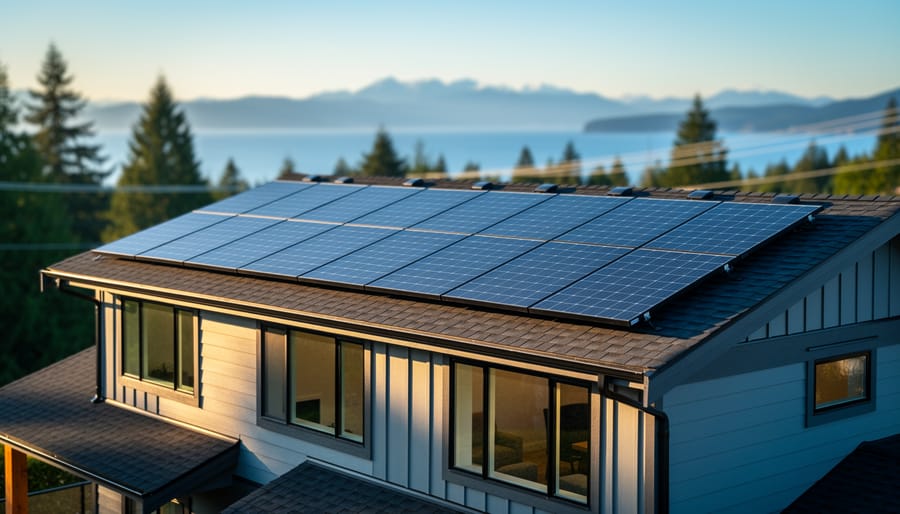
Calculate your solar investment return by examining payback periods across British Columbia’s diverse regions. In the Lower Mainland, homeowners typically recover their solar investment in 12-15 years, while Okanagan residents benefit from higher sun exposure with payback periods of 10-13 years. Vancouver Island sits in the middle at 11-14 years, and northern communities see longer timelines of 15-18 years due to reduced solar irradiance.
Your personal payback period depends on four critical factors: your current electricity rates, the size and efficiency of your solar installation, available provincial and federal incentives, and your property’s sun exposure. BC Hydro’s tiered rate structure means higher-consumption households see faster returns, while the federal Greener Homes Grant can reduce upfront costs by up to $5,000, directly shortening your payback timeline.
Understanding payback period moves you beyond the initial sticker shock of solar installation costs, which range from $15,000 to $30,000 for typical BC homes. This metric reveals when your accumulated electricity savings equal your total investment, transforming solar from an expense into a profit-generating asset. After reaching payback, your system continues producing free electricity for 15-20 additional years, delivering substantial long-term value.
Regional variations matter significantly. A Kelowna homeowner with a south-facing roof and high energy consumption might break even in just nine years, while a Prince George resident with shade challenges could wait 19 years. These differences make location-specific data essential for making an informed solar investment decision in British Columbia.
Understanding Solar Payback Period: What It Means for Your Wallet
The solar payback period is simply the time it takes for your solar panel system to pay for itself through energy savings. Think of it as your break-even point. After this period, every dollar you save on electricity bills becomes pure profit in your pocket.
Calculating your payback period is straightforward: divide your total system cost by your annual electricity savings. For example, if a BC homeowner installs a solar system for $20,000 and saves $2,000 per year on electricity bills, their payback period would be 10 years ($20,000 ÷ $2,000 = 10 years). After that decade, they continue enjoying free electricity for the remaining 25-plus years of their panels’ lifespan.
Here’s why this matters more than just looking at upfront costs. While $20,000 might seem daunting initially, understanding that you’ll recoup this investment and then save money for decades changes the conversation entirely. With BC Hydro rates steadily increasing and the latest solar technology becoming more efficient, many homeowners now see payback periods of 8-12 years.
Let’s look at a real BC scenario. Sarah from Victoria installed a 6kW system in 2023 for $18,500. Her household uses about 11,000 kWh annually, and her solar panels generate approximately 7,000 kWh per year. At current BC Hydro rates, she saves around $1,850 annually, giving her a payback period of exactly 10 years. After that, she’ll pocket those savings year after year.
The key takeaway? Don’t let sticker shock stop you from exploring solar. Focus on the long-term financial picture and how quickly your investment returns to your wallet.
What BC Solar Installations Actually Cost in 2024
Average System Costs by Size
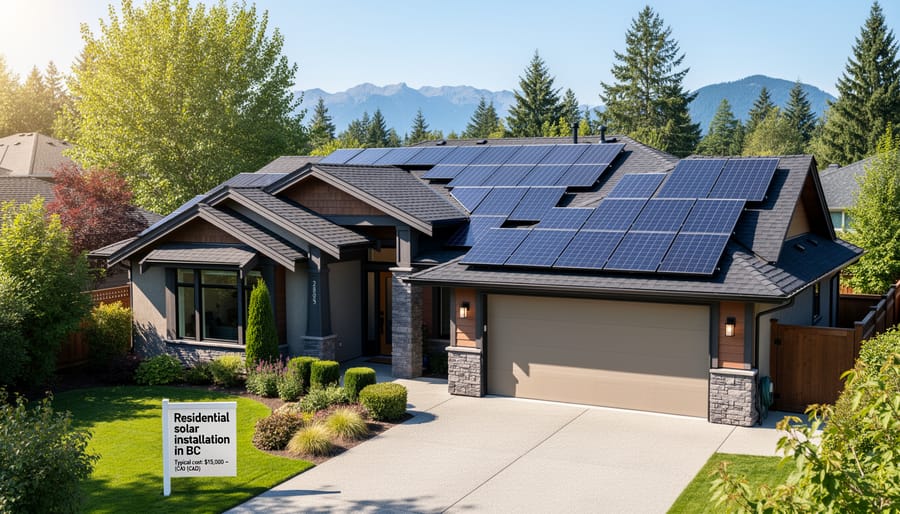
Understanding what solar panels cost in BC helps you calculate your potential payback period accurately. In 2024, residential solar installations typically range from $2.50 to $3.50 per watt after accounting for federal incentives.
For a typical 5kW system, expect to invest between $12,500 and $17,500. This size suits smaller homes with modest energy consumption, generating approximately 5,500-6,500 kWh annually in BC’s climate.
A 7kW system, popular among average BC households, costs roughly $17,500 to $24,500. This produces around 7,700-9,100 kWh yearly, covering most household electricity needs.
Larger homes or those wanting energy independence often choose 10kW systems, priced between $25,000 and $35,000. These generate approximately 11,000-13,000 kWh annually.
Real example: The Johnson family in Kelowna installed a 6.5kW system for $19,800 in 2023. Their system uses solar panels for BC’s climate, optimized for both sunny and overcast conditions.
These costs include equipment, installation, permits, and warranties. Prices vary based on roof complexity, panel quality, and your installer. BC Hydro customers benefit from net metering, which credits excess energy production, improving your overall return on investment.
Regional Price Differences Across BC
Solar installation costs aren’t uniform across BC—where you live significantly impacts your total investment and payback timeline. In the Lower Mainland and Greater Victoria, you’ll typically find more competitive pricing due to a higher concentration of solar installers and economies of scale. A standard 7 kW residential system here might cost between $18,000 and $22,000 before incentives.
Move to the Interior regions like Kelowna or Kamloops, and prices can increase by 10-15 percent. While these areas enjoy excellent sunshine hours that boost energy production, fewer local installers and increased travel costs affect pricing. However, many Interior homeowners still see attractive payback periods thanks to that abundant solar resource.
Northern BC faces the steepest installation costs—sometimes 20-30 percent higher than the Lower Mainland. Limited installer availability, longer travel distances, and complex logistics for equipment delivery drive these premiums. For example, a Fort St. John installation might require additional travel fees and accommodation costs for installation crews.
The good news? Regional incentive programs and net metering rates apply province-wide, helping offset these geographic cost differences. Getting quotes from multiple installers, including those willing to travel to your area, ensures you find competitive pricing regardless of your location.
Hidden Costs That Affect Your Payback Timeline
While calculating your solar payback period, don’t overlook these common hidden costs that many BC homeowners encounter. Electrical panel upgrades can add $1,500 to $3,000 if your current system can’t handle the solar load. Roof repairs or replacement before installation might cost $5,000 to $15,000, but tackling this upfront prevents removing panels later. Tree removal for better sun exposure runs $500 to $2,000 per tree depending on size and location.
Consider the Johnsons in Kelowna who discovered their 40-year-old roof needed replacement, adding 18 months to their payback timeline. However, they viewed it as a smart investment since both upgrades now last decades together.
Ground-mounted systems are an alternative if roof work seems prohibitive, though they require adequate yard space. Building permits typically cost $200 to $500 in BC municipalities. Factor these potential expenses into your calculations early by getting a thorough property assessment from qualified installers who understand local conditions and requirements.
Permits and Approval Process: Timeline and Costs
Municipal Permit Requirements
Before installing solar panels in BC, you’ll need to navigate municipal permit requirements, which directly impact your project timeline and overall costs. Most municipalities require both an electrical permit and a building permit for rooftop installations.
Typical permit costs across BC range from $200 to $500, depending on your system size and location. Vancouver generally charges around $350-$450, while smaller municipalities like Kelowna or Nanaimo typically fall in the $200-$300 range. Victoria’s permit fees average $300-$400 for residential systems.
Processing times vary significantly by municipality. Vancouver typically processes solar permits within 2-3 weeks for straightforward installations. Surrey and Burnaby average 1-2 weeks, while smaller communities often complete reviews within 5-10 business days. During peak installation seasons (spring and summer), expect these timelines to extend by an additional week.
To streamline your approval, work with certified solar installers familiar with local requirements. They’ll handle the paperwork and ensure your application meets building codes and electrical standards. For example, the Johnson family in Richmond saved three weeks by using an installer who had pre-established relationships with municipal building departments. Remember to factor permit costs and processing time into your overall payback calculations, as delays can postpone when you start generating savings.
BC Hydro Interconnection Process
Connecting your solar system to BC Hydro’s grid involves a straightforward process, but understanding the timeline and costs helps you calculate your true payback period. When you apply for net metering through BC Hydro, you’ll submit an interconnection application that includes your system specifications and electrical drawings. Most residential applications receive approval within 4-8 weeks, though larger commercial systems may take longer.
The application fee is $500 for systems up to 100 kW, which should be factored into your total installation cost when calculating payback. This one-time fee covers BC Hydro’s review and grid connection assessment. Once approved, you’ll need a certified electrician to complete the installation and arrange for a final inspection before your system can begin feeding excess power back to the grid.
A helpful tip from local solar owners: start your interconnection application early, even while finalizing your installer choice. The Johnsons in Kelowna saved two months on their project by submitting preliminary paperwork during the planning phase. BC Hydro offers a Net Metering Handbook on their website with detailed checklists to keep your project on track. Remember, any delays in interconnection extend the time before you start seeing returns on your investment, so staying organized with documentation makes a real difference to your overall payback timeline.
BC Solar Incentives That Slash Your Payback Time

Federal Solar Incentives for BC Residents
BC residents can access several federal programs that significantly reduce solar installation costs and improve payback periods. The Canada Greener Homes Grant offers up to $5,000 for eligible solar installations, covering a portion of your upfront investment. To qualify, you’ll need an EnerGuide home evaluation before and after installation, which costs around $600 but is also partially rebundable.
The federal government’s interest-free loans through the Canada Greener Homes Loan program provide up to $40,000 for energy-efficient home upgrades, including solar panels, with repayment terms spanning up to 10 years. This allows you to start saving on electricity bills immediately while spreading installation costs over time.
Additionally, solar equipment qualifies for GST rebates on certain energy-efficient products. Small businesses and farms may access the Canadian Agricultural Partnership or other sector-specific funding that supplements residential programs.
Real example: The Martinez family in Kelowna combined their $5,000 grant with a $25,000 interest-free loan to install an 8kW system. Their monthly loan payment of $208 is actually less than their previous electricity bill, meaning they’re cash-flow positive from day one.
To maximize your savings, apply for the Greener Homes Grant before installation begins, as retrofits completed prior to approval aren’t eligible. Check your utility provider for additional provincial rebates that stack with federal incentives.
BC Provincial and Municipal Programs
British Columbia offers several financial incentives that significantly reduce your solar payback period. The province has eliminated the Provincial Sales Tax (PST) on qualifying solar photovoltaic systems, saving you 7% on equipment costs right from the start. This exemption applies to residential, commercial, and industrial installations, putting hundreds to thousands of dollars back in your pocket depending on system size.
Many BC municipalities provide additional rebates to encourage solar adoption. For example, the City of Vancouver has offered programs supporting renewable energy installations, while smaller communities like Nelson have created local incentives reflecting their sustainability commitments. Contact your municipal office to discover what’s available in your area, as these programs change regularly and can stack with provincial benefits.
Regional utilities also support solar investments. BC Hydro’s Net Metering program allows you to send excess electricity back to the grid, earning credits on your bill. FortisBC offers similar programs in their service areas. These credits effectively increase your energy savings by 20-30% compared to self-consumption alone.
Real success story: The Thompson family in Kelowna reduced their payback period from 15 years to under 11 years by combining the PST exemption with their municipal rebate and maximizing net metering benefits. Research your local options thoroughly—the combined provincial, municipal, and utility incentives can shave 3-5 years off your solar investment timeline.
How Incentives Change Your Real Payback Period
Understanding how incentives affect your actual investment is key to calculating a realistic payback period. Here’s what really happens to your solar investment in British Columbia.
Consider a typical 6-kilowatt residential system with an upfront cost of $20,000. Before any incentives, this might seem like a substantial investment. However, BC residents can access several programs that significantly reduce this amount.
The federal government offers the Canada Greener Homes Grant, which provides up to $5,000 for eligible solar installations. Many BC municipalities and utility companies also offer additional rebates. When you stack these incentives, your $20,000 system could cost between $13,000 and $15,000 out of pocket.
Let’s look at a real example: The Chen family in Vancouver installed a $19,500 system. After receiving $5,000 from the federal grant and $2,000 from their local utility, their net cost dropped to $12,500. With annual savings of $1,800 on their electricity bills, their actual payback period shortened from 10.8 years to just 6.9 years.
This dramatic difference means you’re not just saving money faster—you’re reducing financial risk and seeing positive returns much sooner than the sticker price suggests.
Solar Payback Periods Across BC Regions
Lower Mainland and Fraser Valley
If you’re living in Metro Vancouver, Surrey, Abbotsford, or surrounding Fraser Valley communities, you can expect a solar payback period of 12 to 16 years. This timeline reflects the region’s moderate sunshine levels—approximately 1,900 to 2,100 hours annually—and British Columbia’s relatively low electricity rates through BC Hydro, which currently hover around $0.12 per kWh.
Despite these longer payback periods compared to sunnier regions, Lower Mainland residents are increasingly embracing solar. The key is understanding your specific situation: south-facing roofs without shade, higher-than-average electricity consumption, and participation in BC Hydro’s net metering program all work in your favor.
A compelling example comes from a Surrey homeowner who installed a 6.5 kW system in 2020. With an upfront cost of $18,000 after federal incentives, their system generates enough electricity to offset 85% of their annual consumption. They’re on track for a 14-year payback period, and they’ve already noticed a dramatic reduction in their monthly bills.
The Fraser Valley’s growing solar community demonstrates that even with moderate sun exposure, strategic planning and available incentives make solar a worthwhile long-term investment for families committed to renewable energy.
Vancouver Island
Vancouver Island homeowners enjoy some of the strongest BC’s solar potential, with payback periods typically ranging from 11 to 15 years across Victoria, Nanaimo, and surrounding communities. The Island receives approximately 2,000 hours of sunshine annually, making it ideal for solar energy production despite its reputation for rain.
Current BC Hydro residential rates, combined with the region’s excellent solar resources, create favorable conditions for solar investment. A typical 6kW system costs between $15,000 and $18,000 after available rebates, generating around $1,200 to $1,500 in annual electricity savings.
Victoria homeowners often see payback periods on the shorter end of this range due to slightly higher solar exposure, while communities further north like Campbell River may experience timelines closer to 15 years. One Duncan family reduced their payback period to just 10 years by combining solar installation with energy efficiency upgrades and strategic panel placement to maximize year-round sun exposure.
Island residents should consider their property’s sun exposure, roof condition, and long-term residency plans when calculating potential returns. With BC Hydro rates expected to increase over time, many homeowners find their actual payback periods end up shorter than initial projections.
Interior BC
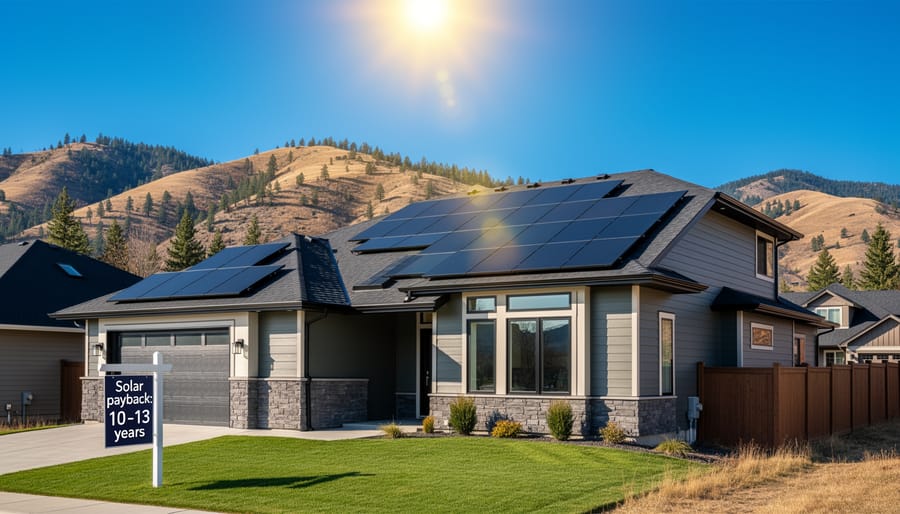
The Interior BC region offers some of the province’s most favorable conditions for solar investment, with cities like Kelowna, Kamloops, and Vernon enjoying payback periods of 10-13 years. This advantage stems from the area’s impressive sunlight hours, which significantly outpace coastal regions.
Kelowna homeowners, for example, typically see their 8kW systems generating more electricity annually due to approximately 2,000 sunshine hours per year. This increased production translates directly into faster returns on investment. In Kamloops, a recent homeowner reported their $20,000 system paying for itself in just under 11 years, thanks to both high solar yield and reduced grid dependency.
Vernon residents benefit similarly, with local installers noting that Interior properties often require slightly smaller systems to meet the same energy needs compared to cloudier regions, reducing upfront costs. The combination of abundant sunshine, available provincial incentives, and lower installation requirements makes the Interior an ideal location for solar adoption. If you’re in this region, you’re positioned to experience some of BC’s quickest financial returns while contributing to cleaner energy production.
Northern BC
Prince George and northern BC communities face longer solar payback periods of 15-20 years due to reduced sunlight hours, particularly during winter months. However, solar remains a viable investment when you consider rising electricity costs and the growing reliability of modern solar technology.
Northern installations often benefit from cooler temperatures, which actually boost panel efficiency. The real advantage lies in off-grid applications. For remote properties or cabins where grid connection costs exceed $30,000, solar combined with battery storage can pay for itself much faster than traditional power infrastructure.
Take the Miller family near Dawson Creek, who installed a 6kW system in 2019. While their grid-tied payback sits at 18 years, they’ve eliminated summer electricity bills entirely and reduced winter costs by 40%. They’re also protected against future rate increases.
If you’re considering solar in northern BC, focus on maximizing southern exposure, using ground-mounted systems to capture low-angle winter sun, and exploring community solar projects. Calculate your specific payback using local solar data and current BC Hydro rates. Battery storage paired with solar can provide energy security worth far more than simple payback calculations suggest.
Factors That Speed Up or Slow Down Your Payback
Your Electricity Consumption Patterns
Your household electricity consumption directly influences how quickly your solar investment pays for itself. Higher energy users typically see faster payback periods because they’re offsetting more expensive grid electricity with solar power. For example, a BC family using 12,000 kWh annually will recover their investment sooner than a household consuming 6,000 kWh, simply because they’re replacing more utility bills with solar-generated power.
The timing of your energy use matters significantly under BC’s net metering program. When you consume solar electricity as it’s being produced—during daylight hours—you maximize immediate savings. Excess power fed back to the grid earns credits at retail rates, but using power in real-time is always more valuable. Consider the Vancouver homeowner who shifted dishwasher and laundry loads to afternoons: they reduced their payback period by eight months simply by aligning consumption with peak solar production hours. This practical approach to energy timing can substantially improve your return on investment without any additional equipment costs.
System Orientation and Efficiency
Your solar system’s design significantly impacts how quickly you’ll see returns on your investment. In BC’s climate, south-facing roofs with minimal shading typically deliver the fastest payback periods, though east and west orientations can still perform well. A roof pitch between 30-40 degrees optimizes year-round energy capture in our region.
Even partial shading from trees or nearby buildings can reduce production by 20-30%, extending your payback timeline. Consider trimming vegetation or adjusting panel placement during installation. The Smiths in Kelowna improved their system output by 25% simply by repositioning panels away from afternoon shade.
High-quality panels matter too. Premium modules with better efficiency ratings produce more power per square foot, which is especially valuable if roof space is limited. While panel quality affects upfront costs, superior performance often shortens payback periods by 1-2 years compared to budget alternatives.
Working with experienced local installers ensures optimal system design tailored to your property’s unique characteristics, maximizing energy production and accelerating your return on investment.
Rising Electricity Rates Work in Your Favor
Here’s an often-overlooked advantage of going solar: your savings actually increase over time. BC Hydro has raised electricity rates by an average of 2-3% annually over the past decade, and this trend is expected to continue as infrastructure costs rise and demand grows.
When you install solar panels, you lock in your energy costs at today’s rates while your neighbors face escalating bills. For example, if your solar system saves you $1,200 in year one, that same system could save you $1,500 annually by year ten as BC Hydro rates climb. These compounding savings significantly accelerate your payback period.
Consider the Thompson family in Kelowna who installed solar in 2018. Their initial payback calculation estimated seven years, but with consistent rate increases, they actually broke even in just under six years. Each percentage point increase in electricity rates means more money stays in your pocket, making solar an increasingly smart financial hedge against future utility costs.
Real BC Solar Success Stories
Meet the Johnsons from Kelowna, who installed a 7.2 kW solar system on their south-facing roof in 2021. Their total investment came to $18,500 after working with a local installer. They qualified for the Canada Greener Homes Grant, receiving $5,000 back, which brought their net cost down to $13,500. Living in the sunny Okanagan, their system generates approximately 8,500 kWh annually, saving them around $1,190 per year on electricity bills. At this rate, their payback period calculates to just over 11 years. The Johnsons appreciate that their system will continue producing free electricity for 25 to 30 years beyond the payback point, making it a solid long-term investment for their family.
Over on Vancouver Island, the Martinez family in Victoria took a different approach. They installed a smaller 5.5 kW system in 2022 for $14,800. After receiving $5,000 through the Greener Homes Grant, their out-of-pocket expense was $9,800. Victoria’s coastal climate means slightly lower solar production than the Interior, generating about 6,200 kWh annually. However, their strategic decision to maximize self-consumption by running major appliances during peak sun hours helped them save approximately $868 per year. Their calculated payback period sits at around 11.3 years.
Both families emphasize the same advice for prospective solar adopters: get multiple quotes from certified installers, understand your current energy usage patterns, and apply for all available incentives promptly. They also note the intangible benefits beyond payback calculations, including increased home value, energy independence, and the satisfaction of reducing their environmental footprint. These real-world examples demonstrate that while payback periods hover around 10 to 12 years across different BC regions, the financial case for solar remains compelling when you factor in decades of future savings and environmental benefits.
Calculate Your Personal Solar Payback Period
Ready to figure out your specific solar payback timeline? Calculating your personal payback period is simpler than you might think, and getting an accurate estimate starts with gathering a few key pieces of information.
Begin by collecting your recent BC Hydro bills from the past year. You’ll need to know your average monthly electricity consumption in kilowatt-hours and your total annual energy costs. Look for patterns in your usage—do you consume more in winter months when heating kicks in, or during summer with air conditioning?
Next, assess your property’s solar potential. Note your roof’s size, orientation, and any shading from trees or nearby buildings. South-facing roofs with minimal shade offer the best returns, but east and west-facing installations can still deliver solid results. If you’re considering a ground-mounted system, measure the available space in your yard.
Solar BC offers a helpful calculator tool that takes these factors into account along with current equipment costs and available provincial incentives. You’ll input your location within British Columbia, as regions like the Okanagan and Vancouver Island have different solar production rates than coastal areas. The tool factors in the federal Canada Greener Homes Grant and any applicable municipal rebates in your area.
The calculator will provide you with an estimated system size, installation cost, annual energy production, and your personalized payback period. Most BC residents discover their payback timeline falls between 10-15 years, though this varies based on your specific situation.
Take action today—spending 15 minutes gathering this information gives you the clarity needed to make a confident investment decision about your solar future.
Going solar in British Columbia is a sound financial investment for most homeowners. While payback periods vary depending on your location, electricity rates, and system size, the majority of residential solar installations across the province pay for themselves within 10-16 years. After that initial period, you’ll enjoy 25 years or more of essentially free electricity, with modern panels maintaining 80-90% efficiency well into their third decade.
Consider the story of the Richardson family in Kelowna, who installed a 6kW system in 2015. They reached their payback point in just under 12 years and now save approximately $1,800 annually on electricity costs. Over their system’s lifetime, they expect to save over $40,000 while significantly reducing their carbon footprint.
The key to understanding your personal payback timeline is getting accurate, customized calculations based on your roof orientation, local weather patterns, and current energy consumption. Connect with certified BC solar installers who can provide detailed assessments and quotes specific to your property. Many offer free consultations and use advanced modeling tools to show exactly when your investment will pay off and how much you’ll save over the system’s lifetime. Take that first step today toward energy independence and long-term savings.