
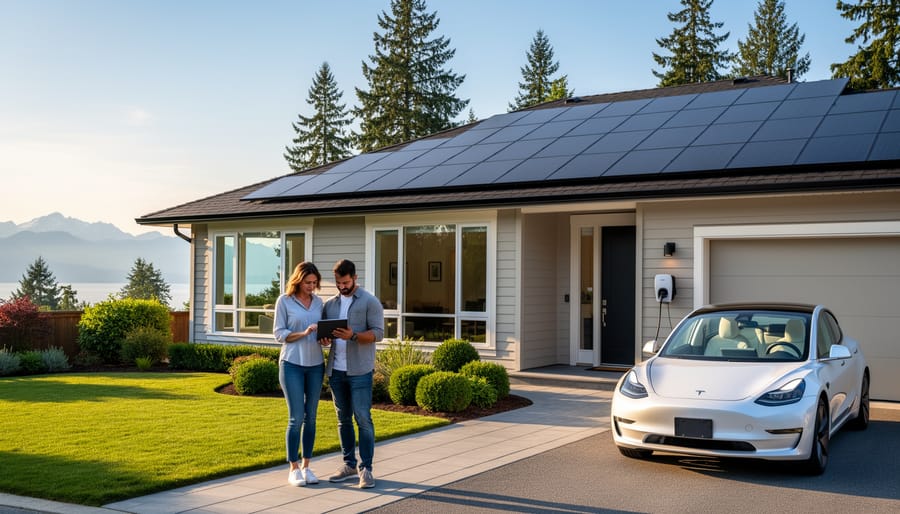
Green housing loans transform solar energy from an expensive dream into an affordable reality for BC homeowners. These specialized financing products offer lower interest rates and favorable terms specifically for energy-efficient home improvements, making your transition to clean energy surprisingly accessible even without significant upfront capital.
Consider this: a typical 6kW solar system in BC costs between $15,000 and $20,000, but through green financing programs, you can start saving on electricity bills immediately while spreading payments over 10-20 years. Many homeowners discover their monthly loan payments are actually lower than their previous electricity costs, creating instant positive cash flow.
BC residents have access to multiple green loan pathways. Credit unions like Vancity and Coast Capital offer dedicated clean energy financing with rates as low as prime plus 1%. The Canada Greener Homes Loan provides up to $40,000 interest-free for qualifying retrofits, including solar installations. Some municipalities have also launched property-assessed clean energy programs that attach loan repayments directly to your property tax bill, simplifying the process and often improving terms.
The key advantage extends beyond attractive rates. Green loans typically don’t require you to tap into home equity lines of credit or refinance your mortgage. They’re structured specifically around energy savings, with lenders understanding that your investment directly reduces operating costs. This targeted approach means faster approvals and terms designed to align with your solar system’s 25-30 year lifespan and energy production guarantees.
What Are Green Housing Loans and How Do They Work?
Green housing loans are specialized financial products designed to help BC homeowners afford energy-efficient upgrades, particularly solar panel installations. Unlike traditional home improvement loans, these eco-friendly financing options reward you for making sustainable choices by offering better terms and lower costs.
At their core, green housing loans work similarly to conventional loans, but with a significant difference: lenders recognize that energy-efficient improvements reduce your ongoing expenses. When you install solar panels, your monthly electricity bills drop, which means you have more income available to repay your loan. Financial institutions acknowledge this improved cash flow by offering lower interest rates, typically 0.5% to 2% below standard loan rates.
Green mortgages allow you to include the cost of solar installations or other energy upgrades directly into your home purchase or refinancing. The lender evaluates your application based on your home’s post-improvement energy efficiency rather than just its current state. This approach often lets you qualify for a larger loan amount because your projected energy savings are factored into your debt-to-income ratio.
Low-interest solar loans specifically target renewable energy installations. These products often come from credit unions, specialized green lenders, or government-backed programs. They typically range from $5,000 to $50,000 with repayment periods of 5 to 20 years.
Qualification criteria for green loans generally mirror traditional lending requirements—good credit score, stable income, and reasonable debt levels—but with added considerations. You’ll need to demonstrate that your planned improvements meet recognized energy efficiency standards. This usually involves an energy assessment or quotes from certified solar installers showing expected energy savings.
Many BC homeowners discover that their monthly loan payments are offset by electricity savings, making solar power affordable from day one. For example, a Victoria family recently shared how their $15,000 solar loan costs them $180 monthly, while their eliminated electricity bill previously averaged $165—meaning they’re building equity in their home for just $15 more per month.
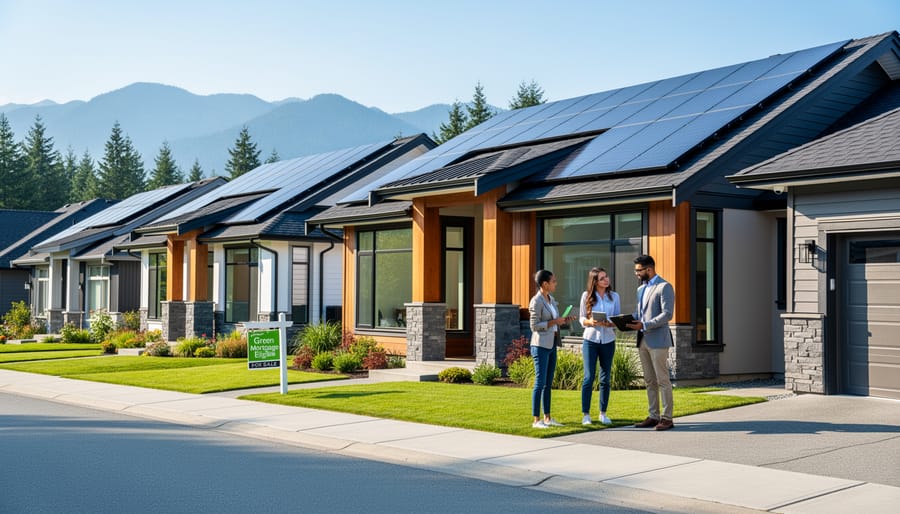
Low-Interest Solar Loans Available in British Columbia
Provincial and Federal Solar Financing Programs
BC homeowners have access to several government-backed financing programs that make solar installations more affordable. Understanding these options can significantly reduce your upfront costs and accelerate your return on investment.
The Canada Greener Homes Loan program offers interest-free financing up to $40,000 for eligible energy efficiency upgrades, including solar panel installations. This federal initiative provides a 10-year repayment period with no interest charges, making it an exceptional option for homeowners ready to transition to solar. To qualify, you’ll need to complete a pre-retrofit EnerGuide home evaluation and ensure your project meets specific energy efficiency criteria.
At the provincial level, BC Hydro has historically offered the Power Smart program, which provides rebates for energy-efficient upgrades. While solar-specific incentives fluctuate, it’s worth checking current offerings as programs are regularly updated to support renewable energy adoption.
The CleanBC Better Homes program complements federal initiatives by offering rebates up to $5,600 for comprehensive home energy retrofits. When combined with solar installations, these rebates can substantially offset project costs. Income-qualified households may access even higher rebate amounts, ensuring equitable access to clean energy solutions.
Most programs require homeowners to work with certified installers and complete energy assessments before and after installation. This ensures quality workmanship and verifies your energy savings. The Pemberton family, for instance, combined federal interest-free financing with provincial rebates to install a 7kW system with minimal out-of-pocket expenses, paying down their loan comfortably through monthly energy savings.
Check program websites regularly, as funding allocations can be limited and eligibility requirements may change annually.
Credit Unions and Banks Offering Solar Loans
Several BC credit unions and community banks have embraced solar financing with competitive loan products designed specifically for renewable energy installations. Coast Capital Savings offers green home improvement loans with rates typically ranging from 5.95% to 8.45%, depending on your credit profile, with repayment terms up to 10 years. This means a $15,000 solar installation could cost around $165 monthly over 10 years.
Vancity Credit Union stands out with their Clean Energy Loan program, featuring preferential rates for solar projects and flexible terms that can extend up to 15 years. Their community-focused approach includes personalized solar financing consultations to help you understand the true payback period when combining loan payments with energy savings.
BlueShore Financial provides unsecured loans up to $50,000 for solar installations, eliminating the need for home equity. What makes these institutions particularly attractive is their understanding of BC’s solar incentive landscape. Many account for provincial rebates and federal grant programs when structuring your loan, effectively reducing your borrowing needs.
Local credit unions often approve applications faster than traditional banks and consider the long-term energy savings in their lending decisions, making solar accessible even for those without significant home equity. Contact multiple lenders to compare rates and find the best fit for your solar journey.
Solar Installer Financing Options
Many BC homeowners don’t realize that going solar can be as simple as choosing financing right at installation. Numerous solar installers across the province have partnered directly with lenders to offer point-of-sale financing, removing traditional barriers to solar adoption. This means when you receive your solar quote, you can immediately explore loan options tailored specifically for your project without visiting multiple banks or filling out countless applications.
These installer partnerships streamline the approval process significantly. During your consultation, installers can present pre-approved financing terms, often within minutes, allowing you to make informed decisions on the spot. This convenience has helped families throughout Metro Vancouver and beyond transition to solar energy faster. For example, a Burnaby family recently secured same-day financing through their installer’s lending partner, starting their solar journey within weeks rather than months. These arrangements typically include competitive interest rates and flexible repayment terms that align with your energy savings, making solar financially accessible from day one.
Green Mortgages: Buying or Refinancing with Solar in Mind
How Green Mortgages Increase Your Buying Power
Energy-efficient homes with solar panels and other green features offer a powerful financial advantage: they can help you qualify for a larger mortgage than you might otherwise obtain. Here’s how it works.
When lenders assess your mortgage application, they calculate your debt-to-income ratio to determine how much you can afford. Green mortgages recognize that energy-efficient homes significantly reduce monthly utility costs, freeing up more of your income for mortgage payments. Many lenders will stretch their standard ratios by 2% for energy-efficient properties, which translates directly into increased buying power.
Consider this practical example: A Vancouver family with a combined monthly income of $8,000 might typically qualify for a mortgage requiring payments of $2,400 per month. With a traditional home costing $250 monthly in utilities, their total housing expenses would be $2,650. However, if they purchase a solar-equipped home with utilities averaging just $80 per month, they’ve saved $170. Lenders can factor these savings into their approval calculations, potentially qualifying the family for an additional $25,000 to $50,000 in mortgage financing.
This approach makes particular sense in BC’s real estate market. A Kelowna couple recently shared how their green mortgage enabled them to purchase a home with a 6kW solar system that was initially beyond their budget. The reduced energy costs meant they could comfortably afford the higher purchase price while actually spending less monthly than they would have in a conventional home. The key is providing documentation of the home’s energy efficiency, typically through an EnerGuide rating or energy assessment report.
Refinancing to Fund Your Solar Installation
If you already own a home in BC, refinancing to access your home equity can be a smart way to fund your solar installation. Green refinancing options allow you to tap into the value you’ve built in your property while potentially securing better interest rates than traditional solar loans.
Home equity typically offers larger loan amounts and lower rates compared to standalone solar loans. For example, a Vancouver homeowner who refinanced their mortgage accessed $25,000 at 4.2% interest to install a complete solar system, compared to solar-specific financing at 6.5%. The monthly payment increase was minimal, but the energy savings were immediate.
Several BC credit unions now offer green refinancing products specifically designed for energy upgrades. These programs often include benefits like reduced closing costs, flexible repayment terms, and the ability to bundle multiple home improvements into one refinanced mortgage. You might combine your solar installation with a heat pump upgrade or better insulation, maximizing your home’s energy efficiency in one go.
The key advantage over standalone solar loans is that mortgage interest rates are generally lower, and you can spread payments over a longer term if needed. However, remember you’re using your home as collateral, so careful financial planning is essential.
Before deciding between refinancing and a dedicated solar loan, calculate your break-even point using online solar savings calculators. Consider factors like your current mortgage rate, remaining amortization period, and projected energy savings. Many BC homeowners find that refinancing makes sense when they have significant equity and can secure favorable rates.
Real Savings: What BC Homeowners Actually Pay
Let’s look at what BC homeowners are actually experiencing when they combine green loans with solar installations. These real-world examples show the true financial picture beyond the initial price tag.
The Thompson family in Victoria installed a 7.5 kW solar system in 2023 for $18,000. They secured a Property Assessed Clean Energy (PACE) loan at 4.5% interest over 15 years, resulting in monthly payments of $138. Their energy savings average $145 per month, meaning they’re ahead by $7 monthly from day one. Even better, their home appraisal increased by $15,000, reflecting the added value of their solar investment.
In Kelowna, single homeowner Janet Chen took a different approach with a smaller 5 kW system costing $12,500. Using a green home equity line of credit at 5.2%, her monthly payment sits at $95. Her summer energy bills have dropped from $110 to just $25, while winter savings average $50 per month. Janet calculates she’s saving approximately $900 annually while building equity in her home through the increased property value.
The Martinez family in Surrey represents a larger-scale success story. Their 10 kW system cost $23,000, financed through a specialized green mortgage refinance at 3.9% over 20 years. Monthly payments are $138, while their energy savings reach $180 during peak summer months and average $155 year-round. That’s a net positive cash flow of $17 monthly, plus they qualified for the Canada Greener Homes Grant, which covered $5,000 of their upfront costs.
What makes these examples particularly encouraging is the consistency of outcomes. All three households achieved positive or near-neutral monthly cash flow immediately, without waiting years to see benefits. Their experiences highlight an important reality: when structured properly, green loans don’t just make solar affordable; they make it financially advantageous from month one.
The key factors in their success included choosing appropriately sized systems for their energy needs, securing competitive interest rates through green loan programs, and maximizing available rebates and incentives. These aren’t exceptional cases requiring perfect circumstances. They represent typical outcomes for BC homeowners who take time to explore their financing options and work with experienced local installers who understand both the technology and the financial landscape.
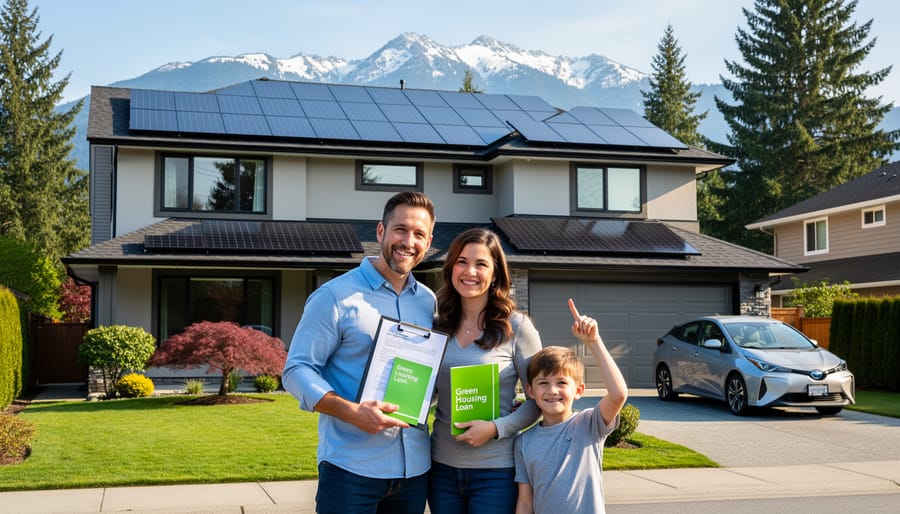
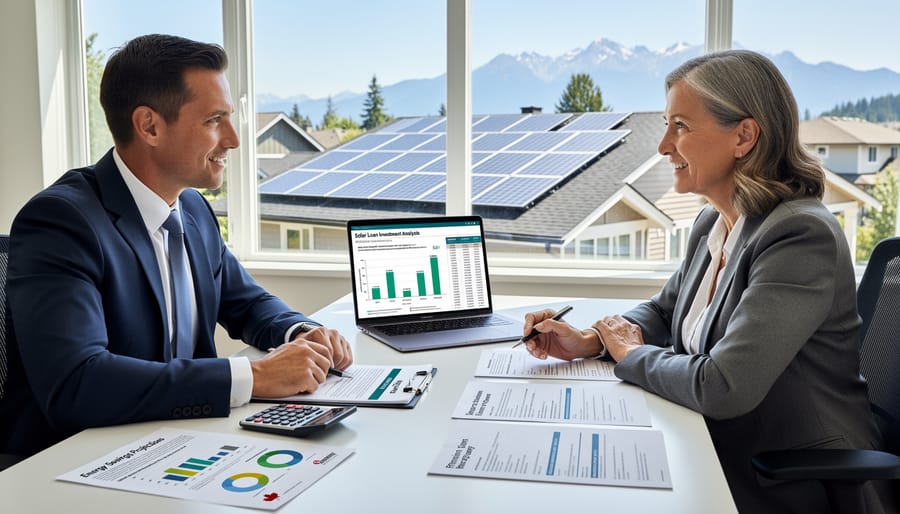
Calculating Your Solar Loan Investment
Key Factors That Impact Your Solar Loan Decision
Several interconnected factors will shape your solar loan decision and determine whether going solar makes financial sense for your household. Start by examining your current energy consumption. Families with higher BC Hydro bills typically see faster payback periods because they’re offsetting more grid electricity with solar generation.
Roof suitability plays a crucial role too. South-facing roofs with minimal shade deliver optimal performance, while east or west orientations still work well but may require adjusted system sizing. The age and condition of your roof matter since you’ll want at least 15-20 years of serviceable life remaining before needing replacement.
Loan terms significantly impact affordability. Interest rates, repayment periods, and whether your lender offers green loan discounts can shift your monthly costs by hundreds of dollars. Compare options carefully, as a lower rate over a longer term often provides breathing room in your budget while maximizing savings.
BC Hydro’s net metering program allows you to bank excess solar production as credits during sunny months and draw on them during winter, effectively using the grid as a battery. This dramatically improves your return on investment.
Finally, investigate available incentives. While federal programs change periodically, rebates and tax credits can reduce your upfront costs by thousands, shortening your payback timeline and making green financing even more attractive.
Using Solar Savings Calculators to Plan Your Investment
Before committing to a green housing loan, it’s essential to understand your potential return on investment. Solar BC offers interactive calculator tools designed specifically for British Columbia properties, helping you make informed financing decisions.
These calculators take into account your location, roof characteristics, current electricity rates, and available incentives to provide personalized estimates. Simply input details like your property’s address, average monthly energy consumption, and roof orientation. Within minutes, you’ll see projected installation costs, estimated annual savings, payback periods, and long-term financial benefits over 25 years.
For example, a Vancouver homeowner using the calculator discovered their 6kW system would save approximately $1,800 annually, with a green housing loan reducing upfront costs significantly. The tool showed their payback period would be just 12 years, compared to 15 years without financing incentives.
These calculators also factor in BC Hydro’s net metering program and federal rebates, giving you a complete picture of your investment. Take 10 minutes to run your own numbers today. You might be surprised at how affordable solar becomes with the right financing, and how quickly your system pays for itself while reducing your environmental footprint.
How to Qualify for a Green Housing Loan in BC
Qualifying for a green housing loan in BC is more straightforward than many homeowners expect. Whether you’re installing solar panels or pursuing other energy-efficient upgrades, understanding the requirements helps you move forward with confidence.
Start by checking your credit profile. Most green loan programs require a minimum credit score between 600 and 680, though some community-focused lenders offer more flexible options. If you’re a homeowner with equity in your property, you’ll have access to additional programs through property tax financing initiatives like the BC Home Owner Mortgage and Equity Partnership.
Next, gather your documentation. You’ll typically need proof of home ownership, recent tax returns, income verification, and an energy assessment or quote from a certified solar installer. Many BC lenders now accept preliminary solar quotes to expedite the pre-approval process, so you don’t need a finalized installation plan before exploring financing.
The application process varies by lender, but generally follows these steps: First, obtain a free energy assessment or solar consultation to understand your project scope. Second, compare loan products from credit unions, banks, and specialized green lenders to find the best rates. Third, submit your application with supporting documents. Fourth, await approval, which often takes 5-10 business days. Finally, coordinate your loan disbursement with your installation timeline.
Consider Sarah from Kelowna, who qualified for a green loan through her local credit union despite being self-employed. By providing two years of tax returns and a detailed solar quote, she secured competitive financing within two weeks. Her experience shows that preparation and clear documentation make the process achievable for diverse financial situations.
Remember, many BC programs prioritize accessibility over perfect credit, recognizing that energy efficiency benefits everyone.
Next Steps: Making Your Solar Dream a Reality
Ready to bring solar energy to your BC home? Here’s your roadmap to make it happen.
Start by connecting with certified solar installers in your community. Solar BC maintains a network of trusted professionals who can assess your home’s solar potential and provide accurate cost estimates. Request quotes from at least three installers to compare system designs and pricing. Ask about their experience with green housing loans and whether they can help coordinate financing applications.
Next, shop around for the best loan terms. Compare offers from credit unions like Vancity and Coast Capital Savings, traditional banks offering green mortgages, and specialized programs like the CleanBC Better Homes loan. Look beyond interest rates to consider factors like prepayment flexibility, loan terms, and whether the lender understands solar projects.
Take advantage of current incentives while they’re available. The federal Greener Homes Grant provides up to $5,000 for solar installations, and provincial programs continue to evolve. Combining these grants with low-interest financing maximizes your savings. Remember Sarah from Kelowna, who reduced her system cost by $8,000 through strategic use of available incentives.
Use Solar BC’s interactive calculator to model your specific savings scenario, factoring in your actual electricity bills and chosen financing option. This personalized projection helps you make confident decisions based on real numbers, not assumptions.
The transition to clean energy starts with a single step. Reach out to a certified installer this week and request your free solar assessment. Your solar-powered future is closer than you think.
Green housing loans have fundamentally transformed solar energy from an ambitious dream into an achievable reality for British Columbia homeowners. Whether you’re drawn to solar for environmental reasons, financial savings, or energy independence, these specialized financing options remove the barriers that once kept sustainable energy out of reach. With interest rates often below traditional home equity products, flexible repayment terms, and programs designed specifically for BC residents, there’s never been a more accessible time to make the switch.
The families across our province who’ve already taken this step are seeing real results—lower electricity bills, increased home values, and the satisfaction of reducing their carbon footprint. Their success stories demonstrate that solar isn’t just for early adopters anymore; it’s a practical choice for everyday homeowners.
The combination of current low rates and available incentives won’t last forever. Take advantage of online solar calculators to understand your potential savings, reach out to local green lenders familiar with BC-specific programs, and connect with your community solar network. Your journey toward energy independence starts with a single conversation. The tools, financing, and support system are all in place—now it’s your turn to join BC’s growing solar community.