
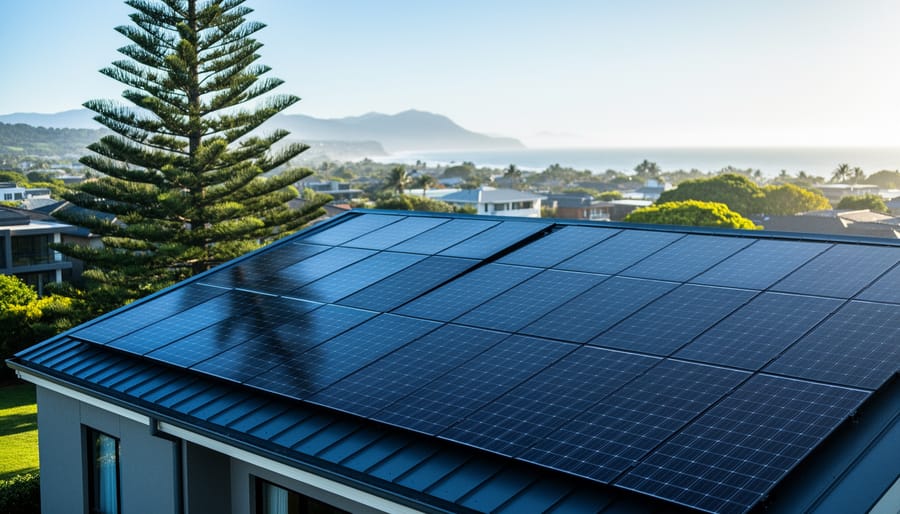
Measure the shadow patterns across your property at four key times: 9 AM, noon, 3 PM, and during winter solstice when shadows stretch longest. Use stakes and string to mark areas where tree shadows fall during these periods, then photograph each location to create a visual baseline. This simple assessment reveals which trees pose immediate concerns versus those that may never impact your solar array.
Calculate your trees’ future height and canopy spread using BC-specific growth rates. A Douglas fir grows approximately 24 inches annually in coastal regions, while Western red cedars add 12-18 inches per year. Map these projections forward 25 years to match your solar system’s lifespan. Trees currently 10 feet from your planned solar location may create significant shading within a decade, while those 40 feet away might remain clear indefinitely.
Document the exact species, trunk diameter, and distance from your proposed solar installation site for every tree within 50 feet. This data allows solar professionals to model precise shade impact over time using specialized software. A 6-inch diameter maple 30 feet south of your roof will affect your system differently than a 12-inch cedar at the same distance, and these calculations determine whether tree management makes financial sense.
Consider selective pruning rather than removal as your first strategy. Strategic limb removal maintains tree health while opening solar windows, and BC municipalities often approve pruning where they’d reject removal permits. Work with certified arborists who understand both tree biology and solar access requirements to identify sustainable solutions that protect your investment without sacrificing your landscape.
What Is Tree Shadowing and Why Should You Care?
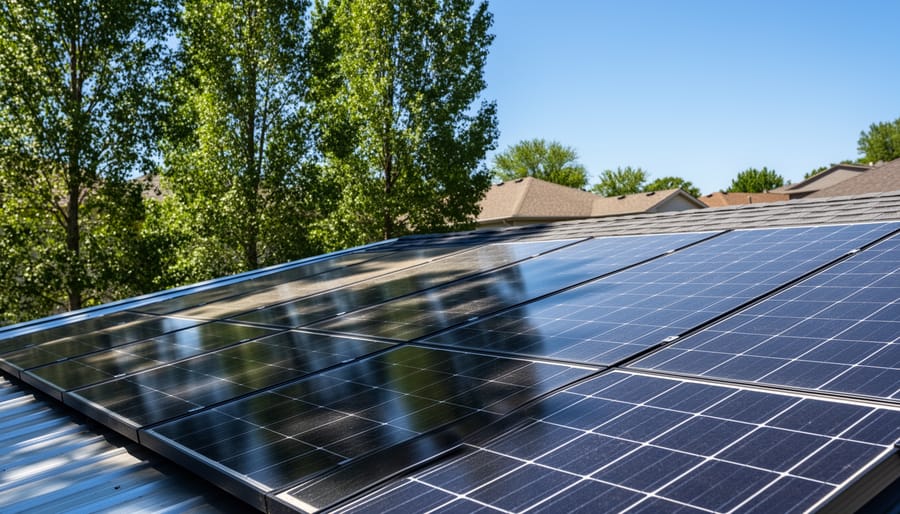
The Difference Between Temporary and Long-Term Shading
Understanding the type of shade affecting your property is essential when planning a solar installation. In British Columbia, shade patterns change throughout the year and evolve as trees mature.
Seasonal shadows occur naturally as the sun’s angle shifts between summer and winter months. A Douglas fir might cast minimal shade on your roof during high summer sun but create significant coverage during winter when the sun sits lower on the horizon. These predictable patterns can be mapped during solar assessments to determine year-round energy production potential.
Growing tree canopies present a different challenge. Young western red cedars or hemlocks may seem harmless now, but these species can grow 30-60 centimeters annually in BC’s climate. A sapling planted 15 feet from your home today could cast substantial shade within a decade, gradually reducing your solar system’s output. Consider the Robinsons in Victoria, who factored their neighbor’s young cedars into their solar design by adjusting panel placement to the south-facing sections of their roof, ensuring 25 years of optimal production.
Permanent shade issues involve mature trees or established forests unlikely to change significantly. A 100-year-old Douglas fir creates consistent, predictable shade that requires strategic system design rather than wait-and-see approaches.
The key distinction lies in planning horizons. Seasonal shade requires smart panel positioning, growing canopies need growth projections and potential management agreements, while permanent shade demands creative solutions like ground-mounted systems or selective trimming that respects both your energy goals and BC’s environmental values.
How Trees Change Over Time (And What That Means for Your Panels)
BC Tree Species and Their Growth Patterns
Understanding the trees on your property is essential when planning a solar installation, especially since the solar panel lifespan can extend 25-30 years. Here’s what you need to know about common BC species and their growth patterns.
Douglas Fir, BC’s iconic evergreen, grows 30-60 cm annually and can reach 60-80 metres at maturity. A young 10-metre Douglas Fir on your property today could be 25 metres tall in 25 years, potentially casting shade where there currently is none.
Western Red Cedar grows more slowly at 20-40 cm per year, typically reaching 45-60 metres. Its dense foliage creates significant shade year-round, making it a key consideration for south-facing roof installations.
Bigleaf Maple, a deciduous option, grows 30-60 cm annually to heights of 15-30 metres. While it drops leaves in winter when solar production is already lower, summer shading can still impact your system’s performance.
Garry Oak grows slowly at 15-30 cm per year, reaching 15-25 metres. Its moderate height and slower growth make it less concerning for most residential solar installations.
Take time to walk your property during different seasons and times of day. Note which trees are closest to your planned solar array and their current heights. A quick measurement using a smartphone app can help you project future growth. This assessment ensures your solar investment remains productive throughout its entire operational life.
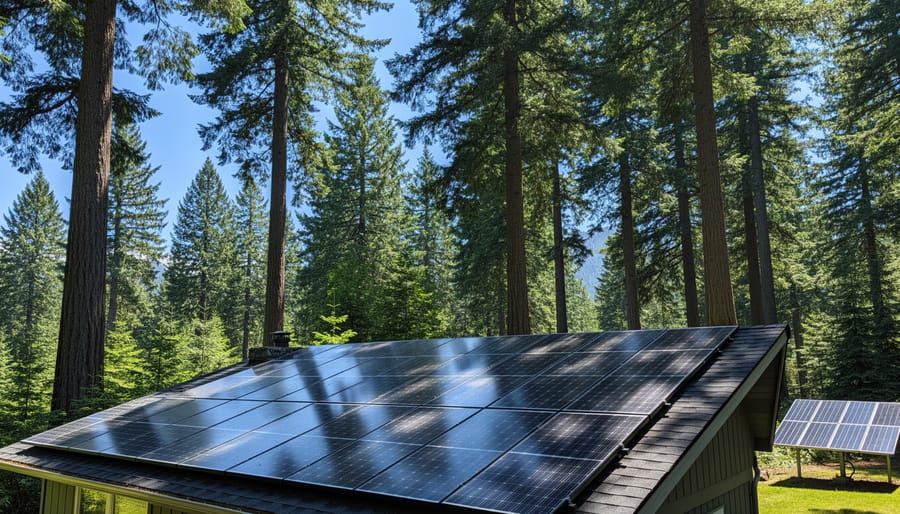
Assessing Your Property’s Long-Term Shade Risk
The Sun Path and Seasonal Variations in BC
British Columbia’s northern latitude—ranging from 49°N in Vancouver to over 60°N in northern regions—creates dramatic seasonal variations in sun paths that directly impact solar panel performance and tree shadowing patterns. During summer months, the sun traces a high, wide arc across the sky, minimizing shadows even from tall trees. However, winter presents a completely different scenario.
From November through February, the sun remains low on the horizon, never rising above 25 degrees in many BC communities. This low angle means trees cast shadows three to four times longer than their actual height. A 15-meter Douglas fir that barely shades your roof in July could blanket your entire solar array in December shade. Since winter already brings reduced daylight hours and BC’s weather challenges like cloud cover, any additional shading from trees significantly compounds energy production losses during months when you need power most for heating.
Understanding these seasonal shadow patterns is essential for accurate solar assessments. A site visit in summer might look perfectly sunny, while winter conditions reveal critical shading issues that could reduce your system’s annual output by 30-50 percent if left unaddressed.
Simple Tools to Map Your Shade Today and Tomorrow
You don’t need expensive equipment to start assessing shade on your property today. Several practical tools can help you understand both current conditions and future shading patterns as your trees grow.
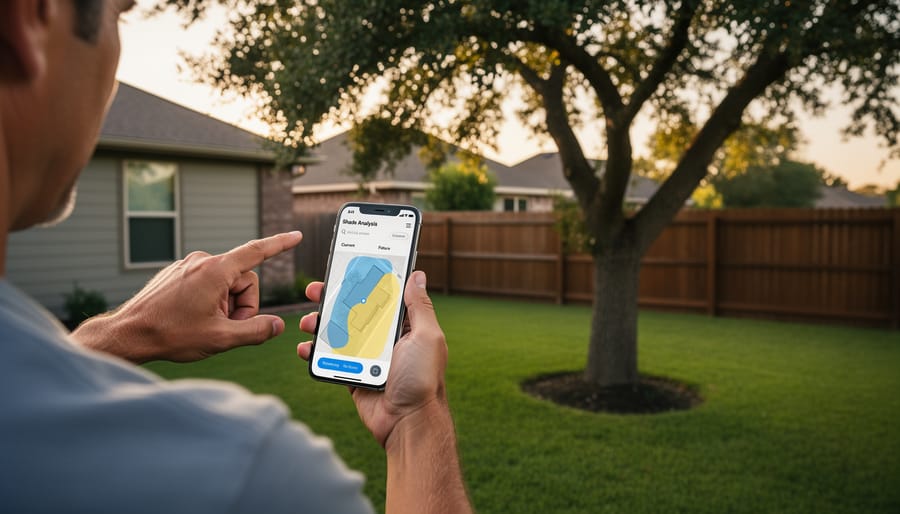
Start with your smartphone. Free apps like Sun Seeker and Sunpath let you visualize the sun’s trajectory across your property throughout the year. Simply point your phone at potential panel locations, and these apps overlay the solar path, showing exactly where shadows will fall during different seasons. They’re particularly useful for identifying problematic morning or afternoon shade that might not be obvious during a single site visit.
For a more comprehensive approach, solar pathfinders provide detailed shade analysis. These dome-shaped tools reflect your site’s horizon, including trees and structures, onto a diagram showing sun paths throughout the year. Many BC solar installers offer complimentary assessments using these devices, giving you professional-grade data about your site’s solar potential.
Consider professional assessment when you’re dealing with complex situations like multiple large trees, properties with varied terrain, or when significant tree trimming decisions are involved. Professional solar assessors use specialized equipment to measure precisely how much shade impacts different roof areas throughout the year. They can also factor in BC-specific considerations like typical cloud cover patterns and seasonal variations.
Take action by documenting your property’s conditions now. Photograph your roof from multiple angles during different times of day across seasons. Mark tree locations and heights on a simple site map. This baseline information becomes invaluable for tracking changes and making informed decisions about your solar investment as your landscape evolves.
Your Options When Trees Threaten Your Solar Investment
Working With BC’s Tree Bylaws and Regulations
Many BC municipalities have tree protection bylaws that require permits before removing or significantly pruning trees, especially mature specimens. These regulations reflect our community’s commitment to preserving urban forests while accommodating development needs. If trees are shading your potential solar installation, you’ll need to navigate these bylaws thoughtfully.
Start by contacting your municipal planning department to understand local requirements. Most communities protect trees above certain diameter thresholds, typically 20-30 cm measured at chest height. Vancouver, Victoria, and many other BC cities require permits for protected tree removal, with applications reviewed by arborists who assess tree health, ecological value, and site-specific factors.
When applying for permits, present a complete picture. Include your solar assessment showing specific shading impacts, proposed tree management alternatives like selective pruning rather than removal, and any professional arborist recommendations. Municipalities often approve permits more readily when applicants demonstrate they’ve explored options that minimize tree loss.
Consider the Richmond case study: a homeowner worked with city arborists to remove one severely declining Douglas fir while preserving two healthy cedars through strategic pruning, achieving 85% solar efficiency while maintaining neighbourhood canopy. This collaborative approach satisfied both energy goals and environmental protection.
If permits are denied, explore alternatives like adjusting your solar array placement, using microinverters to minimize whole-system shading impacts, or planting replacement trees in less problematic locations. Many communities offer tree replacement programs that let you contribute to urban forestry while pursuing your solar investment. This balanced approach honours both your clean energy goals and BC’s environmental values.
When to Trim, When to Remove, and When to Redesign
Understanding your options helps you make choices that honor both your solar goals and environmental values. Here’s a practical framework to guide your decision.
Choose trimming when trees are mature and minimal pruning (removing a few lower branches) would restore 15-20% of shaded area. This works well for established cedars or firs where strategic cuts won’t harm tree health. A Vancouver homeowner recently trimmed two lower branches from a Douglas fir, improving their panel output by 18% while maintaining the tree’s canopy and privacy benefits.
Consider removal when a young, fast-growing tree will inevitably create significant shade within 5-7 years and relocation isn’t possible. However, before removing any tree, check municipal bylaws—many BC communities require permits for trees over certain diameters. One Victoria family chose to remove two young alders after calculating they’d block 40% of their array within a decade, then planted native shrubs as replacements.
Redesign your system when trees provide irreplaceable ecosystem services or heritage value. Moving panels to a less-shaded roof section or adding ground-mounted arrays in sunnier yard areas often proves more sustainable than removing mature trees. A Kelowna property kept their beloved 80-year-old oak and relocated panels to their garage roof, achieving 95% of their original production estimate while preserving neighborhood character.
Real BC Solar Success Stories: Managing Tree Shadowing
Real BC homeowners and businesses are proving every day that tree shadowing doesn’t have to be a dealbreaker for solar energy. Here are three inspiring examples from our province that show different approaches to this common challenge.
The Richmond Retrofit: When Sarah Chen installed solar panels on her East Richmond home in 2019, she faced significant afternoon shading from her neighbor’s 40-foot Douglas fir. Rather than removing the beloved tree, Sarah worked with her installer to position panels on the west-facing roof section that received morning sun and added micro-inverters to minimize the impact of partial shading. The result? Her system still generates 85% of her household electricity needs, saving her approximately $1,200 annually. She notes that understanding her specific shading pattern through a professional solar assessment made all the difference in system design.
The Kelowna Compromise: Okanagan Organic Farms faced a tough decision when planning their 50kW commercial installation. Several mature ponderosa pines on their property’s southeast corner were creating morning shade across their ideal panel location. After consulting with both a solar professional and an arborist, they strategically trimmed lower branches and thinned the canopy without removing the trees. This selective pruning improved solar access by 30% while maintaining the windbreak protection the trees provided for their crops. Their system now offsets 70% of the farm’s energy costs, generating roughly $8,500 in annual savings.
The Victoria Vision: James and Linda Park took a long-term view when installing panels on their Oak Bay home. Their solar assessment identified young maple trees that would eventually shade their roof. They chose to transplant two trees to better locations on their property and entered into a friendly agreement with their neighbor to maintain the third tree at a specific height. Five years later, their system continues performing at 95% capacity, and they’re on track to achieve full payback within seven years while keeping their urban canopy intact.
Planning Ahead: Installing Solar in Treed Properties
If you’re considering solar panels for a property with mature trees or planning new landscaping, a proactive approach can save you thousands and maximize your system’s performance for decades to come.
Start with a comprehensive site assessment before finalizing your solar installation planning. Work with your installer to map out tree positions, species, and projected growth patterns. In BC, fast-growing species like Western Red Cedar can add significant height over a 25-year solar panel lifespan, while slower-growing Arbutus trees present less risk. Request a digital shade analysis that models tree growth over time, showing how shadows will shift as trees mature.
Consider strategic tree management options that balance environmental values with energy goals. Selective pruning of specific branches, rather than removal, often provides sufficient sunlight while maintaining tree health and aesthetics. For new landscaping, choose placement and species thoughtfully. Plant deciduous trees on the south side for summer shade on your home while allowing winter sun to reach panels, and reserve evergreens for north-side windbreaks.
Optimize panel placement by prioritizing the least-shaded roof sections or ground-mount locations. Modern microinverters allow partially shaded panels to operate independently, preventing one shadowed panel from reducing your entire system’s output.
Future-proof your investment by leaving expansion space on unshaded areas. If current tree coverage limits your ideal system size, install what works now with room to add panels after selective pruning or if tree health changes.
The Thompsons in Saanich successfully navigated this challenge by relocating their array 15 feet west and pruning two Douglas Firs, achieving 95% of their energy goals while keeping their cherished trees. With thoughtful planning, your solar investment and natural landscape can thrive together.
Tree shadowing doesn’t have to be a dealbreaker for your solar ambitions. With proper assessment and thoughtful planning, you can harness clean energy while preserving the trees that make BC communities beautiful and healthy. The key is understanding your specific shade situation and working with professionals who can design systems that maximize your solar potential.
Remember that shading challenges have real solutions. Whether it’s strategic tree trimming, optimizing panel placement, adjusting tilt angles, or using microinverters to minimize the impact of partial shade, experienced installers have helped countless BC homeowners overcome similar obstacles. The Sullivan family in Victoria and Oak Bay Community Centre demonstrate that solar and trees can absolutely coexist when you approach the decision with accurate information and expert guidance.
Your next step is simple: get a professional shade assessment. This evaluation will give you concrete data about how current and future tree growth might affect your system’s performance, along with personalized recommendations for your property. Don’t rely on guesswork or online calculators alone when making a long-term investment.
Connect with Solar BC certified installers who understand local tree species, growth patterns, and municipal regulations. These professionals can conduct thorough site assessments, model long-term shading scenarios, and design systems optimized for your unique conditions. Many offer free consultations to discuss your options.
Taking action today means you’ll be generating clean energy sooner while making informed decisions that respect both your environmental values and your energy goals. Your solar journey and your trees can grow together.