
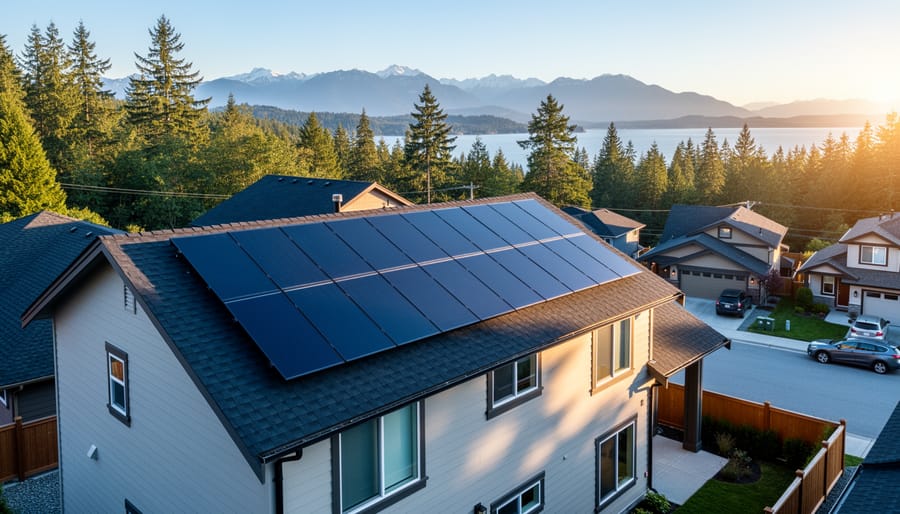
Zero-interest solar loans exist, and they’re transforming how BC homeowners access clean energy without the traditional financial barriers. These financing options eliminate interest charges over loan terms typically ranging from 12 to 24 months, making solar installations genuinely affordable by spreading costs into manageable monthly payments that often match or beat current electricity bills.
The mechanism works through manufacturer and installer partnerships that subsidize the interest cost, betting that removing financial obstacles accelerates solar adoption. In British Columbia, several regional programs and solar companies offer these arrangements, particularly for residential installations between 5kW and 10kW systems. A family in Kelowna recently installed a 7kW system through a 18-month zero-interest program, paying $350 monthly while immediately reducing their BC Hydro bills by $280, creating minimal net impact during the payoff period.
However, understand the conditions: these loans typically require strong credit scores above 680, may include origination fees between 2-5%, and often come with shorter repayment windows than traditional solar financing. Compare the total system cost against standard loans and cash purchases, as some zero-interest offers inflate the base price to compensate for waived interest charges. Calculate your specific savings scenario and verify the installer’s reputation before committing to ensure this accelerated path to solar ownership genuinely serves your financial situation.
What Is a Zero Interest Solar Loan?
The Real Cost: What You Actually Pay
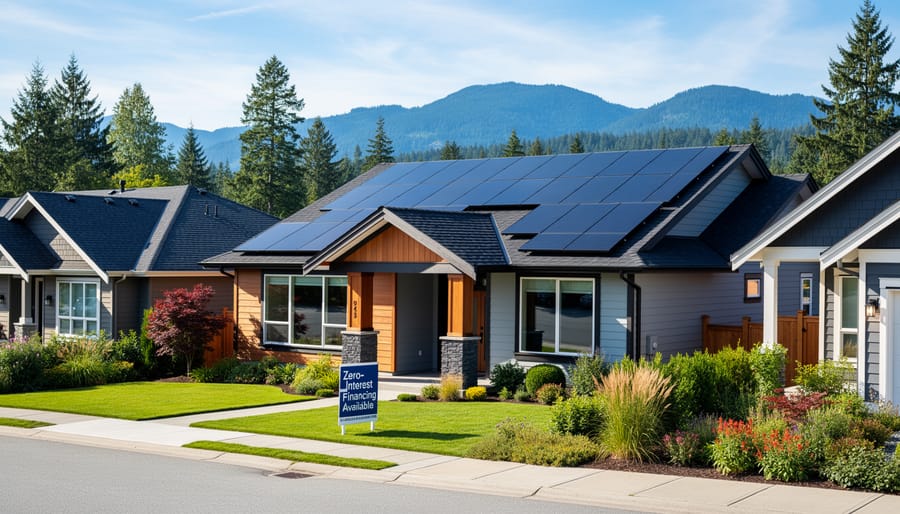
Let’s break down what you’re really paying with a 0% interest solar loan using a realistic BC example.
Consider a Vancouver homeowner installing a 6kW solar system costing $18,000. With a genuine 0% interest loan over five years, your monthly payment would be exactly $300 ($18,000 ÷ 60 months). After five years, you’ve paid precisely $18,000—no more, no less.
Here’s where transparency matters. Some solar lenders advertise “zero interest” but include conditions that can increase your actual cost. Watch for origination fees (typically 2-5% of the loan amount), which might add $360 to $900 upfront. Some programs require automatic payments or charge penalties for early payoff. Others offer 0% interest only if you pay within a promotional period, then jump to standard rates if you carry a balance beyond that timeframe.
A Kelowna family recently shared their experience: their quoted $22,000 system included a $600 processing fee they hadn’t initially noticed. While still a good deal, it meant their true cost was $22,600, not the advertised amount.
Before signing, request a complete fee schedule in writing. Calculate your total repayment amount including all fees. Ask specifically about prepayment penalties, late payment charges, and whether the rate changes if you miss the promotional window. A legitimate 0% loan should clearly state the total amount you’ll repay matches the original loan amount plus any disclosed upfront fees—nothing hidden in the fine print.
Where BC Homeowners Can Find Zero Interest Solar Financing
Provincial and Federal Programs
BC residents have access to several government-backed programs that can make solar energy more affordable. The Canada Greener Homes Grant provides up to $5,000 for eligible solar installations, effectively reducing your project costs before financing even begins. This federal initiative works alongside provincial rebates to lower the financial barrier for homeowners.
To qualify for most government programs, you’ll need to own your home and complete an energy audit through a certified advisor. The application process typically involves three steps: registering your property online, booking a pre-installation assessment, and submitting proof of completed work. Processing times range from 4-8 weeks, so plan accordingly.
Some BC credit unions and municipalities offer additional green energy financing programs with reduced interest rates or special terms for residents who combine federal grants with their loans. For example, a Port Moody family recently combined their Greener Homes Grant with a municipal green loan, cutting their effective financing costs significantly while contributing to their community’s climate action goals. Check with your local government office to discover what programs serve your specific area and how to stack benefits for maximum savings.
Solar Installer Financing Partnerships
Certified solar installers across British Columbia often partner with financial institutions to offer promotional 0% interest periods, making solar energy more accessible to homeowners. These partnerships work by having lenders absorb the interest cost during the promotional window, betting that customers will either pay off the balance or continue with standard interest rates afterward.
When evaluating these installer-lender partnerships, look for transparency in all terms. Reputable installers will clearly explain the promotional period length (typically 12-18 months in BC), what happens when it ends, and any conditions that might void the 0% rate. Ask whether the quoted system price is the same for cash purchases versus financed deals, as some installers may inflate costs to compensate for lender fees.
The Nanaimo Solar Co-op recently partnered with a local credit union to offer members 18 months of interest-free financing, resulting in 47 residential installations in just six months. This community-focused approach demonstrates how collaborative financing can accelerate solar adoption.
Before committing, request written documentation of all terms, compare offers from at least three certified installers, and verify that the installer is accredited through programs like the Solar BC network. Remember, the best financing partnership combines competitive equipment pricing, quality installation standards, and genuinely beneficial loan terms that align with your household budget.
Comparing Zero Interest Loans to Other Solar Financing Options
Traditional Solar Loans (With Interest)
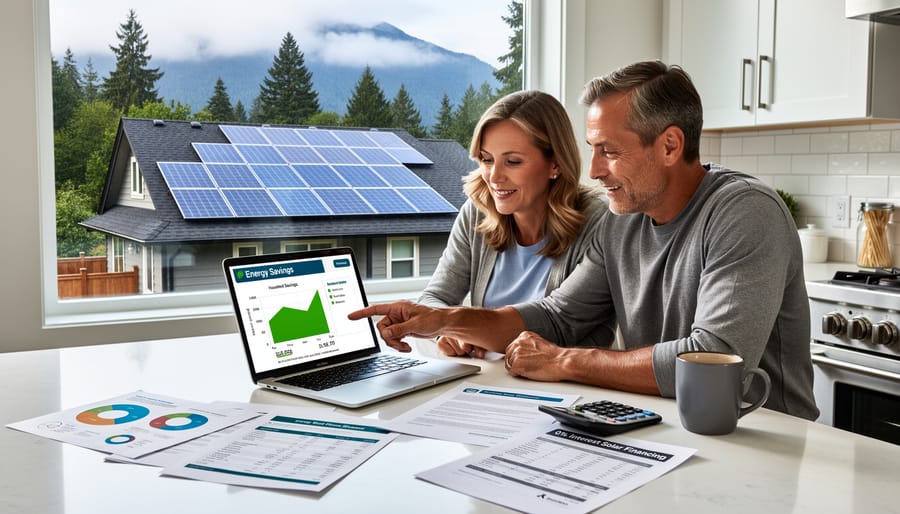
Traditional solar loans with interest rates typically range from 4-8% in British Columbia, which significantly impacts your total cost over time. Let’s look at a practical example: A $20,000 solar system financed at 6% interest over 10 years would cost you approximately $26,640 total—that’s $6,640 in interest charges alone. Your monthly payment would be around $222. Compare this to a 0% interest loan where the same system costs exactly $20,000 with payments of roughly $167 monthly. Over the loan term, you’re paying an extra $55 each month with a traditional loan, money that could instead go toward other energy-efficiency upgrades or household expenses. While traditional loans offer flexibility in choosing your installer and may have fewer restrictions, the interest charges add up considerably, especially on larger commercial installations where the difference can reach tens of thousands of dollars.
Solar Leases and Power Purchase Agreements
Unlike 0 interest solar loans where you own your system from day one, solar leases and Power Purchase Agreements (PPAs) involve third-party ownership. With leases, you pay a fixed monthly fee to use the equipment, while PPAs charge you per kilowatt-hour of electricity produced—often at rates lower than BC Hydro’s.
The trade-off? You won’t benefit from provincial rebates or federal tax incentives since you don’t own the system. Long-term savings are typically lower compared to ownership through solar financing. However, leases and PPAs require zero upfront costs and include maintenance, making them attractive for those wanting immediate savings without financial commitment.
For BC homeowners seeking maximum return on investment and property value increase, ownership through 0 interest loans generally delivers stronger long-term benefits. Leases work best for short-term residents or those unable to qualify for loan programs.
Cash Purchase vs. Zero Interest Financing
Choosing between cash and zero interest financing depends on your financial situation and goals. If you have $20,000-$30,000 readily available without impacting your emergency fund or other investments, paying cash eliminates paperwork and gives you immediate full ownership. You’ll start saving on electricity bills right away with no monthly loan payments.
However, zero interest financing often makes more sense for most BC homeowners. Consider this: if your money is invested earning 5-7% annually, keeping it invested while making interest-free payments means you’re actually gaining financially. A Kelowna family kept their savings in a balanced portfolio and used zero interest financing, effectively earning returns while their solar system paid for itself through utility savings.
Financing also preserves cash flow for unexpected home repairs or other priorities. With BC’s incentive programs reducing total costs, manageable monthly payments typically equal or fall below your previous electricity bills, creating immediate positive cash flow. The key question isn’t whether you can afford to pay cash, but whether that’s the smartest use of your money when free financing is available.
The Hidden Benefits (And Potential Catches)
What to Watch Out For
While 0% interest solar loans offer genuine savings, it’s important to understand the conditions that come with them. Most programs have qualifying requirements you’ll need to meet upfront.
Credit score thresholds typically range from 640 to 680, though some BC programs are more flexible. If your credit needs work, consider improving it before applying to access better terms.
Watch for deferred interest provisions. Some promotions advertise 0% interest but charge retroactive interest on any remaining balance if you don’t pay in full by a specific deadline. Always ask whether the offer is true 0% interest or deferred interest with promotional terms.
Prepayment penalties are rare with solar loans but worth confirming. Most BC financing programs actually encourage early payoff, but reviewing your contract ensures no surprises.
Loan terms matter significantly. A 0% rate over 20 years might carry higher overall costs through fees or insurance requirements compared to a low-rate 10-year loan. Calculate your total payment amount, not just the interest rate.
Finally, be cautious of installers who inflate system prices to offset the financing costs. Get multiple quotes and compare both the equipment costs and financing terms separately. Local BC installers familiar with provincial programs can often provide transparent pricing alongside legitimate 0% financing options.
Real BC Homeowners Who Made It Work
Meet the Johnsons from Kelowna, who transformed their energy bills without spending a dollar upfront. In 2023, this family of four was paying $180 monthly for electricity during winter months and worrying about rising rates. After researching solar options, they discovered a 0% interest financing program through a local installer participating in CleanBC initiatives.
“We were skeptical at first,” admits Sarah Johnson. “Zero interest sounded too good to be true, but our installer walked us through the numbers, and it made complete sense.”
The Johnsons installed a 7.2 kW system for $21,600. With available rebates totaling $4,320, their financed amount dropped to $17,280. Through their 0% interest loan over five years, they pay $288 monthly—but their solar system generates approximately $165 in electricity savings each month, meaning their actual out-of-pocket increase is only $123 monthly.
The decision-making process took them three months. They compared several financing options, checked installer credentials, and reviewed their electricity bills from the past two years. “Understanding our actual usage patterns was crucial,” Sarah explains. “We learned we were paying peak rates during dinner time, which solar production offset perfectly during summer.”
Their biggest lesson? Don’t wait for the perfect moment. “We almost delayed another year, but that would have meant another $2,000 in electricity costs we didn’t need to spend,” Sarah notes.
After 18 months, the Johnsons report their system performs exactly as projected. Once their loan is paid off in three more years, they’ll enjoy $165 monthly in savings with no payments—adding up to nearly $50,000 over the system’s 25-year lifespan.
How to Qualify and Apply
Improving Your Chances of Approval
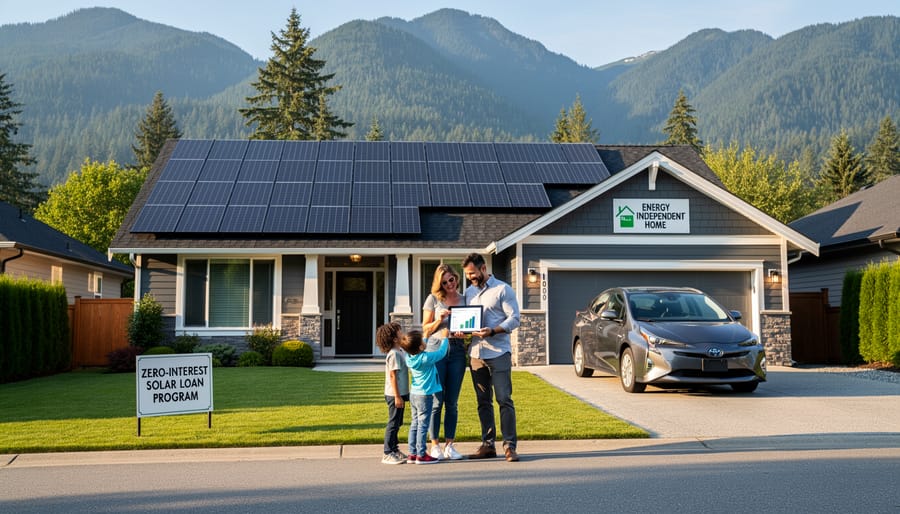
If your credit score needs improvement, don’t let that stop you from pursuing solar. Start by checking your credit report for errors and disputing any inaccuracies—this simple step can boost your score quickly. Pay down existing credit card balances to reduce your debt-to-income ratio, which lenders carefully review. Consider adding a co-applicant with stronger credit, such as a spouse or family member, to strengthen your application. Some BC homeowners have successfully qualified by demonstrating stable employment history and showing documentation of regular bill payments. Shopping around is essential—different lenders have varying credit requirements, and some local programs prioritize environmental impact over perfect credit scores. If you’re still denied, ask about smaller loan amounts or explore BC Hydro rebates to reduce the total financing needed. Building your credit for six months before reapplying can make a significant difference in approval odds.
Calculate Your Potential Savings
Understanding your potential savings starts with three key numbers: your current electricity costs, expected solar production, and loan payment amount. Solar BC’s interactive calculator makes this straightforward, requiring just your recent BC Hydro bill and postal code to generate personalized estimates.
Begin by gathering your last 12 months of electricity bills to determine your average monthly consumption in kilowatt-hours. BC Hydro’s tiered rate structure means higher consumption translates to greater savings potential. Enter this information along with your roof specifications into the calculator, which uses local weather data and solar irradiance patterns specific to your BC location to estimate system production.
Next, the tool factors in your loan details. With a 0 interest solar loan, your monthly payment remains consistent throughout the term, making budgeting predictable. The calculator shows your new monthly total: loan payment minus electricity savings. Many BC homeowners discover they break even immediately, while others achieve positive cash flow within the first year.
The calculator also projects your payback period and lifetime savings. A typical 6 kW system in Vancouver produces approximately 6,500 kWh annually, offsetting $650-800 in electricity costs at current rates. Over a 25-year system lifespan, this represents substantial savings even after loan repayment.
For accuracy, schedule a free assessment with Solar BC’s team. They’ll conduct a detailed site evaluation, considering shading, roof orientation, and your household’s specific energy patterns to refine these estimates and ensure you make an informed decision.
A 0% interest solar loan makes the most sense when you’re ready to go solar now but want to preserve your savings for emergencies or other investments. These programs shine brightest for BC homeowners who qualify through utility rebates, government initiatives, or community lending programs that genuinely offer interest-free terms for a set period.
Before you move forward, take three practical steps. First, use Solar BC’s calculator to estimate your potential savings and see how a loan payment compares to your current electricity bills. Many families discover their monthly loan payment is less than what they’re already spending on power. Second, connect with certified solar installers in your area who can assess your home’s solar potential and explain which 0% financing programs you qualify for. Third, check your eligibility for CleanBC and federal programs that can reduce your overall project cost, making even standard financing more affordable.
The transition to solar is more accessible than ever for BC residents. Whether you choose a 0% interest loan, a traditional solar loan, or another financing path, the key is taking that first step. Your future self, your community, and our environment will thank you for making the switch to clean, renewable energy today.