
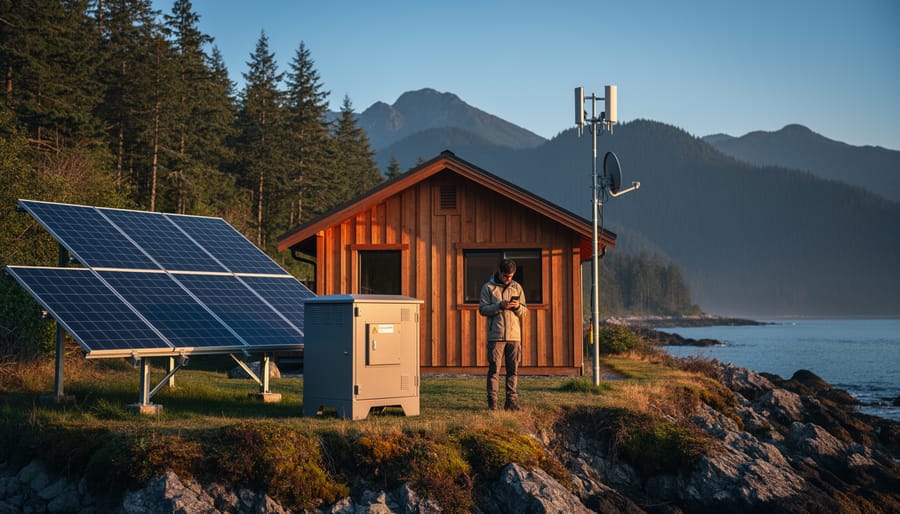
Check your system’s performance daily through a dedicated monitoring platform that tracks solar production, battery charge levels, and energy consumption in real-time. Most modern off-grid systems in BC’s remote regions now include cellular or satellite-connected monitors that send data to your smartphone, alerting you immediately when panel output drops or batteries aren’t charging properly.
Install monitoring equipment that matches your property’s connectivity reality. Properties within cellular range can use affordable 4G-enabled monitors, while truly remote locations need satellite-based solutions or radio-frequency systems that transmit data to a base station. The investment typically ranges from $300 to $1,500 depending on your setup, but prevents costly emergency service calls and system failures that could leave you without power for days.
Track three critical metrics that predict problems before they escalate: daily kilowatt-hour production compared to historical averages, battery state-of-charge patterns throughout each day, and any voltage irregularities that signal failing components. When your Sunshine Coast cabin shows 30% lower production than last month, you’ll know to clear debris from panels before your next visit rather than arriving to dead batteries.
Set up automated alerts for voltage thresholds, low battery warnings, and production anomalies so your system essentially watches itself. A Kootenay homeowner recently avoided a $4,000 inverter replacement by receiving a high-temperature alert that revealed a simple ventilation blockage, catching the issue within hours instead of weeks.
Why Off-Grid Systems Need Your Attention (Even When You’re Not There)
Off-grid power systems operate independently, which means there’s no utility company monitoring performance or dispatching repair crews when something goes wrong. You’re entirely responsible for catching problems before they escalate—and in BC’s remote locations, those problems can develop quickly and quietly.
Battery banks represent your system’s most vulnerable and expensive component. Without proper monitoring, you won’t know if individual cells are deteriorating, if charge cycles are becoming unbalanced, or if temperatures are affecting capacity. A failing battery bank can mean thousands of dollars in premature replacements that could have been prevented with early detection.
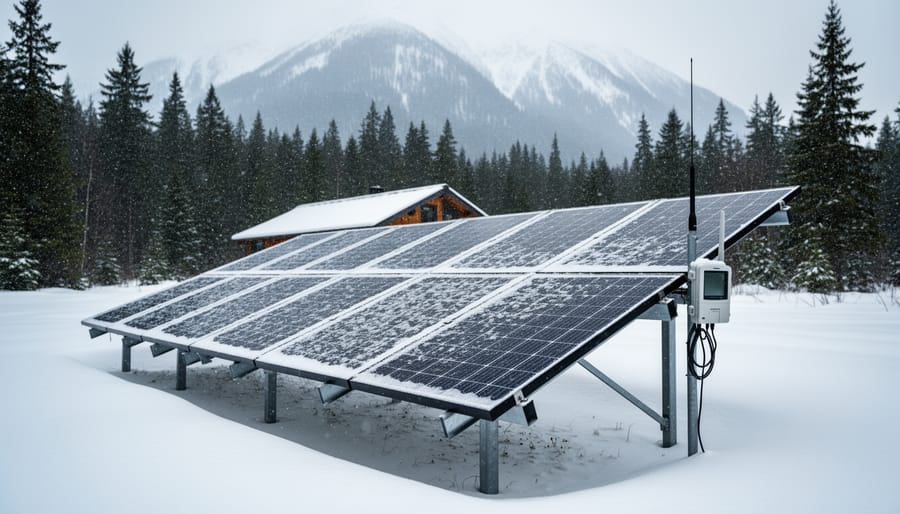
BC’s dramatic weather presents constant challenges. Heavy snowfall in the Interior and Northern regions can blanket solar panels for days, cutting power generation to zero. Coastal storms bring weeks of cloud cover that strain battery reserves. Without real-time data, you might not realize your batteries are critically depleted until you’ve already caused permanent damage through deep discharge.
Equipment failures happen without warning. Charge controllers can malfunction, inverters can overheat, and connections can corrode—especially in BC’s humid coastal climate. A small wiring issue that starts on Monday could leave your entire system offline by Friday if you’re not checking in regularly.
Wildlife interference is surprisingly common in rural BC properties. Bears have damaged panel wiring, rodents have nested in equipment boxes, and birds have left enough debris to significantly reduce panel efficiency. One Sunshine Coast cabin owner discovered raccoons had disconnected several panel connections—his system had been producing at 40% capacity for two weeks before he visited the property.
The consequences extend beyond inconvenience. Spoiled food, frozen pipes, failed security systems, and damage to sensitive electronics all result from power interruptions. For properties generating income through vacation rentals, unexpected outages mean cancelled bookings and unhappy guests. Remote monitoring transforms these risks into manageable alerts, letting you respond proactively rather than discovering problems during your next site visit.
What Remote Monitoring Actually Does for Your System

Real-Time Data That Matters
Modern monitoring systems track four essential metrics that tell you everything about your off-grid system’s health. Think of it like checking vital signs—each one reveals something important about performance.
Battery state of charge is your most critical reading. It shows how much energy remains in your storage system, displayed as a percentage. A healthy off-grid home in BC typically maintains 60-80% charge during normal operation. If you’re consistently dropping below 50%, especially during summer months, it signals you may need more solar capacity or battery storage. One Sunshine Coast family discovered their battery regularly hit 30% each evening, prompting them to add two panels that solved the issue completely.
Solar production numbers reveal how much energy your panels generate throughout the day. On a clear June day in BC’s Interior, expect peak production around midday. Cloudy winter days might show 20-30% of summer output—that’s normal. However, a sudden 40% drop on a sunny day could indicate panel shading or equipment problems requiring attention.
Power consumption tracking shows your household’s energy use in real-time. Most BC off-grid homes use 5-15 kWh daily. Unexpected spikes often reveal forgotten appliances or inefficient equipment worth investigating.
System alerts notify you immediately about problems—low battery warnings, inverter faults, or connection issues. One Kootenay homeowner received a frozen pipe alert during a cold snap, preventing thousands in potential damage. These proactive notifications transform monitoring from passive observation into active system protection, giving you confidence whether you’re home or away.
Getting Alerts Before Problems Become Disasters
Modern monitoring systems act as your system’s early warning network, sending automatic notifications directly to your phone or email when something needs attention. You’ll receive alerts for critical issues like battery levels dropping below safe thresholds, irregular charging patterns, or equipment malfunctions—all before they cascade into expensive repairs or power outages.
These systems typically notify you about battery voltage drops, inverter errors, unusual energy consumption patterns, and component temperature changes. The notifications arrive in real-time, giving you the chance to respond quickly or schedule maintenance during convenient times rather than dealing with emergency situations.
Consider a Sunshine Coast homeowner who received a low battery alert during an unexpectedly cloudy stretch last winter. The notification prompted them to reduce non-essential loads for a few days, preventing a complete system shutdown. Without that warning, they would have faced a costly emergency service call and potential food spoilage during the outage.
Similarly, a Kootenay cabin owner caught a failing charge controller through temperature alerts, replacing it for three hundred dollars instead of dealing with damaged batteries worth several thousand. These practical examples demonstrate how proactive monitoring transforms system management from reactive crisis response into manageable, planned maintenance that protects your investment and ensures reliable power year-round.
Tracking Your System’s Performance Over Time
Your monitoring system becomes more valuable over time as it collects historical data about your off-grid setup. By reviewing months or years of performance records, you’ll spot patterns that help you make smarter energy decisions. For example, a homeowner in the Okanagan discovered through their data that their battery bank consistently underperformed during February and March, prompting a timely replacement before a complete failure.
BC’s distinct seasons create predictable energy patterns. Winter brings shorter days and frequent cloud cover, reducing solar production just when heating demands peak. Your monitoring data reveals exactly how these seasonal shifts affect your system, allowing you to adjust usage habits or plan for generator backup during low-production months.
This historical perspective also helps predict maintenance needs. Gradual declines in panel efficiency or battery capacity become visible through trend analysis, letting you schedule maintenance proactively rather than dealing with emergency repairs. Many BC off-gridders use their annual data to plan equipment upgrades during summer months when installation is easier and backup power needs are minimal.
Remote Monitoring Technology That Works in BC’s Backcountry
The Hardware: Simple Add-Ons to Your Existing System
Adding monitoring to your off-grid system doesn’t require complex installations or expensive overhauls. Most modern systems accept simple plug-and-play devices that connect directly to your inverter or charge controller.
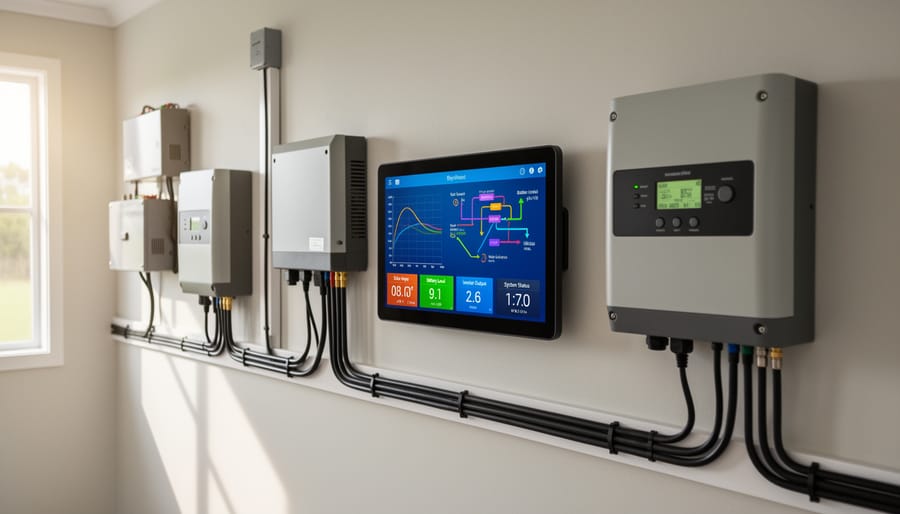
Popular monitoring hardware includes display panels that mount on your wall, showing real-time energy production and battery levels at a glance. Many BC homeowners prefer wireless sensors that transmit data through cellular or satellite connections, eliminating the need for internet infrastructure in remote locations. Brands like Victron Energy, Outback Power, and Schneider Electric offer monitoring devices specifically designed to work with their equipment, ensuring seamless compatibility.
Installation typically involves connecting a small device to your inverter’s communication port—a straightforward process many owners complete themselves in under an hour. For properties beyond cellular range, satellite-based monitoring systems provide reliable data transmission, though they carry slightly higher monthly costs.
When selecting hardware, verify compatibility with your existing inverter and battery brands before purchasing. Most manufacturers provide compatibility charts on their websites. Look for devices with weatherproof ratings if mounting outdoors, and consider battery backup features to maintain monitoring during power fluctuations.
A Sunshine Coast resident recently shared how adding a basic monitoring display helped identify a failing solar panel within days, preventing larger system issues. These simple additions transform how you understand and manage your off-grid power, bringing peace of mind to remote living.
Staying Connected Without Cell Service
Remote monitoring only works when you can actually transmit data from your off-grid system to the outside world. In BC’s truly remote areas, this connectivity challenge requires creative solutions.
Cellular connectivity remains the simplest option where available. Many monitoring systems use cellular modems that consume minimal data—typically under 100MB monthly. Check coverage maps carefully, as even towers shown on carrier maps may provide unreliable signal in mountain valleys. A Sunshine Coast cabin owner found their system worked perfectly despite showing weak signal, while a Cariboo property just 15 kilometres away couldn’t maintain connection. Expect $15-30 monthly for basic data plans.
Satellite internet provides reliable coverage across BC’s most isolated regions. Systems like Starlink offer consistent connectivity for $140-170 monthly, though initial equipment costs $600-800. While pricier than cellular, satellite eliminates the frustration of intermittent connections. Several Haida Gwaii properties now use satellite for both monitoring and household internet, making the cost more justifiable.
WiFi bridges work when your off-grid system sits within a few kilometres of an internet connection. These point-to-point antennas can beam data across valleys or between properties. Initial setup costs $300-600, with no monthly fees beyond your existing internet service. A Gulf Islands homeowner successfully bridges 2.3 kilometres from their main house to a detached solar array.
For properties with absolutely no connectivity options, local data logging still provides value. Systems store performance data onsite, which you review during periodic visits—better than flying completely blind between maintenance trips.
A Sunshine Coast Off-Grid Home That Hasn’t Gone Dark in Three Years
When Sarah and Michael Thompson moved to their property near Sechelt three years ago, they knew their off-grid solar system would be their lifeline. What they didn’t expect was how remote monitoring would transform their experience from anxious uncertainty to confident self-sufficiency.
“We’re about 40 minutes from town, and in winter, we’d worry constantly about whether we had enough power,” Sarah explains. “Now I check my phone while having morning coffee, and I know exactly where we stand.”
The Thompsons installed a 10kW solar array with 30kWh of battery storage, paired with a cellular-based monitoring system that sends real-time data to their smartphones. The investment of $800 for the monitoring equipment seemed significant at first, but it paid for itself within the first year.
Last February, their system detected unusual voltage fluctuations in one battery string at 2 AM. Michael received an alert on his phone and contacted their installer the next morning. “They diagnosed a failing charge controller remotely and ordered the part before we even lost power,” he says. “Without monitoring, we wouldn’t have noticed until the batteries were damaged or we went dark completely.”
That early detection saved them roughly $3,500 in battery replacement costs and prevented a week-long power outage during one of the coldest stretches of winter. The monitoring data also helped their technician troubleshoot the issue without making an expensive site visit, saving another $400 in service charges.
Beyond emergency alerts, the Thompsons use their monitoring data to adjust daily habits. They learned their well pump was their biggest power draw and now run laundry and pumping tasks on sunny afternoons when their panels produce peak power. These small changes extended their system’s capacity by approximately 20 percent without any hardware upgrades.
“The best part is the peace of mind,” Sarah adds. “We travel for work sometimes, and we can check that everything’s running smoothly from anywhere. Our neighbour watches our place, but now he doesn’t need to trek up to check gauges in a snowstorm.”
Three years in, the Thompsons haven’t experienced a single unplanned outage. Their system operates at 94 percent efficiency, and they’ve caught three potential issues before they became expensive problems. For them, remote monitoring isn’t just convenient technology but essential infrastructure for confident off-grid living.
Is Remote Monitoring Right for Your Off-Grid Setup?
When Monitoring Makes the Most Sense
Monitoring delivers the greatest return on investment in specific situations. Vacation properties and seasonal cabins across BC benefit tremendously, as owners can verify system performance between visits and receive alerts before small issues become expensive repairs. If your off-grid system powers essential equipment like well pumps, refrigeration for medications, or livestock infrastructure, real-time monitoring provides peace of mind that critical functions continue operating. Properties with high-value equipment investments, particularly systems exceeding $15,000, justify monitoring costs through early problem detection that prevents component damage. Fully remote locations where physical access requires significant time or expense make monitoring particularly valuable. A Cariboo rancher recently avoided a three-hour drive by identifying and resolving a simple controller setting remotely. For owner-occupied homes with simpler systems and daily visual checks, basic monitoring or manual tracking often suffices without additional technology investment.
What You’ll Invest (And What You’ll Save)
Initial costs for off-grid monitoring systems typically range from $300 to $800, depending on features and connectivity options. Many BC homeowners find cellular-based monitors ideal for remote properties, with data plans averaging $15 to $30 monthly. While this seems like an added expense, monitoring pays for itself by catching issues early.
Consider a Pemberton cabin owner who discovered a failing charge controller through monitoring alerts. The $200 repair prevented a $3,000 battery bank replacement. Most off-grid system owners report saving 20-40% on maintenance costs over five years through early problem detection.
Beyond emergency prevention, monitoring optimizes daily energy use, helping you avoid unnecessary generator runtime. One Hornby Island resident saved $600 annually in fuel costs by adjusting consumption patterns based on monitoring insights. For properties valued at $400,000 or more, protecting your energy investment with monitoring becomes essential insurance. Most systems achieve full ROI within two to three years through avoided repairs and improved efficiency.
Getting Started: Your Next Steps
Ready to bring remote monitoring to your off-grid system? Whether you’re upgrading an existing installation or planning a new one, here’s how to get started.
Your first step is connecting with a qualified installer who understands both off-grid systems and monitoring technology. Solar BC’s installer network includes certified professionals throughout British Columbia who can assess your specific needs. When reaching out, explain your property’s location, current system setup (if applicable), and your monitoring goals. Remote properties require different approaches than those with reliable internet access, so be upfront about your connectivity situation.
During your consultation, ask these essential questions: What monitoring equipment works best for my location and internet availability? Will the system track all components including batteries and backup generators? How do I access the data, and what happens if connectivity drops? What’s included in installation and ongoing support? Can the system alert me to specific problems? Understanding the answers will help you choose the right solution and avoid surprises.
Expect the installation process to take one to three days, depending on your system’s complexity. Your installer will mount equipment, configure software, and walk you through the monitoring interface. They should provide training on interpreting your data and responding to alerts. Many installers offer follow-up support during your first few months as you become comfortable with the system.
Budget between $500 and $2,000 for equipment and installation, though costs vary based on your system size and monitoring features. Consider this an investment in protecting your larger solar investment and avoiding costly emergency repairs.
Don’t wait for problems to appear. Adding monitoring now means you’ll catch issues early, optimize performance year-round, and gain peace of mind knowing your off-grid system is running smoothly, even when you’re away.
Remote monitoring transforms your off-grid solar investment from a hopeful experiment into a reliable energy solution you can trust. For British Columbia property owners managing systems from a distance—whether you’re at a cabin in the Kootenays or overseeing a remote business operation—this technology delivers invaluable peace of mind. You’ll catch problems before they escalate, optimize your energy production throughout BC’s varied seasons, and protect the significant investment you’ve made in energy independence.
The practical benefits extend beyond simple oversight. Real-time data helps you understand your energy patterns, make informed decisions about usage, and extend your system’s lifespan through proactive maintenance. Many BC solar owners have discovered that monitoring pays for itself through prevented downtime and improved efficiency.
Ready to enhance your off-grid system’s reliability? Solar BC connects you with certified installers throughout the province who understand remote monitoring solutions tailored to your specific location and needs. Our network professionals can assess your current setup, recommend appropriate monitoring technology, and ensure your system works optimally year-round. Don’t leave your solar investment to chance—explore monitoring options today and gain the confidence that comes with truly knowing your system’s performance.