
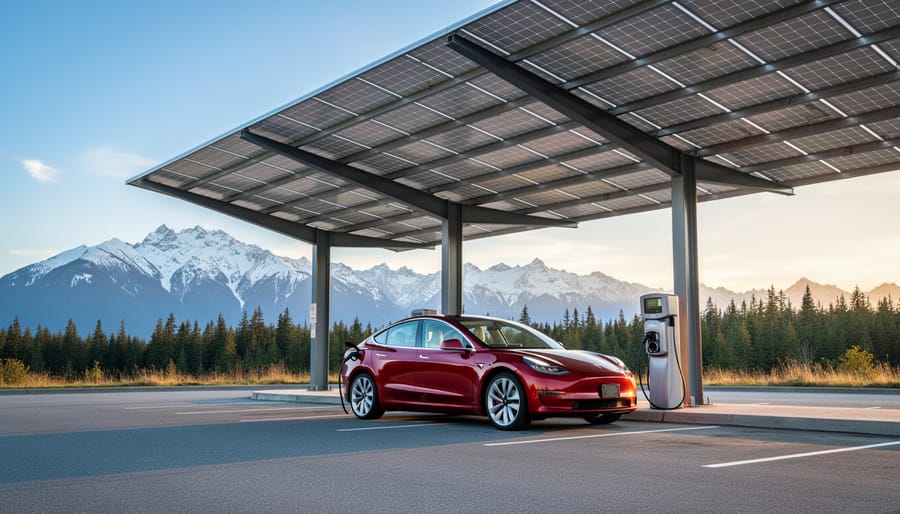
Tesla’s solar-powered charging station concept combines photovoltaic panels with EV charging infrastructure to create a self-sustaining energy ecosystem. The company’s Supercharger stations with solar canopies generate clean electricity on-site, reducing grid dependence and operating costs while supporting their zero-emission vehicle mission.
For BC residents, this technology represents a practical pathway to energy independence. The province’s generous solar incentives, net metering programs, and Feed-in Tariff arrangements make residential and commercial solar charging installations financially viable. Your property can mirror Tesla’s approach by installing rooftop or ground-mounted solar panels connected to a Level 2 home charger, allowing you to power your EV with sunshine rather than fossil fuels.
The economics are compelling. A typical 5-10 kW solar array in British Columbia’s southern regions generates enough electricity to cover 15,000-25,000 kilometers of annual EV driving. Installation costs range from $12,000 to $25,000 before incentives, with payback periods of 10-15 years depending on your electricity rates and driving patterns. Many BC homeowners offset their entire transportation fuel costs within this timeframe.
Local success stories demonstrate this isn’t theoretical. Vancouver Island residents and Lower Mainland businesses have successfully deployed solar charging systems that eliminate their vehicle fuel expenses while contributing excess clean energy back to BC’s grid. The technology works here, the incentives exist, and the environmental impact is measurable. Whether you’re considering an EV purchase or already own one, understanding solar charging options positions you to maximize both economic and environmental benefits.
What Makes Tesla’s Solar Charging Vision Different

The Technology Behind Solar Superchargers
Tesla’s solar-powered charging stations represent a elegant integration of three key technologies working in harmony. At the heart of the system are solar panels installed on canopies or adjacent structures, capturing sunlight and converting it into electricity throughout the day. This energy doesn’t flow directly to vehicles—instead, it’s stored in Tesla Powerwall battery storage units.
Here’s how the energy flows: During peak sunlight hours, the solar array generates electricity that charges the Powerwall batteries. These batteries act as a buffer, storing excess energy for use during evenings, cloudy days, or high-demand periods. When an electric vehicle arrives for charging, power is drawn from the batteries through Tesla’s Supercharger equipment, delivering the rapid charging speeds drivers expect.
The number of solar panels to charge a Tesla depends on several factors, including location and expected charging volume. In British Columbia, where we experience seasonal sunlight variations, the battery storage component becomes especially important—it ensures consistent charging availability even during our darker winter months.
This self-sustaining approach reduces or eliminates reliance on the electrical grid, lowering operational costs and environmental impact. The system essentially creates a miniature power plant, generating, storing, and distributing clean energy on-site. For BC communities considering similar installations, understanding this three-part system—generation, storage, and delivery—is the foundation for planning your own sustainable charging infrastructure.
Current Tesla Solar Charging Locations
Tesla currently operates solar-powered Supercharger stations in select locations globally, though dedicated solar charging stations remain relatively rare. Notable installations include their Supercharger sites in California and Nevada, where large solar canopies generate renewable energy to supplement grid power. However, most Tesla Superchargers still rely primarily on grid electricity, with solar integration varying by location.
In British Columbia and the Pacific Northwest, Tesla has not yet announced dedicated solar-powered charging stations. The region’s existing Supercharger network, which includes locations in Vancouver, Victoria, Kelowna, and along major highways, currently draws power from BC’s hydroelectric grid—already one of the cleanest electricity sources in North America.
The good news for BC residents is that you don’t need to wait for Tesla’s infrastructure. Several businesses and forward-thinking property owners throughout the province have successfully installed their own solar arrays paired with EV charging stations. These local installations demonstrate how solar charging can work effectively in our coastal and interior climates.
While Tesla hasn’t publicly shared specific expansion plans for solar Superchargers in BC, the province’s commitment to clean energy and growing EV adoption makes it an ideal candidate for future solar charging infrastructure. For now, residents interested in solar-powered EV charging can create their own solutions at home or work.
Why Solar-Powered EV Charging Makes Sense for British Columbia
BC’s Solar Advantage You Might Not Know About
You might be surprised to learn that British Columbia receives more solar energy than you’d think. Many people assume our rainy reputation means solar isn’t viable here, but the data tells a different story.
Vancouver receives approximately 1,900 hours of sunshine annually, while the Okanagan enjoys over 2,000 hours. That’s comparable to Germany, a global solar energy leader. Even our cloudier regions generate substantial solar power because solar panels work on cloudy days, capturing diffused sunlight to produce energy.
The Okanagan and Thompson regions offer exceptional solar potential, with some areas averaging 4.5 peak sun hours daily in summer months. Coastal communities like Victoria and the Sunshine Coast receive 3.5 to 4 peak sun hours, making them ideal for solar charging stations. Even Prince George, in BC’s northern interior, generates enough solar energy to support residential and commercial installations year-round.
A Vancouver-based business recently installed a solar carport that powers their electric vehicle fleet, generating 80 percent of their charging needs despite the city’s maritime climate. This success story demonstrates that location doesn’t limit solar viability in BC.
The key consideration isn’t whether BC gets enough sun, but rather designing systems that match your specific region’s solar profile. Modern solar technology maximizes energy capture even in lower-light conditions, making Tesla solar-powered charging stations practical throughout the province. Understanding your local solar potential is the first step toward implementing sustainable charging solutions for your electric vehicles.
Local Success Story: Solar Charging in Action
The Whistler Resort Association made headlines in 2022 when they partnered with a local solar installer to create BC’s first solar-powered EV charging hub at their staff parking facility. The project features a 50-kilowatt solar array paired with six Level 2 charging stations, providing clean energy for employee vehicles year-round.
The upfront investment totaled $145,000, including both the solar panels and charging infrastructure. However, the resort benefits from BC Hydro’s net metering program, which credits them for excess energy fed back to the grid during sunny periods. They also secured a $35,000 incentive through CleanBC’s Go Electric program, reducing their effective cost to $110,000.
In their first full year of operation, the system generated approximately 55,000 kilowatt-hours of electricity, powering over 180,000 electric vehicle charging sessions. The resort now saves roughly $8,500 annually on electricity costs while reducing their carbon footprint by 22 tons per year.
Project manager Sarah Chen shared valuable lessons from the experience: “Start smaller than you think. We initially planned for ten chargers but scaled back to ensure reliable performance. Also, winter production in BC is lower than summer, so size your battery storage accordingly if you want true energy independence.”
The success has inspired three other Whistler businesses to explore similar installations, demonstrating how one local project can spark community-wide momentum toward renewable transportation solutions.
Beyond Tesla: Your Options for Solar EV Charging at Home or Business
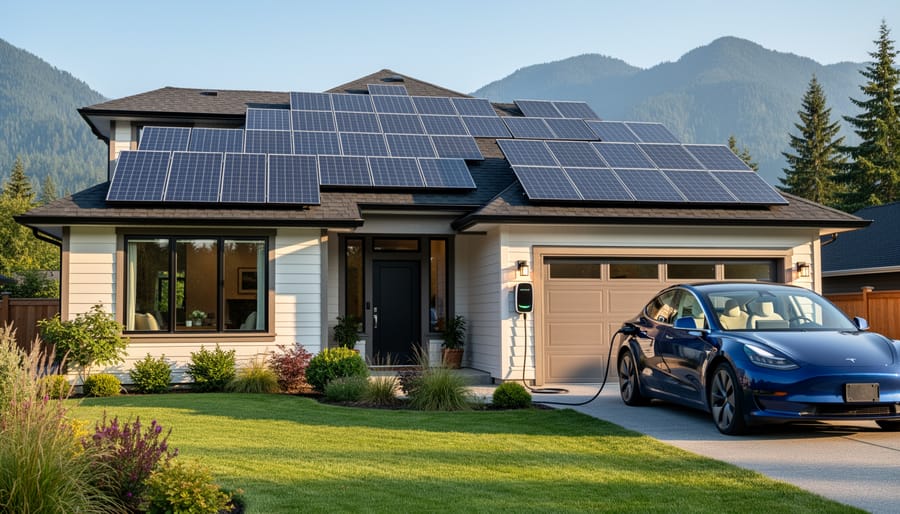
What You’ll Need: Components of a Solar Charging System
Setting up a solar-powered charging station for your Tesla involves four key components that work together seamlessly. Understanding each element helps you make informed decisions for your BC home or business.
Solar panels form the foundation of your system. These photovoltaic panels, typically mounted on your roof or property, capture sunlight and convert it into direct current electricity. In British Columbia, even our cloudy days provide sufficient light for effective solar generation, making this a practical year-round solution.
An inverter transforms the direct current from your panels into alternating current that your home and charging equipment can use. This component acts as the translator between your solar array and electrical system, ensuring compatibility and efficient power flow.
Battery storage options allow you to store excess solar energy generated during daylight hours for nighttime charging or cloudy periods. While optional, batteries provide energy independence and ensure you can charge your Tesla even when the sun isn’t shining. Popular choices include lithium-ion systems that integrate smoothly with residential setups.
A Level 2 EV charger connects directly to your electrical system and charges your Tesla significantly faster than a standard outlet. These chargers work perfectly with solar installations, drawing power from your panels during the day or your battery storage when needed.
When properly integrated, these components create a closed-loop system where sunshine powers your vehicle, reducing grid dependence and lowering your carbon footprint. Many BC homeowners find this combination provides both environmental benefits and long-term cost savings.
Installation Process and Timeline in BC
Installing a solar-powered EV charging station in BC typically takes 2-4 months from start to finish. Your journey begins with an initial consultation where certified installers assess your property’s solar potential, energy needs, and existing electrical setup. They’ll evaluate your roof orientation, shading, and structural capacity to determine the optimal system size.
Next comes the design phase, where installers create a customized plan and submit permit applications to your local authority. BC municipalities generally require electrical and building permits, with processing times varying from 2-6 weeks depending on your location. Your installer will handle this paperwork on your behalf.
Once permits are approved, installation usually takes 1-3 days for the solar panels and another day for the charging station integration. A local inspection follows to ensure everything meets BC Electrical Code standards and safety requirements.
After passing inspection, BC Hydro connects your system to the grid, enabling net metering if applicable. This final step typically takes 2-4 weeks. Throughout the process, reputable installers provide regular updates and coordinate all appointments.
For example, a Vancouver homeowner recently completed their installation in just 10 weeks during summer months when permit processing accelerated. Working with experienced, certified installers familiar with BC regulations ensures a smoother timeline and proper system performance from day one.
Grid-Tied vs. Off-Grid Solar Charging
Grid-tied systems connect your solar panels to BC Hydro’s electrical grid, allowing you to draw power when needed and earn credits through net metering programs. This approach works well for urban locations with reliable grid access and offers lower upfront costs since you don’t need battery storage. Your Tesla charges during sunny days, and the grid supplements power during cloudy periods or at night.
Off-grid solar charging operates independently from the utility company, relying entirely on solar panels and battery storage. This option suits remote properties, recreational areas, or those seeking complete energy independence. While initial investment is higher due to battery requirements, you gain autonomy and protection from power outages.
For most BC residents, grid-tied systems provide the best balance of cost and reliability. However, cabin owners or those in rural areas with limited grid access often benefit from off-grid solutions. Consider your location, budget, and energy independence goals when choosing your system.
The Real Numbers: Costs, Savings, and Payback Period
Upfront Investment for BC Installations
Understanding the upfront costs helps you plan your solar EV charging investment effectively. In British Columbia, residential installations typically range from $15,000 to $30,000 for a complete system. This includes solar panels (averaging $2.50 to $3.50 per watt), a Level 2 EV charger ($800 to $2,500), inverters, mounting hardware, and professional installation.
For commercial properties, expect investments between $40,000 and $150,000 depending on system size and the number of charging stations. Businesses often opt for larger arrays to power multiple vehicles and offset facility energy use simultaneously.
Here’s what influences your final cost: roof condition and type, electrical panel upgrades, permit fees (typically $500 to $1,500), and your chosen equipment quality. BC’s net metering program and federal incentives can significantly reduce these expenses. Many homeowners see 40 to 60 percent cost recovery through available rebates and tax credits.
Local installer Sarah from Victoria notes that most residential clients recover their investment within 8 to 12 years through fuel savings and reduced electricity bills. Getting multiple quotes from certified BC installers ensures competitive pricing while supporting your local solar community.
BC Incentives and Rebates You Can Access Now
BC residents have excellent opportunities to offset the cost of solar installations and EV charging infrastructure through various government programs. The CleanBC Better Homes and Home Renovation Rebate Program offers up to $5,000 for qualified solar installations, while the Canada Greener Homes Grant provides an additional $5,000 at the federal level. These programs can significantly reduce your upfront investment.
For businesses, the Commercial Solar Program through BC Hydro offers incentives for larger installations. Indigenous communities and organizations may qualify for additional funding through dedicated clean energy programs. To access BC solar rebates, you’ll need an energy assessment from a registered advisor before installation begins.
Application steps are straightforward: book your pre-installation assessment, obtain quotes from certified installers, submit your application, and complete installation within the specified timeframe. Keep all receipts and documentation for the post-installation verification. Many BC homeowners have successfully combined these programs, reducing their solar investment by 40-50%. Local installer networks can guide you through the process, ensuring you maximize available incentives while meeting all eligibility requirements for your specific property type and location.
Calculate Your Solar Charging Savings
Understanding your potential savings makes the switch to solar-powered EV charging more tangible. For a typical BC household driving a Tesla Model 3 approximately 20,000 km annually, you’d consume around 3,400 kWh. With BC Hydro’s residential rates, that’s roughly $340 per year in electricity costs. A solar charging setup could offset 70-90% of these costs, depending on your system size and location.
Business fleet operators see even greater returns. A Vancouver delivery company running three electric vehicles reported savings of $2,800 annually after installing a 10 kW solar array. Your actual savings depend on factors like your vehicle’s efficiency, driving patterns, local electricity rates, and available sunlight hours.
Solar BC offers interactive calculators that factor in your specific location, roof orientation, and energy consumption patterns. These tools provide personalized estimates including installation costs, available incentives, payback periods, and long-term savings projections. Simply input your postal code and current energy bills to receive a customized assessment that helps you make an informed decision about solar-powered charging for your situation.
Overcoming Common Concerns About Solar EV Charging
Charging Speed and Reliability
Understanding charging speeds helps set realistic expectations for solar-powered EV stations. Solar panels alone typically generate 5-10 kW in peak conditions, which translates to roughly 25-50 kilometers of range per hour of charging. This works well for overnight charging or workplaces where vehicles park for extended periods, but won’t match the speed of traditional Level 3 fast chargers.
BC’s variable weather means sunny summer days deliver full capacity while winter months or overcast conditions reduce output significantly. This is where battery storage becomes essential. A properly sized battery system stores excess solar energy generated during peak hours, ensuring your charging station remains operational even during cloudy stretches or after sunset. Many BC businesses and community centers already use this approach successfully, maintaining consistent charging availability year-round.
For backup reliability, most solar charging installations remain grid-connected. This hybrid approach means you draw primarily from your solar panels and battery, with the grid providing supplemental power when needed. You’re still dramatically reducing your carbon footprint while guaranteeing your EV never sits uncharged. Think of it as having the best of both worlds: clean energy leadership with practical reliability for BC’s climate realities.
Winter Performance in BC’s Climate
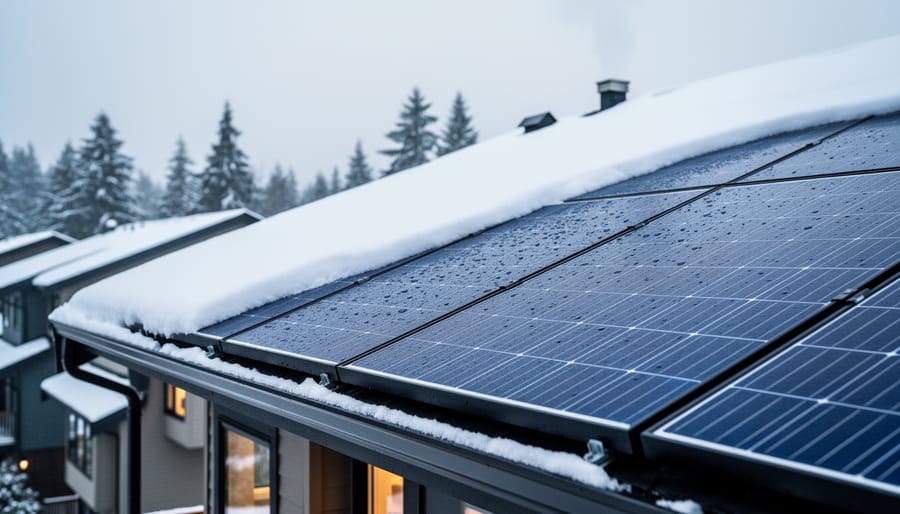
BC’s winter conditions present unique challenges for solar EV charging, but modern systems are designed to handle them effectively. While solar panels do produce less energy during shorter winter days—typically 40-60% of summer output—they actually perform more efficiently in cold temperatures. Snow can temporarily reduce production, but panels installed at optimal angles often shed snow quickly, and the reflective properties of snow on the ground can boost energy generation by up to 25%.
Several BC installations demonstrate winter viability. A Vancouver Island business with a solar-powered Tesla charging station reported their system maintained 55% of summer capacity during December and January, sufficient to charge two vehicles daily when paired with grid connection. In the Lower Mainland, a residential installation continued providing meaningful charging support throughout winter by prioritizing midday charging when production peaks.
Practical winter solutions include installing panels at steeper angles (45-50 degrees) to facilitate snow shedding, pairing solar with battery storage to capture available energy, and maintaining grid connectivity for supplemental power during extended cloudy periods. Most BC solar EV charging systems operate as hybrid setups, maximizing solar use while ensuring reliable year-round charging. With proper system sizing accounting for seasonal variation, winter performance remains economically viable across most of BC.
Solar-powered EV charging represents a practical, achievable solution for British Columbia drivers who want to reduce their environmental impact while enjoying long-term cost savings. Whether you’re inspired by Tesla’s vision of integrated solar charging or simply want to power your electric vehicle with clean energy, BC’s solar resources and supportive programs make now an excellent time to explore this option.
The path forward is straightforward. Start by connecting with certified solar installers in your area who understand BC’s unique climate conditions and can assess your property’s solar potential. Many installers offer free consultations where they’ll evaluate your roof orientation, shading, and energy needs to design a system that works for you. Use online solar calculators to estimate your potential savings and understand the return on investment for your specific situation.
Remember that every solar installation contributes to BC’s broader environmental goals and helps build resilient, sustainable communities. The BC Energy Step Code and CleanBC initiatives continue to make solar energy more accessible, and joining the growing number of households and businesses already benefiting from solar-powered transportation means you’re part of a positive movement.
Take the first step today by researching qualified installers, exploring available incentives, and calculating your potential solar savings. The combination of falling equipment costs, government support programs, and BC’s commitment to clean energy creates an ideal environment for making the switch to solar-powered EV charging.