
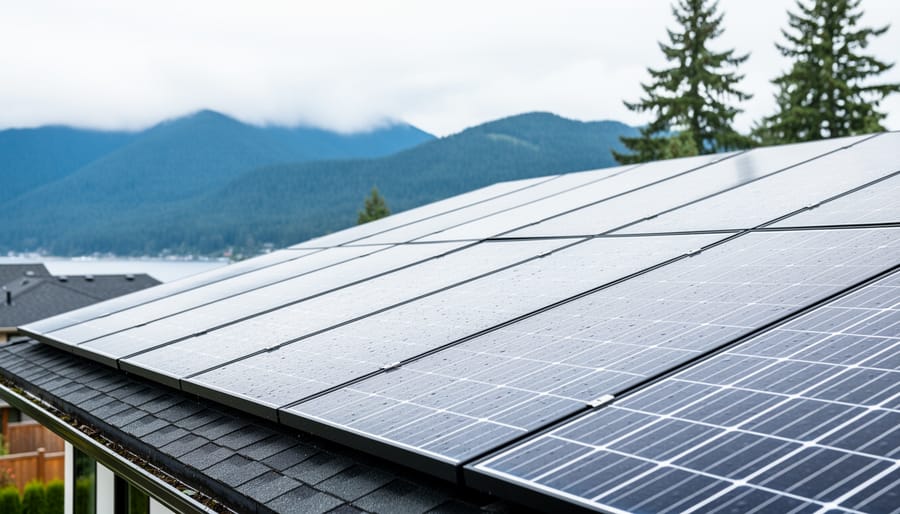
Calculate your solar panel’s efficiency by dividing its maximum power output (in watts) by the product of its surface area (in square meters) and the solar irradiance hitting it (typically 1000 watts per square meter under standard test conditions). This simple equation—Efficiency = (Power Output) / (Panel Area × Solar Irradiance) × 100—gives you a percentage that reveals how well your panels convert sunlight into usable electricity.
Understanding this formula empowers BC residents to make smarter solar investments, especially given our province’s unique weather patterns. A standard 400-watt residential panel measuring 2 square meters achieves 20% efficiency under ideal conditions, meaning it converts one-fifth of available sunlight into power. However, BC’s coastal cloudiness and seasonal variations significantly impact real-world performance, making it essential to account for local solar irradiance data when projecting your system’s output.
Compare efficiency ratings across different panel technologies before purchasing. Monocrystalline panels typically deliver 18-22% efficiency, while polycrystalline options range from 15-17%. Though higher efficiency costs more upfront, it maximizes energy production in BC’s limited roof space and cloudy conditions, ultimately providing better long-term returns for your investment in clean energy.
What the Solar Panel Efficiency Equation Actually Tells You

The Simple Formula Every Solar Owner Should Know
Understanding solar panel efficiency doesn’t require an engineering degree. The basic equation is straightforward: divide your panel’s output power by the input power from the sun, then multiply by 100 to get a percentage. In practical terms, if sunlight delivers 1,000 watts per square meter to your panel (a standard measurement condition), and your panel produces 200 watts, you have 20% efficiency.
Let’s look at a real BC example. On a typical summer day in Kelowna, your roof receives about 1,000 watts per square meter of solar energy at peak sun. If you have a modern 400-watt panel measuring roughly 2 square meters, you’re getting 200 watts per square meter output. Using our formula: 200 ÷ 1,000 × 100 = 20% efficiency. This helps you calculate solar panel efficiency and understand what you’re actually getting from your investment. Most residential panels in BC range between 18-22% efficiency, which is perfectly adequate for generating significant savings on your electricity bills throughout our sunny seasons.
Why Your Panel’s Rated Efficiency Isn’t the Whole Story
When you purchase solar panels, the efficiency rating on the spec sheet represents performance under Standard Test Conditions: a controlled laboratory environment with perfect light at 25°C. Here in British Columbia, your panels will rarely experience these ideal conditions.
Real-world performance varies significantly based on local factors. During our coastal winters, diffuse light from cloudy skies reduces output, though modern panels still generate power on overcast days. Summer heat actually decreases efficiency—panels typically lose 0.3-0.5% efficiency for every degree above 25°C. This means a hot July afternoon might yield less power than a crisp spring morning with similar sunlight.
BC’s diverse microclimates create additional variations. A Vancouver installation faces different conditions than one in the sunny Okanagan or foggy Prince Rupert. Seasonal angles matter too—our northern latitude means dramatic differences between summer and winter sun positions.
Understanding this gap between rated and real-world efficiency helps set realistic expectations for your solar investment. The good news? BC’s moderate temperatures actually favour solar performance compared to hotter regions, and our long summer days provide extended generation periods that help offset winter reductions.
The Real-World Factors That Change Your Efficiency Numbers
Temperature’s Hidden Impact on Your Solar Output
Here’s a surprising advantage for BC solar adopters: cooler weather actually helps your panels perform better. While many assume solar panels thrive in scorching heat, the reality is quite different.
Every solar panel has a temperature coefficient, typically around -0.3% to -0.5% per degree Celsius above 25°C. This means that for every degree the panel heats up beyond this standard temperature, efficiency drops slightly. In hot climates like Arizona, panels can reach 65°C on summer days, losing 15-20% of their rated efficiency just from heat.
BC’s moderate climate provides a real competitive edge. Even during our sunniest summer days, coastal temperatures rarely push panels beyond optimal operating ranges. Interior regions experience more heat, but still benefit from cooler mornings and evenings when panels generate substantial power.
Consider this local example: A Kelowna homeowner noticed their system produced its best output on clear, cool spring days rather than the hottest summer afternoons. This temperature advantage helps BC systems maintain efficiency levels that can actually outperform installations in traditionally sunnier but hotter locations.
When reviewing quotes from installers, ask about the temperature coefficient of proposed panels. Lower coefficients mean better performance in varying conditions, maximizing your year-round energy production across BC’s diverse climate zones.
Light Intensity and Angle: BC’s Seasonal Challenge
British Columbia’s location means the sun’s angle changes dramatically between seasons, directly impacting your solar panel efficiency. In summer, the sun sits high in the sky at nearly 65 degrees, allowing panels to capture maximum energy. Come winter, that angle drops to just 18 degrees, reducing the efficiency equation’s cosine factor and overall output.
This seasonal variation affects different BC regions uniquely. Vancouver Island residents experience milder winter light loss compared to northern communities like Prince George, where the sun barely clears the horizon during December. However, longer summer days in the north can balance annual production. Kelowna’s semi-arid climate offers consistent angles with less atmospheric interference, while coastal areas must factor in how lower angles interact with cloudy day performance.
The practical solution? Most BC installers angle panels between 35-40 degrees to optimize year-round collection. This compromise captures winter’s low-angle light while remaining efficient during summer peaks. Understanding these seasonal shifts helps you set realistic expectations and calculate your system’s true annual performance, not just its peak summer output.
Shading, Dirt, and Age: The Efficiency Killers
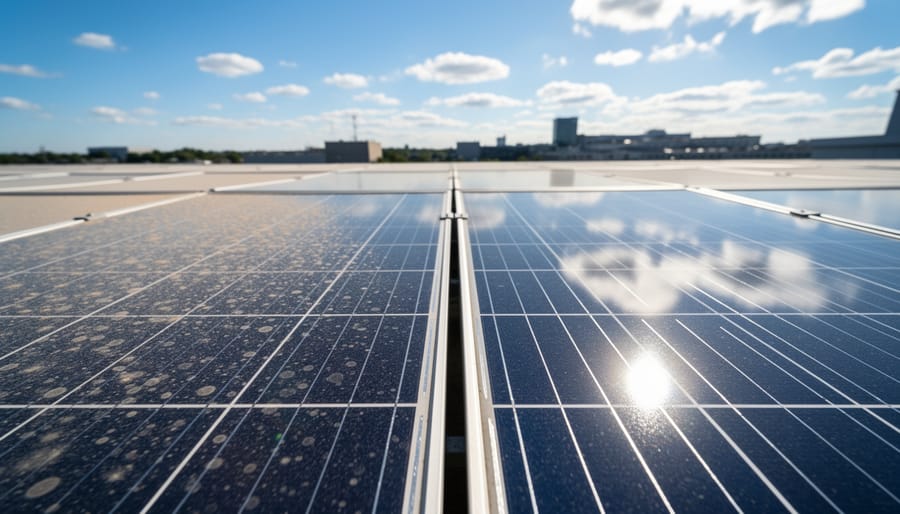
Even the most efficient solar panels lose performance when environmental factors accumulate on their surface. Shading from trees, chimneys, or neighboring buildings can reduce output by 25% or more, as panels work best with direct, unobstructed sunlight. In British Columbia’s climate, dirt, pollen, moss, and bird droppings create a film that blocks light from reaching the photovoltaic cells.
Panel degradation also affects your efficiency calculations over time. Most solar panels lose about 0.5% efficiency annually, meaning a panel rated at 20% efficiency today might operate at 19% efficiency after two years. While this sounds concerning, quality panels still perform at 80-85% of their original capacity after 25 years.
The good news? Simple maintenance keeps your panels performing optimally. BC’s frequent rainfall naturally cleans panels, but an annual professional inspection helps identify issues early. Check for shading patterns as trees grow and seasons change. Consider trimming branches that cast shadows during peak sun hours. One Victoria homeowner increased their system output by 18% simply by cleaning their panels twice yearly and addressing a shading issue from a nearby cedar tree. Regular monitoring helps you maintain the efficiency levels you counted on when calculating your solar investment.
Using Efficiency Equations to Maximize Your Solar Investment
Calculating Your Actual Energy Production
Understanding your solar panel’s potential is easier than you might think. To calculate your actual output, you’ll need just a few key pieces of information specific to your BC location.
Start with the basic equation: Energy Output (kWh) = Panel Wattage × Peak Sun Hours × Efficiency Factor × Days. Your panel wattage is listed on the manufacturer’s specifications. Peak sun hours vary across BC—Vancouver averages 3.5 hours daily, while Interior regions like Kelowna can see up to 4.5 hours during summer months.
The efficiency factor accounts for real-world conditions. Most systems operate at 75-85% of rated capacity due to temperature, shading, and inverter losses. For BC’s moderate climate, use 0.80 as a starting point.
Here’s a practical example: A 400-watt panel in Victoria (4 peak sun hours) would produce: 400W × 4 hours × 0.80 × 365 days = 467 kWh annually. That’s roughly $60 in annual savings at BC’s average electricity rates.
We’ve developed an interactive calculator on our website that automatically factors in your postal code, roof angle, and local weather patterns. Simply enter your system size and location to get a customized projection. This tool has helped hundreds of BC residents make informed decisions about their solar investments, providing realistic expectations based on actual local data rather than generic estimates.
When Higher Efficiency Panels Are Worth the Extra Cost
For BC homeowners with limited roof space, investing in higher efficiency panels often makes financial sense. Let’s break down when the premium is worthwhile using practical examples.
Consider a typical Vancouver home with only 250 square feet of suitable roof area. Standard 17% efficiency panels might generate 4.25 kW of capacity, while premium 22% panels could produce 5.5 kW from the same space. Using BC’s solar incentives and typical electricity rates, that extra 1.25 kW translates to approximately $200 more in annual savings. Over a 25-year lifespan, you’re looking at $5,000 in additional value, often justifying the 15-20% price premium for high-efficiency models.
The Richmond Community Centre faced exactly this scenario in 2022. With architectural constraints limiting their installation area, they chose premium panels. The project achieved a 13-year payback period compared to 17 years with standard panels, demonstrating how maximizing watts per square meter accelerates returns when space is tight.
However, if you have ample roof space and a tight budget, standard efficiency panels often provide better value. A Kelowna farm with 1,000 square feet available chose 18% efficiency panels over 22% models, reducing upfront costs by $3,500 while achieving their energy goals.
The calculation is straightforward: divide the price premium by annual energy gains. If the result exceeds your system’s warranty period, standard panels likely serve you better.
BC Success Story: How One Vancouver Business Used Efficiency Math to Triple Their Savings
When Vancouver-based Green Valley Café decided to go solar in 2022, owner Maria Chen faced a common challenge: how to maximize her return on investment within a modest budget. Rather than simply installing the cheapest panels available, Maria worked with a local solar installer who walked her through the efficiency equation and showed her how small differences in panel efficiency could dramatically impact her long-term savings.
The café’s roof had limited space—only about 300 square feet suitable for solar panels. Maria initially considered standard 17% efficiency panels, which would have generated approximately 4.5 kilowatts. However, after calculating the numbers, she discovered that investing in premium 22% efficiency panels would produce nearly 5.8 kilowatts in the same space—a 29% increase in power generation.
The math was compelling. While the higher-efficiency panels cost $2,800 more upfront, they generated an additional 1,800 kilowatt-hours annually. At BC Hydro’s rates, this meant an extra $270 in savings each year. Combined with federal and provincial incentives, Maria’s payback period actually decreased from 12 years to 9 years, and her 25-year savings tripled from $18,000 to $54,000.
What made the difference? Maria’s installer helped her understand that efficiency wasn’t just about the panels themselves. They optimized the installation angle for Vancouver’s latitude, ensured proper ventilation to prevent heat loss, and positioned the array to capture maximum sunlight during BC’s shoulder seasons when café traffic peaked.
Today, Green Valley Café generates 85% of its electricity from solar, and Maria has become a vocal advocate for efficiency-focused solar planning in her business community. Her advice? Don’t just count panels—count performance per square foot.

Your Action Plan for Solar Efficiency Optimization
Now that you understand how solar panel efficiency works, let’s turn that knowledge into action. Whether you’re a homeowner considering solar or a business looking to maximize your existing system, these practical steps will help you optimize your investment.
Start by conducting a solar site assessment. Walk around your property and note any new shade sources like growing trees or new construction. Take photos of your roof or installation area at different times of day to track sun exposure patterns. This simple observation can reveal optimization opportunities you might have missed.
Next, establish a regular cleaning schedule. BC’s coastal climate means panels can accumulate salt spray, pollen, and debris. A gentle rinse with water every few months can boost efficiency by 5-15 percent. For ground-mounted systems, trim nearby vegetation to prevent shading as plants grow throughout the season.
Monitor your system’s performance using your inverter’s app or monitoring system. Compare your actual output against expected production based on the efficiency equation we discussed earlier. If you notice drops in performance that cleaning doesn’t fix, contact your installer for a professional inspection.
Take advantage of Solar BC’s free resources, including our solar savings calculator that factors in your specific location, roof angle, and local electricity rates. This interactive tool helps you understand your system’s real-world efficiency under BC conditions.
Connect with your local solar community through Solar BC workshops and webinars. Learning from neighbours who’ve optimized their systems provides invaluable insights. Many BC residents have discovered simple adjustments, like changing panel tilt seasonally, that significantly improved their energy harvest.
Finally, keep detailed records of your system’s performance, maintenance activities, and any changes you make. This documentation helps you identify what works best for your specific situation and proves valuable if you ever need warranty service or decide to upgrade your system.
Understanding the solar panel efficiency equation isn’t just about numbers on a page—it’s about making informed choices that benefit your wallet, your community, and our shared BC environment. When you grasp how efficiency impacts your solar investment, you can confidently select systems that maximize energy production in our unique coastal and interior climates, whether you’re navigating Vancouver’s cloudy winters or leveraging the Okanagan’s sunny days.
By applying this knowledge, BC residents and businesses are already reducing their carbon footprint while building resilient, energy-independent communities. The ripple effects are powerful: lower greenhouse gas emissions, reduced strain on provincial grids, and meaningful contributions to British Columbia’s clean energy future.
Ready to turn understanding into action? Solar BC’s interactive calculator tools help you estimate your potential savings based on your specific location and roof conditions. Simply input your details to see how efficient solar panels could work for your property. Better yet, connect with our certified local installers who understand BC’s building codes, permitting processes, and available incentives. They’ll guide you from calculation to installation, ensuring your solar journey is smooth and successful. Take the first step today—your sustainable energy future starts with one informed decision.