
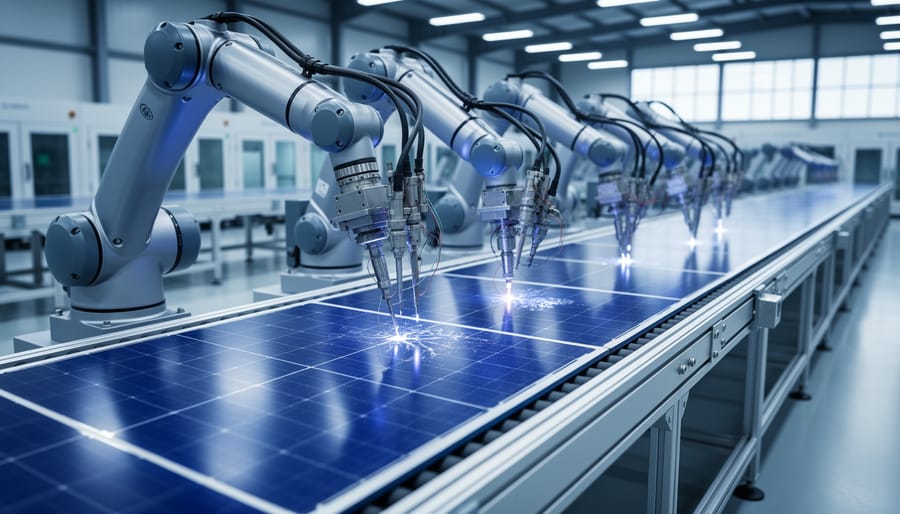
Understanding how solar panels are manufactured empowers you to make informed investment decisions and identify quality products for your British Columbia home or business. The manufacturing process directly impacts panel efficiency, durability, and long-term performance in our unique coastal climate.
Examine the silicon purification standards when reviewing manufacturer specifications, as higher-grade polysilicon produces more efficient cells that maximize energy output even during BC’s cloudier months. Request documentation showing the ingot slicing thickness and wafer quality metrics, since thinner wafers with fewer defects translate to better energy conversion rates for your specific installation needs.
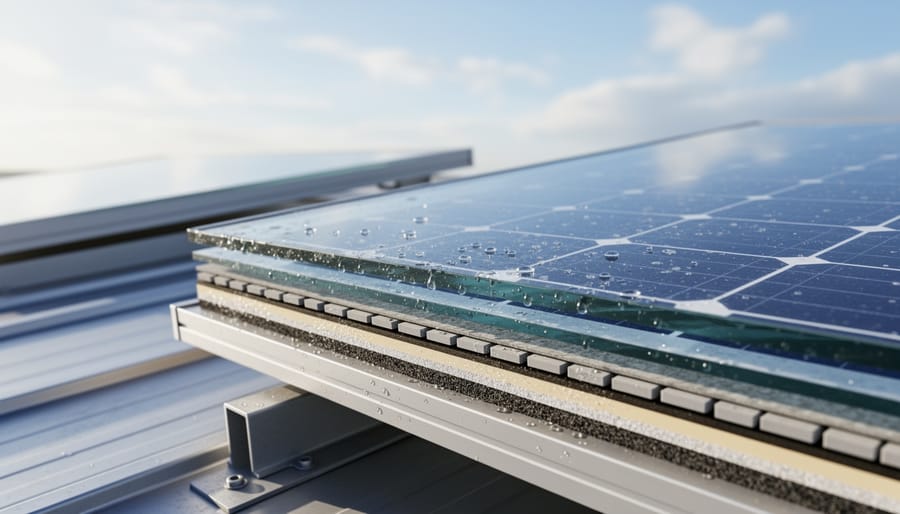
Verify the cell soldering and layering techniques used in assembly, particularly the encapsulation materials and anti-reflective coatings, which determine how well panels withstand moisture and salt air exposure common in coastal regions. Look for manufacturers employing automated precision soldering rather than manual processes, ensuring consistent electrical connections that prevent power loss over decades of operation.
Evaluate the testing protocols documented in manufacturer PDFs, specifically the temperature cycling, mechanical load, and humidity-freeze tests that simulate British Columbia’s seasonal weather patterns. Panels passing rigorous IEC certification standards demonstrate proven resilience against thermal expansion, snow loads, and rain penetration that could compromise your system’s 25-30 year lifespan.
Compare junction box quality and frame materials across different manufacturers, as marine-grade aluminum frames and sealed electrical connections prevent corrosion in BC’s humid environment. This technical knowledge transforms abstract manufacturing specifications into concrete criteria for selecting panels that deliver maximum return on your solar investment while supporting local sustainability goals.
From Sand to Silicon: Where Solar Panels Begin
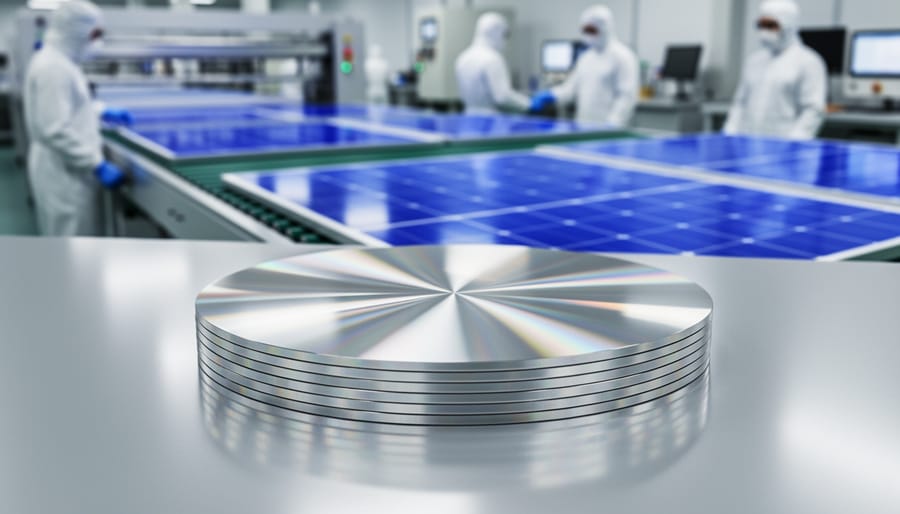
Why Silicon Purity Matters for Your BC Installation
High-quality silicon directly impacts how well your solar panels will perform in British Columbia’s unique climate. When solar modules start with ultra-pure silicon, they convert more of BC’s available sunlight into electricity, even during our cloudier winter months. This matters because panels with higher purity silicon maintain better performance over their 25-year lifespan, delivering consistent returns on your investment.
For BC homeowners, understanding efficiency ratings helps you compare products and choose panels that maximize energy production within your available roof space. Panels made with superior silicon typically achieve 18-22% efficiency, meaning they generate more power per square foot. This becomes especially valuable in coastal areas where marine moisture affects performance, or in northern regions with shorter daylight hours.
Consider the experience of Vancouver’s Green Community Centre, which chose premium panels with high-purity silicon. Despite BC’s rainy winters, their system consistently exceeds production estimates. The upfront investment in quality silicon pays dividends through higher energy output, reduced electricity bills, and greater energy independence for decades to come.
Creating the Solar Cells: The Heart of Your Panels
Monocrystalline vs. Polycrystalline: Manufacturing Differences That Matter
When choosing solar panels for your property, understanding the difference between monocrystalline and polycrystalline manufacturing helps you make the right investment decision.
Monocrystalline panels are made from single silicon crystals grown using the Czochralski process. Manufacturers cut cylindrical ingots into thin wafers, then trim the edges to create the distinctive rounded-corner cells you see in these panels. This process produces higher purity silicon, resulting in efficiency rates of 18-22%. While more expensive to manufacture, monocrystalline panels perform better in low-light conditions, making them ideal for BC’s climate conditions.
Polycrystalline panels use a simpler manufacturing approach. Silicon fragments are melted together and poured into square molds, creating the characteristic blue, speckled appearance. This method is less wasteful and more cost-effective, though it produces slightly lower efficiency rates of 15-17%.
For BC homeowners, the choice depends on your specific situation. If you have limited roof space or want maximum energy production, monocrystalline panels deliver better performance per square foot. However, if you have ample space and want to minimize upfront costs, polycrystalline panels offer excellent value. A Vancouver homeowner recently shared that their polycrystalline system generates enough power to offset 85% of their electricity bills, proving that both technologies work well in our region. Consider getting quotes for both types to compare the long-term return on investment for your property.
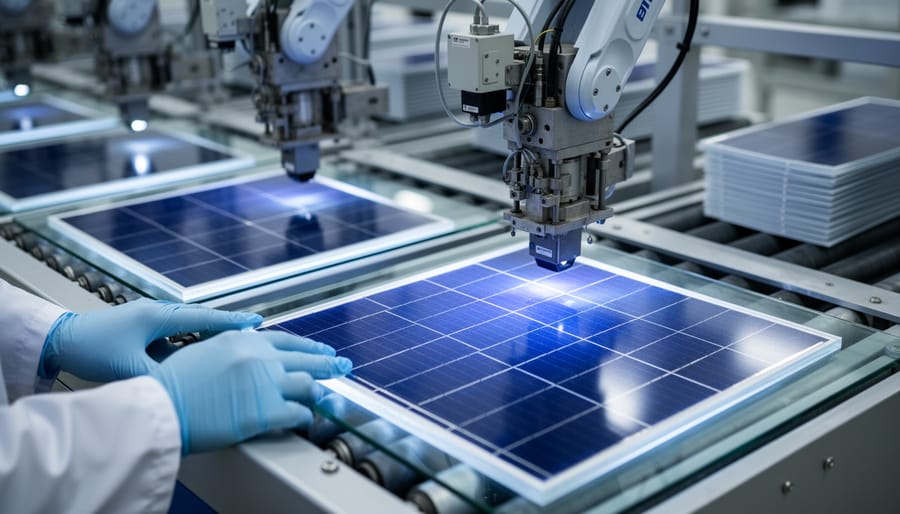
Assembly and Encapsulation: Building Weather-Resistant Modules
Quality Testing That Protects Your Investment
Before solar panels reach your rooftop, they undergo rigorous quality testing to ensure they can handle everything BC’s climate throws at them – from the heavy snowfalls in the Interior to the coastal rain and wind. Understanding these quality measures helps you recognize why reputable manufacturers stand behind their products with 25-year warranties.
Flash testing is the industry standard for verifying each panel’s electrical performance. Technicians expose completed modules to calibrated light that simulates peak sunlight conditions, measuring the actual power output, voltage, and current. This data gets recorded on a specification sheet, so you know exactly what you’re getting. Panels that don’t meet rated specifications get flagged for further analysis or rejected entirely.
Visual inspection catches manufacturing defects that could compromise long-term performance. Trained inspectors examine each panel for cell cracks, discoloration, bubbles in the encapsulation material, or frame damage. Even minor flaws can allow moisture infiltration, which is especially important in BC’s wet climate where water damage could void your warranty.
Environmental stress testing pushes panels beyond normal operating conditions. This includes thermal cycling between extreme temperatures, humidity-freeze testing, and mechanical load testing that simulates snow accumulation and wind pressure. These tests ensure your investment can withstand decades of BC weather patterns.
When reviewing solar quotes, ask your installer about the manufacturer’s quality certifications and testing protocols. Companies that invest in comprehensive quality control produce panels that perform reliably throughout their expected lifespan, protecting your financial investment and environmental commitment.
What Manufacturing Quality Means for BC Solar Buyers
Local Success Story: How Manufacturing Quality Paid Off
The University of British Columbia’s Centre for Interactive Research on Sustainability provides an excellent example of how manufacturing quality translates to real-world performance. Installed in 2012, their solar array has consistently exceeded performance expectations over the past decade, demonstrating how well-manufactured panels maintain efficiency throughout their lifespan.
The facility’s operations manager reports that the panels have retained 96% of their original capacity after ten years, significantly outperforming industry-standard warranties that typically guarantee 80-85% capacity after 25 years. This exceptional performance directly correlates to the rigorous quality control measures implemented during manufacturing, particularly in cell selection, junction box sealing, and lamination processes.
What makes this case particularly relevant for BC residents is the challenging coastal climate. The panels have withstood our region’s heavy rainfall, salt air exposure, and dramatic temperature fluctuations without degradation. This durability stems from proper encapsulation techniques and quality materials used during production, protecting the delicate solar cells from moisture infiltration.
The financial impact has been substantial. The superior performance has generated an additional $47,000 in energy savings compared to projections based on standard degradation rates. For BC homeowners and businesses considering solar investment, this case demonstrates why understanding manufacturing quality matters when evaluating solar options for our unique climate conditions.
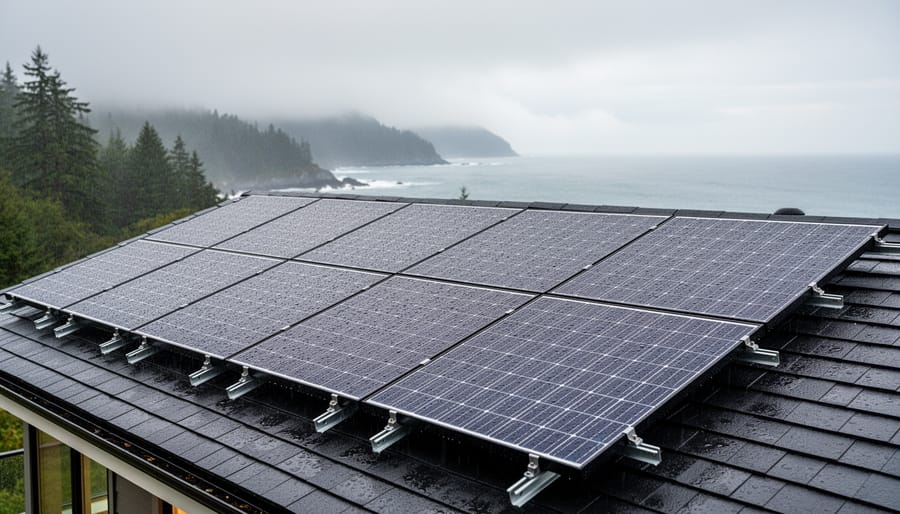
The Environmental Impact of Solar Manufacturing
While solar panel manufacturing does have an environmental footprint, it’s crucial to understand this in context. The production process requires energy and materials, including silicon processing, glass manufacturing, and aluminum framing. However, research shows that most solar panels offset their manufacturing emissions within 1-3 years of operation, then continue producing clean energy for 25-30 years or more.
Here in British Columbia, our abundance of hydroelectric power means panels installed locally offset even cleaner compared to fossil fuel-dependent grids. A typical residential solar system in BC prevents approximately 4-5 tonnes of CO2 emissions annually, equivalent to taking a car off the road.
Modern manufacturers are significantly reducing their environmental impact through several key approaches. Many now use renewable energy in their production facilities, implement water recycling systems, and source materials more sustainably. The industry has cut its energy consumption per panel by over 50% in the past decade.
Looking ahead, recycling initiatives are becoming increasingly sophisticated. European manufacturers have developed processes to recover up to 95% of materials from old panels, including silicon, glass, and metals. As BC’s solar adoption grows, local recycling programs are emerging to handle end-of-life panels responsibly.
The bottom line for BC residents considering solar: while no manufacturing process is impact-free, solar panels repay their environmental cost many times over during their lifetime. When you compare this to the continuous emissions from fossil fuel extraction, processing, and burning, solar represents a dramatically cleaner path forward. Your investment supports an industry committed to improving sustainability at every stage.
Understanding how solar panels are manufactured empowers you to make smarter investment decisions for your home or business. When you know what separates quality modules from inferior ones—from the purity of silicon wafers to the precision of cell assembly and rigorous testing standards—you can ask the right questions before making a purchase.
Before signing any solar installation contract, inquire about panel manufacturing origins and quality certifications. Ask potential installers which brands they recommend and why, what warranties cover manufacturing defects, and whether panels meet IEC and UL certification standards. Request documentation showing tier-one manufacturer status and performance guarantees specific to British Columbia’s climate conditions.
Quality manufacturing directly impacts your system’s long-term performance and return on investment. Panels built with superior materials and stringent quality control will generate more electricity over their lifetime, require less maintenance, and better withstand our coastal weather patterns.
Ready to invest in solar with confidence? Connect with certified Solar BC installers who prioritize quality products and transparent information. Our network of trusted professionals can guide you through selecting panels with proven manufacturing excellence, ensuring your solar investment delivers maximum environmental and financial benefits for decades to come.