
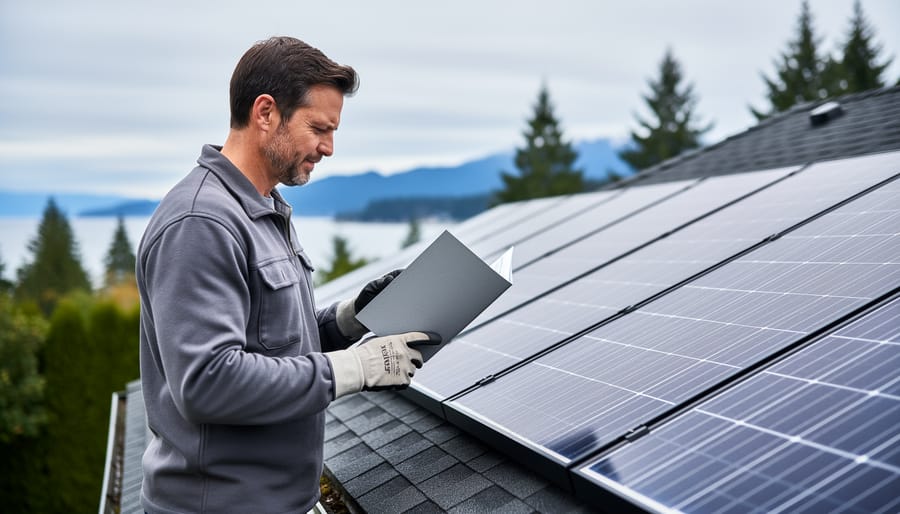
Understand exactly what your solar panel warranty covers before signing any contract. Most solar module warranties include two distinct components: a product warranty covering manufacturing defects (typically 10-15 years) and a performance warranty guaranteeing minimum energy output (usually 25-30 years). Read both documents carefully, as they protect different aspects of your investment and have separate claim processes.
Verify the manufacturer’s financial stability and local service presence in British Columbia. A 25-year warranty means nothing if the company disappears in five years. Research the manufacturer’s track record, check if they maintain regional service centers, and confirm whether your installer will handle warranty claims or if you’ll need to contact the manufacturer directly. BC homeowners have faced significant delays when dealing with overseas manufacturers without local representation.
Document your system’s performance from day one using monitoring tools and keep detailed installation records. Warranty claims require proof that performance degradation exceeds guaranteed thresholds, typically 2-3% in year one and 0.5-0.7% annually thereafter. Take photos during installation, save all invoices and certificates, and track monthly energy production to establish baseline performance.
Review exclusion clauses that void coverage, particularly environmental damage, improper installation, and unauthorized modifications. Many warranties exclude coverage for extreme weather events, salt spray corrosion in coastal areas, or damage from wildfires—all relevant concerns in British Columbia’s diverse climate zones. Ask your installer which exclusions apply to your specific location and whether additional insurance coverage makes sense for your property.
The Two Types of Solar Module Warranties You Need to Know
Product Warranties: Protection Against Defects
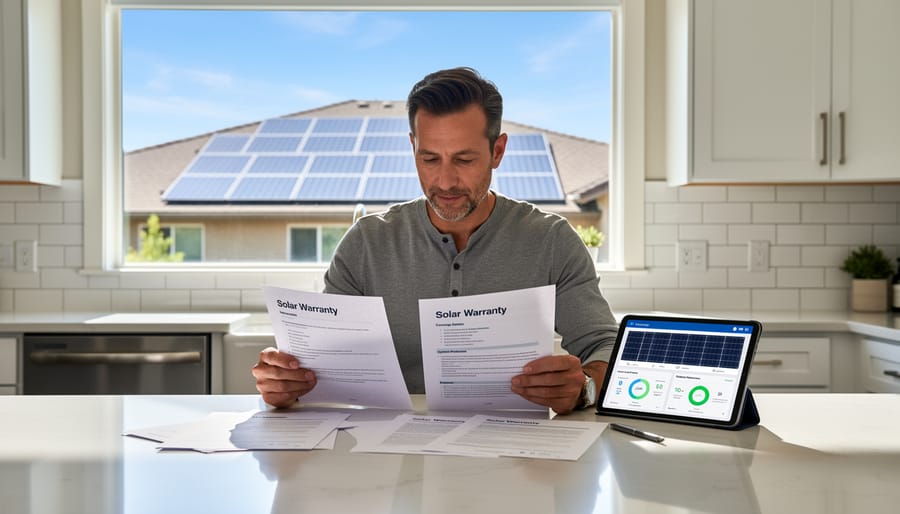
Product warranties protect your solar investment against manufacturing defects and physical problems with the panels themselves. Think of this as your safety net if something goes wrong with how the modules were made or assembled.
In the BC market, most reputable manufacturers offer product warranties ranging from 10 to 25 years, with premium brands typically providing longer coverage periods. These warranties cover issues like cracked glass, frame defects, junction box failures, and problems with the solar cells that aren’t related to normal performance decline.
For example, a homeowner in Surrey discovered hairline cracks in several panels just three years after installation. Because these were manufacturing defects rather than damage from external factors, the product warranty covered full replacement at no cost.
Product warranties specifically address physical integrity issues such as delamination (when panel layers separate), discoloration of the backsheet, or premature degradation of materials. They also cover workmanship problems in how the module was constructed at the factory.
It’s important to understand that product warranties are separate from performance warranties. While performance warranties guarantee a certain power output level over time, product warranties focus on the physical condition and proper functioning of the module components. When comparing solar quotes in BC, always verify both the length and comprehensiveness of product warranty coverage, as this protection can save you thousands in potential replacement costs.
Performance Warranties: Guaranteeing Your Energy Output
Performance warranties protect your investment by guaranteeing that your solar panels will continue generating electricity at specified levels throughout their lifespan. Most manufacturers offer 25-year performance warranties, typically guaranteeing that panels will produce at least 80-85% of their original output by year 25.
Here’s how it works: Solar panels naturally experience degradation, usually losing about 0.5-0.8% of their efficiency annually. Quality manufacturers guarantee this won’t exceed certain thresholds. For example, a standard warranty might promise 90% output after 10 years and 80% after 25 years.
In BC’s climate, which offers excellent conditions for solar longevity due to moderate temperatures, panels often exceed these minimum performance standards. A Kelowna business recently documented their 15-year-old panels still operating at 92% capacity, well above the guaranteed 85% for that timeframe.
If your panels underperform the warranty threshold, manufacturers typically have two options: repair the system, replace defective panels, or provide financial compensation for lost energy production. However, you’ll need proper documentation. Keep your installation records, regular performance monitoring data, and professional inspection reports showing the underperformance isn’t due to shading, debris, or installation issues.
Before purchasing, ask your installer about the specific performance degradation rate guaranteed and the claims process. Understanding these details upfront ensures you know exactly what protection you’re receiving for your solar investment.
What BC Homeowners Should Expect from Their Solar Module Warranty
Industry Standard Coverage in 2024
In 2024, reputable solar module manufacturers typically offer tiered warranties that set clear industry benchmarks. For product warranties covering defects and workmanship, you should expect a minimum of 12 years, though many top-tier brands now provide 15 to 25 years. Performance warranties, which guarantee your panels will maintain a certain power output level, commonly span 25 to 30 years.
Here’s what competitive warranties look like today: panels should retain at least 92% of their original capacity after 10 years and 84% after 25 years. The latest solar panel technology often comes with even better degradation rates, sometimes guaranteeing 90% output after 25 years.
When evaluating solar quotes in BC, compare these benchmarks carefully. A module with significantly shorter warranty periods or lower performance guarantees may indicate lower quality construction. Most established installers working across British Columbia partner with manufacturers meeting or exceeding these standards, giving you confidence that your investment is protected for decades. Remember, a strong warranty reflects a manufacturer’s confidence in their product and provides you with essential long-term security.
Premium vs. Budget Panel Warranties
Premium solar panels typically offer 25-30 year product warranties and 25-year performance guarantees, while budget options often provide 10-15 year product coverage with similar performance promises. The key difference lies in manufacturer stability and claims support. Premium brands backed by established companies are more likely to honor warranties decades from now, whereas budget manufacturers may not survive market changes.
A Vancouver homeowner who chose budget panels in 2015 faced challenges when the manufacturer ceased Canadian operations, making warranty claims nearly impossible. Meanwhile, their neighbor with quality solar modules from a tier-one manufacturer successfully processed a warranty claim within weeks.
The value equation isn’t just about upfront cost. Premium panels with robust warranties protect your 25-year investment, potentially saving thousands in replacement costs. Budget options might save 20-30% initially, but limited warranty support could mean absorbing repair expenses yourself.
Consider your timeline: if you plan to stay in your BC home long-term, premium warranties offer peace of mind. For shorter horizons, budget panels might suffice. Check if warranties are transferable to future homeowners, adding resale value. Review the manufacturer’s financial stability and Canadian presence before deciding. Your solar investment deserves protection that lasts.
The Fine Print: Common Warranty Exclusions That Catch BC Residents Off Guard
Environmental Factors and ‘Acts of Nature’
British Columbia’s unique climate presents specific challenges for solar installations that impact warranty coverage. While solar panels for BC’s climate are designed to withstand local conditions, it’s crucial to understand what warranties exclude.
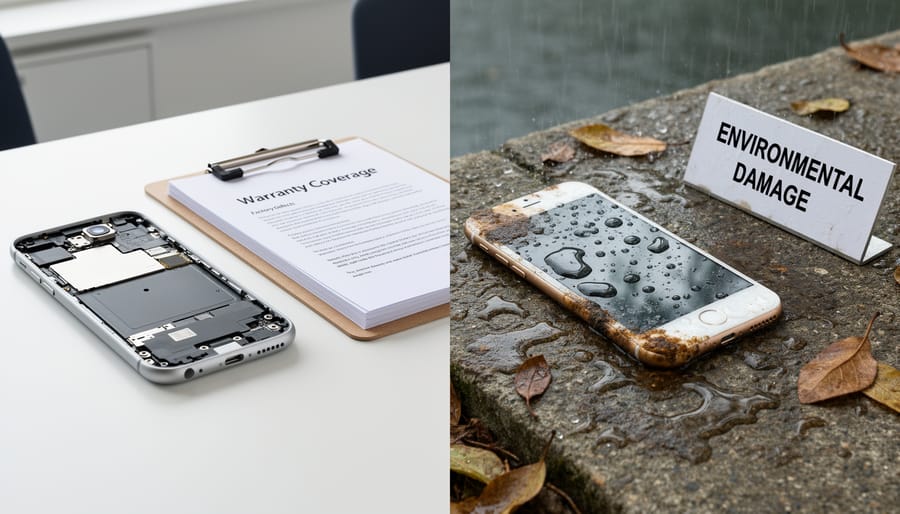
Most manufacturers classify extreme weather events as “Acts of Nature,” which typically aren’t covered under standard warranties. In BC, this includes damage from heavy snowfall in Interior regions, salt air corrosion along coastal areas, and windstorm damage during severe weather events. For example, a Surrey homeowner discovered their cracked panels from a rare hailstorm weren’t covered because the event exceeded specified warranty thresholds.
However, normal wear from typical BC weather conditions should be covered. The key distinction is between expected environmental stress and extraordinary events. To protect your investment, verify your homeowner’s insurance covers solar equipment for natural disasters and ensure proper installation that meets regional building codes for wind and snow loads. Request documentation showing panels are rated for your specific BC microclimate, whether coastal, valley, or mountain regions. This preparation helps prevent disputes when filing claims.
Installation and Maintenance Issues
Your solar module warranty can become void if your system isn’t installed correctly or maintained properly. This is why choosing certified installers matters tremendously for protecting your investment.
Most manufacturers require that installations follow specific guidelines and local electrical codes. When systems are installed by uncertified contractors or as DIY projects, manufacturers often refuse warranty claims, even for legitimate defects. In BC’s climate, where heavy snow loads and coastal moisture present unique challenges, professional installation becomes even more critical.
Consider the experience of a Kelowna homeowner who attempted a self-installation to save costs. When several panels failed after two years, the manufacturer denied the warranty claim due to improper mounting that violated installation specifications. The homeowner faced thousands in replacement costs that proper installation would have prevented.
Regular maintenance also matters. While solar panels require minimal upkeep, neglecting basic care like clearing debris or ignoring obvious damage can void coverage. Most warranties expect reasonable maintenance, though they don’t require professional servicing.
The solution is straightforward: work with certified installers who understand both manufacturer requirements and BC’s specific conditions. Many BC solar companies offer installation warranties alongside product warranties, providing additional peace of mind. Ask potential installers about their certifications, insurance coverage, and track record with warranty claims. This upfront investment in quality installation protects your long-term warranty rights and system performance.
Physical Damage vs. Manufacturing Defects
Understanding the difference between manufacturing defects and physical damage is essential when evaluating your solar warranty coverage. Manufacturing defects refer to issues that arise from faulty materials or workmanship during production. These are covered under your warranty and include problems like delamination (when panel layers separate), internal corrosion, or premature power output decline beyond the guaranteed threshold.
Physical damage, however, falls outside standard warranty coverage. This includes cracked glass from fallen branches, hail damage exceeding the panel’s rated impact resistance, or mounting system failures due to improper installation. For example, a Vancouver homeowner discovered their panels weren’t covered when a windstorm lifted improperly secured modules, causing frame damage.
The key distinction: if the problem existed from day one due to how the panel was made, it’s likely covered. If external forces or improper handling caused the issue after installation, you’ll need to rely on your homeowner’s insurance or installation contractor’s workmanship warranty. Always document your system’s condition immediately after installation and maintain records of regular maintenance to support any future warranty claims.
Real Warranty Claims: What Actually Happens When Things Go Wrong
A Vancouver Island Success Story
When Sarah Chen noticed her solar panels underperforming at her Nanaimo home, she worried about navigating a complicated warranty claim. Instead, the process took just three weeks from start to finish.
What made Sarah’s experience so smooth? She had kept detailed records from day one. Her installation photos, maintenance logs, and monthly production data gave her installer everything needed to quickly identify a manufacturing defect in three panels. The installer handled all communication with the manufacturer, and replacement panels arrived within two weeks.
Her installer’s five-year workmanship warranty also covered the labour costs for removing the faulty panels and installing replacements at no charge. This local support made all the difference, as she had one point of contact throughout the entire process.
Sarah’s key advice for other BC homeowners: photograph your system from multiple angles after installation, keep your inverter monitoring data accessible, and maintain a simple spreadsheet tracking monthly production. She also recommends choosing installers who have been operating locally for several years and can demonstrate their track record with warranty claims.
This real-world example shows that while warranty claims may seem daunting, proper documentation and choosing experienced local installers creates a safety net that actually works when you need it.
When Warranty Claims Get Complicated
Let’s be honest: even with solid warranties, filing claims doesn’t always go smoothly. Understanding potential obstacles helps you prepare and respond effectively.
Manufacturer exits or acquisitions create the most common complication. While rare with major brands, some companies merge or discontinue operations, making warranty claims challenging. Before purchasing, research the manufacturer’s financial stability and ask your installer about their experience with the brand’s claim responsiveness.
Documentation gaps cause many claim denials. Missing installation records, unclear photos of defects, or incomplete maintenance logs can halt the process. From day one, maintain a dedicated folder with all system documents, annual inspection reports, and dated photos of your panels. BC homeowners who establish this habit typically resolve claims within weeks rather than months.
Communication delays frustrate many solar owners, especially when dealing with overseas manufacturers. Set realistic expectations for response times and follow up persistently but professionally. Your installer often serves as your strongest advocate, as they maintain direct industry relationships and understand the technical language required.
When facing resistance, don’t hesitate to escalate through official channels. Document every interaction, request written explanations for any denials, and know that Consumer Protection BC offers resources for resolving disputes. Local solar cooperatives in Victoria and Vancouver also provide community support and shared experiences navigating warranty challenges.
Protecting Your Investment: How Monitoring Services Support Your Warranty

Why Documentation Matters for Warranty Claims
When your solar panels underperform or fail, solid documentation becomes your strongest ally in filing successful warranty claims. Modern monitoring systems continuously track your system’s energy production, creating a digital record that shows exactly when performance declined or stopped. This data proves invaluable when manufacturers require evidence that panels aren’t meeting guaranteed output levels.
Consider a Kelowna business that noticed gradually decreasing energy production over six months. Their monitoring system captured detailed performance data showing a 15% decline, which helped them quickly process a warranty claim for defective modules. Without this documentation, proving the issue would have been nearly impossible.
Beyond supporting claims, monitoring helps you catch problems early—often before they become serious enough to void warranty coverage. Most monitoring apps send alerts when production drops unexpectedly, allowing you to address issues like shading, debris, or equipment failures before they cause permanent damage.
The key takeaway: Install a quality monitoring system from day one and regularly review your production data. Keep records of system performance, maintenance visits, and any unusual weather events. This proactive approach ensures you have compelling evidence ready if warranty issues arise, protecting your solar investment for decades to come.
Regular Maintenance as Warranty Protection
Think of regular maintenance as your warranty’s best friend. Most solar module manufacturers require documented maintenance to keep warranty coverage valid. This typically includes annual inspections, cleaning panels to maintain efficiency, and checking electrical connections. In BC’s coastal regions, where salt air and moisture are common, keeping up with these simple tasks becomes even more important.
A Vancouver Island homeowner learned this the hard way when moss buildup caused hotspots on their panels. Because they couldn’t show proof of regular cleaning, the manufacturer denied their warranty claim. The lesson? Keep detailed records of all maintenance activities, including dates, photos, and any professional service reports.
The good news is that maintenance doesn’t have to be complicated or expensive. Many BC solar installers offer affordable annual check-ups, and some tasks you can handle yourself with basic safety precautions. By staying on top of scheduled maintenance, you’re not just protecting your warranty—you’re maximizing your system’s performance and ensuring those sunny BC days translate into maximum energy savings for years to come.
Questions to Ask Before You Sign: Warranty Checklist for BC Solar Buyers
Before signing any solar contract, arm yourself with these essential questions to protect your investment and ensure you’re getting the coverage you expect.
Start with warranty specifics: Ask your installer exactly how long each component is covered—panels, inverters, batteries, and mounting hardware all have different terms. Request written documentation that clearly states who provides each warranty: the manufacturer, installer, or both. Understanding coverage transfer is crucial if you plan to sell your home, so confirm whether warranties are transferable and if any fees apply.
Dig into the claim process early. Ask how you initiate a warranty claim and what documentation you’ll need. Find out the typical response time and whether your installer handles claims or if you’ll deal directly with manufacturers. This matters significantly in BC, where weather-related issues may require quick resolution. Request examples of how they’ve handled past claims for customers in your region.
Evaluate your installer’s stability by asking how long they’ve operated in BC and for local references you can contact. Since many warranties depend on your installer remaining in business, inquire about their workmanship warranty and what happens if they close. Some BC solar buyers have successfully negotiated extended installer warranties or third-party guarantees for added protection.
Don’t forget about maintenance requirements. Ask what maintenance you must perform to keep warranties valid and whether annual inspections are required. Clarify what routine costs you’ll bear versus what’s covered.
Finally, request everything in writing. A reputable installer will provide clear, written answers to all these questions. If they hesitate or provide vague responses, consider it a warning sign. Your solar investment deserves transparency and solid protection from day one.
Understanding your solar module warranty isn’t just about reading the fine print—it’s about protecting your investment and ensuring your system delivers clean energy for decades to come. Throughout British Columbia, homeowners and businesses who take the time to thoroughly understand warranty coverage, choose certified installers, and maintain their systems properly consistently see the best long-term results.
The key takeaways are straightforward: look for comprehensive product warranties of at least 25 years, performance guarantees that protect against excessive degradation, and installers who offer solid workmanship warranties backed by established track records. Remember that certifications like CEC listing and partnerships with reputable manufacturers provide important safeguards that generic warranties simply can’t match.
Regular maintenance plays a crucial role in keeping your warranty valid. Simple actions like annual inspections, keeping panels clean, and documenting any issues can make the difference between a seamless warranty claim and a denied one. BC’s coastal climate presents unique challenges, from salt air to heavy rainfall, making proper installation and ongoing care particularly important.
Don’t navigate this journey alone. Connecting with qualified BC solar professionals ensures you’re working with installers who understand local conditions, provincial regulations, and warranty requirements. Take the next step today by reaching out to certified solar installers in your area. Request detailed warranty documentation, ask about their claims process, and discuss how they support clients throughout the warranty period. Your solar investment deserves nothing less than comprehensive protection and expert guidance.