

Community solar subscription fees typically range from $10 to $50 monthly, but understanding what you’re actually paying for makes the difference between a smart investment and an unnecessary expense. Before signing any agreement, calculate your projected annual savings by multiplying your allocated kilowatt-hours by your current BC Hydro rate, then subtract all subscription and administrative fees to determine your true net benefit. Request a detailed fee breakdown from providers that separates fixed monthly charges from usage-based costs, and verify whether you’re locked into long-term contracts with early cancellation penalties.
Compare at least three local providers using identical scenarios based on your actual energy consumption, since subscription structures vary widely across British Columbia. Some charge flat monthly fees regardless of production, while others tie costs directly to the solar credits you receive through virtual net metering. Review community solar basics to understand how your subscription translates into bill credits, ensuring the math works in your favor before committing. Look for providers offering transparent pricing with no hidden enrollment fees, transfer charges, or mandatory donation requirements that erode your savings potential.

Understanding Community Solar Subscription Fees
What’s Included in Your Subscription Fee
When you sign up for community solar, your monthly subscription fee covers several essential components that keep the solar farm operating and your benefits flowing. Understanding this breakdown helps you see the real value you’re receiving.
The largest portion of your fee goes toward solar farm maintenance and operations. This includes regular equipment inspections, panel cleaning, vegetation management, and repairs to ensure your solar garden operates at peak efficiency year-round. In British Columbia’s climate, proper maintenance is crucial for consistent energy production through all seasons.
Administrative costs make up another component, covering billing services, customer support, and coordination with BC Hydro for virtual net metering credits. These credits are the heart of your financial benefit—they appear on your electricity bill as reductions based on your share of the solar farm’s production.
Infrastructure investments are also built into your fee, funding the ongoing development and improvement of solar facilities. Some providers in BC allocate a portion toward expanding renewable energy access to underserved communities, aligning with broader environmental justice goals.
Finally, your subscription supports grid integration services that ensure seamless connection between the solar farm and the provincial electricity network. This technical coordination is what makes virtual net metering possible, allowing you to benefit from solar energy without rooftop panels.
Most transparent providers offer a detailed fee breakdown in your subscription agreement. When comparing options, ask for itemized costs to understand exactly where your money goes and how it translates to savings on your monthly energy bills.
Common Fee Structures in BC
Community solar providers in BC typically use one of three pricing models to structure their subscription fees. The most straightforward approach is a fixed monthly fee, where you pay a set amount regardless of energy production fluctuations. This model offers predictability, with fees typically ranging from $15 to $50 per month depending on your subscription size.
The second common structure is a per-kilowatt-hour rate, where you pay based on the actual energy your share of the solar array produces. This rate is usually set below your current utility rate, ensuring immediate savings. For example, if BC Hydro charges you 14 cents per kWh, your community solar rate might be 12 cents per kWh, generating savings from day one.
Many BC providers have adopted a hybrid approach that combines elements of both models. You might pay a small base subscription fee plus a discounted per-kWh rate for the energy credits you receive through virtual net metering. This structure balances revenue stability for the solar project while keeping costs transparent for subscribers.
Understanding which model works best for your situation depends on your energy consumption patterns and budget preferences. Most providers offer calculators to help you estimate your monthly costs and savings under their specific fee structure.
How Virtual Net Metering Works With Your Subscription
The Credit Flow: From Solar Farm to Your Bill
When you subscribe to a community solar farm, you’re essentially reserving a portion of the panels that generate clean electricity on your behalf. Here’s how those solar credits flow from the farm to your monthly utility bill.
First, your allocated solar panels capture sunlight and convert it into electricity throughout the month. The solar farm measures this production and reports the total kilowatt-hours (kWh) generated by your share to your utility provider. This is where virtual net metering comes into play—a system that tracks and applies your solar credits even though the panels aren’t physically on your property.
Your utility company receives these production records and converts them into dollar-value credits based on BC’s current electricity rates. These credits then appear directly on your regular electricity bill, typically as a line item showing “community solar credits” or similar wording. The credits offset your actual electricity usage for that billing period.
For example, if your subscription generates 500 kWh in a month and BC Hydro’s rate is 14 cents per kWh, you’d receive $70 in credits. Meanwhile, you pay your monthly subscription fee to the solar farm operator. The difference between your credits and your subscription fee represents your actual savings.
This process happens automatically each month. You’ll continue receiving your normal utility bill, but you’ll notice the solar credit reducing your amount owing. Most subscribers in the Lower Mainland see these credits appear within one billing cycle after the solar farm begins operating.
Calculating Your Net Savings
Understanding your actual savings is straightforward. Simply subtract your monthly subscription fee from the energy credits you receive. For example, if you pay $75 per month in subscription fees but receive $95 in credits on your utility bill, your net savings is $20 monthly, or $240 annually.
Most BC community solar programs aim for 5-15% savings, though this varies based on your energy rates and subscription size. A typical household subscribing to cover 50% of their electricity usage might see $15-30 in monthly net savings.
To get a personalized estimate based on your actual BC Hydro or FortisBC bills, use Solar BC’s interactive tool to calculate your savings. This calculator factors in your current rates, seasonal variations, and local program offerings to show exactly what you’d save with community solar.

Are Community Solar Subscription Fees Worth It?
Who Benefits Most from Community Solar
Community solar works particularly well for renters who want to support clean energy but can’t install panels on properties they don’t own. If you’re currently renting an apartment in Vancouver or Victoria, a community solar subscription lets you access solar savings without needing landlord approval or making a long-term infrastructure investment.
Homeowners with shaded roofs, heritage homes with installation restrictions, or older roofs needing replacement within the next few years also benefit significantly. Rather than investing $15,000-$25,000 in rooftop panels that may not be optimal for your property, you can participate in a professionally-managed solar farm designed for maximum efficiency.
Small businesses and non-profits with limited capital budgets find community solar especially attractive. Instead of securing financing for a full solar installation, you can redirect those funds toward core operations while still reducing your electricity costs and demonstrating environmental leadership to customers.
Finally, anyone wanting to test solar energy without major commitment will appreciate the flexibility. Most community solar programs in British Columbia allow you to adjust or cancel your subscription with reasonable notice, making it a lower-risk entry point into renewable energy compared to purchasing your own system.
Real BC Community Solar Success Story
Meet Sarah Chen, a small business owner from Kelowna who joined the Okanagan Community Solar Project in January 2023. Like many British Columbians, Sarah was eager to support renewable energy but couldn’t install rooftop panels on her leased commercial space.
Sarah subscribed to 15 kilowatt-hours of monthly community solar generation, paying an upfront subscription fee of $450 and a monthly service charge of $12. Her subscription was sized to offset approximately 60% of her business’s electricity consumption.
Over her first 14 months in the program, here’s what Sarah experienced:
Total subscription costs paid: $618 (initial fee plus monthly charges)
Total electricity credits received: $742
Net savings to date: $124
Beyond the direct financial return, Sarah values knowing that her subscription supports local clean energy infrastructure. “The monthly credits appear automatically on my BC Hydro bill, making it completely hassle-free,” she explains. “I’m essentially locking in my energy costs while supporting our community’s transition to renewables.”
Sarah notes that her savings fluctuate seasonally, with higher credits during sunny summer months. She recommends fellow business owners carefully review their annual electricity usage before selecting their subscription level. “Start conservatively,” she advises. “You can always increase your subscription if you find you have room for more credits.”
Her experience demonstrates that community solar subscriptions deliver tangible financial benefits while making renewable energy accessible to renters and businesses across British Columbia.
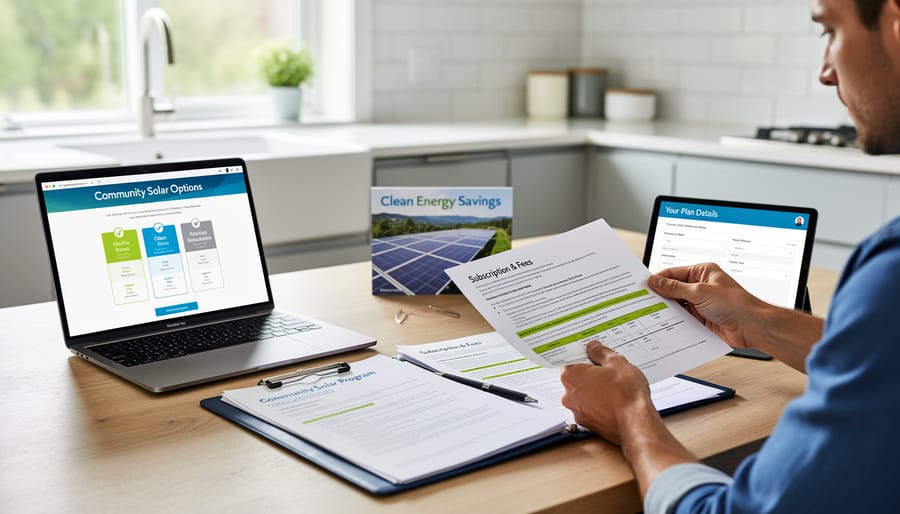
What to Watch Out For: Hidden Costs and Contract Terms
Red Flags in Subscription Agreements
Before signing a community solar subscription agreement, watch for several warning signs that could impact your investment. Enrollment fees exceeding $100 should prompt questions about what services justify the cost, as many reputable BC providers charge minimal or no upfront fees.
Be cautious of contracts requiring commitments longer than five years without clear performance guarantees. While community solar projects typically operate for 20-25 years, flexible exit clauses protect you if circumstances change. Ask specifically about cancellation policies and any penalties for early termination.
Vague language around credit calculations is a significant red flag. Your agreement should clearly state how much electricity you’ll receive credits for, the rate you’ll be credited, and when those credits apply to your utility bill. If a provider can’t explain their credit calculation method in simple terms, consider it a warning sign.
Also scrutinize agreements lacking transparency about maintenance fees or those that allow unlimited fee increases. Reliable providers, like those working with Surrey’s community solar initiative, typically cap annual fee increases at the rate of inflation. Always request a detailed breakdown of all costs before committing, and don’t hesitate to walk away from agreements that feel unclear or overly restrictive.
How to Choose the Right Community Solar Program in BC
Questions to Ask Before You Subscribe
Before signing up for community solar, ask your potential provider these essential questions to ensure you’re making an informed decision:
What are all the fees involved? Request a complete breakdown of subscription fees, enrollment costs, and any ongoing administrative charges. Understand whether fees are fixed or variable.
How do credit rates work? Clarify the exact rate you’ll receive for your share of solar energy and how it compares to your current electricity rate. Ask if rates change seasonally or over time.
What contract flexibility do I have? Determine the minimum commitment period, cancellation policies, and any penalties for early termination. Find out if you can transfer your subscription if you move.
Where is the solar farm located and how does it perform? Ask about the facility’s distance from your community, its operational history, and average energy production. Request performance data from similar months or seasons.
What’s the provider’s track record? Research how long they’ve been operating in British Columbia, read customer reviews, and ask for references from current subscribers. A Vernon-based provider, for example, successfully served over 200 households in their first year, demonstrating reliability.
Can I see a personalized savings projection? Request calculations specific to your energy usage showing realistic savings scenarios, including best and worst-case estimates.
Understanding community solar subscription fees empowers you to make informed decisions that benefit both your wallet and our environment. The transparency around these costs—typically ranging from subscription fees to small administrative charges—ensures you know exactly what you’re paying for and why. With most British Columbians saving 10-15% on their electricity bills while supporting renewable energy, community solar offers a practical path toward sustainability without rooftop installation hassles.
Ready to take the next step? Use Solar BC’s interactive calculator to estimate your personalized savings based on your current energy usage and local community solar options. Then explore our directory of certified solar providers to find reputable programs in your area. Look for providers who clearly outline their fee structures, offer transparent virtual net metering credits, and align with your values.
Every subscription contributes to British Columbia’s clean energy future while putting money back in your pocket. Whether you’re a homeowner, renter, or business operator, community solar makes renewable energy accessible today. Compare providers, ask questions about their fees, and join your neighbors in building a more sustainable tomorrow.