
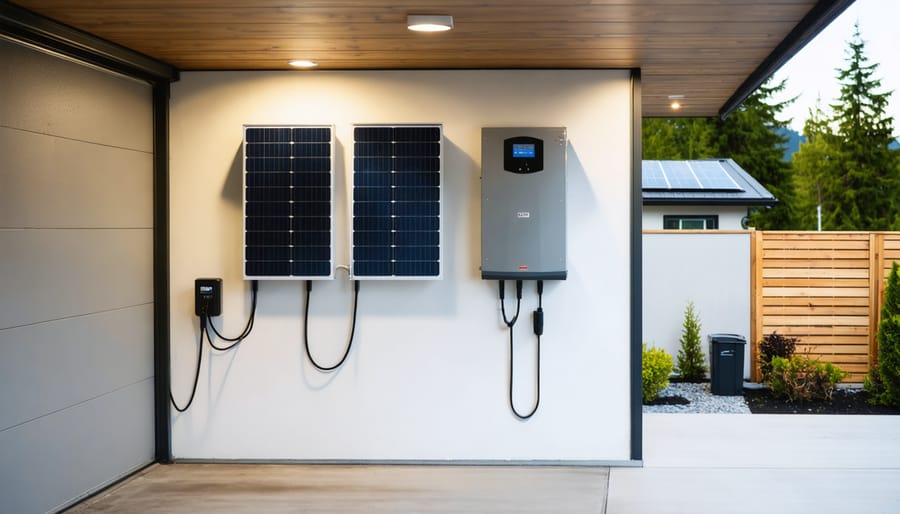
**Maximize your solar energy independence by pairing two batteries with your photovoltaic system**—a configuration that’s transforming how British Columbia homes and businesses store renewable power. A dual battery setup doubles your energy storage capacity, keeping your lights on during BC Hydro outages, extending your solar power availability through dark winter evenings, and reducing grid dependence when electricity rates climb during peak hours.
This configuration works by charging both batteries simultaneously during sunny periods, then drawing stored energy when your panels aren’t producing. Think of it as having a backup for your backup—when one battery depletes during an extended cloudy stretch or overnight usage, the second battery seamlessly takes over. For BC homeowners facing increasing extreme weather events and rising energy costs, this redundancy isn’t luxury; it’s practical resilience.
**The investment typically ranges from $8,000 to $15,000 for the second battery and installation**, depending on your chosen capacity and existing system compatibility. While the upfront cost seems substantial, BC residents often recoup expenses within 5-8 years through reduced grid consumption and enhanced energy security.
Consider the Vancouver Island family who added a second battery last winter: during a three-day storm outage, their dual setup powered essential appliances, home office equipment, and even their electric vehicle charger—maintaining normal life while neighbors went dark. Their experience illustrates why two-battery systems are becoming the new standard for serious solar adopters in our province.
What Is a 2-Battery Solar Setup?
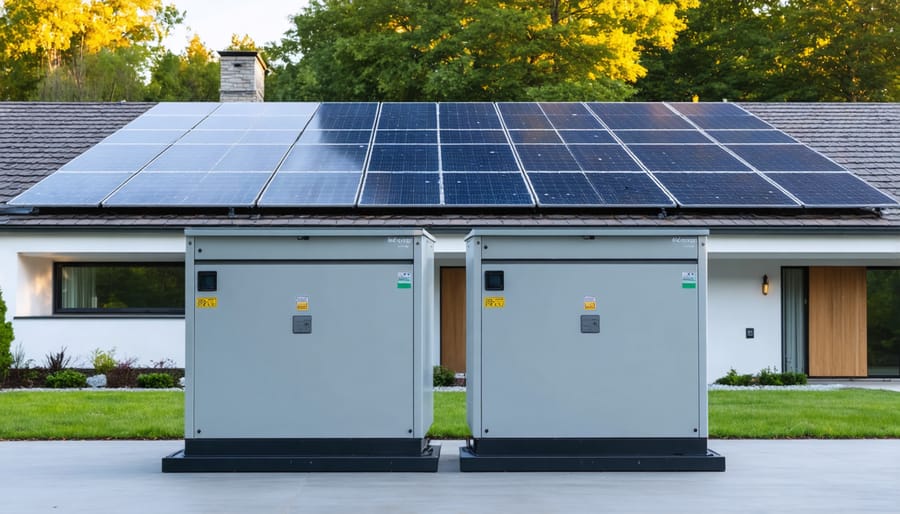
Series vs. Parallel: Which Configuration Works Best?
When adding a second battery to your solar system, you’ll need to choose between two connection methods: series or parallel. Understanding the difference helps you match your setup to your home’s needs.
**Series configuration** connects batteries end-to-end, doubling your voltage while keeping capacity the same. If you connect two 12V batteries in series, you get 24V total. This setup works well when your solar inverter requires higher voltage to operate efficiently—common in larger BC homes with significant power demands. For example, a Kelowna family running multiple appliances found that series configuration reduced energy loss during transmission, making their system more efficient during long winter days.
**Parallel configuration** connects batteries side-by-side, maintaining the same voltage but doubling your storage capacity. Two 12V batteries in parallel still give you 12V, but with twice the amp-hours. This is ideal for BC homeowners who want extended backup power during outages or need to store more energy from shorter winter daylight hours. A Vancouver Island cottage owner chose parallel setup to maximize overnight power availability without upgrading their existing 12V system.
Most residential solar systems in BC use 12V or 24V configurations. Parallel setups are generally simpler for homeowners expanding existing systems, while series configurations suit new installations with higher voltage requirements. Consider your current system voltage, backup power needs, and whether you prioritize runtime over power output. Your certified installer can assess your specific situation and recommend the best configuration for BC’s unique climate conditions.
The Real Benefits of Adding a Second Battery

Powering Through BC’s Dark Winter Days
British Columbia’s winter months bring shorter days and frequent cloud cover, which means reduced solar production when you need energy most. A two-battery solar setup becomes particularly valuable during this challenging season, providing the storage capacity to bridge those long, dark evenings.
During BC’s winter, a single battery might only store enough energy to power essential evening needs—lighting, refrigeration, and heating controls. Adding a second battery effectively doubles your available stored energy, letting you run additional appliances like your heat pump, entertainment systems, or home office equipment without drawing from the grid during expensive peak hours.
Consider a typical December day in Vancouver: your solar panels might only generate 4-5 hours of usable energy compared to summer’s 12-14 hours. With two batteries, you can store surplus energy from those brighter autumn days or capture every watt during brief sunny breaks between storms. This extra capacity means fewer worries about running short on stored power during extended periods of overcast weather.
Many BC homeowners find that their dual battery system pays for itself faster during winter months when grid electricity rates are highest and solar production is lowest.
Better Return on Your Solar Investment
A two-battery solar setup helps you capture more value from every kilowatt-hour your panels produce. Instead of sending excess solar energy back to the grid during BC’s sunny days, you store it for evening use when electricity rates are higher and solar production stops. This means you’re directly offsetting the power you’d normally purchase from BC Hydro at premium times.
BC homeowners with dual battery systems typically see 70-85% reduction in grid dependence compared to single-battery setups. When you maximize solar energy use through adequate storage, you’re essentially creating your own mini utility that serves your household first.
Consider the Johnsons in Kelowna, who added a second battery to their existing system. Their annual electricity costs dropped by an additional $780 compared to their single-battery year, while maintaining full backup power capability. With BC Hydro rates climbing steadily, locking in free solar energy through proper storage becomes increasingly valuable.
The payback period for that second battery shortens every time rates increase, making it a hedge against future energy costs while reducing your environmental footprint.
Is Your Home Ready for Two Batteries?
Calculating Your Energy Storage Needs
Determining whether you need two batteries starts with understanding your household’s energy consumption patterns. Begin by reviewing your BC Hydro bills from the past year to identify your average daily usage in kilowatt-hours (kWh). Most BC households consume between 20-30 kWh per day, though this varies significantly based on home size, heating systems, and lifestyle.
Next, identify your critical loads—the essential appliances you’d need during a power outage. This typically includes refrigeration, heating or cooling systems, lighting, medical equipment, and communication devices. Calculate the total wattage of these items and estimate how many hours per day they’d need to run. For example, a household prioritizing their fridge (150W), furnace blower (600W), and essential lighting (200W) would need roughly 23 kWh to power these items for 24 hours.
Solar BC offers interactive calculator tools on their website that simplify this process. These calculators help you input your specific energy needs and receive personalized recommendations. Generally, a single battery (typically 10-13.5 kWh capacity) handles basic backup needs, while two batteries become worthwhile if you’re aiming for multi-day backup during extended outages, supporting high-demand appliances like electric vehicle charging, or pursuing greater energy independence.
Consider seasonal variations too—BC winters mean longer nights and potentially higher heating demands, which may justify the additional storage capacity a second battery provides. The calculator tools factor in these regional considerations specific to our province’s climate and energy patterns.
Costs and Savings: What to Expect in British Columbia
BC Rebates and Incentive Programs
Adding a second battery to your solar setup is more affordable than ever, thanks to generous provincial and federal rebate programs available to BC residents.
The federal Canada Greener Homes Grant offers up to $5,000 for home battery storage systems when paired with solar installations. This program requires a pre-retrofit energy assessment, but the investment in evaluation often pays for itself through the rebate alone.
At the provincial level, BC Hydro and FortisBC periodically offer incentives for energy storage solutions, particularly for customers in areas with grid constraints. While these programs change annually, they can reduce your upfront costs by 20-30%.
Many BC municipalities also provide property tax exemptions for renewable energy improvements, including battery storage. Vancouver, Victoria, and Kelowna currently offer such exemptions, effectively lowering your long-term ownership costs.
To maximize your savings, start by contacting a certified solar installer who can identify all applicable programs for your specific location and system size. They’ll guide you through the application process and ensure your two-battery setup meets program requirements. Most rebates require professional installation and specific equipment certifications, so planning ahead with an expert is essential for securing these valuable incentives.
Local Success Story: A 2-Battery System in Action
When the Johnsons of Courtenay, BC, experienced their third winter power outage in two years, they knew it was time to upgrade their solar system. “We had installed a single 10kWh battery with our solar panels in 2021,” Sarah Johnson explains, “but during extended cloudy periods in winter, we’d run out of stored power by evening and lose our backup capability.”
After consulting with their solar installer, the Johnsons added a second 10kWh battery in spring 2023. Their primary goals were simple: maintain power during outages and reduce their reliance on grid electricity during BC Hydro’s higher-rate evening hours.
The installation took just one day, with minimal disruption. “The existing inverter and wiring were already set up to accommodate a second battery, so it was mostly plug-and-play,” Sarah notes. The total cost came to $8,500 including installation, compared to the $12,000 they had paid for their complete initial system.
The results exceeded their expectations. Through summer months, their dual battery system captures abundant solar energy, allowing them to run entirely off-grid most days. “We’ve gone entire weeks without drawing from the grid,” Sarah shares. More importantly, during the November and December storms, their home remained powered while neighbors lost electricity for up to 18 hours.
Winter performance proved the real value. Even on overcast January days, their system maintains enough charge to cover essential loads through the night. “We’re not completely energy-independent in winter, but we’ve cut our evening grid consumption by 60%,” Sarah calculates. Their annual electricity costs dropped by approximately $900.
The Johnsons’ advice for others considering a second battery? “Think about your actual usage patterns and backup needs. For us, the peace of mind during outages and the energy cost savings made it worthwhile within the first year.”
Choosing the Right Batteries and Equipment
What to Look for in a Certified Installer
Choosing the right installer is crucial for a successful 2 battery solar setup. Start by asking potential installers about their experience with multi-battery configurations specifically—how many similar systems have they installed in BC, and can they provide local references? Request details about warranty coverage for both equipment and installation work.
Verify that installers hold current certifications from recognized bodies like the Canadian Solar Industries Association (CanSIA) or are registered electricians with Technical Safety BC. Ask about their familiarity with BC Hydro’s interconnection requirements and local permitting processes, as these can significantly impact your timeline.
Important questions include: How will they size your system based on your actual energy usage? What monitoring capabilities will you have? Do they offer post-installation support?
Solar BC simplifies this process by connecting you with pre-vetted, certified professionals throughout the province. Our network includes installers who have demonstrated technical expertise and customer satisfaction in BC communities. When you reach out through Solar BC, you’re accessing professionals who understand our unique climate challenges, from coastal humidity to interior temperature swings, ensuring your 2 battery system is optimized for local conditions and delivers the reliability you expect.

Maintenance and Longevity Considerations
Caring for your 2-battery solar setup in BC doesn’t require specialized knowledge—just consistent attention to a few key practices. Both lithium-ion and lead-acid batteries typically offer warranties ranging from 5 to 15 years, with lithium options generally lasting longer and requiring less maintenance.
BC’s moderate coastal climate is actually ideal for battery lifespan, as extreme temperatures can degrade performance. However, if you’re in the interior where winter temperatures drop significantly, consider installing batteries in a temperature-controlled space like your garage or utility room rather than an unheated shed.
Simple maintenance steps include keeping batteries clean and dust-free, ensuring proper ventilation, and monitoring your system’s app for unusual discharge patterns. Most modern systems send alerts when attention is needed, making upkeep straightforward even for non-technical users.
To extend your investment, avoid consistently draining batteries below 20% capacity and keep them charged during extended periods of non-use. Regular software updates from your installer can also improve efficiency as technology advances.
Maximizing performance also means scheduling an annual inspection with your certified installer—they’ll check connections, verify optimal settings for seasonal changes, and ensure your system adapts to your evolving energy needs.
Many BC homeowners report their dual battery systems performing excellently after 7-10 years with minimal intervention, proving that proper initial installation and basic ongoing care deliver reliable, long-term energy independence.
Choosing a 2-battery solar setup is a significant decision that depends on your energy consumption patterns, backup power needs, and budget. If you experience frequent outages, run energy-intensive appliances, or want the peace of mind that comes with extended backup capacity, a dual battery system offers substantial value. British Columbia’s evolving energy landscape makes energy independence more achievable than ever.
Before moving forward, take time to assess your specific situation. How many hours of backup power do you realistically need? What appliances are essential during outages? What’s your household’s typical daily energy consumption? These questions will help you determine whether a single battery suffices or if investing in two makes practical sense.
Ready to explore your options? Solar BC offers interactive tools to calculate your potential solar savings and energy storage needs. We connect you with certified installers throughout British Columbia who understand local conditions and regulations. They’ll provide personalized assessments and transparent quotes tailored to your property.
Taking control of your energy future starts with one informed decision. Whether you choose one battery or two, you’re investing in resilience, sustainability, and long-term savings for your home or business.