
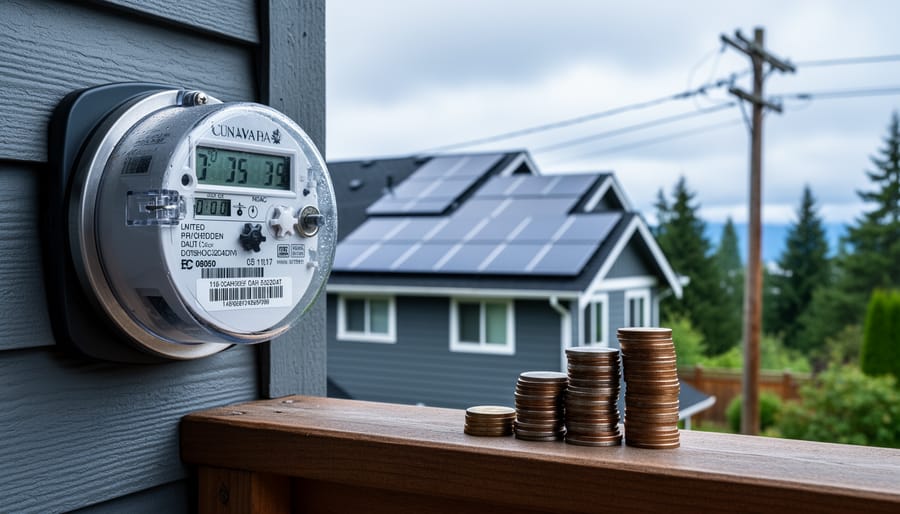
Understand that SBC payments (Small Business Conservation and low-income programs charges) will remain on your BC Hydro bill even after installing solar panels, typically costing residential customers $1-3 monthly regardless of your solar production. These fixed charges cannot be offset through net-metering credits, which means your actual solar savings will be lower than simply multiplying your electricity consumption by the current rate.
Calculate your true solar payback by separating offsettable charges from non-offsettable ones on your current bill. Look at your BC Hydro statement and identify the basic charge, transmission charge, and SBC payment—these fixed costs continue whether you generate solar power or not. A typical BC household paying $100 monthly might only offset $85-90 of that amount with solar, as the remaining $10-15 covers infrastructure and program charges that apply to all grid-connected customers.
Review recent billing statements to determine what percentage of your costs are actually offsettable. Most BC residential customers find that 85-92% of their total bill can be reduced through solar generation, while the remainder covers essential grid services and conservation programs. This distinction matters significantly when evaluating solar quotes: a system promising to offset 100% of your electricity costs is overstating potential savings by ignoring these mandatory charges.
Factor SBC payments into your financial modeling by extending your expected payback period by 6-12 months compared to calculations that ignore fixed charges. This realistic approach prevents disappointment and helps you make informed decisions about system sizing and financing options.
What Are SBC Payments on Your BC Hydro Bill?
The Purpose Behind SBC Charges
When you see SBC payments on your electricity bill, you’re contributing to essential programs that benefit all British Columbia residents. These charges support three key areas that maintain our provincial power infrastructure.
First, SBC payments fund critical infrastructure maintenance and upgrades across BC Hydro’s extensive network. This ensures reliable electricity delivery to your home, whether you’re generating solar power or not. Think of it as maintaining the highway system you use to connect with the broader grid.
Second, these charges support low-income assistance programs that help vulnerable households afford electricity. Programs like the Customer Crisis Fund and Energy Conservation Assistance Program receive funding through SBC payments, ensuring everyone in our province has access to essential power services.
Third, SBC payments contribute to grid reliability and emergency preparedness. This includes maintaining backup systems, managing peak demand, and ensuring BC’s electrical infrastructure can handle extreme weather events and growing community needs.
For solar homeowners, understanding that SBC payments continue regardless of your energy production helps you calculate realistic savings. While your solar panels offset consumption charges through net-metering credits, these infrastructure and social support costs remain. This shared responsibility model ensures our collective power system stays robust and equitable for all British Columbians.
How SBC Payments Appear on Your Bill
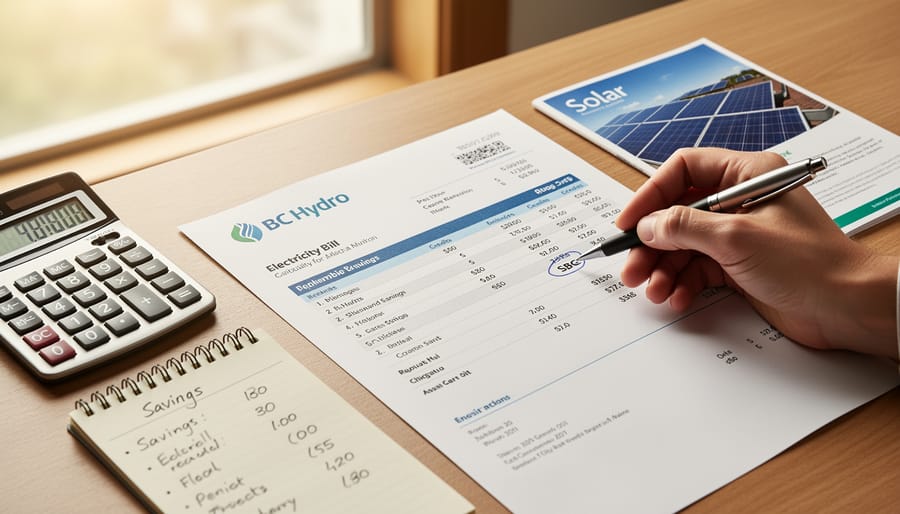
On your BC Hydro bill, SBC payments appear as a separate line item in the charges section, typically labeled “Rate Rider” or similar terminology. You’ll find this charge calculated based on your total electricity consumption for the billing period, regardless of whether you generated solar power.
For example, if your household consumed 900 kWh during a billing cycle, the SBC charge applies to all 900 kWh—even if your solar panels generated 600 kWh that same month. This means you’ll see both your net energy charges (reflecting credits from solar production) and the full SBC charge side by side on your statement.
Many BC residents notice this distinction only after installing solar panels, when they realize their bill doesn’t drop to zero as expected. The SBC portion remains constant based on consumption, making it essential to factor these non-offsetable charges into your solar savings calculations from the outset. Reviewing past bills can help you estimate your average monthly SBC payments and plan accordingly.
How SBC Payments Interact With Net-Metering Credits
What Net-Metering Credits Actually Cover
When you generate solar power in BC, your net-metering credits apply to specific portions of your electricity bill, but not everything gets offset. Understanding this breakdown is essential for calculating your realistic solar savings.
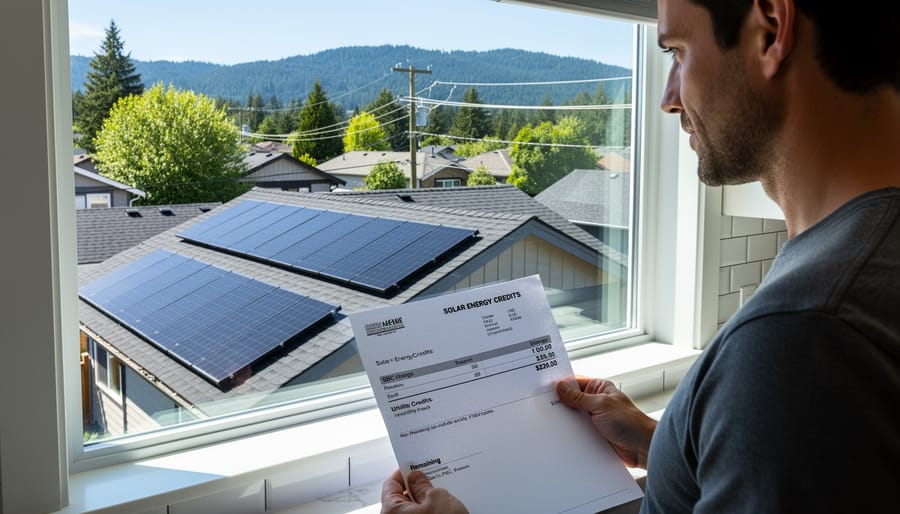
Net-metering credits reduce your electricity consumption charges—the kilowatt-hours you use each month. If your solar panels produce 500 kWh and you consume 700 kWh, you’ll only pay for the 200 kWh difference. This is where most homeowners see their savings.
However, SBC payments remain completely unaffected by your solar production. These charges continue appearing on your bill at the same rate regardless of how much electricity you generate. The same applies to the basic charge, which covers your connection to the grid.
For example, a Kelowna family with a 6 kW solar system found they eliminated 85% of their consumption charges during summer months, but their SBC payments stayed constant at approximately $8-12 monthly. This meant their total bill reduction was closer to 70% rather than the 85% they initially expected.
When evaluating solar quotes, always ask installers to show projections that separate consumption charge savings from fixed charges. This transparency helps you understand your true payback period and avoid disappointment when reviewing your first post-solar bills.
The Math: Your True Savings After SBC Payments
Understanding your actual savings starts with simple math. Let’s walk through a realistic example using BC Hydro’s residential rates.
Meet the Johnsons, a family in Kelowna with a 6 kW solar system. Their monthly bill before solar was $120. After installing solar, they generate enough energy to offset $80 of electricity charges through net-metering credits. However, their SBC payments remain at $25 per month.
Here’s the calculation:
Original monthly bill: $120
Energy charges offset by solar: -$80
Remaining energy charges: $15
SBC payments (non-bypassable): $25
New monthly bill: $40
True monthly savings: $120 – $40 = $80 (not the full $120 they might have expected)
This means the Johnsons save 67% on their electricity bills, not 100%. Over a year, that’s $960 in real savings. When calculating payback periods for their solar investment, they used this realistic $960 annual figure rather than assuming complete bill elimination.
The key takeaway? Always subtract your SBC payments from projected savings when evaluating solar proposals. This gives you an honest picture of your return on investment and helps set realistic expectations for your solar journey.
Current BC Net-Metering Rates and Credit Structure
2024-2025 BC Hydro Energy Rates
Understanding BC Hydro’s rate structure is essential when calculating your actual solar savings. For the 2024-2025 period, residential customers pay a two-tier rate system. The first tier covers your initial 1,376 kWh per billing period at approximately 10.45 cents per kWh, while consumption beyond this threshold jumps to around 15.70 cents per kWh in the second tier.
These rates apply to your energy charges, which solar panels can offset through net metering credits. When your solar system generates excess electricity, you receive credits at these same tier rates. However, it’s important to note that your bill includes both energy charges and delivery charges. While your solar production reduces the energy portion, the delivery charges—which include SBC payments—remain unchanged regardless of how much electricity you generate. This distinction significantly impacts your payback period calculations, as most BC solar customers continue paying between 30-40 dollars monthly in non-offsetable charges even with substantial solar production.
How Your Solar Credits Are Valued
When you generate more electricity than your home uses, that excess power flows back to the grid through BC Hydro’s net-metering program. The credit you receive is based on your retail electricity rate, which in BC currently ranges from about 9.9 cents to 15.6 cents per kilowatt-hour depending on your consumption tier.
Here’s what makes this valuable: you earn credits at the same rate you pay for electricity. If you’re charged 11 cents per kWh during the day, your solar credits are worth 11 cents per kWh too. This one-to-one exchange is what makes net-metering financially attractive for BC homeowners.
These credits accumulate on your account and offset future electricity charges throughout the year. For example, a Surrey family with a 6 kW system typically generates surplus credits during summer months that offset their higher winter consumption. However, it’s important to understand that these credits only reduce your electricity consumption charges, not your SBC payments, which remain constant regardless of your solar production.
Calculating Your Real Solar Payback Period in BC
Fixed Charges That Reduce Your Savings Potential
When you install solar panels, it’s important to understand that not all charges on your BC Hydro bill will disappear. While your energy consumption costs drop significantly, several fixed charges remain regardless of how much solar electricity you generate.
System Benefit Charge (SBC) payments continue at the same rate because they fund provincial energy efficiency programs and low-income assistance initiatives. These charges apply to all grid-connected customers, even those producing their own power.
Basic charges or service fees cover the cost of maintaining your connection to the electrical grid. Think of this as your membership fee for accessing BC’s electricity network whenever your panels aren’t producing enough power, like during winter evenings or cloudy weeks.
Delivery charges also persist because you still rely on BC Hydro’s infrastructure to transmit excess energy you produce and receive credits through net-metering. The poles, wires, and transformers require ongoing maintenance whether you’re consuming or contributing electricity.
A typical residential customer in Vancouver might see these fixed charges total $20-30 monthly. While solar panels dramatically reduce your consumption charges, accounting for these persistent costs ensures you calculate realistic payback periods and actual savings, typically ranging from 40-70% reduction in total bills rather than complete elimination.
Realistic Payback Examples From BC Homeowners
Meet the Johnsons from Langley, who installed a 6kW solar system in 2022. Their initial payback calculation showed 12 years, but after accounting for SBC payments that couldn’t be offset, their realistic payback extended to 13.5 years. “We still love our solar panels,” says Maria Johnson, “but we wish we’d known about the SBC charges upfront. It would have changed our financing approach.”
Over in Victoria, the Chen family took a different route. After learning about SBC payments during their research, they explored green housing loans and solar PPAs to reduce upfront costs. Their 8kW system achieved payback in 11 years despite SBC charges, primarily because they minimized interest payments.
In Kelowna, the Patel family’s 5kW installation demonstrated how energy efficiency improvements matter. By reducing their baseline consumption before going solar, they lowered their overall SBC payments proportionally. Their combined approach yielded a 10-year payback period.
These real BC homeowners show that while SBC payments add roughly 1-2 years to typical payback calculations, strategic planning makes solar still worthwhile. The key takeaway? Factor in all costs from day one, explore financing options that reduce total system cost, and consider efficiency upgrades alongside solar installation for optimal financial outcomes.
Maximizing Your Net-Metering Value Despite SBC Payments
Right-Sizing Your Solar System
The key to maximizing your solar investment while respecting SBC payments is right-sizing your system to match your actual electricity consumption. Since SBC payments can’t be offset regardless of how much solar you generate, oversizing your system won’t improve your payback period.
Start by reviewing 12 months of BC Hydro bills to understand your average monthly usage in kilowatt-hours. A properly sized system should aim to offset 80-95% of your variable energy charges without generating significant excess. For example, a Vancouver homeowner using 800 kWh monthly would target a 6-7 kW system rather than a 10 kW installation.
Remember that net-metering credits don’t carry monetary value for SBC payments, so surplus generation beyond your annual consumption provides no financial benefit. Consider seasonal variations too. BC households typically use more electricity in winter when solar production is lower, making year-round balance important.
Working with experienced local installers who understand BC’s net-metering rules ensures your system size aligns with realistic savings potential. Some BC residents also explore alternative solar financing options that remove upfront costs while still reducing variable charges. Request detailed production estimates based on your specific location and roof orientation before committing to any system size.
Pairing Battery Storage to Reduce Grid Dependence
While solar panels help you offset energy consumption charges through net-metering credits, your SBC payments remain constant regardless of how much solar power you generate. This is where battery storage becomes a powerful tool to further reduce your overall electricity costs and grid dependence.
Adding a home battery system allows you to store excess solar energy generated during the day and use it during evening peak hours when you’d otherwise draw from the grid. This means you’re purchasing less electricity overall, which reduces both your consumption charges and, importantly, the fixed costs calculated based on your grid usage patterns.
A Kelowna family who installed a 10 kW solar array found they still paid approximately $25 monthly in SBC payments. After adding battery storage, they reduced their grid electricity purchases by an additional 40%, lowering their total bill further while maintaining backup power during outages.
Battery storage is particularly valuable in BC’s net-metering system because it maximizes the value of every kilowatt-hour your panels produce. Rather than sending excess power to the grid for credits, you’re keeping that energy for your own use when you need it most, minimizing the charges that solar alone cannot eliminate.
Yes, SBC payments will remain on your electricity bill even after installing solar panels in BC. But here’s the important reality: solar still delivers substantial long-term value for most homeowners. While you won’t offset these system access charges, you’ll significantly reduce your consumption-based costs, which typically represent 60-70% of your total bill. Over a 25-year system lifespan, BC solar owners typically save $20,000-$40,000, even accounting for SBC payments.
The key is getting accurate calculations based on your specific situation. Take Sarah from Kelowna, who discovered her actual 12-year payback period still made solar worthwhile for her family’s energy goals and environmental values.
Ready to see your personalized savings? Use BC Hydro’s online calculator to estimate your net-metering credits, factoring in SBC payments from day one. Then connect with local certified installers who understand BC’s rate structures and can provide realistic projections. Explore available financing options that can reduce upfront costs and accelerate your path to savings. The sooner you start, the sooner you’ll begin building energy independence while contributing to BC’s clean energy future.