
Look beyond the sticker price when evaluating solar quotes. The lowest upfront cost rarely translates to the best long-term value, especially when you factor in equipment warranties, maintenance requirements, energy production estimates, and financing terms over 25 years.
Calculate the true cost per kilowatt-hour your system will produce by dividing total system costs—including installation, financing interest, insurance, and projected maintenance—by estimated lifetime energy production. This gives you a comparable metric across different quotes that reflects actual value rather than marketing numbers.
Request detailed performance guarantees and warranty coverage from each installer. A system that costs $2,000 more upfront but includes 25-year equipment warranties and performance guarantees often saves $8,000-$12,000 compared to budget options with 10-year coverage that leave you exposed to replacement costs.
Compare financing structures carefully, as interest rates and loan terms dramatically impact total ownership costs. A 1.99% loan versus a 6.99% loan on a $20,000 system creates a $6,800 difference over 15 years—enough to erase any initial savings from choosing a cheaper quote.
Track ongoing operational expenses including inverter replacements (typically every 10-12 years), monitoring system fees, insurance adjustments, and periodic cleaning or maintenance. BC’s wet climate means lower cleaning costs than other regions, but these expenses still accumulate and vary significantly between installers and equipment choices.
What Total Cost of Ownership Really Means for Solar
When you’re investing in solar energy, understanding total cost of ownership (TCO) is like looking at the complete story rather than just the first chapter. TCO represents every dollar you’ll spend on your solar system throughout its entire lifespan, minus the money you’ll save and earn back. This includes your initial purchase price, installation costs, ongoing maintenance, potential repairs, and even financing interest if you take out a loan.
Here’s where many British Columbia homeowners and businesses make a critical error: they choose a solar quote based solely on the lowest upfront price. Imagine two neighbours in Kelowna both installing solar panels. The first selects a $15,000 system because it’s the cheapest option available. The second invests $18,000 in a system with higher efficiency panels and a better warranty. Five years later, the cheaper system requires a $2,500 inverter replacement and produces 15% less energy than expected. Meanwhile, the second neighbour’s system is running smoothly and generating enough power to eliminate their electricity bills completely.
The difference becomes even more significant when you consider solar panels typically last 25 to 30 years or more. That’s a quarter century of electricity production, maintenance needs, and potential savings. A system that costs less today might demand higher maintenance expenses, produce less energy, or need replacement components sooner than a quality alternative.
Think of TCO as the true price tag that reveals itself over time. Just as a fuel-efficient car might cost more upfront but saves you thousands at the pump over its lifetime, a well-designed solar system with quality components pays dividends year after year. The goal isn’t finding the cheapest option today; it’s identifying which investment delivers the best value across decades of BC sunshine, reducing both your carbon footprint and your long-term energy expenses.
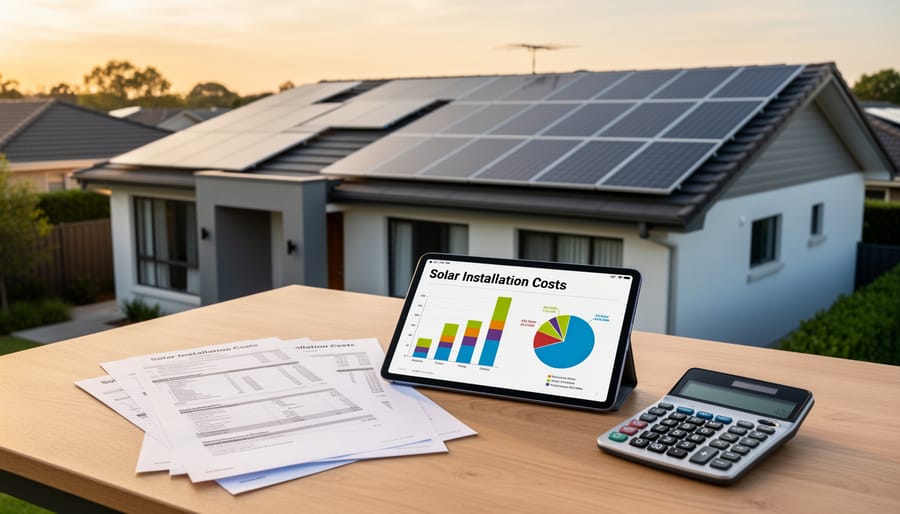
The Hidden Costs Most Solar Quotes Don’t Show Upfront
Maintenance and Monitoring Expenses
Your solar system’s maintenance and monitoring costs can significantly impact your long-term savings. While solar panels require minimal upkeep, you’ll want to budget for annual inspections, occasional cleaning, and potential repairs over your system’s 25-30 year lifespan.
Most BC installers include monitoring systems that track your energy production in real-time through smartphone apps. Basic monitoring comes free with many systems, while advanced features may cost $100-300 annually. These tools help you quickly identify performance issues before they affect your savings.
Maintenance costs typically range from $150-400 per year, depending on your installer’s warranty coverage and local conditions. Systems in coastal areas may need more frequent cleaning due to salt buildup, while those near forests might require debris removal. Some installers offer prepaid maintenance packages that lock in rates and provide priority service.
A Kelowna homeowner recently shared how their installer’s comprehensive 10-year maintenance plan cost $2,000 upfront but saved them over $800 compared to pay-as-you-go servicing. When comparing quotes, ask about warranty coverage, what maintenance tasks you’ll handle yourself, and whether monitoring systems require subscription fees. These seemingly small expenses add up, so factor them into your total cost comparison to make an informed decision.
Equipment Warranty Differences That Affect Your Wallet
Warranty coverage significantly impacts your long-term solar investment costs, yet many BC homeowners overlook these details when comparing quotes. A comprehensive warranty package protects you from unexpected expenses down the road.
Solar panel warranties typically include two components: a performance guarantee (usually 25 years) ensuring panels maintain a certain efficiency level, and a product warranty (10-25 years) covering manufacturing defects. Premium panels often offer stronger performance guarantees, meaning less degradation and more energy production over time.
Inverter warranties deserve special attention since inverters often need replacement before panels do. Standard warranties range from 5-12 years, while extended warranties can cover 20-25 years. Calculate replacement costs if your inverter warranty is shorter than your system’s expected lifespan—a $2,000-$3,000 expense can substantially affect your total ownership cost.
Installation workmanship warranties vary dramatically between providers. A Vernon family recently discovered their 2-year workmanship warranty didn’t cover roof penetration issues that emerged in year three, costing them $1,800 in repairs. Look for installers offering 10-year workmanship warranties, which demonstrate confidence in their work and protect your investment. Always request warranty terms in writing and verify what specific components and labour costs are covered before signing any agreement.
Performance Degradation and Efficiency Loss
Not all solar panels age the same way. While most manufacturers promise 25-year warranties, the actual performance degradation rates vary significantly between premium and budget panels—and these differences directly impact your long-term savings.
Premium panels typically degrade at around 0.3% to 0.5% annually, meaning they’ll still operate at 90-92% capacity after 25 years. Standard panels often degrade at 0.6% to 0.8% per year, dropping to 80-85% efficiency over the same period. For a typical BC home with a 6kW system, this difference translates to approximately $3,000 to $5,000 in lost energy production value over the system’s lifetime.
Consider a Vancouver homeowner who chose budget panels to save $2,000 upfront. By year 15, their system’s declining efficiency meant they were purchasing more grid electricity during peak winter months. Over 25 years, they spent an additional $4,200 on supplemental power compared to their neighbor who invested in higher-quality panels.
When comparing quotes, ask installers for degradation rates and calculate the efficiency difference over time. A simple calculation: multiply your annual energy production by the degradation rate difference, then by your electricity rate and 25 years. This reveals the true cost of choosing lower-quality panels, helping you make an informed decision that maximizes your solar investment.
Financing Costs and Interest Payments
Financing significantly impacts your solar system’s true cost. In BC, you have three main options: cash purchases, loans, and power purchase agreements (PPAs). With loans, factor in interest rates—typically ranging from 4-8% over 10-20 years—which can add thousands to your total cost. A $20,000 system financed at 6% over 15 years costs roughly $25,000 total. Leases and PPAs require no upfront investment but mean higher long-term payments and forfeited incentives. When comparing quotes, calculate the total amount you’ll pay over the system’s lifetime, including all interest and fees. BC residents using Clean Energy BC financing programs often secure better rates, reducing overall ownership costs while maintaining immediate savings on electricity bills.
How to Build Your Own Total Cost of Ownership Comparison
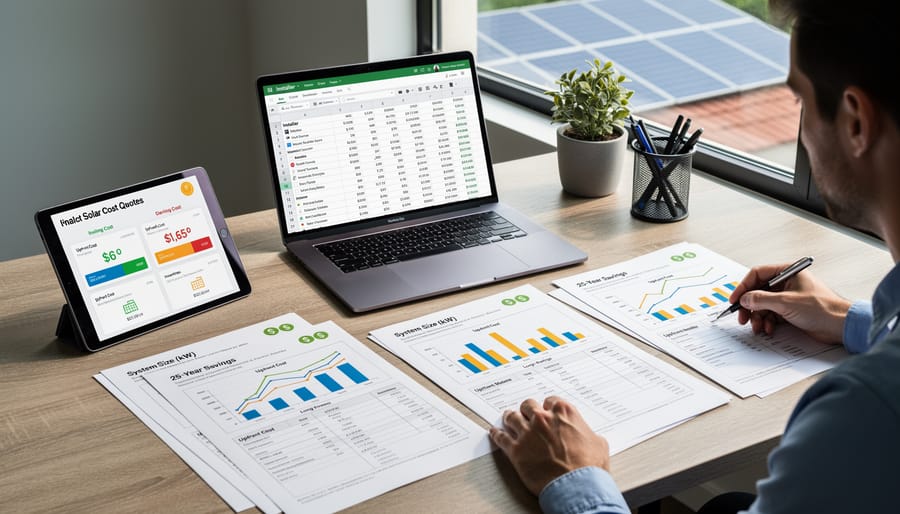
Essential Data Points to Gather From Each Quote
When requesting quotes from solar installers, you’ll need comprehensive information to accurately calculate the total cost of ownership. Start with the basics: system size measured in kilowatts, the specific panel brands and models being proposed, and inverter specifications. These details directly impact your system’s energy production and longevity.
Request detailed warranty information for all components. Panel warranties typically cover 25 years for performance, but equipment warranties vary significantly between manufacturers. Ask about workmanship warranties from the installer as well, which usually range from 5 to 10 years in British Columbia.
Get clarity on what’s included in the installation price. Does it cover electrical upgrades, permits, and inspection fees? Will they handle the connection to BC Hydro and all necessary paperwork? These hidden costs can add thousands to your project.
Ask for projected annual energy production in kilowatt-hours and estimated maintenance requirements over the system’s lifetime. While solar panels need minimal upkeep, inverters may require replacement after 10-15 years, representing a significant future expense.
If considering financing, request the complete terms: interest rates, loan duration, any balloon payments, and total amount you’ll pay over the loan period. Compare this against paying cash upfront or using a home equity line of credit.
Finally, ask about monitoring systems and performance guarantees. Will you receive alerts if production drops? What recourse do you have if the system underperforms? A Richmond homeowner recently saved $1,200 by catching an inverter issue early through their monitoring system, demonstrating the value of proactive oversight.
Calculating Your 25-Year Cost Projection
Understanding your solar system’s true 25-year cost requires adding up several key components. Start with your initial investment, which includes equipment, installation, permits, and any necessary electrical upgrades. This baseline figure appears prominently in your quotes, but it’s just the beginning.
Next, calculate annual maintenance costs. Most BC solar installations require minimal upkeep—typically an annual inspection and occasional cleaning. Estimate around $150-300 per year, though many installers offer maintenance packages. Multiply this annual figure by 25 to get your total maintenance projection.
Don’t forget replacement costs. Inverters usually need replacing after 10-15 years, costing $1,500-3,000 depending on your system size. Factor this expense into your timeline. Meanwhile, quality solar panels should last the full 25 years with minimal degradation.
If you’re financing your system, add interest charges over the loan period. A $20,000 system financed at 5% over 10 years adds approximately $5,500 in interest costs.
On the positive side, calculate your energy production value. Multiply your system’s expected annual output (in kWh) by your current electricity rate, then project this over 25 years. Remember to account for BC Hydro’s rate increases, which historically average 2-3% annually, making your solar production increasingly valuable over time.
Subtract any available rebates, tax credits, or incentive programs from your total costs. Several BC municipalities and regional districts offer additional solar incentives beyond provincial programs, so research local opportunities in your community.
Factoring in BC’s Solar Incentives and Rebates
Understanding BC’s solar incentives is essential for calculating the true cost of your solar investment. These programs can significantly reduce your total cost of ownership, sometimes by thousands of dollars, making solar more accessible than many homeowners initially realize.
Start by researching current provincial rebates through CleanBC initiatives. These programs periodically offer rebates for residential and commercial solar installations, particularly for systems that include battery storage. Check the CleanBC website regularly, as funding availability can change throughout the year.
Next, factor in federal tax incentives. While Canada doesn’t offer the same tax credits as some U.S. jurisdictions, businesses can claim the Capital Cost Allowance for solar installations, which accelerates depreciation and reduces taxable income. Homeowners may qualify for the Canada Greener Homes Grant, which provides up to $5,000 for energy-efficient upgrades including solar panels.
Don’t overlook local utility incentives. BC Hydro and FortisBC occasionally offer net metering programs and connection credits that affect your long-term savings. Some municipalities also provide property tax exemptions for the added home value from solar installations.
When comparing quotes, create a simple spreadsheet that subtracts all applicable incentives from each proposal’s total cost. For example, if one installer’s quote is $18,000 and you qualify for $5,000 in combined rebates, your actual investment drops to $13,000. This adjusted figure should be your starting point for calculating payback period and lifetime savings. Remember to verify eligibility requirements for each program before finalizing your calculations, as some incentives have specific installation or equipment criteria.
Real BC Example: When the Cheaper Quote Costs More
When Sarah Chen from Nanaimo started comparing solar quotes for her 2,200 square foot home, she nearly made a costly mistake. The first quote came in at $18,500, while the second was $22,300. The choice seemed obvious until her neighbour, who’d recently gone solar, suggested she dig deeper into the numbers.
Sarah created a simple spreadsheet to compare what each system would actually cost over 25 years. The less expensive quote offered tier-two panels with a 12-year warranty and an inverter guaranteed for just 10 years. The company also charged $150 annually for monitoring and maintenance. The pricier quote included premium panels with a 25-year performance warranty, a micro-inverter system with a 25-year guarantee, and free monitoring for life.
Here’s what the math revealed. The cheaper system would need an inverter replacement around year 12, costing approximately $2,800. The annual monitoring fees added up to $3,750 over 25 years. Meanwhile, the panels’ degradation rate of 0.7 percent annually meant she’d generate about 2,400 fewer kilowatt-hours over the system’s lifetime compared to the premium option’s 0.4 percent degradation rate. At current BC Hydro rates, that translated to roughly $600 in lost energy savings.
Adding it all together, the “cheaper” quote would actually cost Sarah $26,050 over 25 years, while the premium system totalled $22,300. That’s a difference of $3,750, not counting potential repair costs or the hassle of dealing with warranty claims from multiple manufacturers.
Sarah chose the higher upfront quote and hasn’t looked back. Three years later, her system produces exactly as promised, requires zero maintenance, and she receives automatic performance reports monthly. The peace of mind alone, she says, was worth comparing beyond the bottom line.
This real-world example shows why comparing total cost of ownership matters. The few hours Sarah spent analyzing both quotes saved her thousands and eliminated future headaches.
Red Flags That Signal Higher Long-Term Costs
When reviewing solar quotes, certain warning signs can indicate you’ll face higher costs down the road. Recognizing these red flags early protects your investment and ensures you’re getting what you pay for.
Vague warranty terms should immediately raise concerns. If a quote doesn’t clearly specify warranty duration, what’s covered, or who honors the warranty if the installer goes out of business, you could be left paying for expensive repairs. Quality installers provide detailed warranty documentation for panels, inverters, and workmanship separately. A Vancouver homeowner learned this the hard way when their installer’s “25-year warranty” only covered manufacturing defects, not installation issues that caused a roof leak.
Unknown or budget equipment brands often signal future problems. While established manufacturers like Canadian Solar or LG have proven track records and accessible service networks in BC, obscure brands may lack local support or replacement parts. If the installer can’t explain why they’ve chosen specific equipment or provide performance data, consider it a warning sign.
Missing maintenance plans are another concern. Solar systems aren’t entirely maintenance-free. Quotes should address cleaning schedules, monitoring systems, and inspection protocols. Without these details, you might face unexpected service costs or reduced energy production over time.
Unrealistic performance projections deserve scrutiny. If one quote promises significantly higher energy production than others for similar systems, question the assumptions. BC’s climate varies considerably—a realistic projection for Kelowna differs from Vancouver’s expectations. Reputable installers base estimates on actual weather data and conservative calculations.
When you spot these red flags, don’t hesitate to ask questions or request clarification. A trustworthy installer welcomes your concerns and provides transparent answers. Your diligence now prevents costly surprises later.
Making Your Final Decision With Confidence
Making an informed solar investment means looking beyond the price tag to understand the complete financial picture. By taking the time to compare total cost of ownership across different quotes, you’re setting yourself up for decades of satisfaction and optimal savings. The few extra hours you spend analyzing maintenance costs, warranty coverage, system efficiency, and long-term performance will pay dividends throughout your system’s 25-plus year lifespan.
Solar BC’s network of certified installers understands the importance of transparency. When you connect with these professionals, you’ll receive detailed quotes that break down all the cost factors we’ve discussed, making your comparison process straightforward and stress-free. These installers have proven track records in BC’s unique climate conditions and are committed to helping you make the best decision for your specific situation.
Ready to start your solar journey? Begin by requesting quotes from at least three certified installers in your area. Use the TCO framework we’ve outlined to evaluate each proposal systematically. Don’t hesitate to ask questions about any cost factors that aren’t immediately clear. Remember, the lowest upfront price rarely equals the best long-term value.
The solar owners who express the highest satisfaction are those who took time to compare properly. They understood that investing wisely means considering the complete picture, and that decision-making confidence comes from thorough analysis. Your future self will thank you for the care you take today in choosing the right solar solution for your home or business.