
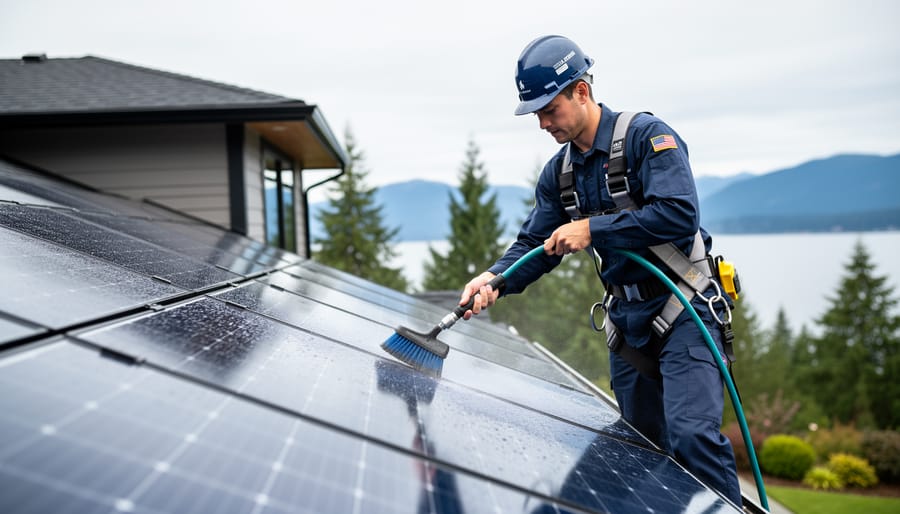
Monitor your solar panel performance weekly through your system’s app or inverter display to catch efficiency drops of 10% or more, which typically indicate dirty panels or shading issues requiring immediate attention. Clean panels every 2-3 months during BC’s rainy season and monthly during summer, as a buildup of pollen, dust, and debris can reduce output by up to 25%.
Adjust your electricity usage patterns to align with peak solar production hours between 10 AM and 3 PM. Run dishwashers, washing machines, and charge electric vehicles during this window to consume your generated power directly rather than drawing from the grid at higher rates. BC Hydro’s net metering program credits you for excess power, but self-consumption delivers better immediate savings.
Upgrade outdated inverters if your system is over 8 years old, as newer models offer 3-5% better conversion efficiency and advanced monitoring capabilities that pinpoint underperforming panels. Consider adding battery storage to capture surplus energy during summer months when BC experiences extended daylight hours, enabling you to use stored solar power during evening peak-rate periods.
Trim tree branches that cast shadows on your array, as even partial shading on a single panel can reduce your entire system’s output by 30-40%. Schedule vegetation management twice yearly in spring and fall to maintain optimal sun exposure as trees grow and seasons shift.
These optimization strategies transform your solar investment from a passive installation into an active energy asset, delivering measurable improvements in both performance and financial returns throughout British Columbia’s diverse climate conditions.
Why Most Residential Solar Systems Don’t Reach Their Full Potential
The Performance Gap: What’s Normal vs. What’s Possible
Most BC homeowners are surprised to learn their solar systems aren’t performing at the manufacturer’s rated capacity. Here’s what’s actually happening on your roof and what you can realistically expect.
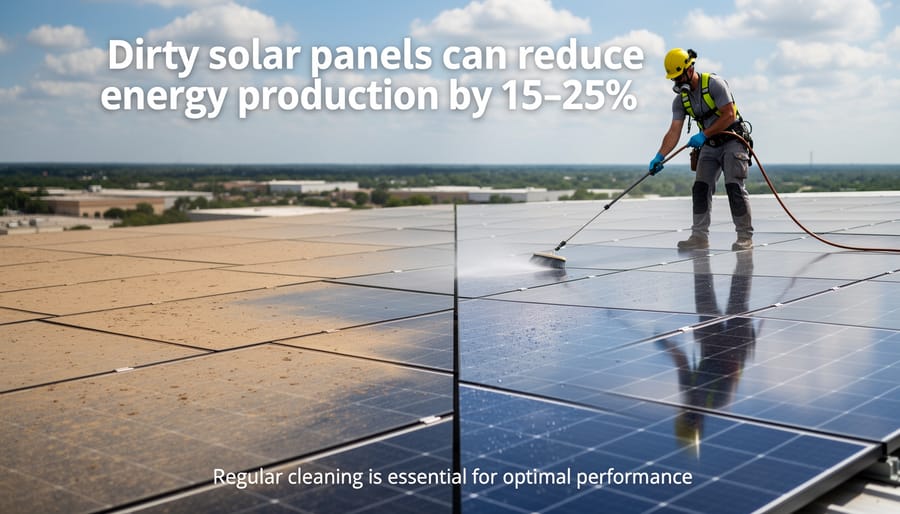
In typical conditions, residential solar systems in British Columbia experience 15-25% efficiency losses from their nameplate ratings. This isn’t a malfunction – it’s normal. A system rated at 10 kilowatts might produce 7.5-8.5 kilowatts during peak conditions. These losses come from several factors: temperature effects (panels lose about 0.5% efficiency per degree above 25°C), dust and debris accumulation, wiring resistance, and inverter conversion losses.
For example, a Vancouver homeowner with a 6kW system installed in 2020 expected 8,000 kWh annually but actually generated 6,400 kWh – a 20% gap that falls within normal range. Understanding this helps you calculate solar panel efficiency accurately and set realistic expectations.
However, BC’s climate offers distinct advantages. Our moderate temperatures mean less heat-related efficiency loss compared to hotter regions. A well-maintained system in Victoria or Kelowna should maintain 80-85% of rated capacity, while exceptional setups with optimal positioning, regular cleaning, and quality components can reach 88-90%.
The key is knowing your baseline. Systems consistently performing below 75% of rated capacity need attention, while anything above 82% indicates excellent optimization. Check your monitoring app monthly and compare production to similar systems in your area to gauge where you stand.
BC-Specific Challenges That Impact Your System
British Columbia’s diverse geography creates unique challenges for solar energy systems that differ significantly from other regions. Understanding these regional factors helps you set realistic expectations and optimize your system’s performance year-round.
Coastal communities face persistent fog and marine layer conditions that can reduce solar output, particularly during summer mornings. Vancouver Island and Lower Mainland residents often experience cloudy periods that extend well into late spring, impacting solar performance in BC’s climate. Meanwhile, Interior BC locations like Kelowna and Kamloops enjoy more consistent sunshine but must contend with extreme temperature variations that affect panel efficiency.
Daylight hours fluctuate dramatically across seasons in our northern latitude. Summer brings extended daylight, with some areas receiving over 16 hours of potential solar generation, while winter days shrink to just 8 hours or less. This seasonal swing means your system might overproduce in summer and underperform in winter, making net metering arrangements particularly valuable for balancing annual energy needs.
Snow accumulation presents another consideration for Interior and Northern BC residents. While panels can generate power through light snow, heavy accumulation blocks sunlight completely. The good news is that panels installed at optimal angles often shed snow naturally, and their dark surface helps accelerate melting.
Regional microclimates also play a role. A homeowner in sunny Penticton will see different results than someone in rainy Prince Rupert, even with identical systems. This variability makes working with local solar installers essential, as they understand your specific area’s challenges and can design systems accounting for local weather patterns, typical cloud cover, and seasonal variations.
Simple Fixes That Make an Immediate Difference

Panel Cleaning: When and How to Do It Right
Dirty solar panels can significantly reduce your system’s efficiency, but knowing when to clean them helps you avoid unnecessary work. In BC’s wet climate, rain naturally cleans panels during fall and winter months. However, during our drier summers, or if you live near farmland or busy roads, dust and debris accumulate more quickly.
Check your panels when you notice a visible drop in energy production through your monitoring system, or conduct a visual inspection every few months. Look for dirt buildup, bird droppings, pollen, or tree sap. If you can’t see the panel surface clearly, it’s time for cleaning.
For safe cleaning, work from the ground using an extendable soft-bristle brush and a regular garden hose with lukewarm water. Never use pressure washers, abrasive materials, or harsh chemicals that can damage protective coatings. Clean during early morning or evening when panels are cool to prevent thermal shock. If your roof is steep or high, hire professional solar cleaning services instead of risking injury.
A recent case study from a Kelowna homeowner showed impressive results. After cleaning panels that hadn’t been maintained for eight months during summer, their system’s output jumped by 18 percent. The cleaning took just 45 minutes and resulted in an extra 2.1 kilowatt-hours daily throughout the summer season.
Most BC homeowners find that cleaning panels two to three times yearly, focusing on late spring and late summer, maintains optimal performance without excessive effort.
Trimming Back Shade-Causing Growth
Shade is one of the most underestimated obstacles to solar performance. Even a small shadow covering just one panel can reduce your entire array’s output by 25% or more, thanks to how panels are wired together in series. This means a single tree branch can cost you hundreds of dollars annually in lost production.
Start by monitoring your system at different times throughout the day, particularly during morning and late afternoon hours when shadows are longest. BC’s lower winter sun angle creates different shadow patterns than summer, so check your panels during both seasons. Many modern monitoring apps can help you identify when output dips occur, pinpointing shade-related issues.
Walk around your property and look for potential culprits: nearby trees, new construction, or structures that have grown or appeared since installation. A Vancouver Island homeowner discovered that trimming just three branches from a Douglas fir increased their annual production by 18%, paying for the arborist’s visit within four months.
Consider the math: if shade reduces your system’s output by 300 kWh annually, and electricity costs 14 cents per kWh, you’re losing $42 yearly. Professional tree trimming typically costs $200-500, meaning most shade removal projects achieve payback within 5-12 years while providing ongoing benefits. For significant obstructions, consult with a certified arborist who understands both tree health and your energy goals.
Monitoring System Health Through Your Inverter
Your inverter is more than just a converter—it’s your solar system’s health monitor and diagnostic tool. Most modern inverters come with built-in monitoring capabilities accessible through smartphone apps or web portals, giving you real-time insights into your system’s performance without additional equipment costs.
Start by checking your daily energy production graphs. Consistent patterns indicate healthy operation, while sudden drops or irregular curves often signal issues like shading, soiling, or panel degradation. For example, a Vancouver homeowner noticed a 15% production dip in late spring and discovered that newly grown tree branches were casting afternoon shadows—a quick trim restored full output.
Many inverters display individual panel or string performance, making it easy to identify underperforming units. If one panel consistently produces less energy than its neighbors, it may need cleaning or have a faulty connection. Catching these problems early prevents minor issues from escalating into costly repairs.
Set up alerts for system errors or abnormal shutdowns. Most inverters will notify you via email or app notifications when problems occur. Regular weekly check-ins during your morning coffee—just a quick glance at yesterday’s production—help you stay ahead of potential issues and maintain optimal performance throughout BC’s varied seasons.
Optimizing Your Energy Usage Patterns
Time-Shifting Your Power-Hungry Appliances
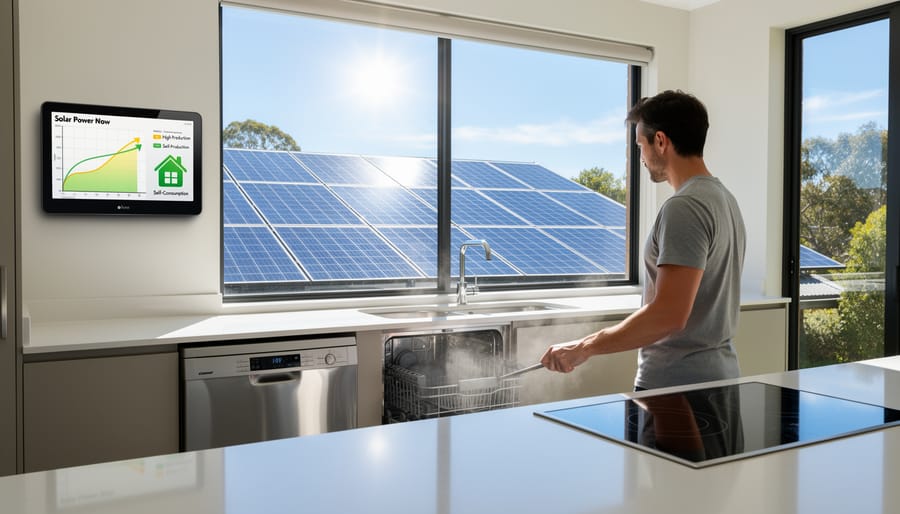
One of the simplest yet most effective ways to maximize your solar investment is aligning your energy-intensive activities with your peak production hours. In British Columbia, solar panels typically generate the most power between 9 AM and 3 PM, with the strongest output around midday. By shifting when you use major appliances to these hours, you can dramatically increase your self-consumption rate and reduce the electricity you purchase from the grid.
Start with your dishwasher and washing machine. Instead of running them in the evening when most households use them, load them up and set delayed start times to kick in during mid-morning or early afternoon. Many modern appliances have this feature built in, making the transition effortless. A Kelowna family recently shared that this simple adjustment saved them approximately 35 dollars monthly on their electricity bills while using their own clean solar power.
Electric vehicle charging offers substantial savings potential. Rather than plugging in overnight when you’re drawing from the grid, charge your EV during daylight hours. If you work from home, this is straightforward. For those commuting, consider charging on weekends or investing in a smart charger that automatically draws power during your solar peak times.
Pool pumps are significant energy consumers but offer flexibility since most pools only need 6-8 hours of filtration daily. Program your pump to run during solar production hours rather than overnight. This single change can shift hundreds of kilowatt-hours per month from grid consumption to solar self-consumption, especially valuable during BC’s summer months when both pool use and solar generation peak simultaneously.
Understanding BC Hydro’s Net Metering Program
BC Hydro’s Net Metering Program offers solar panel owners a valuable opportunity to maximize their renewable energy investment. When your solar system produces more electricity than your home uses, that excess energy flows back into the grid, earning you credits on your hydro bill at the retail electricity rate.
Here’s how it works in practice: during sunny summer months when your panels are producing peak power, you’ll likely generate more electricity than you need. These surplus kilowatt-hours become credits that accumulate in your account. As winter arrives and production drops, you can draw on these banked credits to offset your electricity costs during those darker months.
The program operates on an annual cycle from April 1st to March 31st. Any credits remaining at the end of this period are paid out at a lower rate than retail, so strategic planning is essential. To optimize your financial benefits, aim to size your system so that your annual production closely matches your annual consumption, minimizing leftover credits.
Consider shifting energy-intensive activities to winter months when you’re using banked credits. For example, one Vancouver family scheduled their hot tub usage and electric vehicle charging primarily during November through February, effectively using their summer solar harvest to power winter luxuries at no additional cost.
Track your credit balance through BC Hydro’s online portal monthly. This awareness helps you make informed decisions about energy usage timing and identifies if your system size needs adjustment. Understanding these seasonal patterns ensures you’re capturing the full value of every kilowatt-hour your panels produce.
When to Consider System Upgrades
Battery Storage: Does It Make Sense for Your Home?
Let’s be honest: in British Columbia, battery storage isn’t essential for most solar homeowners. BC Hydro provides one of North America’s most reliable grids, with 98% clean hydroelectricity already powering our homes. Unlike jurisdictions with frequent outages or time-of-use pricing that drastically penalizes evening consumption, our stable grid and net metering program reduce the urgency for battery storage solutions.
That said, batteries make sense in specific situations. If your home experiences frequent power interruptions due to location (rural areas, storm-prone regions like the Gulf Islands), a battery provides peace of mind and keeps essential systems running. Homeowners with medical equipment, home offices requiring uninterrupted power, or those wanting true energy independence find genuine value in storage systems.
The Okanagan’s Thompson family installed a 13.5 kWh battery after experiencing three multi-day outages in two years. While their payback period extends beyond 15 years based purely on financial returns, they consider it worthwhile insurance that happens to optimize their solar usage.
Current battery systems in BC cost between $12,000 and $18,000 installed. Without time-of-use rates or significant demand charges, purely financial payback remains lengthy. However, if BC Hydro transitions to time-of-use pricing or if outage frequency increases in your area, batteries become more compelling.
Consider batteries as a backup solution with optimization benefits, rather than a money-saving necessity. Evaluate your specific needs: outage history, critical power requirements, and future grid changes before investing.
Microinverters and Panel-Level Optimization
If your roof has sections that experience shade from trees, chimneys, or neighboring buildings, microinverters can significantly improve your solar system’s performance. Unlike traditional string inverters where one shaded panel reduces the output of all connected panels, microinverters allow each panel to operate independently. This panel-level optimization technology means unshaded panels continue producing at full capacity while only affected panels experience reduced output.
For BC homeowners with complex roof layouts or partial shading issues, microinverters typically pay for themselves within 3-5 years through increased energy production. Real installations across the province show output improvements of 15-25% compared to string inverter systems in similar conditions.
A Burnaby homeowner recently reported a 20% production increase after upgrading to microinverters on their west-facing roof that receives afternoon shade from nearby trees. The system now generates an additional 800 kWh annually, translating to roughly $100 in savings per year.
Consider microinverters if your roof has multiple orientations, potential shading for more than two hours daily, or if you plan future expansions. The higher upfront cost delivers measurable returns through optimized panel performance and improved system monitoring capabilities.
Adding Capacity: When More Panels Make Financial Sense
Before expanding your solar system, consider these practical factors. First, assess your available roof space—ideally south-facing areas receiving minimal shade throughout the day. BC’s building codes require electrical panel upgrades when adding significant capacity, so factor this cost into your budget.
Calculate your return on investment by reviewing your recent BC Hydro bills. If you’re consistently hitting tier-two pricing or using more than 1,376 kWh monthly during winter, additional panels make financial sense. A Port Moody family recently added four panels after tracking their usage and saw their payback period drop to seven years thanks to increased consumption during electric vehicle charging.
Check with your municipality about permit requirements—some BC communities have streamlined processes for capacity additions. Consider future needs too: planning an EV purchase or heat pump installation? Adding panels now avoids repeat permitting costs. Use online solar calculators specific to BC’s Net Metering program to model your potential savings based on current electricity rates and your household’s growth trajectory.
Seasonal Optimization Strategies for BC Homeowners

Maximizing Winter Production When It Matters Most
Winter in British Columbia presents unique challenges for solar production, but understanding what to expect helps you make the most of shorter days and cloudier skies. While output naturally decreases during these months, several practical strategies can help optimize your system’s performance.
Snow accumulation is the most common winter obstacle. Light snow often slides off tilted panels naturally, but heavier accumulation requires attention. Using safe snow removal techniques protects both your panels and your investment. A soft-bristled roof rake designed for solar panels works well for ground-level or accessible systems.
If your mounting system allows angle adjustments, increasing the tilt during winter months can improve snow shedding and capture more of the available low-angle sunlight. Even a modest adjustment of 10-15 degrees can make a noticeable difference.
Setting realistic expectations matters too. BC homeowners typically see winter production drop to 20-40% of summer levels, depending on location. Coastal areas with milder, cloudier winters differ significantly from interior regions that experience clearer but colder conditions.
One Vancouver Island homeowner tracks their monthly production and schedules high-energy tasks like running their electric vehicle charging during peak winter sunlight hours, maximizing the value of every kilowatt-hour produced. This simple habit helps offset reduced winter output while maintaining year-round energy consciousness.
Taking Full Advantage of Summer Surplus
British Columbia’s long summer days create a golden opportunity to build energy credits that carry you through darker months. Between May and September, your solar panels can produce 60-70% of your annual energy output, so having a clear strategy makes a real difference to your bottom line.
Start by shifting energy-intensive activities to peak production hours, typically 10 AM to 4 PM. Run your dishwasher, do laundry, and charge electric vehicles during this window to consume solar energy directly rather than pulling from the grid later. One Vancouver family saved an extra $320 annually simply by programming their hot water heater to operate during midday hours.
BC’s net metering program allows you to bank excess energy credits for up to 12 months, essentially using the grid as a battery. However, many homeowners miss out by not understanding the March 31st annual reconciliation date. Any unused credits reset then, so timing major efficiency upgrades or big purchases for early spring helps you use those accumulated credits before they expire.
A common pitfall is assuming all surplus automatically benefits you. Without proper monitoring, you might miss system issues during your highest production months. Check your inverter readings weekly and compare them to weather conditions. If a sunny July week shows unexpectedly low output, you could be losing hundreds of dollars in potential credits due to shading issues, dirty panels, or technical problems that need addressing immediately.
Working With Your Installer for Long-Term Performance
Annual Check-Ups That Prevent Expensive Problems
Professional solar inspections in BC typically cost between $150-$300 annually, a small price compared to the thousands you might spend on major repairs from neglected issues. These check-ups should include a thorough examination of your panels for cracks, hot spots, and debris accumulation, as well as testing of inverter performance, electrical connections, and mounting hardware integrity.
Your technician should also verify that your system’s monitoring software accurately reflects actual production and check for potential shading from new tree growth or structures. In BC’s wet climate, inspectors pay special attention to water damage, moss buildup, and corrosion on connections.
Many BC solar companies offer maintenance packages that bundle annual inspections with cleaning services, often saving 20-30% compared to individual service calls. Some homeowners in Vancouver discovered during routine inspections that a single malfunctioning optimizer had reduced their entire system’s output by 15% for months, costing them hundreds in lost production.
Think of these check-ups like regular oil changes for your car. Catching small issues early prevents costly failures and keeps your warranty valid, as most manufacturers require documented maintenance. Schedule inspections in early spring to ensure your system performs optimally during peak production months.
Using Your Monitoring Data to Track Improvements
Your monitoring data is a powerful tool for measuring real improvements in your system’s performance. Start by establishing a baseline using at least one month of production data, noting your average daily kilowatt-hour output and any significant dips. Once you’ve implemented optimization changes like panel cleaning or shade removal, compare subsequent months to this baseline to quantify your gains. Many BC solar owners report 15-25% production increases after addressing simple issues.
Document patterns in your data with screenshots or notes to share with your installer if concerns arise. Clear evidence of underperformance makes conversations more productive and helps technicians diagnose problems faster. For example, if you notice one panel consistently producing less than others, that specific data point can guide repairs.
Celebrate your wins too! Share your optimization success with your community through local sustainability groups or neighbourhood forums. Your experience could inspire others to maximize their systems, strengthening BC’s renewable energy network while reducing your environmental footprint and energy costs.
Optimizing your renewable energy system doesn’t require dramatic overhauls or substantial investments. As we’ve explored throughout this article, small, strategic adjustments compound into remarkable improvements in both performance and cost savings over time. Whether you’re adjusting panel angles seasonally, upgrading your monitoring system, or simply shifting energy-intensive tasks to peak production hours, each step contributes to a more efficient, cost-effective system.
Consider the experience of Sarah Chen, a Victoria homeowner who took action after noticing her system underperforming. By cleaning her panels regularly, updating her aging inverter, and rescheduling her dishwasher and laundry to midday hours, Sarah increased her system’s output by 23% within six months. Her energy bills dropped by $47 monthly, and she’s now exporting enough surplus power to earn solar credits year-round. “I thought optimization meant expensive upgrades,” Sarah shared, “but most changes cost me nothing except a bit of time and attention.”
You can start your optimization journey today. Begin with the simplest steps: inspect your panels for shading or debris, review your monitoring data for unusual patterns, and consider your daily energy habits. Ready for personalized guidance? Connect with Solar BC’s network of certified installers who can conduct comprehensive optimization assessments tailored to your specific system and goals. These professionals understand BC’s unique climate challenges and regulatory landscape, ensuring recommendations that deliver real results. Your path to maximum solar performance starts with a single optimization step taken today.