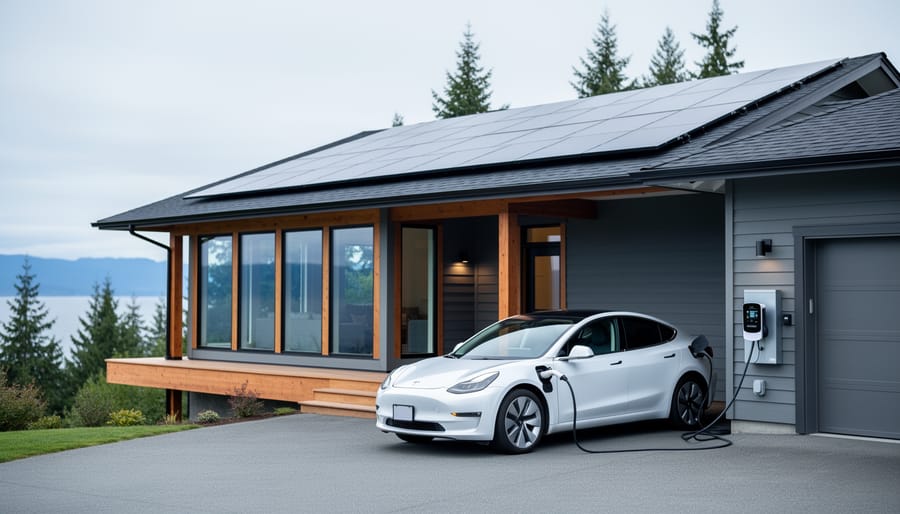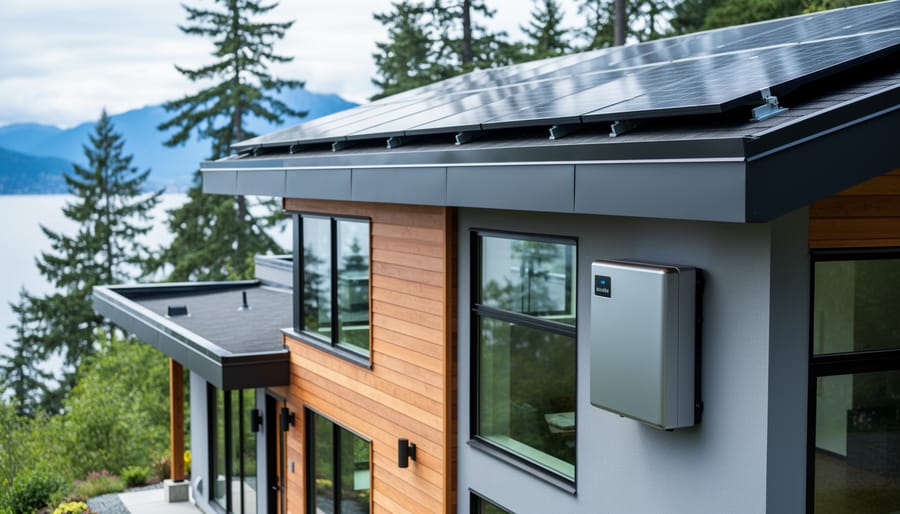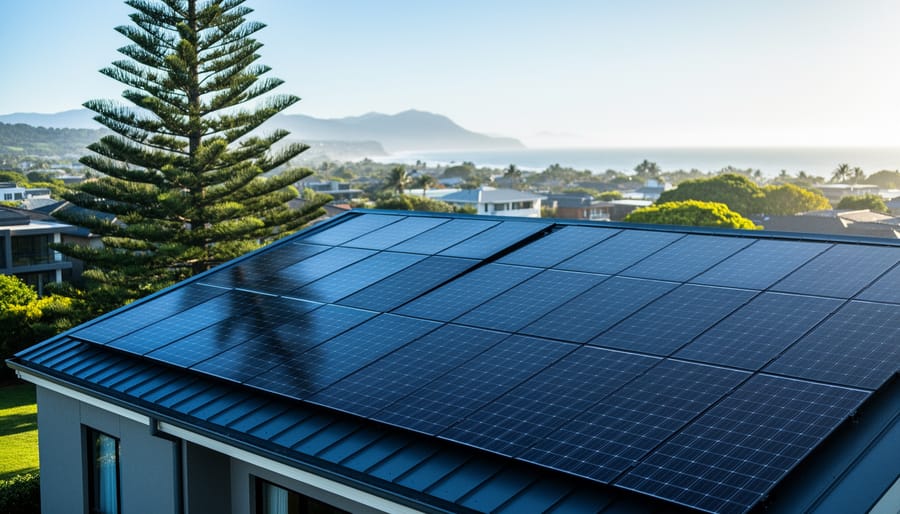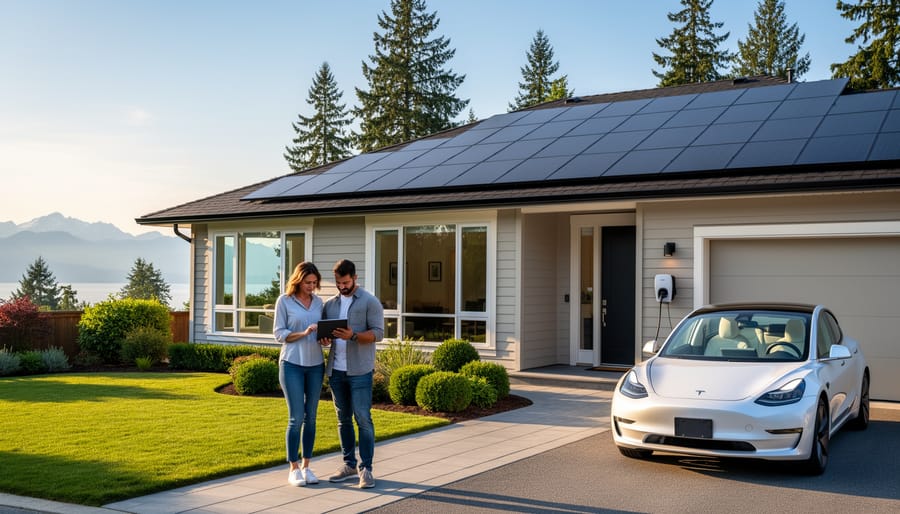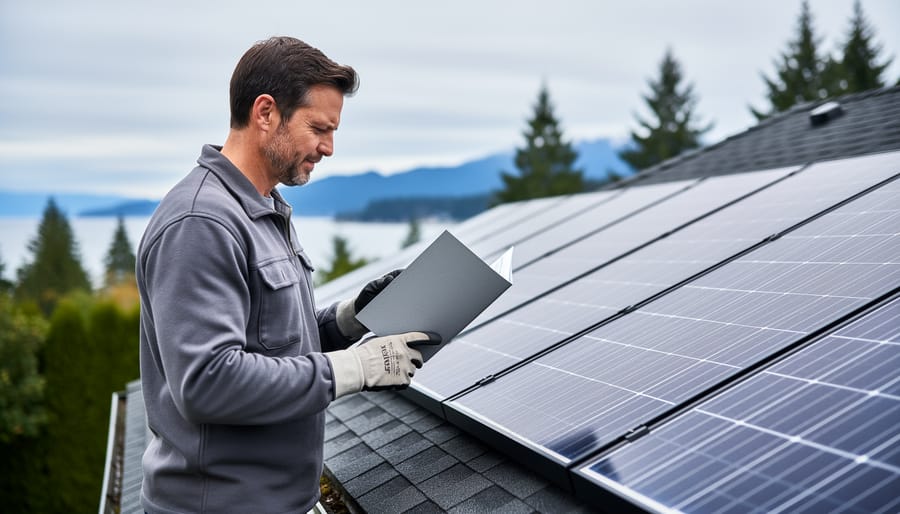
Modern 500-watt monocrystalline solar panels on a south-facing asphalt-shingle roof in British Columbia, viewed at a 45-degree angle with mounting rails and spacing visible; evergreen trees and distant coastal mountains softly blurred under bright overcast light.

What a 500 Watt Solar Panel Actually Measures (And Why It Matters for Your BC Home)

Expect a 500 watt solar panel to measure approximately 27.5 square feet, with typical dimensions of 7 feet long by 3.5 feet wide (2.1 meters by 1.1 meters). These high-output panels require careful planning since each unit demands significantly more roof space than standard residential panels, making accurate measurements essential before committing to any installation project.

Understanding these dimensions helps you calculate how many panels fit your available space. A standard BC home with 400 square feet of south-facing roof can accommodate 12 to 14 panels of this size, generating between 6 to 7 kilowatts of power. Properties with complex roof angles, chimneys, or skylights need additional clearance considerations that reduce usable installation area by 15 to 20 percent.

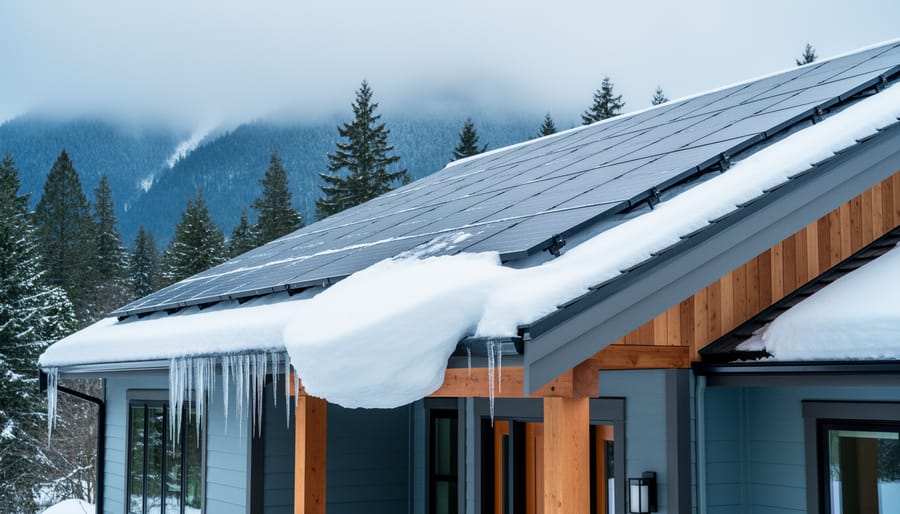
Weight matters equally to size. Most 500 watt panels weigh 60 to 75 pounds each, requiring structural assessment for older roofs or buildings with weight restrictions. British Columbia’s wet climate and occasional heavy snowfall add seasonal load considerations that certified installers evaluate during site surveys.

Ground-mounted systems offer flexibility when roof space proves inadequate. These installations require roughly 35 to 40 square feet per panel including spacing for maintenance access and preventing shade between rows. Rural properties across the Interior, Vancouver Island, and Fraser Valley frequently choose ground mounts to maximize southern exposure without roof limitations.

Standard Dimensions of 500 Watt Solar Panels

500-watt solar panels installed on residential roof showing size and mounting configuration
Modern 500-watt solar panels installed on a British Columbia residential roof demonstrate the physical footprint and mounting requirements for high-wattage systems.

Typical Size Range

A standard 500-watt solar panel typically measures approximately 7.5 feet long by 3.5 feet wide, or about 2.3 meters by 1.1 meters in metric measurements. These dimensions can vary slightly depending on the manufacturer and specific model you choose. Some panels may be a few inches longer or shorter, while width variations are generally minimal.

When planning your installation, it’s important to account for weight as well. Most 500-watt panels weigh between 40 and 55 pounds (18-25 kilograms). This weight consideration matters particularly for BC homeowners evaluating rooftop installations, as your roof structure must safely support not just the panels themselves, but also the mounting hardware and potential snow loads during winter months.

For example, a homeowner in Kelowna recently discovered their garage roof could accommodate four 500-watt panels in a 2×2 configuration, creating a compact 2-kilowatt system that powers their workshop year-round. Understanding these specific measurements helped them visualize the layout and confirm structural capacity before moving forward.

Keep in mind that you’ll need additional clearance around each panel for proper airflow and maintenance access. Most installers recommend leaving at least 6 inches of space between panels and around the array perimeter. This spacing ensures optimal performance and makes future cleaning or repairs more manageable for BC’s varying weather conditions.

How 500W Panels Compare to Smaller Models

When comparing 500W panels to more common residential options, the differences become clear. A typical 300W panel measures approximately 65″ x 39″ (1.65m x 1.0m), while 400W panels are usually 79″ x 39″ (2.0m x 1.0m). In contrast, 500W panels measure roughly 89″ x 43″ (2.26m x 1.1m), making them about 15% larger than 400W models.

The real advantage lies in power density. While 300W panels generate about 17 watts per square foot, 500W panels produce approximately 23 watts per square foot. For a BC homeowner needing 6kW of capacity, this means installing twelve 500W panels instead of twenty 300W panels—a significant space saving that matters when roof area is limited.

Consider the Port Moody family who upgraded from 300W to 500W panels during their retrofit. They achieved the same energy output using 40% less roof space, leaving room for future expansion. This efficiency makes 500W panels particularly valuable for urban properties with smaller rooftops or shaded areas.

Understanding these differences compared to standard solar panel sizes helps you maximize your available space while meeting your energy goals.

Why Panel Size Matters for Your Installation

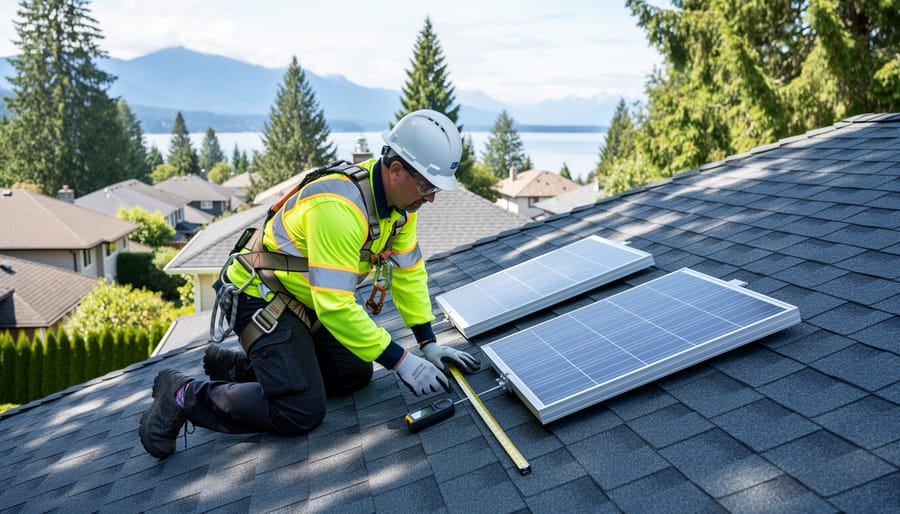
Solar installer measuring panel dimensions with tape measure on rooftop
Precise measurements are essential when planning solar installations to ensure panels fit properly within available roof space and meet structural requirements.

Roof Space Requirements

Before installing 500-watt panels on your BC home, you need to understand how much usable roof space you actually have. Most 500-watt panels measure approximately 2.3 meters by 1.1 meters, occupying about 2.5 square meters per panel. However, calculating roof capacity requires more than simple division.

For effective solar production, installers typically leave 15-30 centimeters between panels for airflow and maintenance access. You’ll also need to avoid areas within one meter of roof edges for safety compliance and account for obstructions like vents, chimneys, and skylights.

Let’s look at a practical example: Consider a typical Vancouver home with a south-facing roof section measuring 8 meters wide by 6 meters deep. That gives you 48 square meters of total space. After deducting edge setbacks (reducing usable width to 6 meters and depth to 4 meters), you have 24 square meters of workable area.

With proper spacing between panels, you could realistically fit 8 to 9 panels in this configuration, generating 4,000-4,500 watts of capacity. For homes with smaller roof sections or multiple obstructions, a Victoria homeowner recently worked with a local installer to create a split array across two roof faces, maximizing their available space.

Remember that shading from nearby trees or buildings significantly impacts production. A site assessment from a certified installer will provide accurate measurements and identify the optimal panel placement for your specific property, ensuring you maximize both space efficiency and energy generation throughout BC’s varying seasonal conditions.

Weight and Structural Considerations

A typical 500-watt solar panel weighs between 25 to 30 kilograms, and understanding panel weight considerations is essential for BC homeowners planning installations. When you’re evaluating your roof’s capacity, remember that a complete system includes not just the panels but also mounting hardware, which adds approximately 3-5 kg per panel.

British Columbia’s building codes require roofs to support the combined weight of solar equipment plus significant snow loads, which vary dramatically across our province. Coastal regions like Vancouver typically see lighter snow accumulation, while interior communities such as Kelowna or Prince George must account for heavier winter loads. Your roof should safely handle at least 200 kg per square meter when factoring in panels, mounting systems, and seasonal snow.

For older homes built before 1990, a structural assessment by a qualified engineer is highly recommended before installation. Many heritage homes in Victoria and Vancouver have been successfully retrofitted with solar systems after minor reinforcements. One homeowner in New Westminster discovered their 1920s bungalow needed only modest beam reinforcement to support a 15-panel array, adding minimal cost to their overall project.

Ground-mounted systems offer an excellent alternative if your roof structure raises concerns. These installations eliminate weight distribution issues entirely while often providing better panel orientation. Connect with BC-certified solar installers who understand regional requirements and can properly assess your property’s specific structural capabilities before moving forward with your solar journey.

Power Output vs. Physical Size: Understanding Efficiency

Why 500W Panels Are More Space-Efficient

High-wattage 500W panels deliver significantly more power per square foot than traditional panels, making them ideal for properties with limited roof space. While a standard 300W panel typically measures around 65 x 39 inches, a 500W panel at roughly 83 x 43 inches produces 67% more power with only 35% more surface area. This efficiency matters tremendously for BC homeowners.

Consider a recent installation in Victoria where a family needed 6,000 watts of capacity. Using 300W panels would require 20 units covering approximately 350 square feet. By choosing 500W panels instead, they needed just 12 panels occupying 250 square feet—saving 100 square feet of valuable roof space. This freed up room for future expansion and reduced installation complexity.

The space efficiency becomes even more valuable when you factor in BC’s varied roof designs and the need to avoid shading from surrounding trees or buildings. Fewer panels mean fewer mounting points, simplified wiring, and often lower installation costs. For businesses with flat commercial roofs, this efficiency translates directly into more capacity per building footprint, maximizing your renewable energy investment while maintaining aesthetic appeal and structural integrity.

Best Applications for 500 Watt Panels in BC

Residential Installations

For many BC homeowners, 500-watt panels are ideal when roof space is limited but energy needs are substantial. A typical 1,500-2,000 square foot home consuming 10,000-12,000 kWh annually can benefit significantly from these high-output panels. You’ll need fewer panels overall, which means simpler installation and potentially lower labor costs.

Consider the Williams family in Victoria, who installed twelve 500W panels on their 1,800 square foot home’s south-facing roof. This 6kW system now covers roughly 70% of their annual electricity needs, demonstrating how efficiently these panels work in BC’s climate. Homes with complex roof layouts, partial shading, or heritage considerations particularly benefit from the space-saving advantage of 500-watt panels.

These panels make the most sense when your household uses major appliances during daylight hours, runs electric vehicle charging, or includes home office setups. If your monthly BC Hydro bills consistently exceed $150, the higher upfront investment in 500W panels often pays off through faster energy savings. Calculate your specific needs using online solar calculators, then connect with certified local installers who understand BC building codes and can assess your roof’s structural capacity for these heavier panels.

Commercial and Off-Grid Applications

For businesses and rural properties across British Columbia, 500-watt panels offer compelling advantages that go beyond residential rooftop installations. The larger output per panel means fewer total units needed, which translates to reduced mounting hardware, simplified electrical connections, and lower labor costs during installation.

Commercial operations benefit significantly from these high-output panels. A craft brewery in the Okanagan Valley recently installed thirty 500-watt panels on their warehouse roof, generating enough power to run their refrigeration systems during peak production hours. The business reduced their electricity bills by 40% within the first year while showcasing their commitment to sustainability to customers.

For off-grid applications, these panels shine particularly bright. Remote cabins, farms, and eco-lodges throughout BC’s interior and coastal regions can achieve energy independence with fewer panels. A Gulf Islands retreat center replaced their diesel generator with a system using just twenty 500-watt panels paired with battery storage, eliminating fuel costs and reducing noise pollution for guests.

The key advantage in commercial and off-grid scenarios is space efficiency. When roof or ground space is limited but energy demands are high, these larger panels maximize production without requiring additional square footage. BC’s Net Metering program also allows businesses to feed excess power back to the grid, creating potential revenue streams during low-consumption periods.

Whether you’re running a small business or establishing an off-grid homestead, calculating your energy needs is the first step toward determining if 500-watt panels make economic sense for your specific situation.

Aerial view of commercial building with 500-watt solar panel array installation
Commercial installations in BC frequently utilize 500-watt panels to maximize energy production within limited roof space, demonstrating efficient use of available area.

Installation Considerations Specific to British Columbia

Mounting Systems and Wind/Snow Loads

British Columbia’s diverse climate zones demand careful attention to mounting systems when installing 500-watt panels. These larger, heavier panels require robust structural support to withstand both coastal wind gusts and heavy interior snowfall.

In coastal regions like Vancouver Island and the Lower Mainland, mounting systems must account for wind speeds that can exceed 120 km/h during winter storms. The increased surface area of 500-watt panels creates greater wind load compared to smaller panels, making proper rail spacing and clamp selection critical. Most certified installers in BC use aluminum mounting rails rated for coastal environments, with corrosion-resistant hardware designed for our wet climate.

Interior communities face different challenges. A homeowner in Kelowna recently shared how their installer calculated snow loads based on local building codes, ensuring their 500-watt panel array could support over 100 cm of accumulated snow without structural stress. The mounting angle was optimized not just for solar gain, but also to encourage natural snow shedding.

When planning your installation, BC Building Code requires engineered mounting systems for arrays over certain sizes. Your certified installer will assess your roof structure, local weather patterns, and municipal requirements to design a system that keeps your investment secure year-round. This professional evaluation protects both your panels and your property, ensuring decades of reliable energy production.

Working with Certified BC Installers

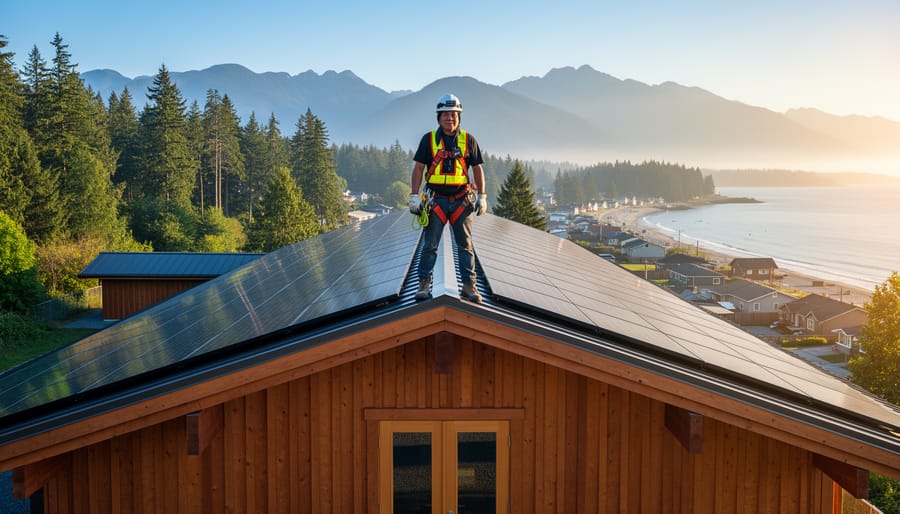
When you’re working with 500-watt panels measuring roughly 7 feet by 3.5 feet and weighing 60-75 pounds each, professional installation becomes essential rather than optional. These larger panels require specialized handling and precise mounting techniques that certified BC installers bring to every project.

A qualified installer begins with a comprehensive site assessment of your property. They’ll evaluate your roof’s structural integrity to ensure it can support the additional weight, especially important for BC homes dealing with snow loads. For example, a Vancouver homeowner recently discovered during their assessment that their 1970s roof needed minor reinforcement before accommodating eight 500-watt panels—a detail that prevented costly issues down the road.

Certified installers also conduct a thorough structural evaluation, examining roof pitch, orientation, and potential shading throughout the year. They understand BC building codes and permit requirements, ensuring your installation meets all safety standards. You can expect them to provide detailed calculations showing exactly how many panels your roof can safely support and the optimal placement for maximum energy production.

The assessment typically includes electrical system evaluation and recommendations for any necessary upgrades. Most reputable installers offer transparent quotes and realistic timelines, giving you confidence in your solar investment from start to finish.

Calculating Your Space and Energy Needs

Before ordering 500-watt panels, let’s work through two simple calculations to ensure they’re right for your property.

Start by assessing your available roof space. Each 500W panel typically measures 2.3 metres by 1.3 metres (about 3 square metres per panel). Walk around your property and identify south-facing areas with minimal shade between 9am and 3pm. Measure your available roof sections, then divide by 3 to estimate how many panels will fit. Don’t forget to account for roof vents, chimneys, and required setbacks from edges. A typical BC home roof can accommodate 8-12 panels of this size.

Next, calculate your energy needs by reviewing your BC Hydro bills from the past year. Add up your total kilowatt-hours consumed and divide by 365 for your daily average. In British Columbia, a 500W panel generates approximately 1.5-2 kilowatt-hours daily, depending on your location. Coastal areas receive less direct sunlight than interior regions, so adjust expectations accordingly.

For example, the Henderson family in Kelowna discovered their 15 panels (each 500W) would cover 85% of their annual consumption, while the Patels in Vancouver found that 10 panels met 60% of their needs due to cloudier conditions.

Consider creating a simple spreadsheet with your measurements and energy data, or use online solar calculators designed for BC’s climate zones. This preparation helps conversations with installers become more productive and ensures you’re investing in the right system size for your specific situation.

Understanding the dimensions of 500-watt solar panels is your first step toward a successful solar installation. These panels typically measure around 7 feet by 3.5 feet, requiring roughly 25 square feet per panel including spacing. For a typical BC home needing 15-20 panels, that translates to 400-500 square feet of roof space.

Armed with these measurements, you can now assess whether your property is ready for solar. Consider factors like roof orientation, structural capacity, and local weather patterns that affect performance in British Columbia’s unique climate.

Ready to take the next step? Use Solar BC’s interactive solar savings calculator to get a personalized assessment of your property’s potential. Connect with our network of certified installers who understand BC building codes and can evaluate your specific situation. They’ll help you determine the optimal panel layout and maximize your return on investment.

By choosing solar, you’re joining a growing community of British Columbians reducing carbon emissions and building energy independence. Your decision today creates lasting environmental benefits for generations to come.


Posted

in

by

Tags: