

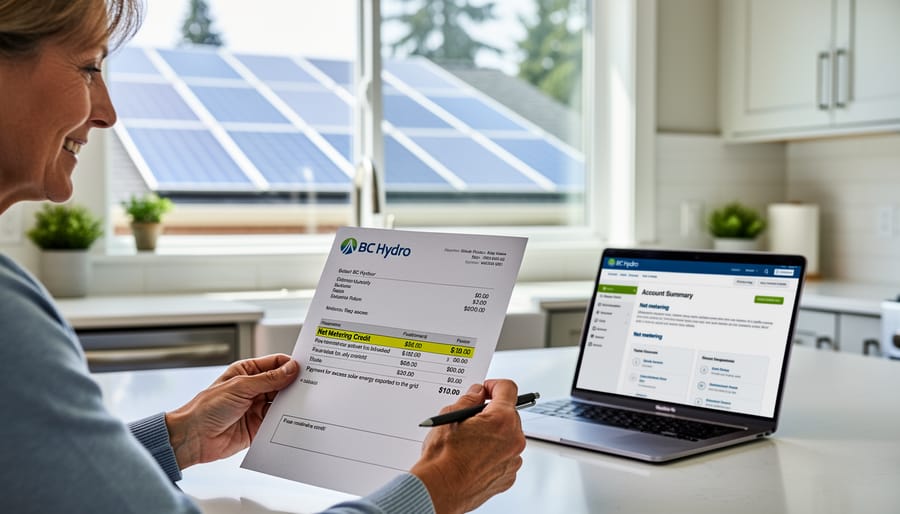
Check your BC Hydro bill’s “accr earning pymt added to account” line item—this represents credits you’ve earned from your solar panel system sending excess electricity back to the grid through BC Hydro’s Net Metering Program. These accumulated earnings offset your future electricity consumption, typically appearing as a credit balance that rolls forward month to month.
Calculate your exact credit rate by dividing the dollar amount shown by your kilowatt-hours (kWh) exported during that billing period. BC Hydro credits solar customers at approximately 9.94 cents per kWh for residential customers in most service areas, though rates vary based on your specific tier and location. Review your statement’s “Energy Delivered to BC Hydro” section to verify your exported energy matches the credited amount.
Track these credits throughout the year because BC Hydro reconciles your account annually each March. If you’ve generated more electricity than you consumed over the 12-month period, you’ll receive a payment for the excess at the current market rate. However, if you’ve used more than you produced, your accumulated credits simply reduce your overall electricity costs without additional charges beyond standard consumption rates.
Compare your monthly credit accumulation against your household’s typical usage patterns to optimize your solar system’s performance. Most BC homeowners see their highest credits during summer months when panels produce peak output but household consumption remains relatively low, with these banked credits offsetting higher winter electricity usage when solar production decreases and heating demands increase.
What ‘Accr Earning Pymt Added to Account’ Actually Means
If you’ve spotted “Accr Earning Pymt Added to Account” on your BC Hydro statement, congratulations—you’re literally earning money from the sun! This line item represents real credits being added to your account for the excess solar energy your panels generate and export back to BC Hydro’s electrical grid.
Let’s break down what each part means. “Accr” is short for accrued, meaning these earnings have built up over your billing period. “Earning” refers to the financial credit you’ve accumulated. “Pymt” stands for payment, and “Added to Account” confirms this amount reduces what you owe BC Hydro—or builds a credit balance if your solar production exceeds your consumption.
Think of it this way: when your solar panels produce more electricity than your home or business uses at any given moment, that surplus energy flows back into the grid. BC Hydro purchases this energy from you through their Net Metering Program, crediting your account at the current retail electricity rate. This is different from simply reducing your consumption—you’re actively becoming a small-scale energy producer.
For many BC Hydro customers new to solar, understanding your BC Hydro bill with solar credits can initially feel confusing. The terminology isn’t always intuitive, but the concept is straightforward: every kilowatt-hour you export earns you money.
These credits accumulate on your account and offset future electricity charges. During sunny summer months, you might build substantial credits that carry forward to cover winter consumption when your panels produce less energy. It’s renewable energy working for your wallet while benefiting the entire provincial grid.
How BC’s Net-Metering Credits Accumulate on Your Account
When Your Solar Panels Produce More Than You Use
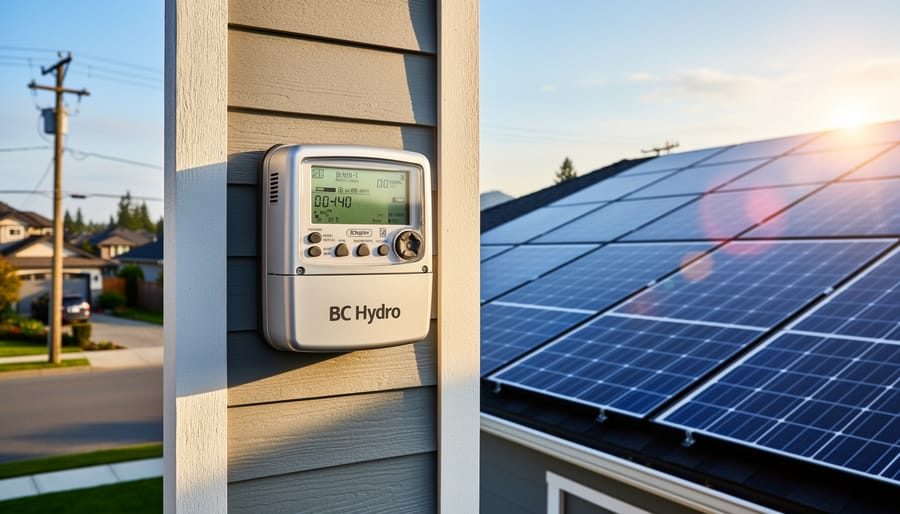
When your solar panels generate more electricity than your home or business uses at any given time, that excess energy doesn’t go to waste. Instead, it flows back into the BC Hydro electrical grid, where it helps power your neighbors’ homes and local businesses. This process happens automatically through your bi-directional meter, a specialized device that tracks both the electricity you draw from the grid and the surplus power you contribute back.
BC Hydro monitors this exported energy carefully, recording it in kilowatt-hours (kWh) throughout each billing period. Think of it like a community energy exchange: during sunny midday hours when your panels are producing at peak capacity but you’re at work using minimal power, your excess electricity supports the broader grid. Later, when you return home in the evening and your panels aren’t generating, you draw from that same grid.
This two-way energy flow forms the foundation of BC Hydro’s net metering program. The utility keeps detailed records of every kWh you export, which then translates into the credits that eventually appear on your bill as that mysterious “accr earning pymt added to account” line item. Your contribution to the grid has real value, both environmentally and financially.
The Credit Calculation Process
BC Hydro calculates your credit based on the amount of surplus electricity your solar system exports to the grid. When your panels produce more energy than you’re using, your meter tracks this excess generation in kilowatt-hours (kWh).
The credit rate you receive varies depending on your billing period. BC Hydro typically compensates solar producers at approximately 9.99 cents per kWh for exported energy. This rate is lower than what you pay for electricity you consume from the grid, which averages around 12-14 cents per kWh depending on your tier and usage. While this difference might seem discouraging at first, remember that your primary savings come from the electricity you use directly from your panels during daytime hours, avoiding the full retail rate entirely.
For example, the Martinez family in Kelowna exports about 200 kWh monthly during summer. At the current rate, they receive roughly $20 in credits each month, which accumulates and offsets their winter consumption when solar production drops. These credits roll over for 12 months, providing year-round value.
Your bill shows these earnings as “accr earning pymt added to account,” creating a running balance that reduces your future electricity costs. Understanding this calculation helps you maximize your solar investment by timing high-energy activities during peak production hours.
From Credits to Cash: How Payments Work
Your accumulated solar credits don’t sit in your account indefinitely—they convert to actual payments during BC Hydro’s annual reconciliation period, which typically occurs in March. At this time, BC Hydro calculates your net energy production for the past year. If you’ve generated more electricity than you’ve consumed, those excess credits become cash payments at the current rate.
However, there’s an important detail: BC Hydro only issues payments when your credit balance exceeds your minimum monthly bill amount. For example, if your basic charge is $15 monthly, you’ll need at least that amount in credits before receiving a payment. Smaller credit balances may roll over to the next billing cycle.
The payment rate matches what BC Hydro pays for electricity—currently around 12 cents per kilowatt-hour for residential customers. While this is lower than retail rates, it still represents genuine income from your solar investment. Many BC homeowners receive annual payments ranging from $200 to $800, depending on their system size and energy usage patterns. Think of it as your solar panels working as a small revenue generator while reducing your carbon footprint.
Current BC Net-Metering Rates and What They Mean for Your Returns
Export vs. Import Rates: Understanding the Gap
One important aspect of BC Hydro’s net metering program is understanding that the rate you pay for electricity differs from what you receive for exported solar energy. Currently, BC Hydro residential customers pay approximately 11-15 cents per kilowatt-hour depending on your consumption tier, while the credit for exported energy is about 9.99 cents per kWh.
This gap exists because the export rate reflects the utility’s avoided cost of generating that power, rather than the full retail rate which includes transmission, distribution, and administrative costs. While this might seem like a disadvantage, it’s actually standard across most net metering programs in North America.
Here’s why it still makes financial sense: First, every kilowatt-hour your solar system produces that you consume directly saves you the full retail rate. You only receive the lower export rate for surplus energy sent to the grid. Second, these credits accumulate on your account and offset future electricity purchases at the higher retail rate during winter months when your solar production drops.
For example, the Chen family in Kelowna discovered their solar system provided 70 percent self-consumption during peak production months. This meant they saved the full retail rate on most of their generated power, with only 30 percent exported at the lower rate. Their annual savings still exceeded $800, demonstrating that strategic energy use timing maximizes your solar investment even with the rate differential.
The key is designing your system size appropriately and shifting energy-intensive activities to sunny daytime hours whenever possible.
Regional Variations Across BC
Good news for solar customers: BC Hydro applies consistent net metering rates across all service areas throughout the province. Whether you’re in Vancouver, the Okanagan, Prince George, or the Kootenays, your accr earning pymt credit is calculated at the same retail rate you pay for electricity consumption.
This standardized approach means a kilowatt-hour generated by your solar panels in Kelowna receives the same credit value as one produced in Victoria or Fort St. John. The uniformity simplifies the system and ensures fairness across different communities, regardless of local infrastructure costs or population density.
However, what does vary between regions is your solar generation potential. Sunnier communities like Penticton or Kamloops naturally produce more solar energy throughout the year compared to cloudier coastal areas, leading to higher accumulated credits. For example, a Vernon homeowner shared that their 6kW system generated approximately 15% more annual credits than a similar installation in North Vancouver, simply due to increased sunshine hours.
This regional variation in solar production doesn’t affect the credit rate itself, but it does influence your total annual earnings. When considering solar installation, factor in your specific location’s solar irradiance data to estimate realistic credit accumulation. The consistent provincial rate structure, combined with your local sunshine advantage, determines your actual financial benefit from net metering.
Real BC Homeowners: Tracking Their Net-Metering Earnings
Meet the Johnsons from Kelowna, who installed a 6.5 kW solar array in early 2022. Their first summer with solar brought pleasant surprises when they checked their BC Hydro account. “We saw ‘accr earning pymt added to account’ show up in June, and honestly, we had to search online to understand what it meant,” says Maria Johnson. “Once we realized these were our net-metering credits, we started tracking them closely.”
Their billing statements reveal telling patterns. During July and August, their system generated $85-$95 monthly in credits. September dropped to $62, while October brought $38. Winter months showed minimal earnings, with December and January producing just $8-$12 each. Their annual total reached $487 in net-metering credits, offsetting nearly 40% of their yearly electricity costs.
David Chen in Victoria shares similar results with his 5 kW installation. “Spring and fall are surprisingly productive here,” he notes. His April statement showed $71 in credits, benefiting from longer days and cooler panel temperatures. Understanding these billing line items helped him optimize his energy usage, running appliances during peak solar production hours.
The Patels in Surrey took a different approach with their 8 kW system. They documented every monthly credit over 18 months, creating a spreadsheet that informed their decision to add battery storage. Their summer months consistently generated $110-$130 in credits, while winter averaged $15-$25. “Seeing actual numbers made the investment real,” explains Raj Patel. “We earned back $892 in our first full year.”
These real-world examples demonstrate how BC homeowners are transforming sunshine into tangible bill reductions. While earnings vary by location, system size, and weather patterns, the consistent message is clear: net-metering credits provide measurable financial benefits that accumulate month after month, season after season.
Maximizing Your Net-Metering Credits and Payback Speed
Timing Your Energy Usage
Maximizing your net metering credits starts with smart timing. Your solar panels generate the most power during midday hours, typically between 10 a.m. and 3 p.m., which is the perfect window to reduce your grid consumption and increase exports.
Consider shifting energy-intensive activities to match your peak production times. Run your dishwasher, washing machine, and dryer during sunny afternoons rather than evening hours. If you have an electric vehicle, program charging to occur during the day when you’re generating surplus power. Many BC Hydro customers have found success by setting timers on pool pumps and hot water heaters to operate during solar production hours.
A Vancouver Island family increased their annual net metering credits by $180 simply by rescheduling their household routines. They moved laundry days to weekends when everyone was home to monitor production, and delayed running heavy appliances until solar generation peaked.
For businesses, this strategy can be even more impactful. A Richmond-based office building redirected their HVAC system’s intensive operations to daylight hours, allowing them to export more power during summer months when production exceeded their reduced evening needs. Track your production patterns for a few weeks to identify your optimal energy windows, then adjust your habits accordingly.
System Sizing for Optimal Returns
Finding the sweet spot for your solar system size is key to maximizing those “accr earning pymt added to account” credits while keeping your upfront investment reasonable. Here’s what BC homeowners should consider.
First, analyze your annual electricity consumption through your BC Hydro account. A system sized to produce 80-100% of your yearly usage typically offers the best financial returns. Why not 100% or more? While BC Hydro’s net metering program does credit your excess generation, those credits expire after one year if unused. Oversizing your system means potentially losing value on surplus production that exceeds what you can use or roll over.
Consider the Richmond family who installed a 6.5 kW system matching their annual 7,500 kWh consumption. During summer months, they export significant power, earning credits that offset their higher winter usage when solar production drops. Their monthly statements regularly show accumulated earnings carrying forward, ensuring year-round savings without wasting excess credits.
Seasonal variation matters greatly in BC. Most solar production happens between April and September, while consumption often peaks during darker winter months. A properly sized system generates enough summer credits to substantially reduce or eliminate winter bills without creating credits that vanish unused.
For those with electric vehicles or planning future electrification (heat pumps, for example), sizing slightly larger makes sense since your consumption will grow. Start by calculating your current and anticipated usage, then work with local installers familiar with BC’s climate patterns to design a system that balances self-consumption with strategic export earnings.

Calculate Your Potential Net-Metering Earnings
Understanding your potential net-metering earnings doesn’t require complex calculations. Let’s walk through a practical example that shows how British Columbia homeowners can estimate their annual credits.
Consider the Williams family in Kamloops, who installed a 6 kW solar system on their south-facing roof. Their system generates approximately 7,200 kWh annually, while their household consumes 9,000 kWh per year. During summer months, their panels produce more electricity than they use, sending the surplus back to the grid. In winter, they draw power from BC Hydro when solar production drops.
Here’s the simple calculation: The Williams family exports about 3,000 kWh to the grid during peak production months. At BC Hydro’s current rate of approximately $0.1239 per kWh, this generates roughly $372 in annual credits. These credits appear on their bill as “ACCR EARNING PYMT ADDED TO ACCOUNT” during surplus months and offset their winter electricity costs.
Your potential earnings depend on three key factors: your system size, your location’s solar exposure, and your consumption patterns. A larger system in a sunny location like Kelowna will generate more credits than a smaller installation in cloudier areas. The timing matters too. Families who use less electricity during summer months maximize their exports and accumulate larger credits.
Solar BC offers an online calculation tool that factors in your specific address, roof orientation, and typical energy usage. Simply enter your current annual consumption from your BC Hydro bill, and the tool estimates both your production and potential net-metering credits. This personalized approach helps you make informed decisions about system sizing and expected financial returns, ensuring your solar investment aligns with your energy goals and budget.
Understanding the ‘accr earning pymt added to account’ notation on your BC Hydro bill is more than just decoding billing terminology—it represents tangible financial returns on your investment in clean energy. Every credit you see reflects power you’ve generated, surplus energy you’ve shared with your community, and real savings accumulating in your account. For BC homeowners and businesses already benefiting from solar, these credits validate your environmental commitment while reducing your energy costs.
If you’re researching whether solar makes financial sense for your property, the net-metering program demonstrates how BC Hydro actively supports renewable energy adoption. With current electricity rates and available incentives, many BC households see significant returns over the lifespan of their systems.
Ready to explore if solar is right for you? Start by requesting a free assessment from certified BC solar installers who understand our province’s unique climate and incentive landscape. They’ll evaluate your roof’s orientation, calculate your potential energy production, and provide a clear picture of your expected savings. Consider exploring financing options for solar or solar PPAs in BC that minimize upfront costs.
Take the next step toward energy independence and join the growing community of British Columbians generating their own clean power. Your future self—and your electricity bill—will thank you.