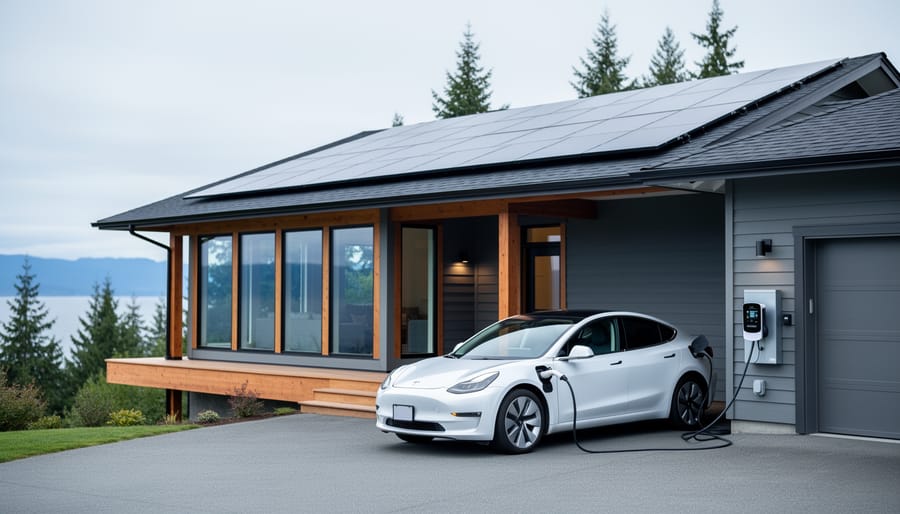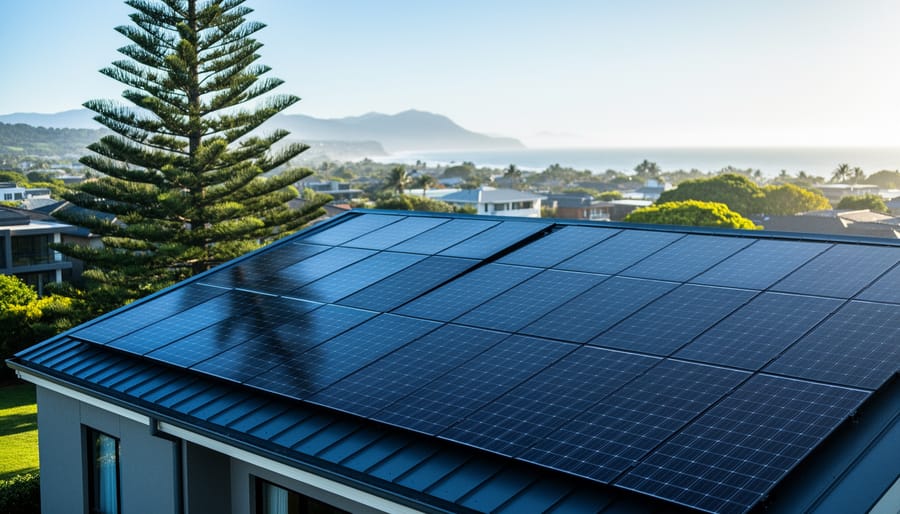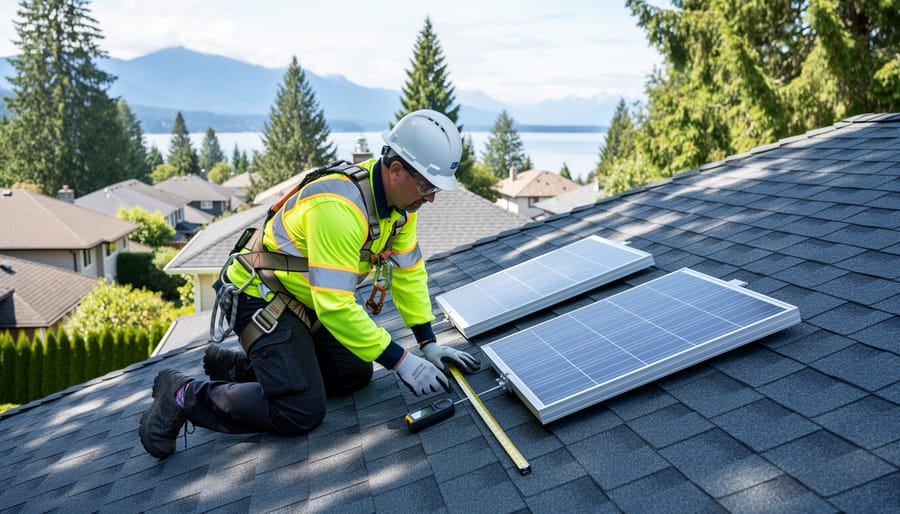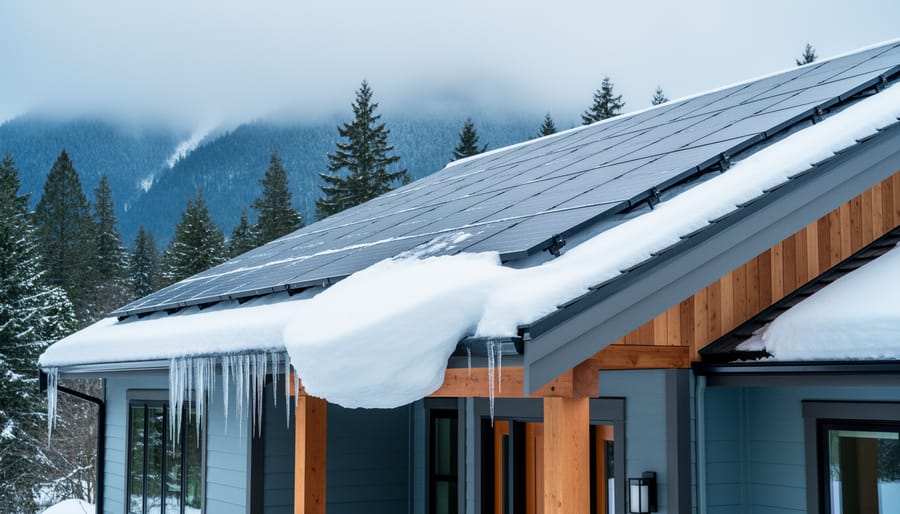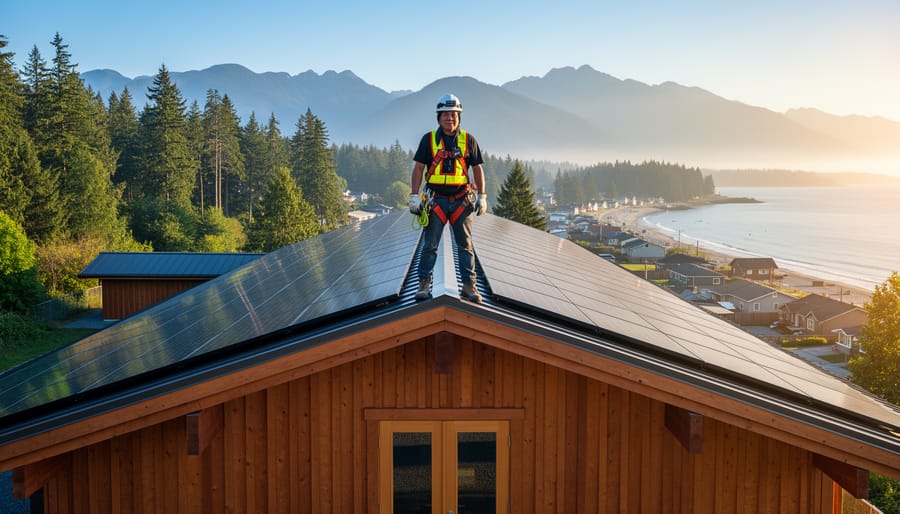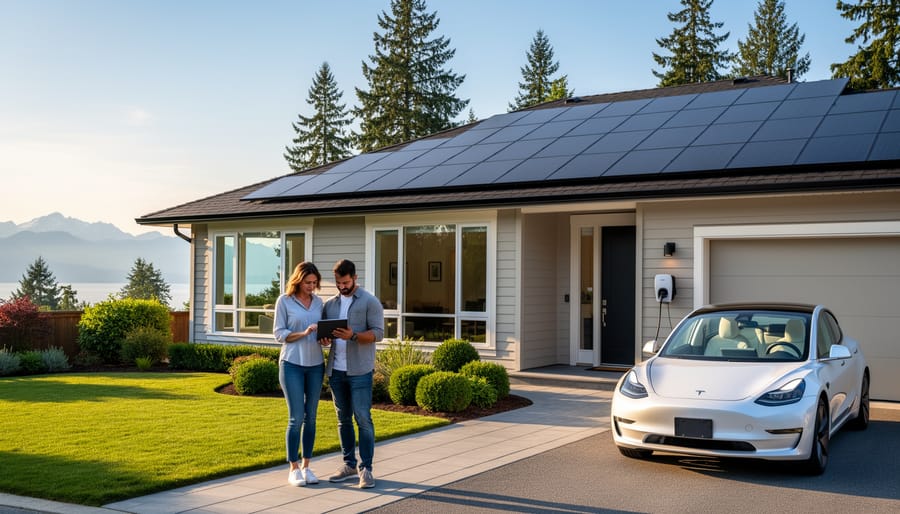
Net-zero homes in British Columbia are no longer just an environmental aspiration—they’re becoming a practical shield against climate uncertainty and rising energy costs. These homes produce as much energy as they consume annually, typically through rooftop solar panels combined with energy-efficient building design. When integrated with Vehicle-to-Home technology, your electric vehicle transforms into a mobile power station, capable of keeping your lights on, refrigerator running, and heating system operational during the increasingly frequent power outages affecting communities across the province.
Consider what happened during recent atmospheric river events in the Lower Mainland. Homeowners with net-zero setups and V2H systems maintained power for days while neighbors faced extended blackouts. This resilience comes from storing energy in your EV’s battery—often holding 60-100 kWh of electricity—and drawing it back into your home when the grid fails or electricity rates peak. You’re essentially creating a closed-loop energy ecosystem that serves triple duty: transportation, daily power needs, and emergency backup.
The technology works through bidirectional charging equipment that allows electricity to flow both ways between your vehicle and home. Combined with BC Hydro’s net metering program, excess solar generation credits your account, while your EV battery provides storage capacity far exceeding traditional home batteries at a fraction of the cost. For British Columbians facing longer wildfire seasons, winter storms, and grid instability, this integrated approach delivers energy security while advancing provincial climate commitments.
What Makes a Home Truly Net-Zero in B.C.
The Missing Piece in Most Net-Zero Homes
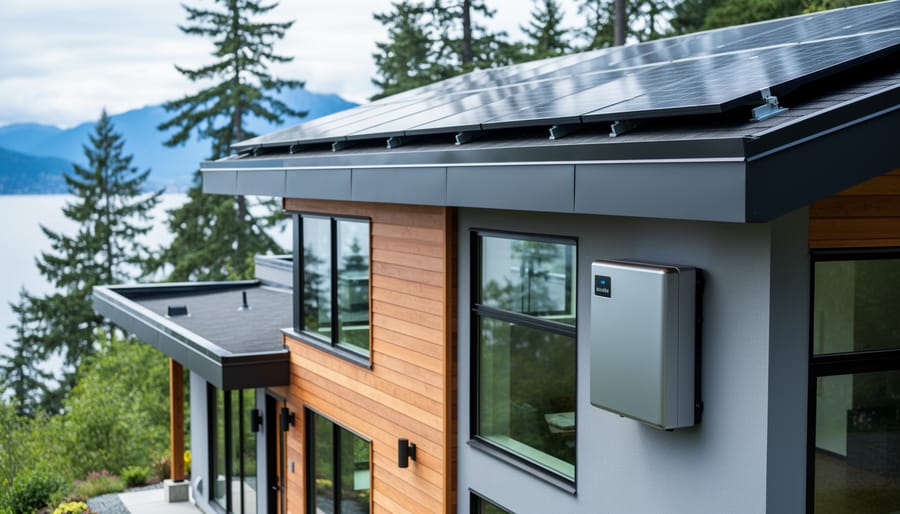
Most net-zero homes in British Columbia achieve their impressive energy balance through rooftop solar panels and efficient building design. However, there’s a critical vulnerability that often gets overlooked: these homes typically remain connected to the electrical grid and lose power during outages, just like conventional homes.
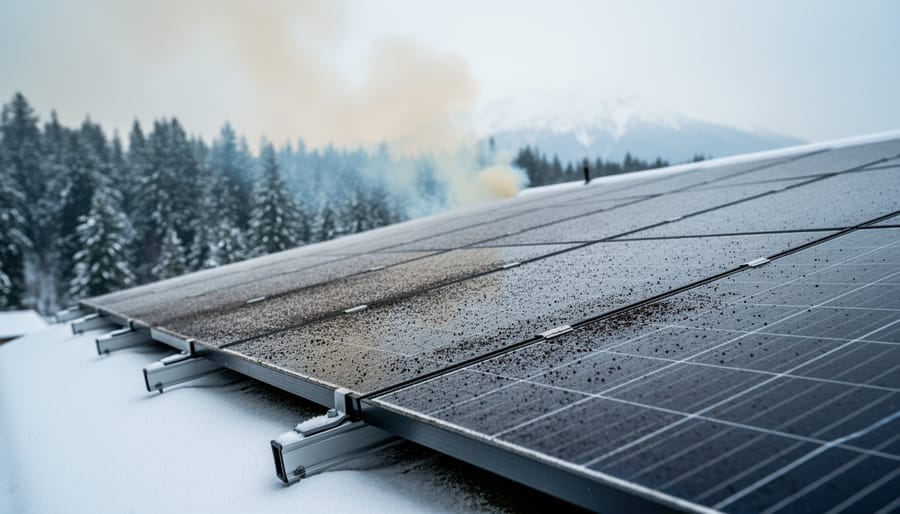
When storms knock out power lines or extreme weather events strain the grid, your solar panels automatically shut down for safety reasons, even on sunny days. This means that while your home might produce all the energy it needs annually, you could still find yourself without electricity during critical moments.
This is what energy experts call the resilience gap. In recent years, B.C. has experienced increasingly frequent power disruptions due to windstorms, wildfires, and extreme weather. A Richmond family discovered this challenge firsthand when their net-zero home went dark during a winter storm, despite having a full solar array on their roof.
Vehicle-to-Home technology fills this gap by turning your electric vehicle into a mobile battery backup system, providing true energy independence when you need it most while maintaining your commitment to sustainable living.
Vehicle-to-Home Technology: Your EV as a Home Battery

How Much Power Can Your EV Actually Provide?
Understanding your EV’s backup power capacity helps you plan for outages and emergencies. The average British Columbia home uses approximately 30 kilowatt-hours (kWh) of electricity per day, though this varies by season and household size.
Let’s look at what popular EV models can provide. A standard Nissan Leaf with a 40 kWh battery could power your home for about 1.3 days during an outage. The Chevrolet Bolt EV, with its 66 kWh battery, extends that to roughly 2.2 days. For longer resilience, the Ford F-150 Lightning’s extended range battery (131 kWh) can support a typical B.C. home for over four days.
However, these estimates assume you’re using your full battery capacity. Most homeowners keep a reserve for transportation needs. If you allocate 50 percent of your battery for home backup, you’re looking at more realistic timelines: 12-24 hours for smaller EVs and 2-3 days for larger batteries.
During winter months when heating demands increase, daily consumption in B.C. homes can jump to 40-50 kWh, reducing backup duration accordingly. Conversely, if you prioritize essential loads only—refrigeration, lighting, and critical devices—you can stretch your EV’s power considerably further.
The key is matching your EV’s capacity with your household’s actual needs. Start by reviewing your utility bills to understand your average daily consumption, then calculate how your specific EV model fits into your emergency preparedness plan.
Building Net-Zero Resilience: Solar + Storage + V2H

Real-World Scenario: Surviving a 3-Day Winter Outage
When a severe winter storm knocked out power across their Vancouver Island community last December, the Morrison family experienced firsthand how their net-zero home kept them comfortable while neighbors struggled. With temperatures dropping to -8°C and the outage lasting three full days, their combination of solar panels, vehicle-to-home technology, and a modest 13.5 kWh battery system proved invaluable.
Day one started with their battery at 80% capacity. The family immediately switched to conservation mode, running only essential appliances like their heat pump (set to 18°C), refrigerator, and minimal lighting. Their electric vehicle, plugged into their V2H system, provided an additional 60 kWh of backup power. Even with limited winter sunlight, their solar panels generated about 8 kWh daily, helping recharge the battery during brief sunny periods.
By day two, the Morrisons had drawn roughly 40% of their EV’s battery while maintaining comfortable indoor temperatures. They cooked meals using their induction stove, kept phones charged, and even ran their internet router for remote work. Sarah Morrison noted they could have extended their power reserves even longer if needed by reducing heat pump usage or unplugging non-essential devices.
When power returned on day three, the family had used approximately half their available energy reserves. Their experience highlights how V2H technology transforms electric vehicles from simple transportation into critical backup power sources, providing genuine energy security during B.C.’s increasingly unpredictable weather events.

B.C. Success Story: The Kelowna Family Who Powered Through
When the Johnsons of Kelowna decided to upgrade their 2019 net-zero home with Vehicle-to-Home technology in 2023, they weren’t just chasing energy independence—they wanted real resilience for their family of four.
Sarah and Mark Johnson invested approximately $18,000 in a bidirectional charging system to complement their existing solar array and Nissan Leaf. Their setup includes a 10 kWh home battery and a V2H-enabled charger that seamlessly switches between grid, solar, and vehicle power.
“We experienced three significant power outages last winter during those intense windstorms,” Sarah explains. “Each time, our home stayed fully operational. The kids didn’t even realize the neighbourhood had lost power until they looked outside and saw the streetlights were out.”
The system automatically draws power from their vehicle’s 62 kWh battery when needed, providing backup capacity that far exceeds their home battery alone. During a 14-hour outage in January, they used only 30 percent of their vehicle’s charge while maintaining heating, refrigeration, and internet connectivity.
Beyond emergency backup, the Johnsons leverage their setup during peak demand periods. Their energy monitoring app alerts them when electricity rates spike, triggering the system to draw from their vehicle instead of the grid. This strategy has reduced their annual energy costs by an estimated 40 percent.
“The provincial rebate covered about $5,000 of our installation costs,” Mark notes. “Combined with our energy savings, we’re looking at a payback period of roughly eight years. But honestly, the peace of mind during outages? That’s invaluable.”
Their vehicle still serves its primary transportation purpose, with the family scheduling charging during off-peak hours and sunny days to maximize their solar investment.
The Economics: What It Costs and What You Save
Incentives and Rebates Available in B.C. Right Now
Making the switch to V2H technology is more affordable than ever, thanks to several government programs available to British Columbians right now. The Canada Greener Homes Grant offers up to $5,000 for home energy retrofits, which can help cover the costs of electrical upgrades needed for bidirectional charging systems. Through CleanBC, homeowners can access the Go Electric EV Charger Rebate, providing up to $350 for Level 2 chargers that are V2H-ready.
For solar installations that complement your V2H setup, the federal government’s interest-free Greener Homes Loan provides up to $40,000 for renewable energy systems. BC Hydro also runs periodic programs supporting energy storage solutions. The federal government’s new Canada Green Buildings Strategy includes incentives for integrated solar-plus-storage systems paired with EV charging infrastructure.
These combined programs can significantly reduce your upfront investment in creating a resilient, net-zero home. A Nanaimo family recently used these incentives to install solar panels and a bidirectional charger, cutting their total project costs by nearly 30 percent. Check program eligibility requirements carefully, as some incentives can be stacked while others have specific timelines and application processes.
Getting Started: Your Path to V2H-Enabled Net-Zero Living
Ready to transform your B.C. home into a resilient, energy-independent sanctuary? Here’s your practical roadmap to V2H-enabled net-zero living.
Start by assessing your home’s energy profile. Review your BC Hydro bills from the past year to understand your typical consumption patterns. Winter months will show higher usage, which is exactly when V2H backup power becomes most valuable. A home energy audit, often subsidized through CleanBC programs, will identify efficiency improvements that reduce your overall energy needs before investing in V2H technology.
Next, choose a compatible electric vehicle. Currently, the Ford F-150 Lightning, Nissan Leaf, and select Hyundai and Kia models offer bidirectional charging capabilities. When selecting your EV, consider your daily driving range needs and the vehicle’s battery capacity. A larger battery provides more backup power for your home during outages.
Finding certified installers is crucial for both safety and accessing incentives. Look for electricians certified by the Electric Vehicle Infrastructure Training Program and experienced with V2H installations. Request quotes from at least three installers and ask for references from previous V2H projects in your area.
Consider phasing your investment if budget is a concern. Many B.C. families start with rooftop solar and home efficiency upgrades, then add an EV, and finally complete the system with V2H equipment as prices decline and more incentives become available. This staged approach spreads costs while building toward full energy independence.
Connect with local sustainability groups and attend CleanBC workshops to learn from neighbours who’ve already made the transition. Their real-world experiences provide invaluable insights beyond what any guide can offer.
As British Columbia faces increasingly unpredictable weather patterns and extreme climate events, combining net-zero homes with Vehicle-to-Home technology offers more than environmental benefits—it delivers real energy independence and peace of mind. When grid power fails during winter storms or summer wildfires, your EV becomes a reliable backup system, keeping essential appliances running while your neighbors remain in the dark. This resilience is particularly valuable in B.C.’s remote communities and areas prone to extended outages.
The technology also makes financial sense. Provincial rebates, federal incentives, and declining equipment costs mean that investing in net-zero construction and V2H capability is more accessible than ever. Homeowners across the province are already experiencing lower energy bills, reduced carbon footprints, and the confidence that comes with energy self-sufficiency.
Ready to take the next step? Start by using online solar calculators to estimate your potential savings based on your home’s location and energy usage. Research current EV models with V2H capability to find the best fit for your needs. Most importantly, connect with Solar BC certified installers who understand local building codes, climate conditions, and available incentives. They’ll help you design a system tailored to your specific situation, ensuring maximum performance and long-term value. Your journey toward energy independence starts today.