

Calculate your break-even point before signing any solar financing agreement. In BC, the average 7kW residential system costs $18,000-$22,000, and with BC Hydro’s current rates averaging $0.124/kWh, most financed systems pay for themselves in 12-18 years depending on your loan terms. Compare this timeline against zero-down financing options where your monthly loan payment equals or falls below your current electricity bill—this creates immediate positive cash flow while building equity in an asset that increases your property value by approximately $15,000-$20,000.
Run the numbers on three financing scenarios specific to your situation: a traditional loan at 6-8% interest, a home equity line of credit at 4-6%, and lease-to-own arrangements. A $20,000 system financed over 10 years at 7% costs roughly $232 monthly but generates $150-$200 in electricity savings, leaving a manageable $32-$82 gap that narrows as BC Hydro rates increase. Factor in federal incentives reducing upfront costs and provincial net metering credits that pay you for excess generation during summer months.
Assess whether your roof and energy consumption align with financing viability. Homes using 10,000+ kWh annually with south-facing roofs and minimal shading see returns 40% faster than average, making financing attractive even at higher interest rates. BC’s 300+ days of usable sunlight annually means your system generates value nearly year-round, not just during peak summer—critical data when evaluating 20-25 year loan payback against 25-30 year panel warranties.
Understanding the True Cost: What You’re Actually Financing
Before diving into financing options, let’s clarify what you’re actually paying for when you go solar in British Columbia. Understanding these costs helps you evaluate whether financing makes financial sense for your situation.
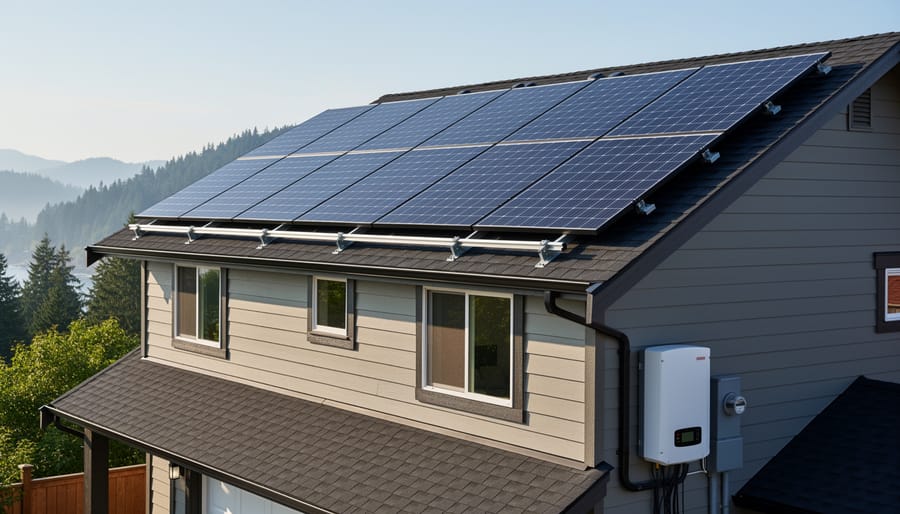
A typical residential solar installation in BC ranges from $15,000 to $30,000, depending on your home’s energy needs and roof characteristics. This investment covers several key components. The solar panels themselves represent about 30-40% of total costs, with modern panels carrying 25-year warranties. Your inverter, which converts solar energy into usable electricity, accounts for another 10-15%. Installation labor, including electrical work and roof mounting, typically makes up 20-30% of the project cost.
What many homeowners overlook are the additional essentials. Permit fees in BC municipalities range from $200 to $800, depending on your location. Electrical upgrades may add $500 to $2,000 if your panel needs updating to handle solar integration. BC Hydro interconnection fees, required to connect your system to the grid, cost approximately $500.
Several factors influence your final price. South-facing roofs without shade offer optimal installation conditions and lower costs, while complex roof angles or structural reinforcements increase expenses. System size matters too—a 5kW system suits average BC homes, while larger properties may need 8-10kW systems.
The good news? These upfront costs become predictable monthly payments through financing, and BC’s net metering program means your system starts offsetting electricity bills immediately. When Sarah from Kelowna financed her $22,000 system, her $185 monthly payment was offset by $140 in electricity savings from day one. Understanding these real numbers helps you calculate your actual out-of-pocket costs and make an informed decision about financing.
The Main Solar Financing Options Available in BC
Solar Loans: Owning Your System Over Time
Solar loans represent one of the most popular solar panel financing options in BC, allowing you to own your system while spreading payments over time. These secured or unsecured loans typically range from $10,000 to $40,000 with terms of 5-20 years.
In BC, you’ll find interest rates between 4-9%, depending on your credit score and lender. Many homeowners secure rates around 5-7% through credit unions or specialized green energy lenders. Monthly payments typically range from $150-$400 for an average residential system.
The key advantage is immediate ownership, meaning you benefit from all energy savings, tax incentives, and increased home value from day one. Unlike leases, you’re building equity in an asset that can last 25-30 years. However, you’re responsible for maintenance costs and carry the loan obligation even if you move.
Solar loans work best for homeowners planning to stay long-term who want full system ownership but prefer preserving cash reserves for emergencies. The Patel family in Surrey, for example, chose a 10-year loan at 6.2% interest, reducing their upfront cost while still achieving positive cash flow within year three after accounting for BC Hydro savings.
Solar Leases and Power Purchase Agreements (PPAs)
If you’re not ready to purchase a solar system outright, solar leases and Power Purchase Agreements (PPAs) offer alternative pathways to clean energy. While these options are common in the United States, they remain relatively rare in British Columbia’s solar market.
With a solar lease, you essentially rent the equipment from a provider who installs and maintains the system on your property. You pay a fixed monthly fee regardless of how much electricity the panels generate. Under a PPA, you’re purchasing the power generated by the system at a predetermined rate per kilowatt-hour, typically lower than BC Hydro’s rates.
The key difference: leases involve fixed payments for equipment use, while PPAs tie costs directly to energy production.
In BC, most solar companies focus on purchase or loan financing rather than leases or PPAs. This is partly because BC Hydro’s net metering program makes ownership more financially attractive. With leases and PPAs, you typically won’t qualify for available incentives or rebates since you don’t own the system.
Long-term implications matter too. These agreements usually span 20-25 years and can complicate property sales, as new homeowners must assume the contract. Ownership through financing generally provides better returns and greater flexibility for BC residents.
Home Equity Financing and Lines of Credit
BC homeowners with existing equity can access some of the lowest interest rates available through home equity lines of credit (HELOCs) or refinancing options. Many local credit unions and banks offer rates between 6-8%, significantly lower than unsecured solar loans. For a $20,000 solar installation, this rate difference could save you $3,000-5,000 over a ten-year term.
The key advantage is flexibility. HELOCs allow you to borrow only what you need and pay interest solely on the amount used. However, keep important considerations in mind: you’re securing the loan against your home, extending your mortgage could mean paying more interest long-term, and you’ll need sufficient equity built up. For Vancouver Island resident Marina Chen, refinancing during a mortgage renewal added minimal monthly costs while eliminating her $180 monthly hydro bill. This approach works best for homeowners planning to stay put for 10-plus years, allowing solar savings to accumulate while building home value through the energy-efficient upgrade.
Cash Purchase with Payment Plans
Many BC solar installers offer direct payment plans that bridge the gap between immediate cash purchases and traditional loans. These arrangements typically involve paying 30-50% upfront, with the remainder spread over 6-24 months, often interest-free or at minimal rates. A Kelowna homeowner recently used this approach, paying $8,000 down on a $16,000 system and settling the balance over 12 months, avoiding loan applications entirely while immediately reducing their BC Hydro bills.
This option works particularly well if you’re expecting a tax refund, year-end bonus, or property sale proceeds within the year. You start generating solar savings immediately while maintaining cash flow flexibility. The key consideration is ensuring the payment terms don’t include hidden fees that effectively create interest charges. Always compare the total amount paid versus the upfront cash price. For many BC residents with steady income but limited immediate savings, installer payment plans provide a practical middle ground that accelerates your transition to clean energy without long-term debt commitments.
Running the Numbers: Real BC Examples
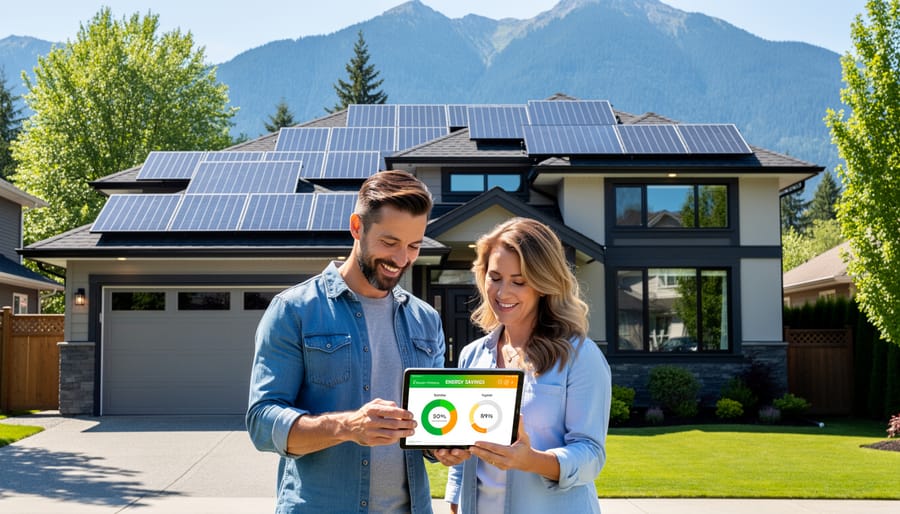
Let’s look at three real-world scenarios from BC homeowners who took the leap and financed their solar installations. These numbers reflect actual energy savings and financing outcomes, giving you a clear picture of what to expect.
Sarah’s Vancouver Home: The Urban Success Story
Sarah installed a 6.5 kW system on her East Vancouver bungalow in 2022. Her total cost was $18,500, financed through a home equity line of credit at 4.5% interest over 10 years.
Monthly payment: $192
Average monthly energy savings: $165
Net monthly cost in year one: $27
While Sarah pays slightly more initially, her typical BC energy consumption patterns showed she was spending $195 monthly on electricity before solar. By year three, with BC Hydro rate increases averaging 3% annually, her savings matched her payment. Her projected payback period is 11 years, after which she’ll save approximately $200 monthly for the system’s remaining 15-plus year lifespan. That’s over $36,000 in long-term savings.
The Martinez Family: Rural Kamloops Installation
Living outside Kamloops, the Martinez family faced higher energy costs due to electric heating. They installed a larger 9 kW system for $24,000, using a specialized green energy loan at 3.9% over 15 years.
Monthly payment: $177
Average monthly energy savings: $245
Net monthly savings from day one: $68
Their rural location provided excellent sun exposure, maximizing production year-round. The family is actually cash-flow positive from month one, pocketing the difference while building equity in their home. Their payback period is projected at just 9 years, with total lifetime savings exceeding $65,000.
Green Leaf Cafe: Small Business Solar
This Kelowna cafe installed a 12 kW commercial system for $32,000, financing through a business loan at 5.2% over 12 years.
Monthly payment: $288
Average monthly energy savings: $340
Net monthly savings: $52
The cafe benefits from daytime production matching peak business hours perfectly. Owner Michael reports the solar panels have become a marketing asset, with customers appreciating their commitment to sustainability. His break-even point arrives in year 10, after which the business saves roughly $4,000 annually on operating costs.
The common thread? Each scenario shows positive long-term returns, with financing transforming a large upfront cost into manageable monthly payments that compete favorably with regular electricity bills.
When Financing Makes Sense (And When It Doesn’t)
Financing is Worth It If…
Financing solar panels becomes a smart investment when your situation aligns with specific financial and lifestyle factors. If your monthly BC Hydro bills consistently exceed $150, financing allows you to redirect those payments toward owning an asset that generates long-term savings rather than simply paying for consumed electricity.
Long-term homeowners benefit most from financing. If you plan to stay in your home for at least seven years, you’ll likely reach the break-even point and enjoy years of reduced or eliminated energy costs afterward. The benefits of solar compound significantly over time, making extended ownership crucial for maximizing returns.
Current tax incentives make financing particularly attractive. British Columbia residents can access federal programs and potential municipal rebates that reduce the overall system cost, improving your return on investment when combined with low-interest financing options.
Rising electricity rates strengthen the financing case. BC Hydro rates have increased steadily, and this trend is expected to continue. Locking in solar financing today protects you from future rate hikes, providing predictable energy costs for decades.
Financing also makes sense if you lack sufficient savings for an outright purchase but want to act now. Waiting years to save the full amount means missing out on immediate savings and incentives. With zero-down or low-down-payment options, you can start generating clean energy immediately while preserving your cash reserves for emergencies or other investments.
Finally, if your roof condition is excellent and won’t need replacement for 15-plus years, financing eliminates concerns about accessing panels during future roof work.
Consider Alternatives If…
While solar financing offers tremendous value for many BC homeowners, certain situations warrant careful reconsideration. If you’re planning to move within the next five years, you may not recoup your investment through energy savings, even with financing. Although solar panels increase property value, the return might not fully offset your remaining loan balance.
Properties with significant shade from tall trees or north-facing roofs may not generate enough energy to justify monthly payments. Similarly, if your roof needs replacement within the next three to five years, address that first—removing and reinstalling panels adds considerable expense.
For renters or those in older buildings requiring electrical upgrades, the upfront costs combined with financing interest may outweigh benefits. Consider a Kelowna family who delayed their solar project by two years to complete necessary roof repairs first, ultimately saving thousands in reinstallation costs.
In these scenarios, exploring community solar programs or starting with energy efficiency improvements might be smarter initial steps. Assess your specific situation honestly—solar financing works best when you can commit to long-term residency and have a solar-ready property that maximizes BC’s generous sunlight hours.
The Break-Even Timeline in BC
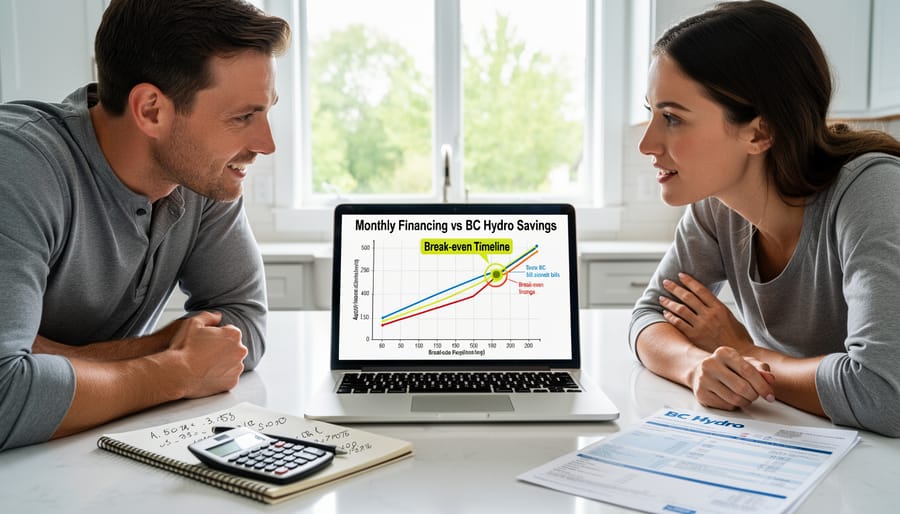
In British Columbia, most homeowners can expect their financed solar panels to pay for themselves within 12-18 years, depending on system size, financing terms, and energy consumption patterns. While BC’s relatively low electricity rates (around 14 cents per kWh) mean longer payback periods compared to other provinces, the numbers still work in your favor when you factor in consistent energy production and rising utility costs.
A typical 6kW system in the Lower Mainland or Okanagan generates enough electricity to offset $800-1,200 annually in energy costs. With financing rates around 5-7%, your monthly loan payment might initially exceed your electricity savings, but once the loan is paid off, you’ll enjoy 10-15 years of virtually free electricity. Homes with higher energy consumption or southern exposure often see faster returns, sometimes breaking even in as little as 10-12 years.
Maximizing Your Investment: Incentives and Programs
British Columbia residents have access to several programs that significantly reduce the actual cost of solar panel installation, making financing even more attractive.
The Canada Greener Homes Grant provides up to $5,000 for eligible solar installations through federal incentives, directly reducing your financing amount. When combined with BC Hydro’s net metering program, you can offset your energy costs by selling excess electricity back to the grid at retail rates. This means your solar system generates value even when you’re not using all the power it produces.
Consider this real example: A Kelowna family financed a $20,000 solar system. After applying the $5,000 federal grant, they financed only $15,000. Through net metering, they reduced their monthly electricity bills by $120, which more than covered their $95 monthly loan payment. They’re essentially getting paid to go solar.
The CleanBC Home Efficiency Rebate program offers additional savings for energy-efficient home upgrades completed alongside solar installation. Some local utilities also provide time-of-use rates, allowing you to maximize savings by using stored solar energy during peak pricing periods.
Carbon tax considerations further improve your return on investment. As carbon pricing increases, traditional electricity costs rise, making your locked-in solar financing payments increasingly advantageous.
To calculate your specific savings with these incentives included, use our interactive solar savings calculator. It factors in all available BC and federal programs to show your true out-of-pocket costs and realistic payback period.
Questions to Ask Before You Sign
Before committing to any solar financing agreement, protect your investment by asking these essential questions. Start with the numbers: What is the effective interest rate, including all fees? How does this compare to current home equity line of credit rates in BC? Request a clear breakdown of total costs over the loan term versus paying cash upfront.
Clarify ownership details immediately. Will you own the system outright, or does the financing company retain ownership until final payment? This matters significantly if you sell your home. Ask whether the financing agreement is transferable to future homeowners and what that process involves.
Examine warranty coverage thoroughly. Who covers maintenance and repairs during the financing period? What happens if the installer goes out of business? Ensure you understand whether performance guarantees are included and how they’re enforced.
Review contract flexibility: Are there prepayment penalties if you want to pay off the loan early? Can you refinance if better rates become available? What happens if you need to relocate unexpectedly?
Finally, request references from BC homeowners who’ve used the same financing option. Their real-world experiences provide invaluable insight beyond sales presentations. A reputable installer will gladly connect you with satisfied customers who can share their financing journey and whether the monthly savings matched initial projections.
So, is financing solar panels worth it in BC? For many residents and businesses, the answer is yes—but your personal situation matters. The combination of rising electricity rates, generous provincial incentives, and BC’s surprisingly solar-friendly climate creates compelling financial cases for most homeowners. Whether you choose a loan, lease, or PPA depends on your priorities: ownership and maximum savings versus lower upfront costs and maintenance-free convenience.
The best next step is to calculate your specific potential savings. Use Solar BC’s interactive calculator to input your actual energy consumption, roof specifications, and preferred financing option. These personalized numbers will give you the clarity you need to make a confident decision.
Ready to explore your options? Connect with certified solar installers in your area who can provide detailed quotes and financing comparisons tailored to your property. Look for companies familiar with BC incentive programs who can walk you through every step—from initial assessment to interconnection approval.
Remember, every solar installation in BC contributes to our collective clean energy future while potentially putting money back in your pocket. Take the time to run the numbers, ask questions, and choose the financing path that aligns with both your environmental values and financial goals.