
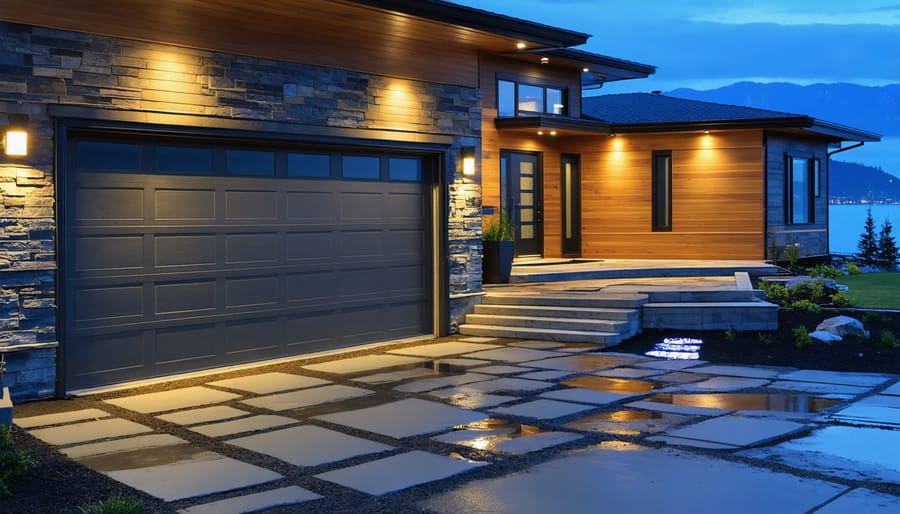
Position solar pathway lights along your walkway at 6-8 foot intervals to create a welcoming, well-lit entrance that guides visitors safely to your door while reducing energy costs. Install motion-activated solar spotlights on either side of your front door to illuminate house numbers and create an inviting focal point that enhances security without running up your electricity bill. Mount solar wall sconces beside your entrance or garage to add architectural interest while providing functional lighting that charges during BC’s longer summer days and operates reliably through winter months.
Choose solar lighting solutions with higher lumen outputs (100+ lumens per fixture) for primary areas like entrances and steps, reserving lower-output decorative lights for accent purposes. Select fixtures with dusk-to-dawn sensors and separate solar panels for optimal placement in sun-exposed areas, even if shaded spots need illumination. Layer multiple lighting types to create depth and dimension across your front landscape, combining ground-level path lights with elevated spotlights on trees or architectural features. Prioritize fixtures with lithium-ion batteries rated for BC’s temperature fluctuations, ensuring consistent performance during our wet winters and maximizing the investment in your home’s curb appeal and safety.
Why Solar Lighting Works Better Than You Think for BC Homes
Many BC homeowners hesitate to invest in solar outdoor lighting, assuming our grey skies won’t provide enough power. The reality is quite different. Modern solar technology has evolved dramatically, making it remarkably effective even in our coastal climate.
Today’s solar lights feature high-efficiency photovoltaic cells that capture significantly more energy than older models. These advanced panels collect light energy even on overcast days, just as solar panels work on cloudy days for home energy systems. While direct sunlight is ideal, diffused light through clouds still generates ample power for reliable operation.
Battery technology has also transformed solar lighting performance. Lithium-ion batteries now standard in quality fixtures hold charges longer and perform better in cold temperatures than previous nickel-based options. A fully charged battery typically provides 8-12 hours of illumination, meaning your lights stay on through entire winter nights even after shorter daylight collection periods.
Strategic placement makes all the difference. Position solar panels where they receive maximum southern exposure, away from tree shade and building shadows. Even 4-5 hours of indirect winter light can generate sufficient power for overnight operation.
Real-world results confirm this reliability. A West Vancouver family installed solar pathway lights in October 2023, expecting reduced performance during winter months. They reported consistent nightly illumination throughout December and January, BC’s cloudiest months. Their secret? Proper south-facing placement and choosing fixtures with adequate battery capacity.
The key is selecting quality products designed for northern climates and installing them thoughtfully. When done right, solar lighting provides dependable, maintenance-free illumination year-round, making it a practical choice for BC homes regardless of our weather reputation.
Pathway and Walkway Lighting: Your Safety Priority
Choosing the Right Brightness and Spacing
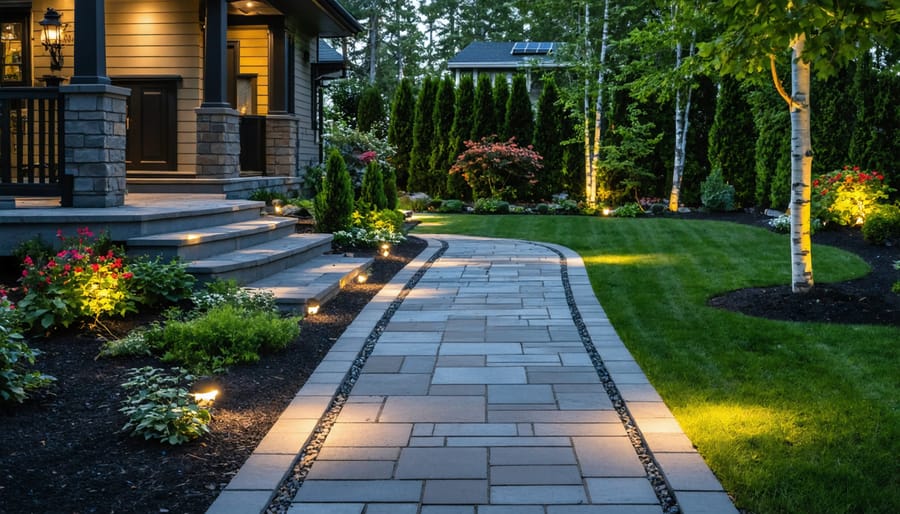
Getting the right brightness ensures your front entrance feels welcoming without wasting energy or creating harsh glare. For pathway lighting, aim for 50-100 lumens per fixture, spacing them about 2-3 meters apart to create a gentle, continuous glow. Entrance lights near your door should be brighter, around 100-200 lumens, providing ample visibility for keys and visitors.
Consider your home’s existing lighting when planning placement. A Vancouver homeowner discovered that spacing pathway lights too close together created unnecessary overlap, while strategic placement at turns and steps maximized both safety and ambiance. Start with fewer fixtures than you think you need—you can always add more.
Create visual flow by maintaining consistent heights for similar fixture types and using complementary styles throughout your front yard. In BC’s darker winter months, consider motion-activated options that boost brightness when needed while conserving energy during quiet periods. Test your layout before permanent installation by placing fixtures temporarily during evening hours. This simple step helps you adjust spacing and brightness levels, ensuring your solar lighting enhances your home’s curb appeal while meeting practical illumination needs efficiently.
Installation Tips for Uneven Terrain
BC’s diverse landscapes present unique installation challenges, but solar lighting can work beautifully on slopes, in garden beds, and even in rocky soil with the right approach.
For sloped yards common throughout the Lower Mainland and Vancouver Island, look for solar lights with adjustable stakes or mounting brackets that can be angled to keep the fixture level while the stake follows the ground’s contour. On steep hillsides, consider terracing your pathway lights or using wall-mounted fixtures on retaining walls instead of ground stakes.
Rocky soil requires patience and strategy. Pre-drilling pilot holes with a metal rod or drill can help guide stakes through challenging terrain. Alternatively, choose solar lights with flat bases that can sit on rocks or be mounted on posts driven into concrete-filled holes. Many Okanagan homeowners successfully use this method where natural bedrock sits close to the surface.
For garden beds, select lights with longer stakes (at least 8-10 inches) to maintain stability in loose, cultivated soil. Place them behind perennials or shrubs to create ambient lighting while protecting fixtures from garden maintenance activities.
When working with uneven terrain, test your layout first using temporary markers. Walk the path at night to ensure adequate coverage before making permanent installations. This simple step saves time and ensures your lighting achieves both safety and aesthetic goals.
Entrance and Porch Lighting That Makes a Statement

Motion-Activated vs. Dusk-to-Dawn Options
When choosing solar lights for your front entrance, understanding the difference between motion-activated and dusk-to-dawn modes helps you match the right technology to your needs.
Motion-activated lights remain off until they detect movement, then illuminate at full brightness. This option maximizes energy efficiency since the lights only operate when needed, extending battery life during BC’s darker winter months. They’re excellent for security, startling potential intruders while alerting you to visitors or wildlife near your entrance. A Vancouver homeowner reported their motion-activated pathway lights lasted through consecutive cloudy weeks thanks to reduced battery drain.
Dusk-to-dawn sensors automatically turn lights on at sunset and off at sunrise, providing consistent illumination throughout the night. While they use more stored energy, they create a welcoming atmosphere and ensure your entrance never sits in darkness. This continuous lighting works well for frequently used entrances or areas where you want constant visibility for safety.
Many solar fixtures now offer both modes, letting you switch based on season or preference. Consider motion-activated lights for side pathways or less-used areas, while dusk-to-dawn suits main walkways where you want reliable guidance. Some BC residents use motion sensors during summer’s long days and switch to dusk-to-dawn during winter for extended coverage when daylight hours shrink.
Complementing Your Home’s Style
Your home’s architectural style should guide your solar lighting choices to create a cohesive, welcoming appearance. British Columbia features diverse housing styles, from heritage Craftsman homes in Victoria to modern West Coast contemporary designs in Vancouver, and each pairs beautifully with specific solar fixtures.
For Craftsman and heritage homes common throughout BC communities, choose solar lights with warm-toned finishes like bronze or copper. Lantern-style fixtures with decorative glass panels complement these traditional designs perfectly. The Johnsons in New Westminster selected vintage-inspired solar coach lights for their 1920s heritage home, enhancing its character while reducing their environmental footprint.
Contemporary and modern homes benefit from sleek, minimalist solar fixtures in black, graphite, or brushed nickel. Clean geometric shapes and integrated LED designs work particularly well. Consider low-profile pathway markers and streamlined wall sconces that emphasize horizontal lines characteristic of West Coast modern architecture.
Rancher and split-level homes, popular in suburban BC areas, pair nicely with transitional fixtures that bridge traditional and modern styles. Opt for simple shapes in neutral finishes that won’t compete with your home’s straightforward design.
Colonial and Georgian-style homes call for symmetrical lighting arrangements. Match solar lanterns on either side of your entrance, and select fixtures with classic proportions and traditional detailing.
When selecting finishes, consider BC’s coastal climate. Marine-grade materials resist salt air corrosion, while weather-resistant coatings withstand our region’s rainfall. Whatever your style, prioritize quality fixtures designed for our Pacific Northwest conditions to ensure lasting beauty and reliable performance.
Garden and Landscape Accent Lighting
Spotlighting Trees and Architectural Features
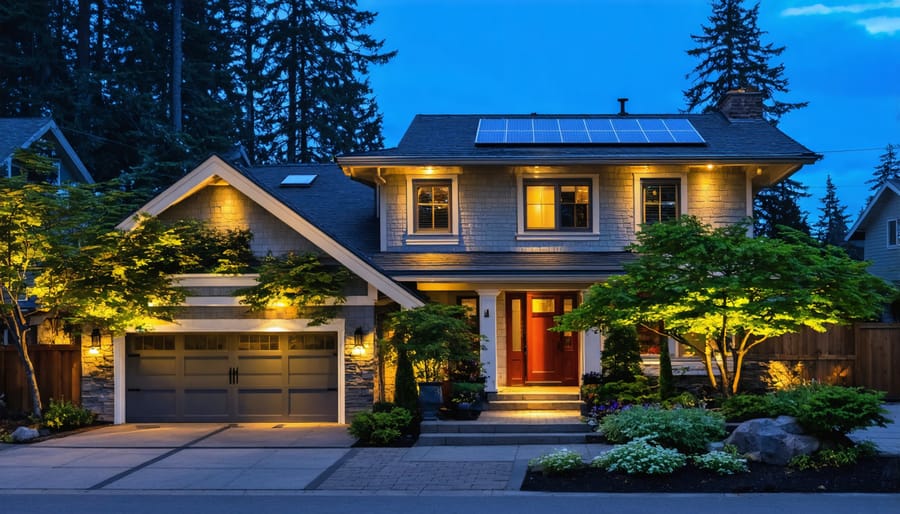
Transform your front yard into an evening showcase by using solar uplights to highlight your property’s standout features. In BC, where Douglas firs, ornamental maples, and flowering dogwoods grace many yards, placing solar spotlights at the base of mature trees creates stunning silhouettes against your home’s facade. Position lights 2-3 feet from the trunk, angling them upward to emphasize branching patterns and seasonal foliage changes.
Stone walls and stacked rock features common in West Coast landscaping benefit from strategic lighting placement. Install solar spots every 6-8 feet along the base to graze light across textured surfaces, revealing depth and character after dark. A Vancouver homeowner in Dunbar recently transformed their century-old stone foundation wall using just four solar uplights, creating dramatic shadows that became a neighbourhood conversation piece.
For homes with unique architectural details like timber posts, craftsman brackets, or decorative trim work, use adjustable solar spotlights to direct attention upward. Modern solar fixtures now deliver 300-500 lumens, sufficient for accent lighting even during BC’s cloudy winter months. Start with one or two focal points rather than overlighting everything, allowing your eye to naturally travel from one highlighted feature to the next. This creates visual interest while keeping your installation budget manageable.
String Lights for Seasonal Charm
Solar string lights offer an enchanting way to transform your front entrance throughout the seasons without adding to your electricity bill. These versatile lights create welcoming ambiance for everything from summer garden parties to winter holiday displays, charging during BC’s daylight hours and automatically illuminating at dusk.
For year-round charm, drape solar string lights along porch railings, wrap them around front pillars, or weave them through decorative trellises flanking your entrance. Many BC homeowners find success installing them along rooflines or fence tops, where they receive optimal sun exposure even during our cloudier months. Choose warm white bulbs for timeless elegance or switch to colored options for seasonal celebrations.
A Kelowna family reduced their holiday lighting costs to zero by transitioning to solar string lights, reporting that their system charged effectively even during December’s shorter days. They recommend positioning the solar panel in the sunniest spot possible, which might mean separating it from the lights themselves using an extension cable.
Look for string lights with larger solar panels and battery backup capacity to ensure consistent performance through BC’s varied weather. Most quality systems provide 6-8 hours of illumination, perfect for evening curb appeal. Start with one strand to test placement before expanding your display, and remember to clean solar panels quarterly for maximum efficiency.
Driveway and Garage Illumination Solutions
Driveways and garage areas often sit in shadow after sunset, creating safety concerns and making it difficult to navigate when arriving home. Solar lighting solutions transform these functional spaces into well-lit, secure areas without adding to your electricity bill.
Solar floodlights mounted above garage doors provide powerful illumination for parking and unloading groceries. Modern solar floods now offer brightness levels comparable to traditional security lights, with motion sensors that conserve energy when the area is empty. A family in Port Coquitlam recently installed solar floodlights on their detached garage, eliminating the need for costly electrical wiring while creating a welcoming glow for evening arrivals.
For longer driveways, solar markers create a defined pathway that’s especially valuable during BC’s winter months when darkness arrives early. These low-profile lights line both sides of your driveway, preventing vehicles from veering onto lawns or garden beds. They’re particularly effective during snow or rain when visibility drops. Many homeowners space them every two to three meters for optimal guidance.
Wall-mounted solar fixtures beside garage doors serve double duty as task lighting and security features. Look for models with adjustable brightness settings so you can customize light levels based on your needs. Some BC residents combine these with solar post lights at the driveway entrance, creating a cohesive lighting design from street to garage.
When selecting driveway lighting, prioritize durability and weather resistance. BC’s wet climate demands fixtures with strong waterproof ratings. Choose lights with larger solar panels positioned to catch maximum daylight, ensuring consistent performance even during overcast periods. Battery backup capacity matters too—look for systems that store enough energy to last through those long winter nights.
Real BC Homeowners Share What Actually Works
When Sarah from Victoria upgraded to solar pathway lights along her home’s front walkway, she was initially skeptical about performance during the rainy season. “I was pleasantly surprised,” she shares. “Even through our grey November days, they charge enough to provide reliable lighting every evening. My electricity bill dropped by $18 monthly, and I love that guests can safely navigate to my door year-round.”
In Kamloops, Marcus tackled his sun-exposed front entrance with solar spotlight fixtures highlighting his landscaping. “The intense summer sun here is perfect for solar. My lights stay bright for 8-10 hours nightly, and installation took just 30 minutes with no electrician needed. After two years, they still perform like new.”
Further north in Prince George, Jennifer worried about winter viability but found success with higher-quality solar units featuring larger panels. “I positioned them to catch maximum southern exposure. Yes, they dim slightly during our darkest weeks, but they’ve never failed completely. The $450 I saved in installation costs made it worthwhile, and summer performance is outstanding.”
Coastal resident David from Vancouver installed solar deck lights on his front porch stairs. “They’ve handled three winters of constant moisture without issues. The automatic sensor means I never fumble for switches, and my HOA approved them immediately since no wiring modifications were needed.”
These BC homeowners prove that with proper placement and quality products, solar lighting delivers reliable performance across our province’s diverse climates.
Making Your Solar Lights Last Through BC Winters
BC’s winter weather presents unique challenges for solar lighting, but with proper care, your front yard fixtures can shine brightly year-round. During our rainy season from October through March, clean your solar panels monthly to remove moss, dirt, and debris that block sunlight absorption. A simple wipe with a soft cloth and mild soap solution keeps panels operating efficiently when daylight hours are already limited.
Snow accumulation requires attention in many BC regions. Gently brush off snow from panels and fixtures after significant snowfall, as even a thin layer can reduce charging capacity by up to 80 percent. Position lights at angles that naturally shed snow when possible, or choose fixtures with sloped panel designs.
Cold temperatures affect battery performance significantly. Most solar lights use rechargeable batteries that lose efficiency below freezing. Consider bringing removable battery packs indoors during extreme cold snaps, or invest in lights rated for cold-weather operation. Replace batteries every two to three years, as BC’s temperature fluctuations accelerate wear.
Seasonal adjustments maximize performance throughout the year. Reposition adjustable panels in winter to capture lower-angle sunlight, and trim back vegetation that creates shade during shorter days. Apply additional winter performance tips from local solar experts to keep your lights operating at peak efficiency.
A Vancouver homeowner shared that implementing these maintenance practices extended her pathway lights’ lifespan from three to seven years while maintaining consistent brightness through coastal winters.
Calculate Your Savings and Get Started
Switching to solar outdoor lighting at your front entrance offers significant savings compared to traditional electric options. Solar fixtures typically cost between $20-150 per unit, with no installation or wiring expenses for DIY projects. Traditional hardwired lights require professional electrical work, adding $200-500 per fixture in installation costs, plus ongoing electricity expenses averaging $3-8 monthly per light.
Over five years, a typical front yard setup with six solar lights costs approximately $300-900 total, while comparable electric lighting runs $1,500-3,000 including installation and energy costs. These solar fixtures help reduce your energy costs while providing the same illumination benefits.
BC homeowners can explore interactive savings calculators available through local solar providers to estimate specific costs based on your property layout and lighting needs. These tools factor in your location’s sunlight hours and seasonal variations to provide accurate projections.
Ready to get started? Begin by assessing which approach suits your situation. Many homeowners successfully install solar pathway and accent lights themselves, avoiding installation costs entirely. For more complex setups, review DIY installation considerations to determine if professional help makes sense.
When working with certified installers, request quotes from multiple BC-based solar specialists familiar with coastal weather patterns. Ask about warranty coverage and maintenance requirements specific to your chosen fixtures.
Check CleanBC Better Homes and Home Renovation Rebate programs for potential incentives. While these primarily support larger solar installations, some municipalities offer additional rebates for energy-efficient outdoor lighting upgrades. Contact your local government office to explore available programs in your area, making your transition to solar front lighting even more affordable.
Transforming your front entrance with solar lighting doesn’t have to be overwhelming or expensive. BC homeowners are discovering that starting with just one area—perhaps your pathway or porch—creates immediate impact while allowing you to experience the benefits firsthand. The beauty of solar lighting lies in its dual advantage: reducing your monthly energy costs from day one while increasing your property’s curb appeal and market value.
Many Vancouver Island residents who began with simple pathway lights have expanded their solar installations after seeing how effortlessly the systems perform, even during our cloudier months. The technology has evolved significantly, making solar outdoor lighting a reliable choice for our coastal climate.
Ready to brighten your home’s entrance sustainably? Start by assessing which area would benefit most from improved lighting. Consider connecting with certified solar installers through Solar BC to discuss your specific needs and site conditions. You can also explore planning tools that help estimate your energy savings and optimal placement for your property. Whether you choose a DIY approach for basic pathway lights or professional installation for comprehensive landscape lighting, you’re making a smart investment in your home’s efficiency, safety, and beauty.