
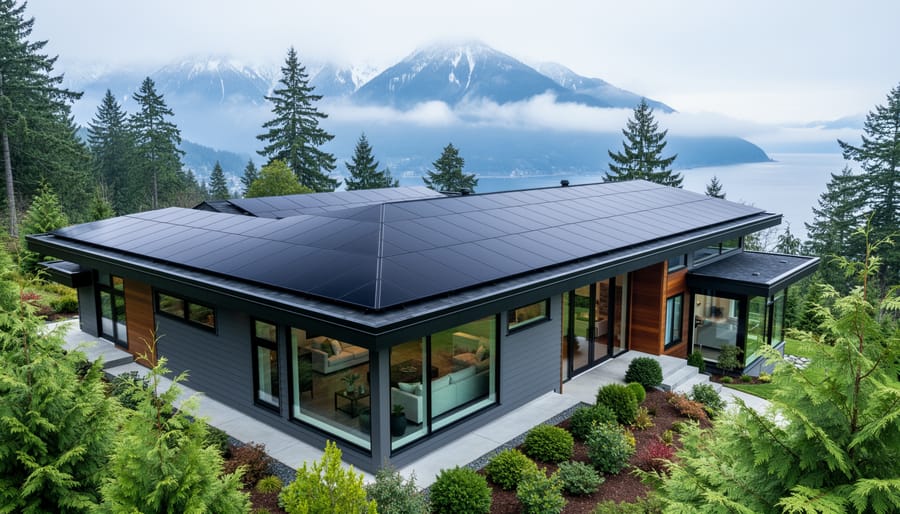
Tesla solar panels deliver 400-425 watts per panel with 19.3-22.2% efficiency ratings, but understanding these numbers requires context for your British Columbia home or business. The specifications matter less than how they translate to your actual electricity bills and our province’s unique weather patterns.
Compare Tesla’s power output against your current BC Hydro consumption, typically 11,000 kWh annually for an average home. A standard Tesla system of 15-20 panels generates enough energy to offset 80-100% of your usage, even during our cloudier winter months. The temperature coefficient of -0.35%/°C means Tesla panels actually perform well in BC’s cooler climate, maintaining efficiency when other systems lose power in heat.
Tesla’s 25-year performance warranty guarantees 85% output after two decades, matching industry leaders while offering integrated Powerwall storage—crucial for maximizing your solar investment during BC’s time-of-use electricity rates. Their monocrystalline PERC cells withstand our coastal moisture and handle snow loads up to 5,400 pascals, exceeding requirements for most BC municipalities.
The real question isn’t whether Tesla’s specifications are impressive—they are—but whether their premium pricing and limited local installer network align with your timeline and budget compared to other high-efficiency options available in British Columbia.
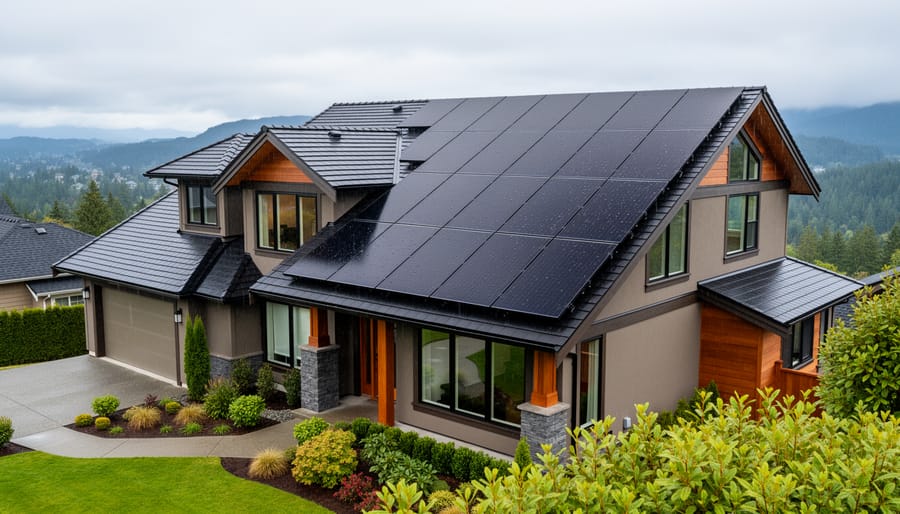
Tesla Solar Panel Core Specifications
Power Output and Efficiency Ratings
Tesla’s solar panels deliver 425 watts of power per panel, positioning them among the higher-output residential options available today. This wattage rating represents the amount of electricity each panel can generate under ideal laboratory conditions, known as Standard Test Conditions.
But what does 425W actually mean for your home or business in British Columbia? In practical terms, a typical residential installation of 20 Tesla panels would have a total capacity of 8.5 kilowatts. On a sunny summer day in the Lower Mainland or Okanagan, this system could generate 40-50 kilowatt-hours of electricity. During shorter winter days, expect approximately 15-25 kilowatt-hours daily.
Tesla’s panels achieve efficiency ratings of approximately 19.8%. Efficiency measures how much sunlight the panel converts into usable electricity. While this falls slightly below premium brands reaching 22%, it remains a solid performer. For BC homeowners, this means you’ll need marginally more roof space compared to ultra-high-efficiency options, but the difference is often negligible for most residential applications.
The real-world performance in British Columbia’s climate varies by region. Coastal areas experience more cloud cover, reducing daily output by 10-20% compared to sunnier Interior locations. However, cooler temperatures actually benefit panel efficiency, as excessive heat can reduce performance.
Understanding these specifications helps you calculate solar panel efficiency for your specific location and energy needs. A Vancouver family recently installed Tesla panels and discovered their actual annual production exceeded estimates by 8%, thanks to the region’s moderate temperatures offsetting cloudier conditions.
Physical Dimensions and Roof Requirements
Tesla solar panels measure 74.4 inches by 41.2 inches, which aligns closely with standard solar panel dimensions used across the industry. Each panel weighs approximately 50 pounds, making them manageable for professional installers while remaining secure once mounted.
For BC homeowners, understanding roof capacity is essential for planning your installation. A typical 1,500 square foot bungalow can accommodate 15-20 panels, generating around 6-8 kilowatts of power. Larger two-story homes with 2,500 square feet of roof space often fit 25-30 panels, producing 10-12 kilowatts. Keep in mind that actual capacity depends on roof pitch, orientation, and obstructions like chimneys or skylights.
Tesla panels work with most roofing materials common in BC, including asphalt shingles, metal roofing, and tile. The mounting system requires adequate structural support, which professional installers assess during site evaluations. Homes built to BC Building Code standards typically handle the additional weight without reinforcement.
One Vancouver homeowner successfully installed 22 panels on their 2,000 square foot roof, covering nearly 80% of their annual electricity needs. Their installer worked around existing vents and a south-facing dormer to maximize sun exposure while maintaining roof integrity.
Warranty and Durability Specs
Tesla backs their solar panels with two distinct warranties that provide solid protection for your investment. The 25-year performance warranty guarantees your panels will maintain at least 80% of their original power output after a quarter century of operation. This means if you install a 10 kW system today, you can expect it to still produce at least 8 kW in 2050, ensuring long-term energy production for your BC home or business.
The 10-year comprehensive warranty covers manufacturing defects, equipment failures, and workmanship issues during the crucial early years of your system’s life. This includes inverters, mounting hardware, and the panels themselves. If anything goes wrong with the materials or installation, Tesla handles repairs or replacements at no cost to you.
For BC property owners, these warranties translate to financial security and peace of mind. Consider the Smiths in Kelowna, who installed Tesla panels in 2019. When a connector issue emerged in year two, Tesla’s comprehensive warranty covered the repair completely, avoiding a $800 out-of-pocket expense. Both warranties are transferable if you sell your property, which can increase your home’s resale value. This protection ensures your solar investment remains productive and valuable throughout BC’s varying weather conditions, from coastal rain to interior snow.
How Tesla Panels Perform in BC’s Climate
Rain and Cloud Performance
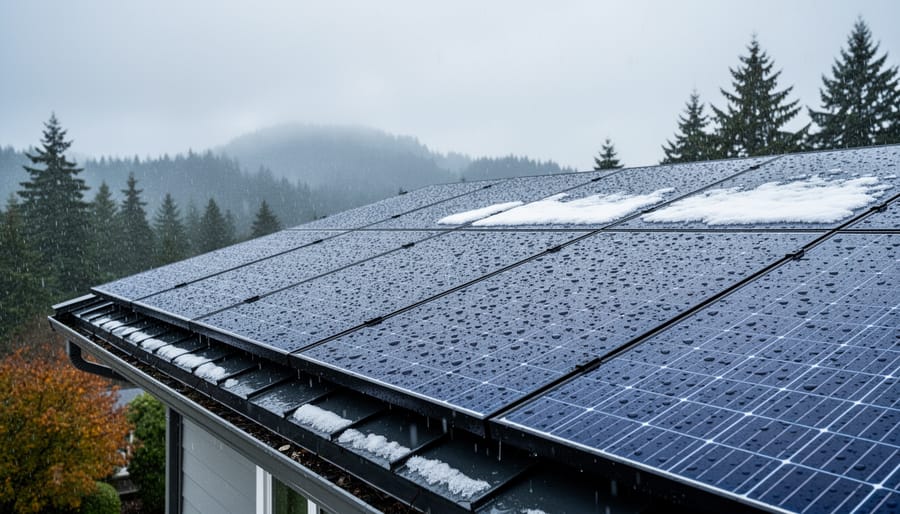
British Columbia’s frequent rainfall and overcast skies naturally raise questions about solar energy viability, but Tesla solar panels are well-equipped to handle our climate. While sunny days produce optimal output, modern panels like Tesla’s still generate meaningful electricity during cloudy conditions.
Tesla panels perform effectively in diffuse light, which is the scattered sunlight that penetrates cloud cover. On overcast days typical of Lower Mainland weather, you can expect panels to produce 10-25% of their rated capacity, depending on cloud density. This means a 400-watt Tesla panel might generate 40-100 watts during rainy periods. While lower than sunny-day performance, this production adds up significantly over BC’s many cloudy days.
Good news: solar panels work on cloudy days because they capture available light rather than requiring direct sunshine. Tesla’s panels use monocrystalline cells that excel at capturing diffuse light compared to older technologies.
A Burnaby homeowner with Tesla panels shared that their system generated 65% of expected annual output during their first rainy winter, exceeding predictions. This demonstrates real-world resilience in our climate.
Temperature also works in our favour. Solar panels actually perform more efficiently in BC’s cooler temperatures compared to hot climates where excessive heat reduces output. Rain provides the added benefit of naturally cleaning panels, maintaining efficiency without manual washing.
The key is setting realistic expectations: size your system accounting for seasonal variation, and you’ll find Tesla panels deliver reliable energy production year-round in BC’s unique climate conditions.
Snow Load and Cold Weather Efficiency
If you’re concerned about Interior BC’s heavy snowfall affecting your solar investment, here’s some good news: Tesla solar panels actually thrive in cold weather conditions. While snow accumulation temporarily reduces energy production, the panels’ performance characteristics make them well-suited for BC winters.
Tesla’s solar panels are engineered to withstand snow loads up to 5,400 pascals, exceeding the requirements for most BC regions. The panels’ smooth glass surface and tilted installation angle facilitate natural snow shedding as temperatures rise. In Kelowna, homeowners typically see snow clear within 1-2 days after a storm, especially on south-facing installations where solar radiation helps melt the bottom layer first.
Here’s the efficiency advantage: solar panels actually produce more electricity in cold temperatures. Tesla panels operate at peak efficiency around -5°C, meaning those crisp winter days deliver excellent power output once snow clears. The crystalline silicon cells in Tesla panels experience less electrical resistance in cold conditions, boosting performance by approximately 5-10% compared to summer heat.
For perspective, a Prince George business owner reported that despite shorter winter days and occasional snow cover, their Tesla system still generated 65% of their annual production during October through March. The combination of cold-weather efficiency gains and BC’s surprisingly bright winter days offsets much of the reduced daylight hours.
To maximize winter performance, consider your roof pitch during installation planning. A steeper angle promotes faster snow clearing, though your installer will optimize this based on year-round production goals. Light snow accumulation usually melts or slides off naturally, making manual clearing unnecessary in most situations.
Comparing Tesla to Other Solar Options Available in BC
Performance vs. Price Reality
Tesla’s solar panels deliver solid performance with their 19.8% efficiency rating, placing them in the competitive mid-range category. For BC homeowners, this translates to about 400 watts per panel under ideal conditions—enough to meet typical BC home energy consumption with a reasonably sized array.
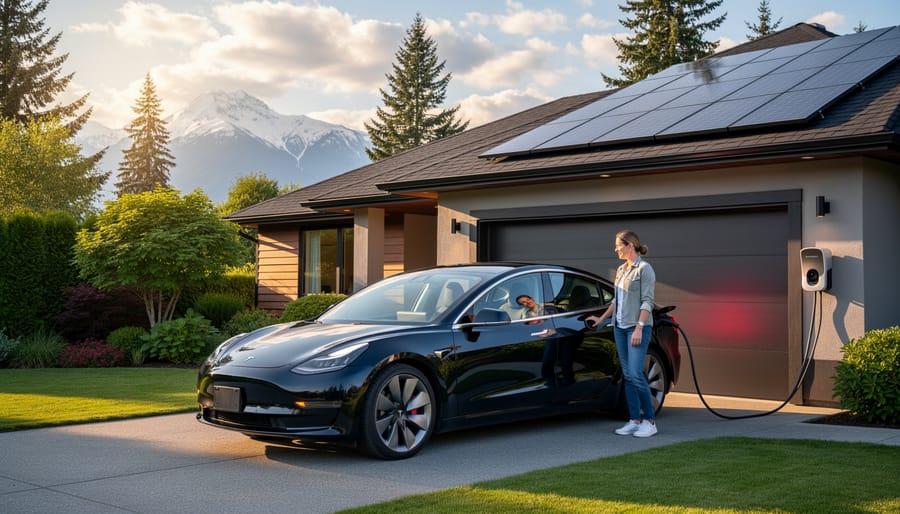
Where Tesla shines is integration. If you’re already considering an electric vehicle, using solar panels to charge a Tesla creates a seamless ecosystem with one company managing your energy needs. Their app interface and warranty support streamline the experience significantly.
However, other manufacturers like LG and REC offer higher efficiency panels (21-22%) that generate more power in the same roof space—a real advantage for homes with limited south-facing area. The Okanagan’s Patel family, for example, chose REC panels and gained 15% more production than Tesla’s equivalent system size would have provided.
Price-wise, Tesla’s panels often come at a premium compared to Canadian-installed alternatives. While Tesla quotes around $2.85 per watt installed in some markets, BC installers using quality brands like Silfab Solar (Canadian-made) frequently deliver comparable systems at $2.50-$2.70 per watt.
The bottom line: Tesla offers excellent value if you prioritize brand integration and streamlined service. For maximum efficiency or budget-conscious choices, exploring local installers with premium or Canadian-manufactured panels might deliver better returns for your specific situation.
Installation and Availability Considerations
Currently, Tesla solar panels are not directly available in British Columbia through Tesla’s retail channels. The company has focused its solar operations primarily on specific U.S. markets, which means BC residents cannot simply order Tesla panels through the company’s website as they might with a vehicle.
However, this doesn’t mean these high-quality panels are completely out of reach. Some certified solar installers in BC may have access to Tesla products through wholesale channels or specialized partnerships, though availability varies significantly. When exploring this option, expect longer lead times and potentially higher costs compared to more readily available alternatives.
The good news is that BC’s solar market offers excellent alternatives with comparable or superior specifications. Local installers have established relationships with manufacturers like Canadian Solar, REC Group, and LG, all producing panels with efficiency ratings matching or exceeding Tesla’s 19.3-20.6% range. These providers offer robust warranty coverage and, crucially, local support networks throughout British Columbia.
Working with established BC solar companies also means faster installation timelines, readily available replacement parts, and installers familiar with our unique climate conditions, from coastal rain to interior snowfall. Many local success stories feature these alternative brands performing exceptionally well across diverse BC environments, making them practical, reliable choices for your solar journey.
Best Applications for Tesla Solar in BC Homes
Ideal Home Profiles
Tesla solar panels work best for BC homes with specific characteristics that maximize their efficiency and return on investment. Understanding whether your property aligns with these ideal profiles helps you make an informed decision about going solar.
Your home is a strong candidate if you have a roof area of at least 300 square feet with minimal shading. This provides enough space for a basic 4-6 kilowatt system, which Tesla’s standardized panel configurations accommodate well. South or southwest-facing roofs deliver optimal results, though east and west orientations can still generate significant power in BC’s climate.
Households with monthly electricity bills exceeding $150 typically see the fastest payback periods. If your annual consumption ranges between 8,000 and 12,000 kilowatt-hours, you’re in the sweet spot for Tesla’s residential systems. The Powerwall battery integration becomes particularly valuable for homes with evening energy peaks, allowing you to store daytime solar generation for use after sunset.
Electric vehicle owners represent ideal candidates for Tesla solar installations. The seamless integration between Tesla solar panels, Powerwall batteries, and Tesla vehicles creates an efficient home energy ecosystem. Consider the Surrey family who installed an 8-kilowatt system in 2022 and now powers both their home and Model 3 entirely from solar energy, eliminating over $3,000 in annual fuel and electricity costs.
Homes with adequate electrical panel capacity for system integration and structurally sound roofs built within the last 20 years face fewer installation complications, reducing overall project costs and timeline.
When to Consider Alternatives
While Tesla’s solar panels offer impressive specifications and seamless integration with their energy ecosystem, they may not be the perfect fit for every BC homeowner. Understanding when to explore alternatives helps you make the best choice for your unique situation.
If your home has a complex roof layout with multiple angles, dormers, or significant shading from trees, you might benefit from exploring panels with higher efficiency ratings. Tesla’s 19.8% efficiency performs well in standard installations, but homes with limited roof space or challenging configurations sometimes need panels that maximize every square foot. In these cases, premium options with 22% efficiency or higher could generate more power from your available area.
Budget-conscious homeowners should carefully evaluate their options. While Tesla’s integrated approach offers long-term value, the upfront investment may stretch beyond comfortable limits for some families. Several Canadian manufacturers and installers offer quality panels at various price points, often with flexible financing arrangements tailored to BC residents.
Consider alternatives if you prioritize working with local BC installers who deeply understand regional building codes, snow load requirements, and municipal permitting processes. Some homeowners value the personalized service and community connection that established local solar companies provide.
Tesla’s current limited service network in British Columbia means installation timelines and support availability may vary. If you need a quick installation or prefer immediate local support, regional solar providers might better serve your timeline and accessibility needs.
The key is matching solar specifications to your specific circumstances rather than choosing based on brand alone.
Real BC Installation: What to Expect
Meet the Johnsons, a family of four in Saanich who installed a Tesla solar panel system in spring 2023. Their experience offers valuable insight into how Tesla’s specifications translate to real-world performance in our coastal climate.
The Johnsons opted for a 7.6 kW system comprising twenty 400W Tesla solar panels covering approximately 340 square feet of their south-facing roof. The system came with Tesla’s integrated monitoring technology, allowing them to track production in real-time through their smartphone app.
During their first full year of operation, the system generated roughly 8,200 kWh of electricity. Sarah Johnson notes, “We were initially concerned about Victoria’s cloudy winters, but even in December and January, we still saw meaningful production. The panels performed better than expected during those surprisingly clear winter days.”
Their peak production occurred in July, when the system generated 980 kWh in a single month, exceeding their household consumption by 35 percent. This surplus energy was fed back into the grid through BC Hydro’s net metering program, creating credits for winter months when production naturally decreases.
The monitoring system proved invaluable for understanding their energy patterns. “We discovered our energy usage habits and adjusted accordingly,” explains Sarah. “Seeing real-time production motivated us to run appliances during peak sunlight hours, maximizing our self-consumption.”
Installation took three days, including electrical work and city inspection. The Johnsons experienced one minor hiccup when installation was delayed by two weeks due to permit processing, a common occurrence they wish they’d anticipated.
Their system offset approximately 75 percent of their annual electricity costs, resulting in monthly savings averaging 120 dollars. Combined with available incentives, they project a payback period of roughly 12 years. Sarah’s advice to prospective buyers: “Understand that specifications on paper are just the starting point. Local weather patterns, roof orientation, and your consumption habits all factor into actual performance.”
Understanding Tesla solar panel specifications is just the starting point for making an informed decision about solar energy in British Columbia. While the technical details like efficiency ratings, power output, and warranty terms matter, what really counts is how these specifications perform in your specific circumstances. BC’s unique climate, varying electricity rates across regions, and available incentives all play crucial roles in determining whether solar is right for your home.
The good news is you don’t have to navigate this alone. Solar BC offers an interactive calculator tool that helps you estimate potential savings based on your location, roof characteristics, and energy consumption patterns. This free resource translates complex specifications into personalized projections you can actually use.
Ready to take the next step? Start by using the calculator to see what solar could mean for your household. Then connect with certified local installers who understand BC’s building codes, permit requirements, and seasonal considerations. They can assess whether Tesla panels or alternative options best suit your roof, budget, and energy goals. Many BC homeowners have already made the switch successfully, and with the right information and local expertise, you can join them in contributing to a cleaner energy future while potentially reducing your electricity costs.