
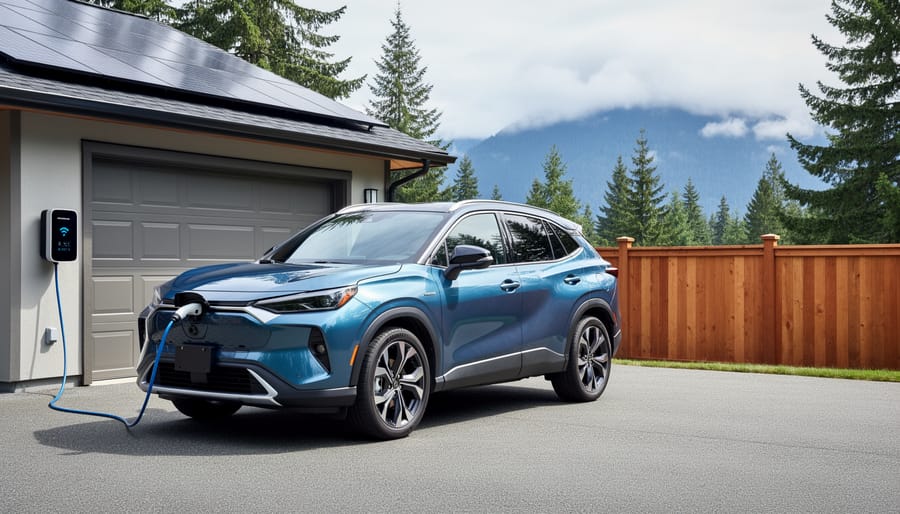
Charging a plug-in hybrid in British Columbia costs between $1.50 and $3.00 for a full charge, significantly less than filling up with gasoline. At BC’s average electricity rate of 14 cents per kWh, a typical plug-in hybrid with a 12 kWh battery costs approximately $1.68 to fully charge and provides 50-80 kilometers of electric driving range.
Compare this to gasoline costs: driving the same distance on fuel alone at current BC gas prices would cost $8-12, making electric charging roughly 80% cheaper for your daily commute. Most BC Hydro residential customers pay lower overnight rates, further reducing charging costs when you plug in before bed.
The real savings multiply over time. A BC driver covering 20,000 kilometers annually in electric mode saves $1,200-1,500 yearly compared to gasoline-only driving. Factor in reduced maintenance costs from less engine wear, and your hybrid becomes even more economical.
For maximum savings, many British Columbia residents pair their plug-in hybrid with home solar panels, effectively charging their vehicle for free during sunny months. This combination eliminates both fuel and charging costs while reducing your carbon footprint. Understanding these specific numbers helps you make an informed decision about whether a plug-in hybrid fits your budget and driving needs.
Understanding How Hybrid Cars Charge (And Why It Matters)
Not all hybrid cars need to be plugged in, and understanding this distinction is essential when calculating charging costs. Traditional hybrids, like the Toyota Prius, generate their own electricity through regenerative braking and the gasoline engine. You never need to plug them in, which means there are no charging costs to consider.
Plug-in hybrid electric vehicles (PHEVs), however, are a different story. These vehicles have larger batteries that you can charge from an external power source, just like a fully electric car. Popular models in British Columbia include the Toyota RAV4 Prime, Mitsubishi Outlander PHEV, and Ford Escape PHEV. PHEVs run on electricity for a certain range (typically 30-80 kilometers) before switching to gasoline, giving you the best of both worlds.
This article focuses specifically on PHEVs because they’re the only hybrid type where charging costs apply. If you’re considering a PHEV, understanding these costs helps you make an informed decision about potential savings. Many BC drivers have found that their daily commutes fall entirely within their electric range, meaning they rarely use gasoline for routine trips. This makes calculating your charging costs particularly important, as it directly impacts your monthly transportation budget and determines how much you’ll save compared to conventional vehicles. When paired with home solar panels, some BC PHEV owners have reduced their charging costs to nearly zero, maximizing their environmental and financial benefits.
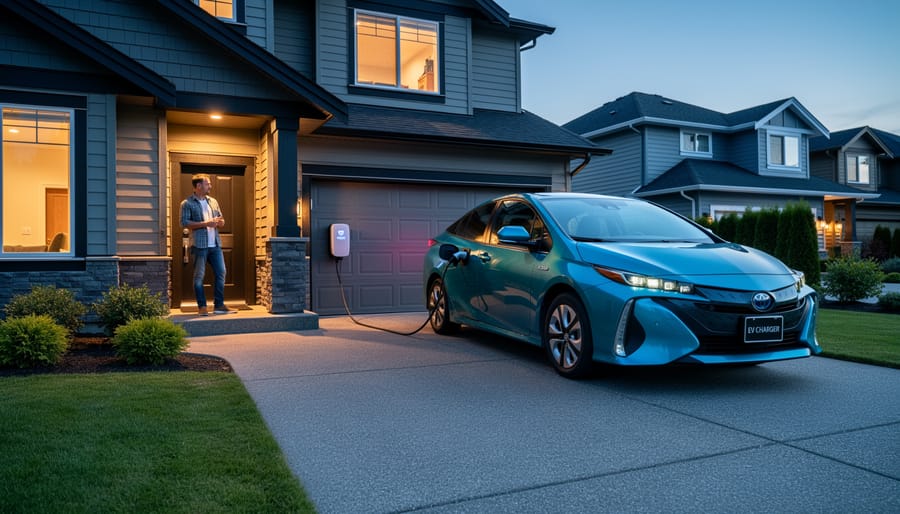
The Real Cost to Charge at Home in British Columbia
BC Hydro Rates: What You’re Actually Paying Per kWh
BC Hydro uses a two-step pricing structure that directly impacts your hybrid charging costs. For the first 1,376 kWh you use each billing period (approximately two months), you’ll pay Step 1 rates of around 9.88 cents per kWh. Once you exceed that threshold, Step 2 rates apply at approximately 14.83 cents per kWh.
Most BC households stay within Step 1 for their regular usage, meaning your hybrid charging will likely fall into this lower rate category. Understanding your home’s residential electricity rates helps you accurately calculate charging expenses.
Here’s what this means practically: charging a plug-in hybrid with a 12 kWh battery from empty to full costs roughly $1.19 at Step 1 rates. Even if you’re in Step 2, that same charge only increases to about $1.78. These rates make home charging significantly more affordable than filling up at the pump.
Your specific costs depend on your household’s overall electricity consumption. Families already using higher amounts may see hybrid charging push them into Step 2 more frequently, while those with lower usage or solar panels can charge while maintaining lower-tier rates.
Calculating Your Charging Costs: A Real Example
Let’s walk through a real example using the popular Toyota RAV4 Prime, one of BC’s most common plug-in hybrids. This model has a 18.1 kWh battery that provides about 68 km of electric range.
Here’s your step-by-step calculation:
Starting with BC Hydro’s residential rate of approximately $0.13 per kWh, multiply this by the battery capacity. For the RAV4 Prime: 18.1 kWh x $0.13 = $2.35 for a complete charge from empty.
However, you’ll rarely charge from completely empty. Most drivers top up nightly after using 60-70% of their battery. If you drive 50 km daily on electricity, you’re using about 13.2 kWh, which costs roughly $1.72 per day or $51.60 monthly.
Compare this to gas costs: driving the same 50 km daily would require about 4 litres of fuel (at 8L/100km efficiency). With gas at $1.80 per litre, that’s $7.20 daily or $216 monthly. Your savings? Over $160 every month just by plugging in overnight.
A Vancouver family shared their experience with us: after switching to charging their RAV4 Prime at home, they reduced their fuel costs by 75%. They drive mostly within the electric range during weekdays and only use gas for weekend trips.
The math clearly shows charging costs are a fraction of filling up with gasoline, making plug-in hybrids an economical choice for BC drivers committed to reducing both costs and emissions.
Public Charging Costs Across BC

Level 2 Public Charging Stations
Level 2 public charging stations are widely available throughout British Columbia at shopping centers, municipal parking lots, and many workplaces. These stations typically charge between $1.00 to $2.50 per hour, though some locations offer free charging as a customer incentive. Charging speed is faster than home outlets, delivering about 25-40 kilometers of range per hour, making them ideal for topping up while you shop or work.
For example, a plug-in hybrid with a depleted 12 kWh battery would need roughly 3-4 hours to fully charge at a Level 2 station, costing approximately $3.00 to $10.00 depending on the provider. Many BC municipalities, including Vancouver and Victoria, provide free or discounted public charging to encourage electric vehicle adoption. Your workplace might also offer complimentary charging as an employee benefit, which can significantly reduce your overall charging costs. Keep in mind that pricing structures vary, with some networks charging by the kilowatt-hour instead of hourly rates, so checking the specific station’s pricing beforehand helps you budget accurately.
DC Fast Charging: Worth It for Hybrids?
Most plug-in hybrids in BC don’t support DC fast charging, so this option rarely applies to hybrid owners. These vehicles typically use standard Level 1 or Level 2 charging, which is perfectly adequate given their smaller battery sizes (usually 8-18 kWh). Fast charging is designed for fully electric vehicles that need to recharge larger batteries quickly during long trips.
A handful of newer plug-in hybrid models, like certain Porsche and BMW variants, do offer fast charging capability. However, the cost difference is significant. BC Hydro’s fast charging stations charge by the minute rather than by kilowatt-hour, with rates typically ranging from $0.27 to $0.57 per minute depending on your vehicle’s charging speed. For a hybrid’s small battery, you’d spend $5-10 for a charge that costs under $2 at home.
The takeaway? Home charging remains your most practical and economical option for plug-in hybrids in British Columbia.
How Solar Panels Change Your Charging Costs
Charging Your Hybrid with Free Solar Energy
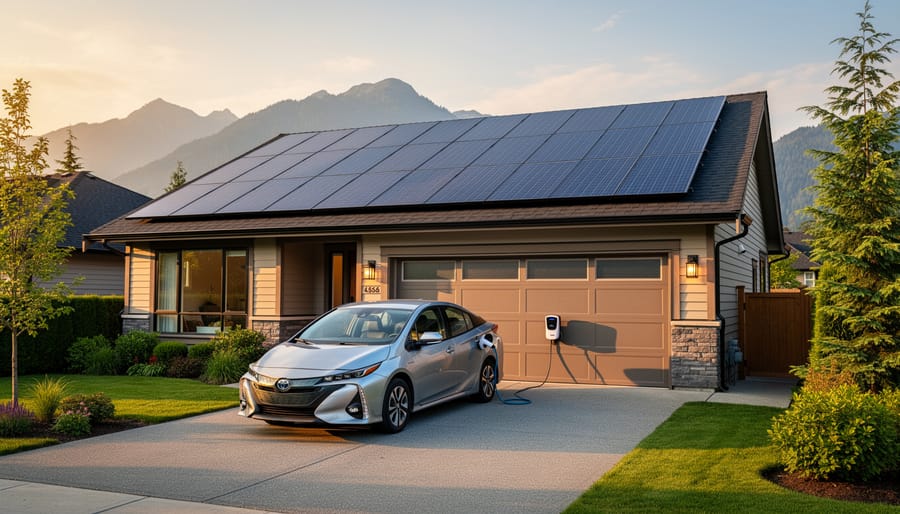
If you’ve already invested in rooftop solar panels, charging your plug-in hybrid becomes even more cost-effective. During daylight hours when your solar system generates electricity, any excess power that isn’t immediately used by your home can charge your vehicle instead of being sent back to the grid. This means you’re essentially fueling your hybrid with free energy from the sun.
For BC homeowners, this strategy works particularly well if you can charge during peak solar production hours, typically between 10 AM and 3 PM. A typical residential solar array generating 5-7 kW can easily handle charging a hybrid’s smaller battery while still powering your household needs. Many British Columbians report reducing their annual transportation fuel costs by 60-80% by combining solar power with hybrid charging.
Consider the Richmond family who installed a 6 kW solar system and now charges their plug-in hybrid primarily with solar energy during weekends and work-from-home days. They’ve cut their combined electricity and fuel bills significantly. The same principles apply to charging electric vehicles with solar, though hybrids require less solar capacity due to their smaller batteries, making this an accessible entry point for sustainable transportation.
BC Success Story: The Vancouver Family Charging for Free
The Chen family from Richmond found a way to eliminate their plug-in hybrid charging costs entirely by installing a 5kW solar panel system in 2022. They drive a Toyota RAV4 Prime and previously spent approximately $35 monthly on charging at BC’s residential electricity rates.
“We installed solar primarily to reduce our home energy bills, but quickly realized it covered our vehicle charging too,” explains Sarah Chen. Their system generates enough electricity during summer months to power both their home and their hybrid, with excess energy credited through BC Hydro’s net metering program. During winter, when solar production drops, those banked credits help offset charging costs.
The family’s initial investment of $12,000 for their solar installation meant a solar panel payback period of roughly eight years when factoring in both home and vehicle charging savings. Provincial rebates and federal incentives reduced their upfront costs by nearly 30 percent.
“Knowing we’re driving on sunshine makes the hybrid experience even better,” Sarah adds. The Chens now share their experience with neighbours, demonstrating how combining electric vehicle technology with solar power creates truly sustainable transportation in BC’s climate.
Comparing Hybrid Charging Costs to Gasoline
Let’s look at real-world cost comparisons using current BC fuel prices to see how charging your hybrid stacks up against filling up with gasoline.
Consider a typical BC driver covering 1,500 kilometers monthly in a Toyota RAV4 Prime. With BC Hydro’s residential rate of approximately $0.14 per kWh and the vehicle’s 18.1 kWh battery capacity, a full charge costs around $2.53. This gives you roughly 68 kilometers of electric range. If you charge every other day and drive primarily on electric power, your monthly charging costs would be about $38.
Compare this to the same distance in a conventional gasoline vehicle averaging 8.5 L/100 km. At current BC gas prices hovering around $1.70 per liter, you’d spend approximately $216 monthly on fuel. That’s a difference of $178 per month, or $2,136 annually, staying in your pocket instead of going to the gas station.
For suburban families like the Chens in Surrey, who installed solar panels and drive a Mitsubishi Outlander PHEV, the savings are even more impressive. They charge primarily during off-peak hours using their solar-stored energy, reducing their charging costs to nearly zero during summer months. Over their first year, they calculated saving over $2,400 in fuel costs.
Even without solar, the math is compelling. A 50-50 split between electric and gas driving still saves most hybrid owners $80-$120 monthly compared to gasoline alone. For those commuting shorter distances within the electric range, the savings approach 80-85 percent on fuel costs.
These real-world examples demonstrate that charging your hybrid isn’t just environmentally responsible; it’s financially smart. The longer you own your plug-in hybrid, the more these daily savings compound, making the initial vehicle investment increasingly worthwhile.
Hidden Costs and Savings to Consider
Beyond the straightforward electricity costs, several factors can significantly impact your overall charging expenses and savings.
If you’re installing a Level 2 home charger, expect upfront costs between $500 and $2,000 for equipment and installation. However, BC rebates and incentives can offset much of this expense. The CleanBC Go Electric program has previously offered rebates up to $350 for home charging stations, making this investment more accessible.
Time-of-use charging strategies offer substantial savings. BC Hydro’s residential rate structure means charging overnight during off-peak hours costs significantly less than daytime charging. By setting your vehicle to charge between 11 PM and 7 AM, many BC residents save 30-40% on their charging costs compared to random charging times.
The maintenance savings with plug-in hybrids are often overlooked. Electric motors have fewer moving parts than gasoline engines, resulting in reduced wear on brakes through regenerative braking, less frequent oil changes, and lower overall maintenance costs. Many hybrid owners report saving $300-500 annually on maintenance alone.
Pairing your home charger with solar panels creates even greater savings. Several BC families have eliminated their charging costs entirely by generating their own clean electricity. For example, a Kelowna family installed a 5kW solar system that powers their home and charges their plug-in hybrid, reducing their combined electricity and fuel costs by 85% compared to their previous gasoline vehicle expenses.
Making the Switch: Your Next Steps
Ready to start charging smarter? Begin by checking if your home’s electrical panel can support a Level 2 charger—most modern BC homes can, but older properties may need upgrades. Search for certified electricians through BC Hydro’s qualified installer list to ensure safe, compliant installation. Request quotes from multiple installers to compare costs, typically ranging from $500 to $2,000 depending on your setup.
Consider pairing your home charging with solar panels to maximize savings. Many BC hybrid owners have cut their charging costs by 60-80% using rooftop solar. Use online solar calculators specifically designed for BC residents to estimate your potential savings based on your location, roof size, and current electricity usage.
Track your actual charging costs for the first few months using your vehicle’s app or a smart outlet meter. This data helps you understand your real-world expenses and identify the best times to charge. Many BC utilities offer time-of-use rates, so charging overnight can reduce costs further. Connect with local hybrid owner communities online to share tips and experiences specific to British Columbia’s climate and infrastructure.