
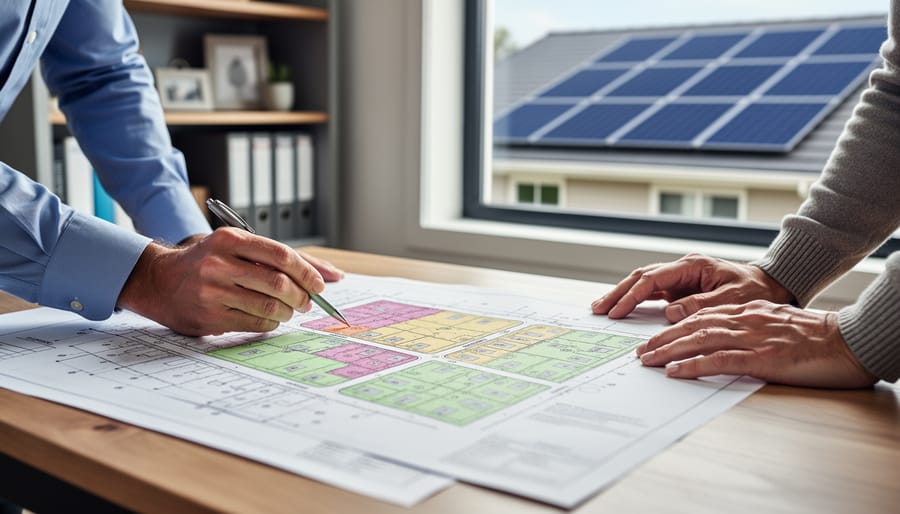
Request your site’s Official Community Plan designation from your municipal office before purchasing solar equipment—this single document determines whether your installation requires a simple building permit or triggers complex rezoning that could add 6-12 months to your solar project timeline. Contact your municipality’s planning department with your property’s legal description and parcel identifier number to obtain zoning verification in writing, as verbal confirmations won’t protect you if disputes arise during permitting.
Schedule a pre-application meeting with your local planning department to identify site-specific restrictions like setback requirements, height limitations, and heritage designations that affect solar panel placement. Bring preliminary system drawings and property surveys to this meeting—planners can flag issues immediately rather than after you’ve invested in detailed engineering plans.
Submit your Development Permit application concurrent with your Building Permit if your property falls within a Development Permit Area, which covers environmentally sensitive lands, steep slopes, and areas near watercourses throughout BC. Sequential applications double your waiting time, while simultaneous submissions allow parallel processing and reduce overall approval periods by 2-4 months.
Understanding Planning and Zoning Basics in BC Solar Projects shortens approval timelines and prevents costly redesigns. Most residential solar installations in established neighborhoods proceed smoothly with standard building permits, but rural properties, heritage areas, and agricultural land reserves face additional layers of review. Vancouver Coastal communities like West Vancouver completed 847 residential solar permits in 2023, with 89% approved within standard timelines because applicants verified zoning compatibility before submitting applications. Your municipality’s planning department serves as your primary resource for navigating local requirements efficiently.
What PBC Planning and Zoning Actually Means for Your Solar Installation
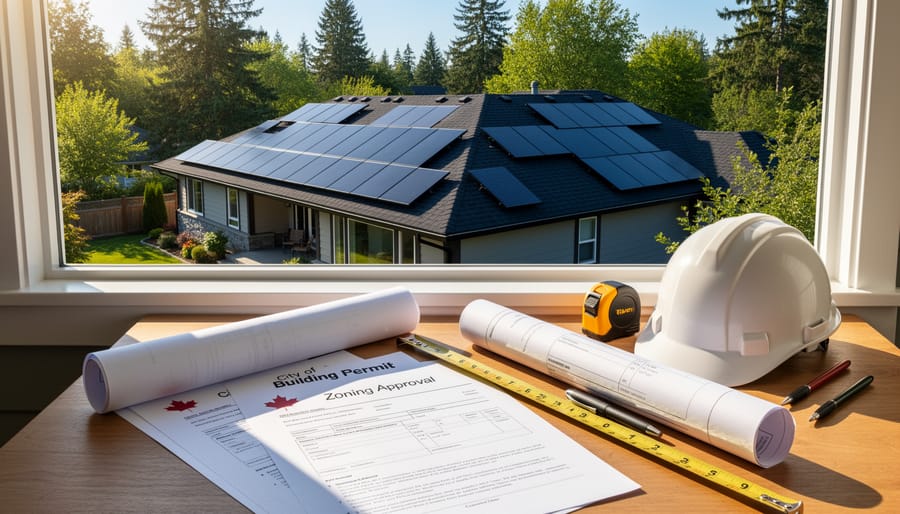
Planning Requirements: Getting Your Project Approved
Before installing solar panels in British Columbia, you’ll need to navigate municipal planning approvals—a process that varies significantly depending on your location and project type. Most residential solar installations require a building permit to ensure structural safety and electrical compliance, though some municipalities have streamlined processes for standard rooftop systems. You’ll typically need to submit engineering drawings showing roof load capacity and electrical plans.
Commercial solar projects face more rigorous scrutiny. Larger installations often trigger development permit requirements, especially if they affect building aesthetics in heritage areas or increase site coverage. Ground-mounted systems may require rezoning applications if they’re considered a primary use rather than an accessory structure.
Timeline expectations matter: residential permits often take 2-4 weeks in smaller communities, while urban centers like Vancouver or Victoria may require 6-8 weeks. Commercial projects involving rezoning can extend to several months.
The good news? Many BC municipalities are solar-friendly and offer pre-application meetings. Take advantage of these consultations to clarify requirements early. Some communities have even created checklists specifically for solar installations, reducing confusion and speeding approvals. Contact your local planning department before purchasing equipment—this simple step prevents costly surprises and keeps your project on track.
Zoning Bylaws That Affect Solar Installations
Before your solar panels can go up, they need to comply with local zoning bylaws that vary across BC municipalities. Understanding these restrictions early helps you avoid costly redesigns and delays.
Setback requirements determine how far your solar installation must be from property lines, typically ranging from 1.5 to 3 meters. These rules protect sight lines and ensure adequate access for maintenance. Height limitations apply especially to ground-mounted systems and can restrict installations in areas with flight paths or view corridors.
Aesthetic considerations matter in heritage districts and residential neighborhoods. Some municipalities require screening of ground-mounted arrays or mandate specific panel colors to minimize visual impact. In Richmond, for example, one homeowner worked with planners to position their array to respect heritage guidelines while maximizing sun exposure.
Special zones bring unique challenges. Agricultural zones may prioritize food production over energy infrastructure, though some municipalities now recognize agrivoltaics as compatible land use. Industrial zones typically offer more flexibility but may require additional safety measures.
The good news? Most BC communities are updating bylaws to accommodate solar energy. Contact your local planning department early to discuss your project. Many municipalities now offer pre-application meetings where staff review your plans informally, saving you time and helping identify potential issues before formal submission.
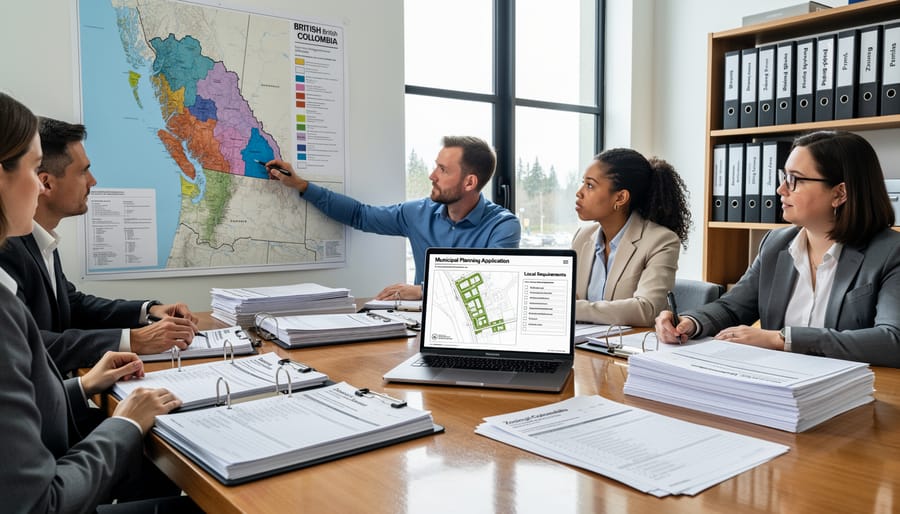
The Real Timeline: How PBC Requirements Fit Into Your Solar Journey
Pre-Application Phase (Weeks 1-2)
Before submitting your solar permit application, invest time in thorough groundwork to prevent costly delays. Start by obtaining your property’s legal description and municipal zoning designation from your local government website or planning department. Verify that solar installations are permitted uses in your zone, as some heritage districts or environmentally sensitive areas may have restrictions.
Conduct a basic site assessment by noting roof orientation, shading from trees or buildings, and available ground space for alternative mounting. Take photos documenting current conditions from multiple angles. Contact your utility provider early to understand grid connection requirements and capacity limits in your area.
Review your municipality’s online permit portal and familiarize yourself with application requirements. Many BC communities now offer pre-application meetings where planning staff provide informal guidance, helping you identify potential issues before investing in detailed engineering plans. A local solar company in Victoria saved their client six weeks by discovering setback requirements during this preliminary phase. Document everything you learn, creating a checklist that will streamline your formal application process ahead.
Planning and Zoning Approval (Weeks 3-6)
Once you’ve submitted your building permit application with planning and zoning documents, the municipal review process typically takes three to six weeks, though timelines vary across BC communities. Smaller municipalities like Squamish or Powell River often complete reviews faster, sometimes within two to three weeks, while larger cities such as Vancouver or Surrey may require the full six weeks or longer during busy periods.
During this phase, your application undergoes several checkpoints. Planners verify that your solar installation complies with zoning bylaws, setback requirements, and community design guidelines. In some BC municipalities, applications requiring variances or discretionary permits may trigger a public notice period, typically 10-14 days, allowing neighbors to provide feedback. This community consultation step is less common for standard rooftop solar but may apply to ground-mounted arrays or installations in heritage districts.
To avoid delays, respond promptly to any requests for additional information. Many BC municipalities now offer online portals where you can track your application status in real-time. Consider this waiting period an opportunity to line up contractors and finalize your solar system specifications. Success story: A Kelowna homeowner used their review period to connect with local solar installers, ultimately saving 15% through early booking discounts while their permits processed smoothly within four weeks.
Building Permit and Electrical Permit (Weeks 7-10)
Once your planning and zoning approvals are secured, the next step involves obtaining building and electrical permits. This typically takes three to four weeks, though timelines vary by municipality. Your building permit application includes structural drawings, equipment specifications, and proof of planning compliance. The electrical permit, issued by Technical Safety BC, ensures your solar installation meets provincial safety standards.
Before applying, confirm whether your home needs electrical service upgrade requirements to handle additional solar capacity. Many older homes require panel upgrades from 100 to 200 amps, which affects permit scope and costs.
Pro tip: Submit both permits simultaneously to avoid delays. Many BC communities now offer streamlined solar permitting processes. For example, Vancouver’s Express Solar program reduces wait times to just days for qualifying projects. Check if your municipality offers similar fast-track options. Keep all documentation organized and respond promptly to any reviewer questions to maintain momentum toward your installation date.
Utility Interconnection Application (Parallel or Sequential)
Your utility interconnection application runs on a separate timeline from your municipal building permit, but smart coordination between both processes saves months. BC Hydro or FortisBC typically requires 30-90 days to review your application, overlapping with your permit review period. Submit your interconnection application early, ideally when you apply for your building permit. This parallel approach prevents the common scenario where your solar system sits installed but inactive, waiting for utility approval. Many BC homeowners have shortened their project timelines by six weeks simply by initiating both processes simultaneously and keeping your installer informed of both approval statuses ensures your installation date aligns with final permissions.
Common PBC Roadblocks That Delay BC Solar Projects
Heritage Districts and Character Home Restrictions
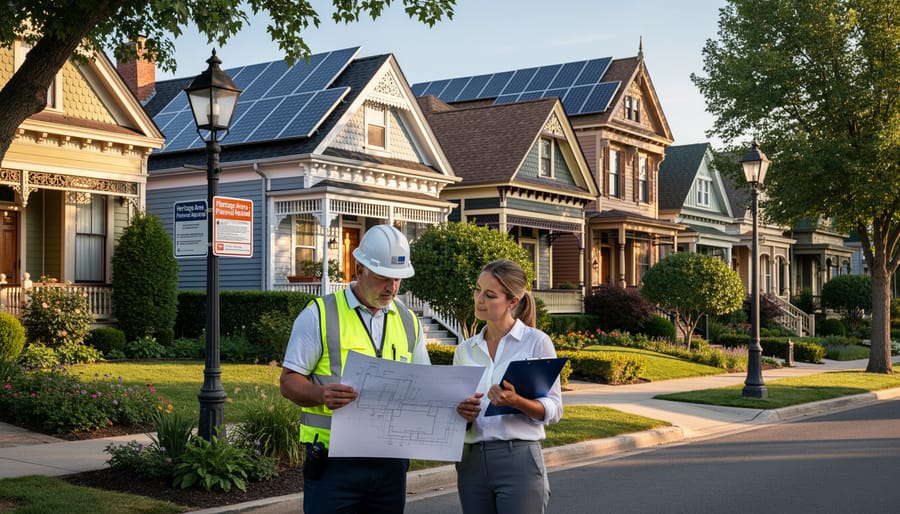
Installing solar panels in Vancouver’s character home zones or Victoria’s heritage districts requires extra attention to design guidelines that preserve architectural integrity. These protected areas have specific restrictions on visible equipment, roof modifications, and color matching to maintain neighborhood character.
Before submitting your application, consult your municipality’s heritage planner early in the design process. They can guide you toward solutions like low-profile black panels, strategic placement on less-visible roof sections, or ground-mounted systems in backyards. In Vancouver’s First Shingle character zones, for example, installers often position panels on rear-facing roof slopes to minimize street visibility.
Victoria homeowner Sarah Chen successfully installed a 6kW system on her 1920s heritage home by working with her local heritage advisory committee. By choosing panels that matched her roof’s dark charcoal color and keeping equipment away from primary facades, she received approval within six weeks.
Document everything with photos, architectural drawings, and manufacturer specifications showing how your system respects heritage guidelines. This preparation helps expedite your solar installation even in protected areas. Many heritage districts now recognize solar as part of sustainable preservation, making approvals more achievable than ever.
Agricultural Land Reserve (ALR) Considerations
If your solar project involves land within BC’s Agricultural Land Reserve, you’ll need approval from the Agricultural Land Commission (ALC) before proceeding. The ALR protects farmland province-wide, and solar installations face specific restrictions to ensure food production remains the priority.
Ground-mounted solar systems typically require ALC approval, especially if they occupy productive soil. The good news? Solar panels mounted on agricultural building rooftops usually don’t need separate ALC permission, making them the simplest path forward for farmers. Some exciting developments are emerging too—agrivoltaics, which combines solar panels with continued farming underneath, is gaining traction as a permissible dual-use approach.
When applying for ALC approval, demonstrate how your solar project minimizes impact on agricultural capability. Position panels on marginal land, slopes, or areas unsuitable for crops. One Okanagan berry farm successfully received approval by installing panels over irrigation infrastructure, creating shade while generating clean energy.
Processing times vary, but expect 60-90 days for straightforward applications. Budget for potential soil studies and agricultural impact assessments. The ALC prioritizes proposals that maintain farming viability while supporting renewable energy goals—frame your application around both benefits. Many farmers find that thoughtfully designed solar projects actually enhance farm operations by providing stable income during challenging growing seasons.
Strata and Multi-Unit Residential Buildings
Installing solar panels on strata and multi-unit residential buildings presents unique considerations that single-family homes don’t face. You’ll need approval from your strata council, which typically requires a three-quarter vote at an annual or special general meeting. Strata bylaws often include specific provisions about alterations to common property and building exteriors, directly affecting rooftop solar installations.
Before approaching your strata, gather information about how solar benefits all residents through reduced common area electricity costs or individual suite savings if individually metered. The Richmond Greenway Condominiums successfully navigated this process by presenting a detailed cost-benefit analysis showing a seven-year payback period, which helped secure overwhelming owner support.
Municipal requirements apply alongside strata rules. Your building permit application must demonstrate compliance with both jurisdictions. Common challenges include rooftop access arrangements, insurance considerations for common property modifications, and determining responsibility for ongoing maintenance. Many stratas establish solar committees to research options and present recommendations to owners.
Consider working with solar installers experienced in multi-unit buildings who understand the dual approval process. They can help prepare compelling presentations for your strata that address technical feasibility, aesthetic considerations, and financial benefits while ensuring municipal permit requirements are met efficiently.
How Different BC Municipalities Handle Solar Permitting
Metro Vancouver (Vancouver, Surrey, Burnaby)
Metro Vancouver’s three largest cities have streamlined their solar permitting processes significantly in recent years. Vancouver typically processes solar permits within 3-5 business days for straightforward residential installations, while Surrey and Burnaby average 5-10 business days. All three municipalities allow online permit applications, making the initial submission quick and convenient.
Vancouver offers a Green Homes Program that includes rebates for solar installations paired with energy efficiency upgrades, and waives building permit fees for projects under 10 kW on detached homes. Surrey’s Solar Ready Program provides pre-approved design templates that can reduce your permit review time to as little as 48 hours when your installer uses certified layouts. Burnaby has introduced a fast-track approval system for installations meeting specific criteria, including proper setbacks and approved mounting systems.
A Vancouver homeowner recently shared how their 6 kW rooftop system received permit approval in just three days using the city’s online portal, allowing installation to begin the following week. When working with installers familiar with your municipality’s specific requirements, including setback rules and structural load calculations, you can expect similarly efficient timelines. Each city maintains detailed solar permit guides on their websites, and planning departments offer free pre-application consultations to address any site-specific concerns before you submit.
Vancouver Island (Victoria, Nanaimo, Comox Valley)
Vancouver Island communities navigate unique considerations when pursuing solar permits through their regional districts. Victoria, Nanaimo, and the Comox Valley each operate under the Coastal Development Permit Area regulations, which require additional environmental assessments for properties near shorelines or environmentally sensitive zones. These coastal zone rules can add 2-4 weeks to your approval timeline, so factor this into your project schedule.
Regional districts on the island often have specific setback requirements different from mainland municipalities, particularly for properties with ocean views or heritage designations. The Capital Regional District, for example, maintains stricter height restrictions that may affect roof-mounted solar arrays in certain neighborhoods.
Success story: A Nanaimo café recently streamlined their solar permit by consulting with their regional planner early, discovering their property fell within a Development Permit Area. By addressing environmental considerations upfront, they avoided a potential three-month delay and now save $400 monthly on electricity.
Action point: Contact your regional district planning department before submitting applications. Island-specific requirements vary significantly between municipalities, and early consultation prevents costly revisions while supporting BC’s clean energy transition.
Interior and Rural BC
Rural BC communities often enjoy more streamlined solar permitting processes compared to urban centers. Regional districts typically handle permits in unincorporated areas, and many have adopted simplified requirements recognizing the lower density and unique needs of rural properties. For example, properties in the Cariboo Regional District may face fewer zoning restrictions for ground-mounted solar arrays, while Vancouver requires extensive documentation for similar projects.
The key difference lies in building department resources and inspection timelines. Rural areas may have limited staff, meaning permit reviews could take longer, but requirements are generally less complex. Some regional districts allow homeowners to self-certify smaller installations under specific wattage thresholds, significantly reducing paperwork and fees.
Success story: A farm in the Peace River region installed a 15kW system with minimal permitting hurdles, processing their application in just two weeks. The regional district’s straightforward checklist and responsive staff made the process remarkably smooth.
Before starting your project, contact your regional district directly to understand local requirements. Many rural areas are actively encouraging renewable energy adoption and may offer helpful guidance tailored to your property’s specific circumstances, making your solar journey surprisingly straightforward.
Your Action Plan: Streamlining PBC Approvals for Your Solar Project
Before You Start: The Pre-Application Checklist
Before diving into your planning and zoning application, gather key information to streamline the process. Start by confirming your property’s legal description, parcel identifier, and current zoning designation through your municipality’s website or planning department. Take clear photographs of your property showing the proposed solar installation location and any potential shading from trees or structures. Contact BC Hydro or your local utility early to discuss grid connection requirements, as some installations may require a service upgrade that impacts your timeline and budget. Review your property title for easements or covenants that might restrict installations. If you’re in a strata or have a heritage property, check additional requirements now rather than mid-application. Finally, collect recent utility bills to help calculate your system size needs. This preparation prevents common delays and helps you provide complete information when submitting your application, keeping your solar project on track.
Working With Your Solar Installer on Permitting
A certified solar installer should handle most permitting paperwork on your behalf, acting as your primary liaison with local planning and zoning departments. Reputable BC installers typically manage building permit applications, structural assessments, electrical permits, and utility interconnection agreements as part of their service package.
During your initial consultation, ask specific questions to clarify responsibilities. Who submits the applications? Do they coordinate directly with your municipality? What’s their experience with your local jurisdiction? Request examples of past projects in your area and typical approval timelines. Understanding their process helps reduce project delays and sets realistic expectations.
Your installer should provide regular updates throughout the permitting phase and explain any additional documentation you might need to supply, such as property surveys or strata approval letters. A professional installer will also flag potential zoning complications early, offering solutions before they become costly problems. Don’t hesitate to request written confirmation of what’s included in their service agreement.
When to Consult a Professional Planner or Expeditor
Most solar installations proceed smoothly through standard permitting, but certain situations benefit from professional expertise. Consider consulting a planning specialist or expeditor if your project involves properties in agricultural land reserves, environmentally sensitive areas, or heritage districts where zoning requirements become intricate. Multi-building commercial installations or projects requiring variance applications also warrant professional guidance.
Signs you need specialized help include receiving multiple revision requests from your municipality, facing unclear zoning restrictions, or dealing with neighbour objections that could delay approvals. Development permit coordinators familiar with BC’s regional variations understand local nuances that generic advice misses.
To find qualified assistance, contact your local solar installer for referrals, as they often work with planning professionals experienced in renewable energy projects. The Planning Institute of British Columbia maintains directories of certified planners. Your municipal planning department can also recommend expeditors familiar with their processes.
While this adds upfront costs, professional guidance typically saves money by preventing delays and ensuring applications meet all requirements the first time. One Nanaimo business reduced their approval timeline from six months to six weeks by engaging a local planner who understood coastal development regulations.
Navigating PBC planning and zoning requirements may add extra steps to your solar installation timeline, but it doesn’t have to be a roadblock. With proper preparation and a clear understanding of your municipality’s specific requirements, you can move through the process smoothly and avoid costly delays. The key is starting early—reaching out to your local planning department before finalizing your solar design gives you time to address any potential zoning concerns or design modifications.
Remember that these regulations exist to ensure safe, harmonious community development. When you work with experienced solar professionals who understand British Columbia’s diverse municipal landscape, you’re setting yourself up for success from day one.
That’s where connecting with local Solar BC installers makes all the difference. These certified professionals have hands-on experience navigating regional permitting processes and can anticipate municipality-specific requirements before they become obstacles. They’ll handle the technical documentation, communicate effectively with planning departments, and keep your project moving forward.
Ready to take the next step? Solar BC offers comprehensive resources to help you find certified installers in your area who are familiar with local planning and zoning requirements. These professionals don’t just install solar panels—they guide you through every regulatory hurdle with confidence. Visit Solar BC’s installer directory to connect with qualified experts who can turn your solar vision into reality while managing all the permitting complexities on your behalf. Your sustainable energy future starts with the right local partner.