
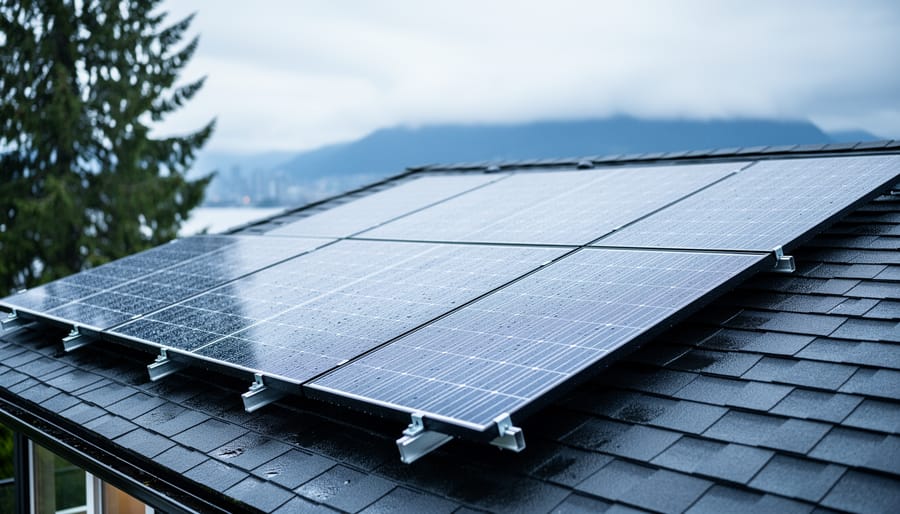
Understand that solar panel capacity—measured in watts or kilowatts—represents the maximum power your system can generate under ideal laboratory conditions, not what you’ll see on cloudy Vancouver mornings or during BC’s shorter winter days. Your actual energy production depends on four critical factors: panel orientation and tilt angle, shading from nearby trees or buildings, local weather patterns, and the quality of your inverter and electrical components.
Calculate your optimal system size by examining your annual electricity bills to determine average daily consumption, then account for BC’s seasonal variations where summer systems can produce 200% more than winter months. A typical British Columbia home consuming 30 kilowatt-hours daily needs approximately 7-10 kilowatts of installed capacity, but this varies significantly based on your property’s solar access and energy efficiency measures already in place.
Avoid the most common sizing mistake: installing undersized systems that save money upfront but fail to offset meaningful portions of your electricity costs, or oversized systems that generate expensive surplus energy if you lack net metering arrangements with BC Hydro. Work with certified installers who conduct thorough site assessments using solar pathfinder tools and shading analysis rather than providing cookie-cutter estimates.
Recognize that capacity optimization isn’t just about panel quantity—strategic placement, high-efficiency equipment selection, and proper system design often deliver better returns than simply adding more panels to suboptimal installations.
What Solar PV Capacity Really Means (And Why It Matters to Your Wallet)
Nameplate Capacity vs. Real-World Performance
When manufacturers rate a solar panel at 400 watts, that’s the nameplate capacity tested under ideal laboratory conditions with perfect sunlight, temperature, and angle. In British Columbia’s real-world environment, your panels typically produce 75-85% of their rated capacity due to factors like cloud cover, seasonal variations, and temperature fluctuations.
This performance gap isn’t a flaw, it’s simply physics. BC’s coastal climate means panels often operate in diffused light conditions, especially during fall and winter months. Temperature actually helps here, cooler weather can boost panel efficiency compared to hot climates where panels lose output.
Understanding this difference is essential for proper system sizing. A 6-kilowatt system won’t consistently deliver 6 kilowatts throughout the day. Instead, you’ll see production curves that peak during midday and taper off in morning and evening hours. To calculate solar panel output accurately for your location, factor in your specific roof orientation, shading patterns, and local weather data.
The good news? BC’s long summer days compensate for winter shortfalls, and modern monitoring systems let you track actual performance against expectations, ensuring your investment delivers the expected returns year-round.
How BC’s Weather Affects Your System’s Capacity
British Columbia’s diverse climate plays a significant role in determining your solar system’s actual capacity utilization. While BC receives excellent solar potential, understanding regional weather patterns helps set realistic expectations for your investment.
Coastal regions like Vancouver and Victoria experience more cloud cover, particularly during winter months. However, solar panels work on cloudy days, producing 10-25% of their rated capacity even in overcast conditions. Your system will generate power year-round, just with seasonal variations.
Interior locations such as Kelowna and Kamloops enjoy significantly more sunny days annually, often achieving 85-95% of optimal capacity during summer months. These areas typically see 20-30% higher annual energy production compared to coastal installations of the same size.
Seasonal shifts matter too. Summer days provide 16+ hours of sunlight, while winter drops to 8 hours. A well-designed system accounts for this variation, sizing capacity to meet your needs across all seasons rather than just peak months. Working with local installers familiar with your specific microclimate ensures your system is properly optimized for BC’s unique weather patterns.
The Hidden Factors That Steal Your Panel Capacity
Shading: The Silent Capacity Killer
Shading is one of the most underestimated threats to your solar system’s performance. Even a small shadow from a chimney, vent, or nearby branch can reduce your entire panel’s output by 50% or more. This happens because traditional solar panels are wired in series, meaning one shaded cell can create a bottleneck that affects the whole string.
In British Columbia, this challenge becomes particularly relevant. Our beloved Douglas fir trees, while beautiful, grow tall and cast long shadows that shift throughout the day. Additionally, BC’s lower winter sun angle means shadows stretch much further across roofs between November and February, potentially affecting panels that receive full sun in summer.
A homeowner in Victoria learned this the hard way when a neighbour’s growing cedar tree reduced their system’s capacity by 40% within three years. Fortunately, solar panel optimizers can help mitigate shading issues by allowing each panel to operate independently.
Before installation, conduct a thorough shade analysis throughout different seasons. Consider future tree growth and discuss strategic trimming with neighbours if needed. Sometimes, repositioning panels to avoid predictable shade patterns makes the difference between an underperforming system and one that meets your energy goals year-round.
Roof Orientation and Tilt Angles That Work in BC
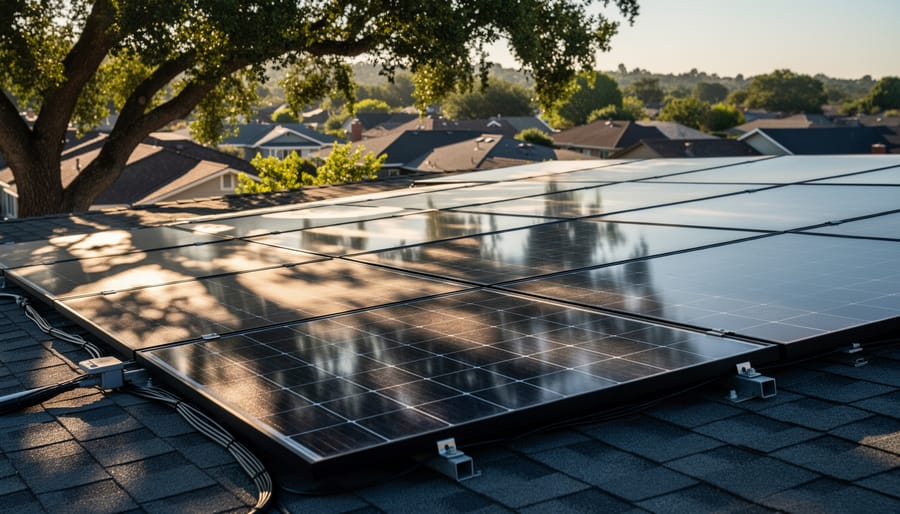
In BC, the optimal tilt angle for solar panels generally ranges between 30 to 40 degrees, with slight variations depending on your location. Coastal communities like Vancouver and Victoria perform well at angles around 30-35 degrees, while northern regions such as Prince George benefit from steeper angles closer to 40 degrees to capture lower winter sun.
The good news? Your roof doesn’t need to be perfectly positioned to generate strong solar returns. South-facing roofs are ideal, but southeast and southwest orientations typically achieve 90-95% of optimal performance. Even east or west-facing installations can deliver 70-80% efficiency, which still translates to significant energy savings over your system’s 25-year lifespan.
If your roof isn’t ideally angled, ground-mounted systems or adjustable racking solutions offer flexibility. A Kelowna homeowner with an east-facing roof initially worried about reduced capacity, but strategic panel placement and quality equipment still delivered 85% of projected output, cutting their electricity bills by over 60%.
The key takeaway: work with a certified installer who understands BC’s regional sun patterns. They’ll assess your specific site conditions and design a system that maximizes capacity regardless of roof limitations, ensuring you get reliable performance year-round.
Temperature Effects: Why Hot Days Aren’t Always Best
Here’s something that surprises many BC residents considering solar: those scorching summer days when temperatures soar above 30°C actually reduce your panels’ efficiency. Solar panels generate less electricity as they heat up, typically losing about 0.5% efficiency for every degree above their rated temperature of 25°C.
Think of it like your smartphone—it performs best at moderate temperatures, not in direct summer heat. On a 35°C day in the Okanagan, your panels might operate at 5% below their rated capacity simply due to heat. This is why spring and fall days with bright sunshine but cooler temperatures often produce your best output.
The good news? BC’s moderate coastal climate actually works in your favour. Unlike Alberta or Arizona, our summers rarely reach extreme temperatures for extended periods, and our long daylight hours offset any heat-related losses. Quality panels with good ventilation and proper mounting that allows airflow underneath help minimize temperature effects.
When sizing your system, certified installers account for these temperature variations in their calculations, ensuring your panels still meet your energy needs even during hot weather. This is why real-world performance data from local installations provides much more reliable estimates than simple capacity ratings alone.
Right-Sizing Your System: Matching Capacity to Your Actual Needs
Calculating Your Energy Consumption Baseline
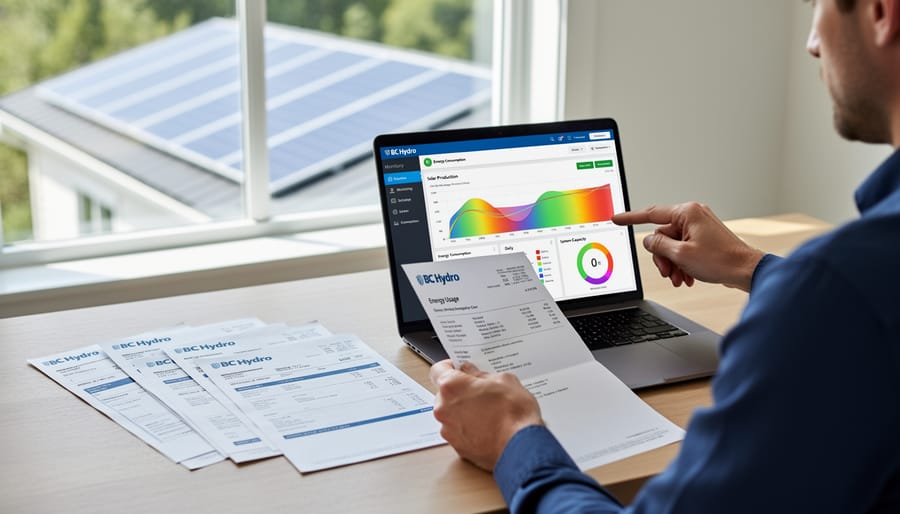
Understanding how much energy you currently use is the foundation for determining the right solar PV panel capacity for your home or business. Start by gathering your BC Hydro bills from the past 12 months to identify patterns in your electricity consumption. Look for the total kilowatt-hours (kWh) used each billing period, typically found on the front page of your statement.
Calculate your annual consumption by adding up all monthly totals. For example, if you used 10,800 kWh over the year, your daily average is about 30 kWh. Pay attention to seasonal variations—many BC homes see higher usage during winter months when heating demands increase and daylight hours are shorter.
Next, examine your peak usage periods. BC Hydro bills often include a graph showing your daily consumption patterns. This helps identify whether your highest energy use occurs during daylight hours when solar panels generate power, or during evenings when you’ll need to rely more on stored energy or the grid.
Consider any upcoming changes to your energy needs. Planning to add an electric vehicle? Replacing gas appliances with electric alternatives? These factors will increase your baseline consumption and should inform your capacity requirements. You can compare your usage against typical BC household energy consumption to see where you stand.
This baseline analysis ensures your solar system is properly sized—neither too small to meet your needs nor unnecessarily oversized for your actual consumption patterns.
Future-Proofing: Planning for EVs and Energy Storage
As BC continues its transition toward cleaner transportation, planning your solar system with future electricity needs in mind is essential. The province has one of the highest electric vehicle adoption rates in Canada, and many homeowners are adding battery storage systems to maximize their solar investment. When sizing your solar array today, consider where your household will be in five to ten years.
If you’re thinking about purchasing an EV, factor in the additional energy requirements. A typical electric vehicle adds approximately 2,000-3,000 kWh to your annual electricity consumption, depending on your driving habits. This translates to roughly 5-8 additional solar panels in most BC installations. By accounting for charging electric vehicles during your initial system design, you can avoid costly expansions later and benefit from economies of scale.
Similarly, consider whether battery storage makes sense for your situation. While not essential for everyone, energy storage systems provide backup power during outages and help maximize self-consumption of your solar energy. Installing additional capacity now, even if you’re not adding batteries immediately, ensures your roof layout and electrical infrastructure can accommodate future upgrades without major modifications.
A practical approach is to install 20-30 percent more capacity than your current needs suggest. This buffer accounts for lifestyle changes, additional household members, or new electric appliances. Work with your installer to evaluate your roof’s maximum potential and discuss flexible expansion options that align with your long-term sustainability goals.
Installation Strategies That Maximize Every Watt
String Configuration and Microinverter Advantages
How you connect your solar panels and which inverter you choose can significantly affect how much of your system’s rated capacity actually powers your home or business. Think of it like water flowing through pipes—poor configuration creates bottlenecks that waste potential energy.
String configuration refers to how panels connect together. When panels with different orientations or shading conditions share the same string, the weakest panel limits the entire group’s performance. A Vancouver homeowner discovered this when tree shade on just two panels reduced their entire 12-panel string’s output by 30%. Proper design separates differently-oriented panels onto separate strings, ensuring each group performs independently.
Microinverters offer an elegant solution by attaching one small inverter to each panel. Unlike traditional string inverters that process power from multiple panels together, microinverters let each panel operate at its own optimal capacity. This proves especially valuable in BC’s varied conditions—coastal fog, mountain shadows, or urban tree cover affect individual panels differently throughout the day.
For a Kelowna business, switching to microinverters increased overall system production by 18% compared to their original string inverter design. While microinverters cost more upfront, they maximize capacity utilization and provide panel-level monitoring, helping you identify and address performance issues quickly.
Monitoring Systems That Keep Your Capacity on Track
Keeping tabs on your solar system’s performance ensures you’re getting the capacity you paid for. Modern monitoring solutions make this easier than ever for BC solar owners.
Most inverters come with built-in monitoring apps that display real-time production data on your smartphone. These platforms track daily, monthly, and yearly output, comparing actual generation against expected performance based on your system’s rated capacity. Popular options include Enphase Enlighten, SolarEdge, and Tesla’s monitoring app, each offering user-friendly dashboards that alert you to potential issues before they impact your energy savings.
For BC homeowners, these tools are particularly valuable during our variable weather patterns. You can see exactly how cloudy days affect production and verify that your panels are performing optimally during summer’s long daylight hours. Many apps also calculate your carbon offset and cost savings, giving you tangible proof of your environmental impact.
Consider integrating your monitoring system with BC Hydro’s net metering program data to get a complete picture of your energy exchange. Some BC solar companies also offer third-party monitoring services that provide professional analysis and maintenance alerts.
Regular monitoring helps identify underperformance early, whether from debris accumulation, shading issues, or equipment problems. Set aside a few minutes monthly to review your data and ensure your system delivers its promised capacity year-round.

Maintenance Practices for Sustained Capacity
Regular maintenance helps your solar panels maintain optimal capacity throughout BC’s changing seasons. Start with quarterly visual inspections to check for debris accumulation, especially during fall when leaves and needles from surrounding trees can reduce output by 15-25%. In coastal areas, salt spray buildup requires attention, while interior regions see more dust and pollen deposits.
Clean panels two to three times yearly using a soft brush and plain water during cooler morning hours. BC’s frequent rain handles much of the cleaning naturally, but panels angled below 15 degrees need manual washing more often. Winter brings unique challenges: gently remove heavy snow loads that block sunlight, but let light dustings melt naturally to avoid surface damage.
Monitor your system’s output through your inverter display or monitoring app. A sudden 10% drop signals potential issues requiring professional assessment. Keep vegetation trimmed to prevent new shading patterns as trees grow. Vernon homeowner Sarah Chen discovered her capacity dropped 20% over two years due to unchecked branch growth, but simple pruning restored full performance. These straightforward practices protect your investment and ensure your system delivers expected capacity for decades.
Real BC Success Stories: Getting the Capacity Right
Meet the Johnsons from Kelowna, who initially considered a modest 4 kW system for their 2,000 square-foot home. After reviewing their actual energy consumption patterns with a certified installer, they discovered their evening usage was significantly higher than average due to their home-based business. They opted for a 6.5 kW system instead, paired with strategic panel placement to maximize southern exposure.
The results speak volumes. In their first year, the Johnsons generated 7,800 kWh, offsetting 85% of their annual electricity costs compared to the projected 60% they would have achieved with the smaller system. Their total investment was $16,250, with BC Hydro net metering credits providing monthly savings averaging $127. The larger capacity meant they could accommodate future electric vehicle charging without additional upgrades, essentially future-proofing their investment.
Over in Victoria, Greenleaf Café faced a different challenge. Their initial quote suggested a 10 kW rooftop system, but their installer noticed significant afternoon shading from neighboring buildings. Instead of compromising with a partially shaded installation, they redesigned their approach with an 8 kW system using high-efficiency panels positioned in optimal zones, supplemented by a small ground-mounted array in their parking area.
This thoughtful capacity optimization delivered impressive outcomes. The café now generates 9,200 kWh annually, cutting their commercial electricity bills by 72%. Owner Maria Chen reports saving approximately $1,450 monthly during peak summer operations. More importantly, their customers appreciate the visible commitment to sustainability, with the ground-mounted panels becoming a conversation starter that reinforces their environmental values. The project paid for itself in under seven years, well ahead of their initial ten-year projection.
Working With Your Installer: Questions to Ask About Capacity
Before signing any contracts, having a candid conversation with your certified solar installer helps ensure your system delivers on its promises. Start by asking about your property’s specific solar potential. Request a detailed shading analysis for all seasons—BC’s weather patterns mean what works in summer might underperform during cloudier months. Ask how they account for our region’s typical fog, rain, and overcast conditions when projecting your system’s capacity.
Inquire about the panel efficiency ratings they recommend and why those specific models suit your roof orientation and pitch. A good installer should explain the difference between nameplate capacity and expected real-world output for your location. For example, a Surrey homeowner recently discovered their installer accounted for nearby tree growth over the system’s 25-year lifespan, adjusting panel placement accordingly.
Don’t hesitate to ask about sizing methodology. How did they calculate your ideal system capacity based on your actual energy consumption patterns? Request examples of similar installations they’ve completed in your area and whether those systems are meeting projected performance targets.
Ask about monitoring capabilities too. Will you receive detailed production data to verify your system operates at expected capacity? Understanding warranty coverage for underperformance gives you peace of mind.
Finally, request multiple scenario projections—best case, typical, and conservative estimates. This transparency helps you make informed financial decisions. Remember, reputable installers welcome these questions and provide clear, jargon-free answers that build your confidence in going solar.
Understanding your solar PV panel capacity needs is the foundation of a successful solar investment. When you grasp how capacity relates to your actual energy consumption and BC’s unique weather patterns, you can make informed decisions that deliver real savings and environmental benefits for decades to come.
The good news? You don’t have to navigate this process alone. Solar BC connects you with certified installers who understand local conditions and can design systems perfectly matched to your property and energy goals. These professionals account for everything from coastal cloud cover to interior sun exposure, ensuring your system performs optimally year-round.
Ready to take the next step? Start by using Solar BC’s interactive tools to estimate your ideal system capacity based on your current energy usage and roof characteristics. These calculators provide personalized insights that help you enter conversations with installers already informed and confident. Whether you’re a homeowner looking to reduce your carbon footprint or a business owner seeking long-term energy savings, understanding capacity puts you in control of your solar journey. Connect with a certified installer today and discover how the right-sized system can transform your relationship with energy.