
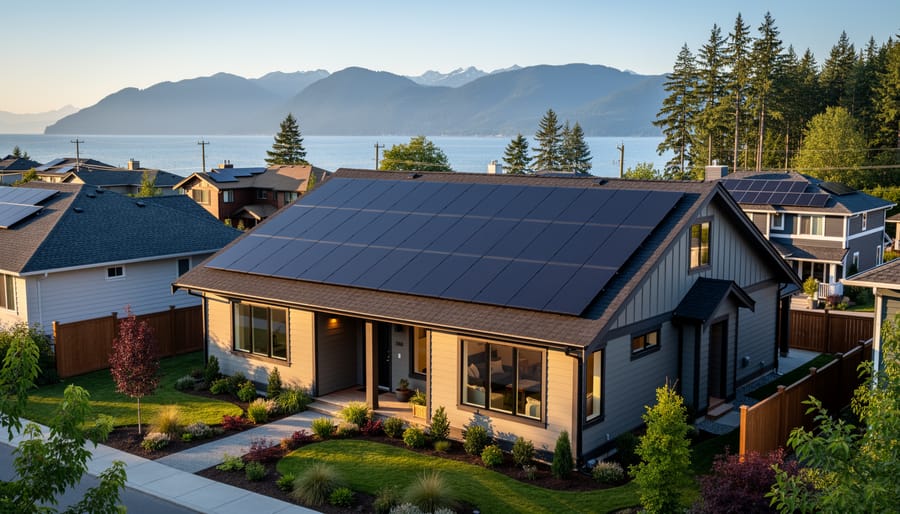
Calculate your home’s annual electricity consumption in kilowatt-hours by reviewing your BC Hydro bills from the past 12 months. A typical British Columbia household uses between 10,000-15,000 kWh yearly, but your actual usage determines the solar system size needed to reach net-zero status. This number becomes your baseline target for solar production.
Understand that a net-zero energy home produces as much renewable energy as it consumes over a year, eliminating your electricity costs while maintaining grid connection for nighttime power and winter backup. In BC’s climate, this means your solar panels generate surplus energy during long summer days that offsets consumption during darker winter months through net metering credits with your utility provider.
Assess your property’s solar potential by examining roof orientation, shading from trees or buildings, and available installation space. South-facing roofs with minimal shade deliver optimal results, but east and west orientations work effectively in BC’s extended summer daylight. Each kilowatt of installed solar capacity generates approximately 1,000-1,200 kWh annually in coastal regions and 1,100-1,300 kWh in interior BC, meaning a typical home needs 8-12 kW of solar panels.
Recognize that achieving net-zero status requires both energy production and efficiency improvements. Before installing solar panels, reduce your consumption through LED lighting, efficient appliances, improved insulation, and smart heating controls. Every kilowatt-hour you eliminate from your baseline reduces the solar system size needed, lowering upfront costs by approximately 3,000 dollars per kilowatt saved.
Map your path forward by requesting quotes from certified solar installers who can conduct site assessments, calculate precise system sizing, and outline available incentives including federal grants and provincial tax exemptions that reduce initial investment by 25-40 percent.
What Makes a Home ‘Net-Zero Energy’?
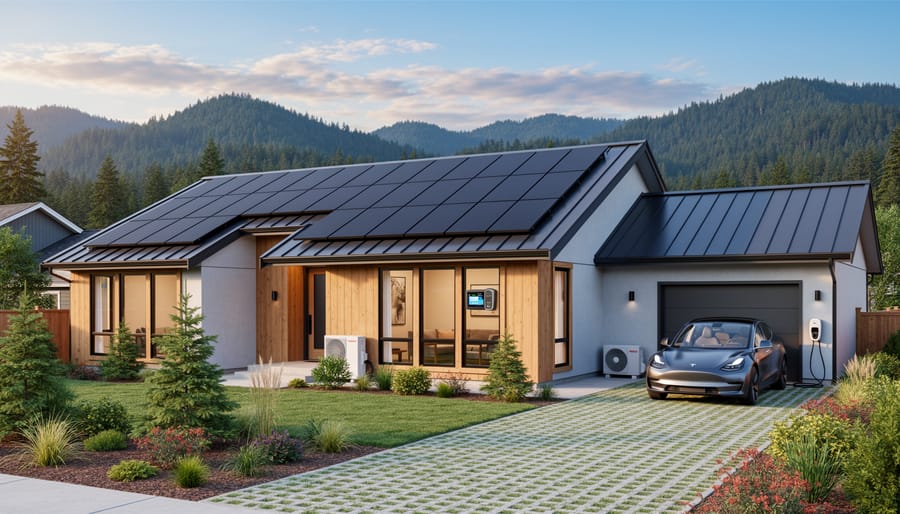
The Solar Energy Production Side
A residential solar system generates electricity whenever sunlight hits your panels, converting that energy into power your home can use immediately. Throughout the year, your system produces varying amounts of electricity based on daylight hours and weather conditions. In BC, you’ll see peak production during those long, sunny summer days from May through August, with systems often generating two to three times more electricity than during the shorter, cloudier winter months.
Energy output refers to the total kilowatt-hours your solar panels produce over time. For example, a typical 8 kW residential system in the Lower Mainland might generate around 9,000 to 10,000 kWh annually, while the same system in the Okanagan could produce 10,500 to 11,500 kWh thanks to sunnier conditions. This seasonal variation is why understanding your year-round production matters when planning for net-zero energy.
The encouraging news for BC homeowners is that even our cloudier months still produce meaningful solar energy. Modern panels are quite efficient at capturing diffuse light on overcast days. Your solar system doesn’t need constant sunshine to work, it just needs daylight. During winter months when production dips, you’ll draw supplemental power from the grid, while summer’s abundant sunshine lets you generate surplus energy that feeds back to the grid, balancing out your annual consumption.
This natural rhythm of seasonal production and consumption is exactly how net-zero energy homes work in our climate, making solar a practical solution even in regions with significant weather variation.
The Energy Consumption Side
Understanding typical BC home energy usage is the first step toward achieving net-zero. Most BC households consume between 10,000 to 15,000 kWh annually, with heating, hot water, and appliances accounting for the largest portions. However, reducing this consumption makes reaching net-zero far more achievable and affordable.
Start with an energy audit to identify where your home loses efficiency. Many BC Hydro customers have reduced their consumption by 20-30% through simple upgrades like adding insulation, sealing air leaks, and upgrading to high-efficiency windows. These improvements not only lower your solar system size requirements but also reduce your upfront costs significantly.
Consider switching to energy-efficient appliances with Energy Star ratings, particularly for high-consumption items like refrigerators, washing machines, and dryers. Heat pumps for space and water heating are game-changers in BC’s mild climate, offering exceptional efficiency compared to electric baseboards or gas furnaces. One Vancouver family reduced their annual consumption from 14,000 kWh to 9,500 kWh simply by installing a heat pump system and upgrading their insulation.
LED lighting, smart thermostats, and mindful energy habits round out your efficiency strategy. Remember, every kilowatt-hour you save means one less solar panel you need to install. The most cost-effective net-zero home combines right-sized solar production with strategic energy reduction, creating a sustainable balance that benefits both your wallet and the environment.
How Much Solar Output Does Your BC Home Need?
Calculating Your Home’s Energy Baseline
Understanding your current energy consumption is the essential first step toward achieving net-zero. Start by gathering your BC Hydro bills from the past 12 months to get a complete picture of your household’s energy use throughout all seasons. Look for the kilowatt-hour (kWh) numbers on each bill, which show how much electricity you’ve consumed during that billing period.
Add up the kWh from all 12 months to determine your annual energy baseline. Most BC homes use between 10,000 and 15,000 kWh annually, though this varies based on home size, heating systems, and lifestyle factors. Winter months typically show higher consumption due to heating and reduced daylight hours.
To simplify this process, use BC Hydro’s online account portal to download your usage data directly. You can also explore interactive calculator tools available through Solar BC that help you visualize your consumption patterns and estimate the solar capacity needed to offset your usage. These tools let you input your annual kWh to calculate solar panel output requirements specific to your home and location in British Columbia, making the path to net-zero energy more tangible and achievable.
BC’s Solar Production Reality
Let’s be clear about what solar panels can realistically produce across British Columbia. Understanding solar production in BC’s climate is essential for planning a net-zero energy home.
In the Lower Mainland, expect your solar system to generate approximately 1,000 to 1,100 kilowatt-hours per installed kilowatt annually. Yes, we have cloudy winters, but our mild temperatures actually help panels work more efficiently than in hotter climates. A typical 8-kilowatt system produces about 8,800 kWh per year, with strong production from April through September and reduced output from November through February.
The Interior regions, including the Okanagan and Kootenays, enjoy BC’s best solar conditions. Annual production reaches 1,200 to 1,300 kWh per kilowatt, thanks to abundant sunshine and clearer skies. That same 8-kilowatt system generates closer to 10,000 kWh yearly.
Vancouver Island falls between these ranges at roughly 1,050 to 1,150 kWh per kilowatt, with coastal areas performing similarly to the Lower Mainland while eastern regions see slightly better production.
The seasonal reality matters for net-zero planning. Summer months can produce three to four times more energy than winter months. This means you’ll generate surplus power in summer (feeding it back to the grid) and draw from the grid during winter, balancing out over the year. A properly sized system accounts for this seasonal variation, ensuring your annual production meets your consumption despite winter shortfalls.
Real BC Families Living in Net-Zero Homes
Meet three BC families who’ve transformed their homes into net-zero energy powerhouses, proving that energy independence is achievable across our province’s diverse climate zones.
The Okanagan Retrofit: Sarah and Michael’s Kelowna Bungalow
When Sarah and Michael Chen purchased their 1980s bungalow in Kelowna, their electricity bills averaged $180 monthly. Three years after installing solar, they’ve achieved net-zero status and haven’t paid for electricity since.
Their system includes 28 solar panels (10.5 kW capacity) paired with a 13.5 kWh battery storage unit. Annual production averages 12,400 kWh, slightly exceeding their household consumption of 11,800 kWh. The couple invested $32,000 upfront, receiving $6,000 in combined rebates, bringing their net cost to $26,000.
“The biggest challenge was optimizing our energy use,” Sarah explains. “We shifted laundry and dishwashing to sunny afternoons and added extra insulation before going solar. Those efficiency upgrades meant we needed fewer panels than originally quoted.”
Their advice? Start with an energy audit. The Chens reduced their consumption by 30 percent through weatherization and appliance upgrades before installing solar, significantly lowering their system requirements and costs.
Coastal Living: The Vancouver Island Passive House
James and Priya Patel built their dream home in Courtenay, combining passive house design with solar technology. Despite the region’s cloudy reputation, their 8.4 kW system (24 panels) generates enough energy to offset their minimal heating and cooling needs.
Their home produces approximately 9,200 kWh annually while consuming just 8,500 kWh, thanks to triple-pane windows, superior insulation, and a heat recovery ventilation system. Total project cost for solar was $28,500, with $5,500 in available incentives.
“People assume solar won’t work on the coast, but our data proves otherwise,” James notes. “We produce 85 percent of our annual needs between April and September, and net metering credits us through winter months.”
The Patels emphasize that building envelope efficiency matters more than solar capacity. Their heating costs run under $200 annually, making net-zero achievable even with fewer sunny days.
Interior Innovation: Prince George’s Cold Climate Success
Rebecca Thompson’s Prince George home demonstrates that net-zero works even in northern BC. Her 12 kW system (32 panels) compensates for reduced winter production with exceptional summer performance when daylight extends past 10 PM.
Annual production reaches 13,100 kWh against consumption of 12,600 kWh. Rebecca invested $35,000 with $7,000 in rebates, paying $28,000 net. Her system includes a ground-source heat pump, dramatically reducing heating loads.
“Winter production drops to 15 percent of summer output, but those long June days make up everything,” Rebecca shares. “Proper system sizing for your specific location is essential.”
These families prove net-zero living works across BC’s varied climates with proper planning, realistic expectations, and commitment to energy efficiency.

Beyond Solar Panels: The Complete Net-Zero Picture
Energy Storage Solutions
Modern battery storage systems are the key to true energy independence in your net-zero home. While solar panels generate abundant electricity during BC’s long summer days, your highest energy needs typically occur during darker winter months. Battery systems bridge this gap by storing excess summer production for later use, though achieving full year-round independence requires careful planning.
Home batteries also provide crucial backup power during grid outages, which have become more common across BC due to extreme weather events. When paired with solar panels, batteries ensure your essential appliances keep running even when the grid goes down.
For BC homeowners, the typical battery system ranges from 10-20 kWh of storage capacity, enough to power essential loads through an evening or provide backup during short outages. While batteries represent a significant upfront investment, provincial and federal incentive programs can offset 25-40% of costs. A Victoria family recently installed a 13.5 kWh battery system, allowing them to store midday solar generation for evening use and reducing their grid dependence by 85%. Consider starting with solar panels and adding batteries later as your budget allows and technology costs continue declining.
Efficiency Upgrades That Matter
Before investing in solar panels, reducing your home’s energy consumption makes reaching net-zero more affordable and achievable. A professional energy assessment can identify where your home loses energy and prioritize improvements that deliver the biggest impact.
Start with insulation upgrades in attics, walls, and basements. BC homes often benefit from air sealing around windows and doors, which can reduce heating needs by 15-30%. Next, replace fossil fuel heating systems with electric heat pumps, which are three times more efficient than traditional baseboard heaters and work effectively even in BC’s coastal climate.
Switch all lighting to LED bulbs, saving up to 75% on lighting energy compared to incandescent bulbs. When replacing appliances, choose ENERGY STAR certified models, particularly for refrigerators, washing machines, and dishwashers, which run constantly or frequently.
A Port Moody family reduced their annual consumption from 12,000 kWh to 7,500 kWh through efficiency upgrades before installing solar, cutting their required system size from 10 kW to 6 kW and saving thousands on installation costs. These improvements create lasting savings whether you install solar immediately or plan for it in the future.
The Financial Reality of Going Net-Zero in BC
Let’s be honest about the investment required for a net-zero energy home in BC. A typical residential solar system sized for net-zero (8-12 kW) costs between $20,000 and $35,000 before incentives. While this might seem substantial, understanding the full financial picture reveals a more encouraging story.
BC homeowners can access several rebates that significantly reduce upfront costs. The federal Canada Greener Homes Grant provides up to $5,000 for solar installations, while the CleanBC Income Qualified Program offers additional support for eligible households. Some municipalities, including Vancouver and Victoria, provide property tax exemptions for solar equipment, further improving your return on investment.
For those concerned about upfront costs, financing options make net-zero accessible without draining savings. Many BC credit unions offer green energy loans with competitive rates, while some solar installers provide payment plans with terms up to 20 years. The key advantage is that your monthly loan payment often equals or falls below your eliminated electricity bill, meaning you’re building equity from day one instead of paying BC Hydro indefinitely.
Payback periods typically range from 10 to 15 years in BC, depending on your energy consumption, system size, and available incentives. After that point, you’re generating free electricity for the remaining 10-15 years of your system’s warranty period and beyond. Over 25 years, most BC homeowners save between $30,000 and $60,000 in electricity costs.
The reality check? You won’t eliminate your BC Hydro bill entirely due to monthly connection fees (typically $15-20), but your energy charges can drop to zero during peak production months. Think of net-zero as a long-term investment in your property value and energy independence rather than a quick financial win. BC homes with solar systems sell faster and command premium prices, adding another layer of return beyond monthly savings.
The bottom line: net-zero requires patience, but the combination of incentives, financing options, and decades of free electricity makes it financially viable for many BC households.
Your Next Steps Toward a Net-Zero Home
Ready to take your first steps toward net-zero living? The journey might feel overwhelming, but breaking it down into manageable phases makes it achievable for most BC homeowners.
Start with a professional home energy assessment. BC Hydro and FortisBC both offer energy evaluations that identify where your home loses energy and which improvements deliver the best return. These assessments typically cost $300-500 but often qualify for rebates. Understanding your current energy consumption provides the baseline you need to size your solar system accurately.
Next, connect with certified solar installers who understand BC’s unique climate and regulations. Look for companies with CSI (Canadian Solar Industries Association) certification and strong local references. Request quotes from at least three installers and ask to see similar projects they’ve completed in your region. Many BC solar companies now offer virtual consultations to get you started without any commitment.
Consider a phased approach if upfront costs feel prohibitive. Start with envelope improvements like air sealing and insulation, which reduce your energy needs before adding solar panels. Some homeowners begin with a smaller solar array and expand once they see results. This stepped implementation spreads costs over time while building confidence in the technology.
Don’t navigate this journey alone. Join online communities like the BC Sustainable Energy Association forums or local Facebook groups where BC residents share experiences, contractor recommendations, and lessons learned. Many municipalities also host net-zero home tours where you can see real installations and ask homeowners questions.
Remember, every net-zero home started with a single step. Whether that’s booking an energy assessment next week or simply tracking your current energy usage, forward momentum matters more than perfection. BC’s supportive rebate programs and growing solar community mean you’ll have plenty of help along the way.
Achieving a net-zero energy home in British Columbia is not just a possibility—it’s a practical reality for homeowners across the province. From Victoria to Prince George, BC residents are demonstrating that our climate, with its combination of sunny summers and reliable year-round solar production, provides excellent conditions for solar energy generation. The environmental benefits are substantial: a typical net-zero home eliminates several tonnes of carbon emissions annually while helping BC meet its climate action goals. Economically, the combination of federal and provincial incentives, declining solar costs, and rising electricity rates makes the investment increasingly attractive, with many homeowners seeing returns within 10-15 years.
The journey to net-zero begins with a single step. Start by assessing your home’s energy consumption, exploring your roof’s solar potential, and connecting with experienced professionals who understand BC’s unique conditions. Solar BC’s network of certified installers can provide personalized assessments and guide you through available incentives and financing options. Whether you’re building new or retrofitting an existing home, the resources and expertise are readily available to help you achieve energy independence while contributing to a cleaner, more sustainable future for British Columbia.